Introduction
Industrial level sensors are frequently installed in environments where temperature and humidity change throughout the day.
A sensor may operate reliably for months before developing intermittent faults, unstable readings, communication errors, or complete electronic failure.
When the instrument is opened for inspection, technicians may discover water droplets, corrosion, or moisture marks inside the housing.
The immediate conclusion is often that the sensor was exposed to rain or cleaning water.
However, moisture inside an enclosure does not always originate from direct water entry.
Condensation can develop when humid air inside the housing cools below its dew point. Repeated heating and cooling may gradually create conditions that damage electronic components, even when the enclosure appears externally intact.
Understanding how moisture enters or forms inside level instruments is essential for reliable installation and long-term maintenance.
This article examines the main mechanisms, common installation mistakes, and practical methods for reducing moisture-related failures.
1. Understanding Condensation Inside Sensor Housings
Air contains water vapor.
The amount of vapor that air can hold before reaching saturation depends strongly on temperature.
When humid air cools, its relative humidity increases. If the temperature falls below the dew point, water vapor can condense on colder surfaces.
Inside an industrial sensor housing, this may occur during normal temperature cycling.
For example, a sensor exposed to strong sunlight during the day may become considerably warmer than the surrounding air.
After sunset, the housing cools.
If humid air is present inside the enclosure, condensation may form on internal surfaces.
This process can repeat over many days.
Small amounts of condensation may initially cause no visible malfunction. Over time, however, moisture can contribute to corrosion, leakage currents, insulation degradation, and unreliable electrical connections.
The risk depends on the enclosure design, internal humidity, temperature variation, and the presence of sensitive electrical components.
2. How Moisture Enters a Level Sensor
Moisture ingress can occur through several pathways.
Cable glands
Cable glands are designed to maintain the required enclosure protection while allowing electrical cables to enter.
Problems may arise when:
- The gland does not match the cable diameter.
- The cable sheath is damaged.
- The sealing components are incorrectly assembled.
- The gland is insufficiently tightened.
- An unused cable entry remains open.
- The cable is pulled sideways, stressing the seal.
A gland may appear mechanically secure while failing to provide the intended environmental protection.
Housing covers
Incorrectly fitted covers and damaged sealing rings can allow moisture to enter.
A cover that is not fully seated may compromise the enclosure seal.
Repeated opening and closing can also introduce contamination onto sealing surfaces.
Before closing a housing, technicians should inspect the gasket and sealing interface according to the manufacturer’s instructions.
Conduit systems
Electrical conduit can unintentionally provide a path for moisture.
Water may enter through distant junction boxes, accumulate inside the conduit, and migrate toward the sensor.
In some installations, moisture travels along cable surfaces or through cable construction.
The resulting failure may appear to originate at the instrument even though the initial entry point is elsewhere.
Process connections
A process connection must maintain the intended boundary between the vessel and the instrument.
Incorrect sealing materials, damaged gaskets, or incompatible installation methods may compromise that boundary.
However, process sealing and enclosure sealing are different functions.
An instrument can have a properly sealed process connection while still experiencing moisture ingress through the electrical housing.
3. Why an IP Rating Does Not Eliminate Every Moisture Risk
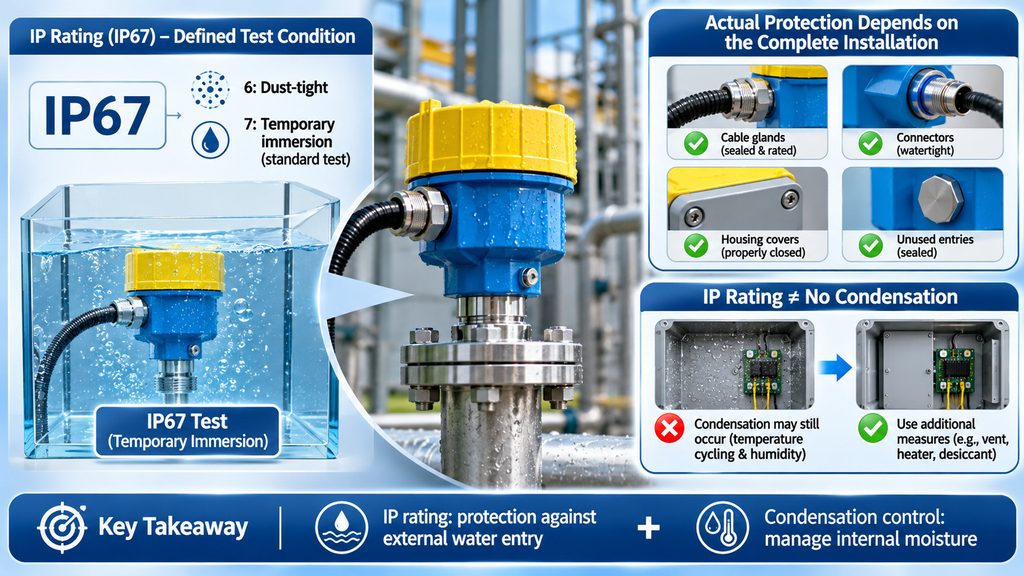
Ingress Protection ratings describe protection against specified solid objects and water exposure under defined test conditions.
For example, an enclosure rated IP67 is tested against temporary immersion under the conditions defined by the relevant standard.
This does not mean that every installed instrument will remain watertight under all operating conditions.
Actual protection depends on the complete installed assembly.
Cable glands, connectors, housing covers, unused entries, and installation practices must maintain the intended rating.
Furthermore, an ingress protection rating does not by itself guarantee that condensation cannot occur inside the enclosure.
Temperature cycling and internal humidity may still create moisture problems.
Engineers should therefore distinguish between protection against external water entry and control of internal condensation.
Both are important.
4. Temperature Cycling and Pressure Changes
Temperature changes can influence the pressure of air inside an enclosure.
As the housing warms, internal air expands.
When the housing cools, the pressure may decrease.
Depending on the enclosure construction, seals, and ventilation design, repeated pressure changes may contribute to moisture migration.
Some industrial enclosures use pressure-compensation or breathable membrane systems designed to reduce pressure differences while maintaining a specified level of environmental protection.
Such components must be selected for the actual application.
They should not be added to certified or hazardous-area equipment without manufacturer approval.
For ordinary installations, preventing unnecessary moisture entry and maintaining the original enclosure design are usually the first priorities.
5. Cable Routing and Drip Loops
Cable routing is a simple but important installation detail.
Where the instrument design permits, the cable should approach the entry point in a way that prevents water from running directly into the gland.
A downward cable loop below the entry point can encourage water to drip away before reaching the housing.
However, the loop must not create excessive cable strain or violate the required bending radius.
The gland orientation should follow the manufacturer’s instructions.
A cable entering from above may require additional attention because water can run along the sheath toward the enclosure.
The best arrangement depends on the instrument design, mounting orientation, and surrounding equipment.
The objective is to prevent water from collecting at the electrical entry and reduce the possibility of long-term exposure.
6. Condensation in Heated Process Applications
Level sensors are often installed on tanks containing warm liquids or heated materials.
The process connection may be exposed to elevated temperatures while the electronics housing remains closer to ambient conditions.
This creates a temperature gradient.
In some applications, vapor or moisture associated with the process can also influence the environment around the instrument.
Engineers should verify that the sensor’s process temperature rating and ambient temperature rating are both suitable.
These ratings are not interchangeable.
An instrument may tolerate the process temperature at the sensing element but require a lower temperature at the electronics housing.
Thermal insulation around a vessel should not automatically cover the sensor electronics.
Covering the housing may reduce heat dissipation and cause the electronics temperature to exceed its allowable range.
Installation drawings should clearly define insulation boundaries where necessary.
7. Recognizing Moisture-Related Failure Symptoms
Moisture-related faults may be intermittent.
Typical symptoms include:
- Unstable output signals
- Unexpected alarms
- Communication interruptions
- Reduced insulation resistance
- Visible corrosion
- Discoloration around terminals
- Water marks inside the enclosure
- Failure after heavy rain or temperature changes
These symptoms are not unique to moisture damage.
Similar behavior may result from wiring faults, supply voltage problems, electromagnetic interference, or electronic component failure.
A proper diagnosis should therefore combine visual inspection with appropriate electrical testing.
If water is found inside the housing, the source should be identified before the instrument is returned to service.
Simply drying the electronics may not prevent recurrence.
8. Preventive Inspection and Maintenance
A preventive maintenance program should consider environmental exposure.
Instruments installed outdoors, near washdown equipment, or in areas with large temperature variations may require particular attention.
During inspection, technicians should check:
- Housing cover condition
- Gasket integrity
- Cable gland tightness
- Cable sheath damage
- Unused entry plugs
- Signs of corrosion
- Water accumulation around mounting points
- Evidence of repeated condensation
Inspection frequency should be based on the operating environment and maintenance history.
Avoid opening instrument housings unnecessarily in wet or dusty conditions.
Opening an enclosure can introduce moisture or contaminants that were previously excluded.
After maintenance, verify that all seals and covers have been restored correctly.
9. What to Do When Water Is Found Inside a Sensor
The first priority is to make the equipment safe.
Follow the plant’s isolation procedures and the manufacturer’s instructions before opening or servicing electrical equipment.
Document the condition of the housing before cleaning or disassembly.
Photographs can help identify the direction of water entry and the areas most affected.
Inspect the cable entries, seals, and nearby conduit system.
Where corrosion or electronic damage is present, replacement of affected components may be necessary.
Do not assume that an instrument is suitable for continued operation simply because it begins functioning after drying.
For hazardous-area or safety-related installations, repairs and replacement must preserve the required approvals and system integrity.
10. Choosing Level Sensors for Humid Environments
Instrument selection should consider both the process and the surrounding environment.
Important factors include:
- Required enclosure protection
- Ambient temperature range
- Process temperature
- Chemical exposure
- Cleaning procedures
- Cable connection method
- Outdoor weather exposure
- Maintenance accessibility
A sensor with a suitable enclosure rating can still fail if installation practices compromise the sealing system.
Therefore, the installation details should be reviewed alongside the instrument specification.
JIWEI provides industrial level measurement instruments for a range of operating conditions. The appropriate enclosure and connection configuration should be confirmed for each application.
Frequently Asked Questions
Can condensation occur inside an IP67 enclosure?
Yes. An IP rating describes protection against defined external ingress conditions. It does not automatically eliminate condensation caused by internal humidity and temperature cycling.
Should desiccant be placed inside a sensor housing?
Only if the manufacturer permits it. Unapproved modifications can interfere with the instrument design, maintenance requirements, or certification.
Why does a sensor fail after rain even when the cover is closed?
Possible causes include damaged seals, incorrectly installed cable glands, conduit water migration, or existing internal moisture.
Can a wet level sensor be repaired?
That depends on the extent of damage and the manufacturer’s repair procedures. Corrosion or damaged electronics may require replacement.
Conclusion
Condensation and moisture ingress are important reliability risks for industrial level sensors.
Preventing these problems requires more than selecting a suitable enclosure rating.
Correct cable installation, sealing integrity, temperature management, and preventive inspection all contribute to long-term reliability.
By identifying moisture pathways and addressing environmental conditions during installation, engineers can reduce intermittent failures and avoid unnecessary maintenance.
Explore JIWEI’s industrial level measurement solutions and consult the technical team when selecting instruments for humid, outdoor, or temperature-cycling environments.