
Load cells are widely used for inventory monitoring and material weighing in concrete batching plants, dry mortar production lines, cement storage facilities, and bulk material handling systems. By measuring changes in the total weight of a silo, a load cell weighing system can estimate how much cement remains inside.
Compared with point level switches or radar level meters, load cells offer one major advantage: they measure weight directly rather than estimating inventory from material level.
However, not every cement silo structure is suitable for accurate load cell weighing.
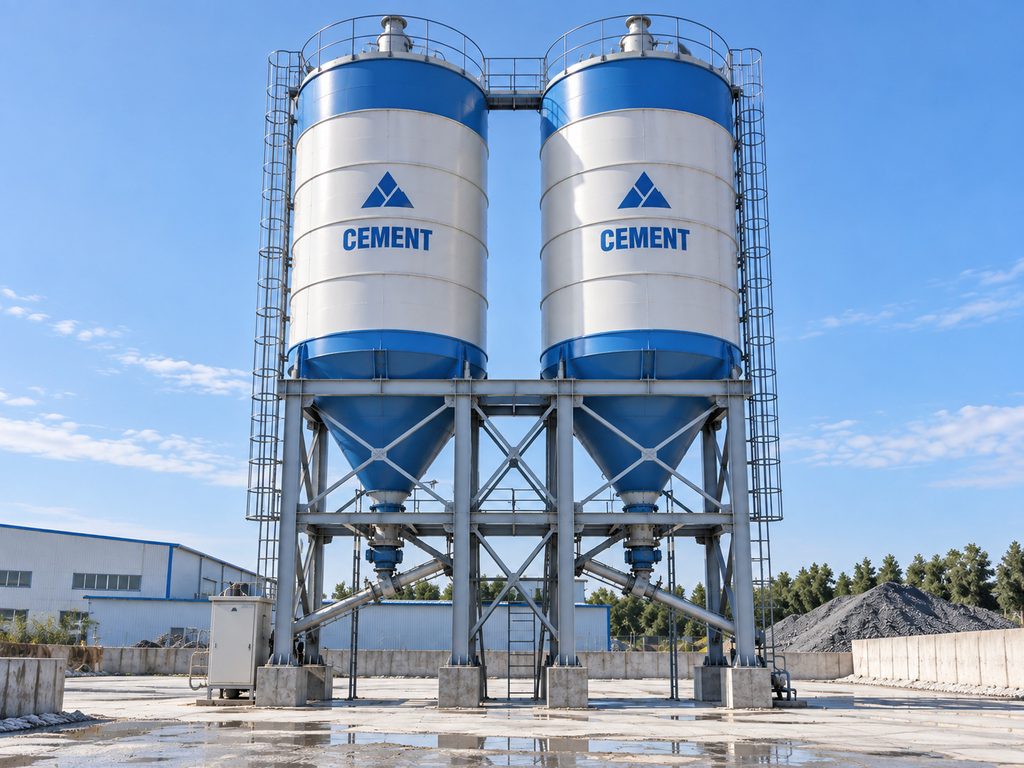
One particularly challenging configuration is an outdoor twin-silo system in which two cement silos share the same structural support frame. In this arrangement, the two silos may be mechanically connected through common beams, columns, cross-bracing, platforms, or foundations. As a result, the load generated by one silo may be transferred through the shared steel structure and affect the load measured beneath the other silo.
So, can two cement silos sharing one support frame still be weighed accurately? Why does structural coupling create measurement errors? And what additional problems can outdoor conditions introduce?
This article explains the major limitations of using load cells for outdoor cement silos installed on a shared support structure.
1. The Main Challenge: The Loads of the Two Silos Are Not Completely Independent
For a load cell weighing system to provide accurate measurements, one basic condition should be satisfied:
The weight of the object being measured should pass through the designated load cells in a predictable and repeatable way.
For a single cement silo with an independent support structure, this is relatively easy to achieve.
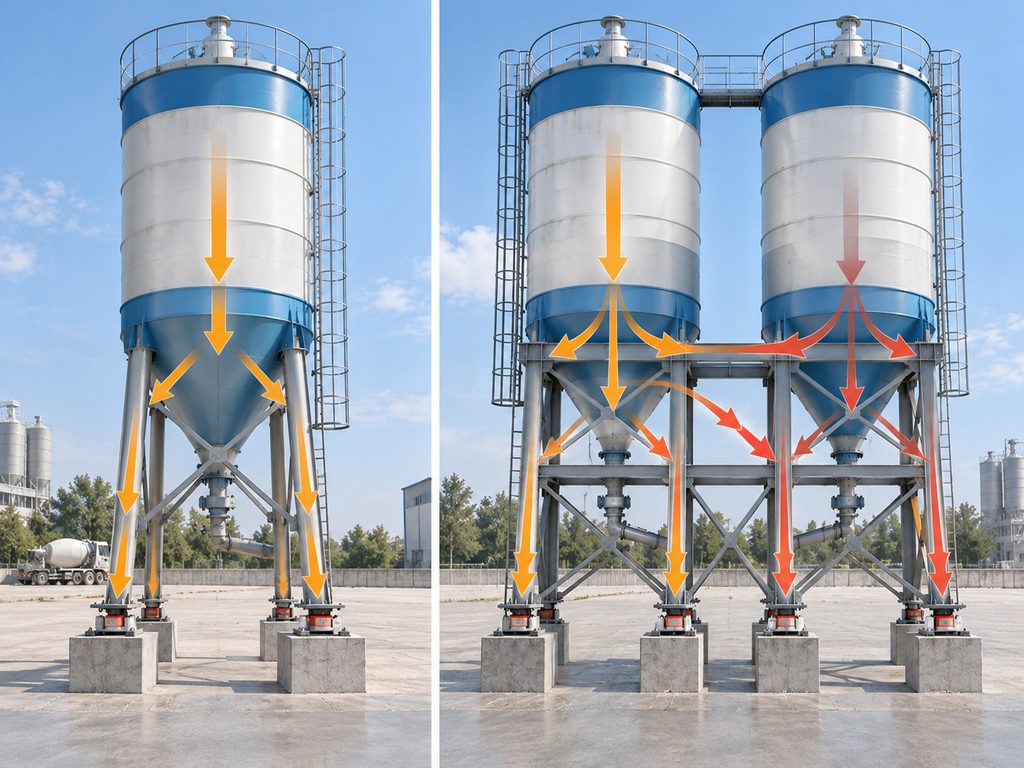
For example, suppose a cement silo has four independent legs, with one load cell or weighing module installed beneath each leg. Most of the vertical load generated by the silo, stored cement, and associated equipment is transferred through these four measurement points to the foundation.
In a simplified system:
Total silo weight ≈ Sum of the loads measured by all load cells.
The situation becomes much more complicated when two silos share the same support frame.
Suppose Silo A and Silo B are installed on the same steel structure and share beams, columns, or cross-bracing. When cement is added to Silo A, its additional weight does not necessarily act only on the supports directly beneath Silo A.
Part of that load may be transferred through common beams, braces, and columns toward the structural supports associated with Silo B.
The same effect can occur in the opposite direction.
As a result, the load cell system may no longer be measuring two completely independent quantities—“Weight of Silo A” and “Weight of Silo B.” Instead, it may be measuring the result of a structurally coupled load distribution across the entire shared support frame.
If the application requires accurate, independent inventory measurements for each silo, this structural coupling can become a significant source of error.
2. Load Sharing Through the Steel Structure Can Reduce Independent Weighing Accuracy
A typical shared silo structure consists of columns, horizontal beams, diagonal braces, connection plates, and foundations.
Steel structures are stiff, but they are not perfectly rigid.
When a cement silo is filled, beams undergo small amounts of deflection and deformation. These movements may be almost impossible to see with the naked eye, but they can still change how the load is distributed among different support points.
For example, when Silo A is empty, the loads at different support points may be relatively balanced.
After tens of tons of cement are loaded into Silo A, the shared beam may deflect slightly. This deformation changes the original load distribution. Some of the additional load may then be transferred through shared beams or braces to common columns or toward the supporting structure of Silo B.
This leads to an important principle in silo weighing:
A high-accuracy load cell does not automatically guarantee a high-accuracy weighing system.
A load cell itself may have excellent rated accuracy under laboratory conditions. However, the final accuracy of a cement silo weighing system depends on much more than the load cell specification.
Structural stiffness, load paths, mounting arrangements, piping connections, wind loads, temperature changes, vibration, and calibration methods can all influence the final measurement.
3. Simultaneous Filling and Discharge Make the Problem More Complicated
Another limitation of a twin-silo shared support structure appears when both silos are operating at the same time.
For example, Silo A may be receiving cement from a bulk tanker through a pneumatic conveying system while Silo B is simultaneously discharging cement through a screw conveyor.
The total load on the shared structure is continuously changing.
The weight of Silo A is increasing while the weight of Silo B is decreasing. At the same time, the structure may be exposed to vibration, pneumatic conveying forces, mechanical impact, and small structural deformations.
If the two silos are not mechanically isolated from each other, it becomes difficult for the weighing system to determine exactly which silo caused a particular change in load distribution.
If the only requirement is to know the combined inventory of both silos, it may be possible to treat the two silos and their shared frame as one weighing system.
However, if the objective is to independently measure:
- remaining material in Silo A;
- remaining material in Silo B;
- material added to Silo A;
- material discharged from Silo B;
then the shared support structure can significantly increase system design, calibration, and measurement complexity.
Therefore, measuring the total weight of a twin-silo system and independently weighing each silo are two very different engineering requirements.
This distinction should be established before the weighing system is designed.
4. Outdoor Wind Loads Can Affect Cement Silo Weighing
Outdoor cement silos are usually tall structures with relatively large diameters. Their large exposed surface area makes them particularly sensitive to wind.
When strong wind acts on the silo wall, it generates horizontal forces and overturning moments. These forces can change the vertical load distribution among the silo support points.
For example, the load measured by load cells on the windward side may decrease, while the load on the leeward side increases.
In an ideal system with symmetrical construction, correctly installed load cells, and no unwanted external load paths, summing the signals from all load cells can compensate for some of these effects.
Real installations, however, are rarely perfect.
When two silos share the same structural frame, wind acting on one silo may also transfer forces through common beams and diagonal braces to the supports of the second silo.
Under gusty wind conditions, this may cause noticeable fluctuations in the load cell signals even though no material is entering or leaving the silo.
For this reason, outdoor cement silo weighing systems often require appropriate mechanical restraints, properly designed weighing modules, signal filtering, and stability algorithms.
Simply selecting a higher-accuracy load cell cannot eliminate all wind-related measurement problems.
5. Temperature Changes Can Alter the Load Distribution
Temperature is another important consideration for outdoor silo weighing.
Steel expands when heated and contracts when cooled. An outdoor cement silo and its supporting steel structure may experience significant temperature differences between daytime and nighttime.
Direct sunlight can heat one side of the structure more than the other, creating uneven thermal expansion.
With an independently supported silo, properly designed load cell mounting assemblies can normally allow a limited amount of horizontal movement, helping to prevent thermal expansion from creating excessive parasitic forces.
With two silos mounted on a large shared steel frame, however, the thermal deformation pattern becomes considerably more complicated.
For example, one silo may be exposed to direct sunlight while the second remains partially shaded. Different sections of the support structure can therefore reach different temperatures and expand by different amounts.
These thermal forces can eventually reach the weighing modules and influence their output.
A typical symptom is:
The indicated silo weight slowly changes throughout the day even though no cement has entered or left the silo.
This does not necessarily mean that the load cells are defective. The apparent weight change may be caused by thermal expansion and structural stress within the shared support frame.
6. Pipes, Dust Collectors, and Screw Conveyors Can Create Load Bypasses
A cement silo is rarely a completely isolated structure.
In a real installation, it may be connected to:
- pneumatic filling pipes;
- dust collection systems and ductwork;
- screw conveyors;
- discharge valves;
- cable trays;
- maintenance platforms;
- ladders;
- silo-top equipment;
- and other auxiliary components.
If these components are rigidly connected to external fixed structures, they can create what is often called a load bypass or force shunt.
This means that part of the silo load no longer passes through the intended load cells. Instead, some of the force is transferred directly to another structure, support, pipe, or foundation.
For a twin-silo system sharing the same support frame, the problem can become even more complex because the two silos may also share platforms, pipelines, ductwork, or other mechanical connections.
If the forces created by these external connections change, the indicated weight can change as well.
Therefore, designing a reliable cement silo weighing system requires more than simply choosing the correct load cells.
The entire mechanical installation must be evaluated to ensure that the silo is actually free to transfer its weight through the intended weighing points.
7. Uneven Loading Makes Calibration More Difficult
Cement is not always distributed uniformly inside a silo.
The filling position, angle of repose, wall buildup, material bridging, and discharge conditions can all cause the center of gravity and internal load distribution to change.
For an independently supported silo, individual load cells may carry different loads, but the sum of all load cell outputs can still provide a relatively stable measurement of total silo weight.
With a shared twin-silo structure, uneven loading can have a more complicated effect.
An eccentric load in Silo A may change not only the forces at the support points beneath Silo A but also the force distribution throughout the shared steel structure. This may influence the measurement associated with Silo B.
As a result, a system that performs well during empty-silo calibration may not necessarily provide the same accuracy when one silo is full and the other is empty.
For a shared-support installation, it is useful to evaluate several loading conditions, such as:
- Silo A empty / Silo B empty;
- Silo A full / Silo B empty;
- Silo A empty / Silo B full;
- both silos partially or heavily loaded;
- one silo filling while the other is discharging.
Testing multiple loading combinations can reveal whether significant cross-interference exists between the two silos.
8. Load Cell Maintenance and Replacement Become More Difficult
Cement silos are heavy structures. Once in operation, the combined weight of the silo body and stored material can easily reach tens of tons or more.
When two silos share the same support structure, replacing a single load cell or weighing module requires careful consideration of the overall structural load path.
It may not be safe to assume that technicians can simply jack up one silo and replace the sensor.
Maintenance planning must consider jacking points, temporary supports, structural stability, neighboring silo inventory, and load redistribution during the maintenance process.
Improper lifting may unexpectedly transfer loads to other parts of the shared frame.
From a long-term maintenance perspective, therefore, a twin-silo shared-frame weighing system can be more complicated than two independently supported silos.
9. Does This Mean Load Cells Cannot Be Used on Twin Silos?
Not necessarily.
Two cement silos sharing one support frame do not automatically make load cell weighing impossible. The feasibility depends primarily on the weighing objective and structural design.
If the purpose is simply to monitor the combined inventory of both cement silos, it may be possible to treat the silos and shared frame as a single weighing structure.
Provided that the load path is clearly defined and external mechanical connections are properly controlled, this approach may be practical.
However, if each silo must be weighed independently with high accuracy, mechanical decoupling should ideally be considered during the structural design stage.
Silo A and Silo B should have clearly defined and independent vertical load paths wherever possible.
A useful design principle is:
If you want to weigh two silos independently, allow them to carry their loads independently. If you only need the combined weight, the entire twin-silo structure may be considered as one weighing system.
This distinction is critical when selecting the appropriate cement silo weighing solution.
10. What Should Be Considered When Designing an Outdoor Twin-Silo Weighing System?
For a twin-silo cement storage system using load cells, the weighing concept should ideally be considered before the steel structure is manufactured.
Structural engineers, weighing system designers, and process piping engineers should evaluate the installation together.
The first question should be whether the application requires individual silo weights or only the combined inventory.
The actual load path should then be analyzed carefully.
If independent silo measurement is required, uncontrolled load-bearing connections between the two silos should be minimized. Piping, screw conveyors, maintenance platforms, dust collection systems, and other attachments should also be designed so that they do not introduce significant parasitic forces into the weighing system.
For outdoor installations, engineers should additionally consider wind loads, thermal expansion, lightning protection, water ingress protection, corrosion resistance, load cell overload protection, and maintenance access.
Load cell capacity should not be selected based only on the maximum cement inventory.
The calculation should also consider:
silo dead weight + maximum material weight + eccentric loading + dynamic forces + appropriate safety margin.
Correct load cell sizing is therefore a structural and system-level engineering decision rather than simply a comparison between silo capacity and sensor capacity.
Conclusion: The Real Question Is Not “How Accurate Is the Load Cell?” but “Where Does the Load Go?”
Load cells can provide highly accurate measurements, but in an outdoor twin-silo installation with a shared support frame, sensor accuracy alone does not determine the accuracy of the complete weighing system.
Structural load coupling, uneven loading, wind forces, thermal expansion, piping constraints, equipment vibration, and frame deformation can all change the path through which forces travel from the silo to the foundation.
These effects can make independent silo weighing considerably more difficult.
For outdoor cement silos sharing one support structure, applications requiring accurate individual silo inventory measurements should prioritize mechanical decoupling and clearly defined load paths rather than relying solely on higher-accuracy load cells.
A reliable cement silo weighing system should always be considered as a complete system consisting of:
mechanical structure + load cells + weighing modules + signal processing + calibration.
Before selecting a weighing solution for a cement silo, there is one fundamental question worth answering:
When one additional ton of cement enters the silo, exactly where does that force go before it reaches the foundation?
Understanding that load path is one of the most important steps toward improving weighing accuracy, reducing long-term drift, and minimizing maintenance problems.