
When selecting a radar level meter, the antenna design is often one of the key concerns for engineers and plant operators. In particular, people who have previously used conventional radar level instruments may wonder whether a radar without a visible metal horn antenna can provide reliable performance.
Will the radar signal become weaker without a horn antenna? Is the measuring range sufficient? Should a horn antenna still be selected for an ambient-temperature storage tank?
As radar measurement technology has evolved from traditional lower-frequency radar to 80 GHz FMCW millimeter-wave radar, antenna design and signal-processing technology have changed significantly. For storage tanks operating under ambient temperature and atmospheric or near-atmospheric pressure, the need for a horn antenna should no longer be determined solely by conventional experience.
In many standard liquid level measurement applications, an 80 GHz radar level meter equipped with a compact lens antenna can provide reliable measurement while offering advantages in installation space, beam focusing, maintenance, and overall project cost.
The following practical case explains why, under relatively simple ambient-temperature conditions, there is often no need to specify a horn antenna simply because it has traditionally been associated with radar level measurement.
1. Project Background: Liquid Level Measurement in an Ambient-Temperature Storage Tank
A manufacturing facility needed continuous liquid level monitoring for several raw-material storage tanks.
The main process conditions were as follows:
- Tank height: approximately 8 m
- Tank diameter: approximately 4 m
- Operating temperature: approximately 20–35°C
- Operating pressure: close to atmospheric pressure
- Liquid with relatively favorable dielectric properties
- Generally stable liquid surface
- No large internal agitators
- No significant high-temperature vapor
- No severe foam formation
- No serious crystallization or buildup
- Non-contact continuous level measurement required
- Measurement signal connected to the plant PLC system
From an instrumentation perspective, this was a typical ambient-temperature, near-atmospheric-pressure storage tank level measurement application.
During the early stage of the project, the customer originally planned to use a radar level meter with a metal horn antenna. The reason was straightforward: many radar instruments previously used at the plant were equipped with horn antennas.
As a result, operators had developed a common assumption:
“The larger the horn antenna, the stronger the radar signal and the more reliable the measurement.”
This idea may have had some practical basis for certain conventional radar technologies. However, applying the same assumption directly to modern 80 GHz radar level meters can lead to unnecessary or oversized configurations.
2. Why Were Horn Antennas Commonly Used on Traditional Radar Level Meters?
To understand this application, it is useful to first understand the purpose of a horn antenna.
A radar level meter transmits electromagnetic waves toward the surface of the measured material. When the waves reach the liquid or solid surface, part of the signal is reflected back to the instrument.
The radar receives this reflected signal and calculates the distance between the antenna and the material surface. The level is then determined from this distance.
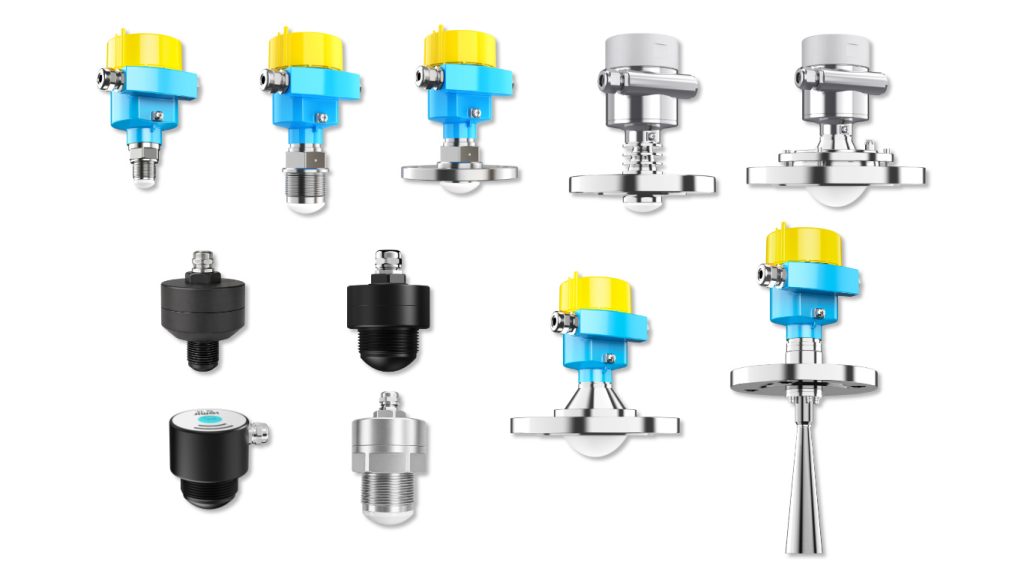
Horn antennas have traditionally been widely used in radar level measurement.
One of their main functions is to improve the directionality of the transmitted radar energy and focus it toward the target.
With certain lower-frequency radar technologies, obtaining better directivity and a narrower beam angle often requires a physically larger antenna. This is why traditional radar level meters are frequently associated with large metal horn antennas.
Over time, this created a simple rule of thumb:
A larger radar antenna means better measurement performance.
However, antenna size cannot be evaluated independently of radar frequency.
Actual radar level measurement performance depends on several factors, including:
- Operating frequency
- Wavelength
- Beam angle
- Antenna gain
- Signal-processing capability
- Echo-tracking algorithms
- Installation position
- Dielectric properties of the measured medium
Therefore, in the era of 80 GHz millimeter-wave radar, judging radar performance solely by the physical size of the horn antenna is no longer appropriate.
3. How 80 GHz Radar Changes Antenna Design
The radar level meter selected for this application was based on 80 GHz FMCW (Frequency-Modulated Continuous Wave) radar technology.
Compared with conventional lower-frequency radar, 80 GHz radar operates at a much higher frequency and a shorter wavelength. This makes it possible to achieve effective beam focusing with a relatively compact antenna.
For storage tank applications, a narrow radar beam offers several important advantages.
A tank may contain structures such as:
- Tank walls
- Reinforcing components
- Inlet pipes
- Manways
- Support structures
- Internal ladders
- Other mechanical obstructions
If the radar beam is too wide, some of the transmitted energy may strike these objects and create unwanted reflections or false echoes.
An 80 GHz radar level meter can concentrate the radar energy into a relatively narrow measurement area, allowing the signal to be directed more precisely toward the liquid surface.
This means that, in many conventional storage tanks, a large metal horn is no longer the only way to achieve good radar beam directivity.
A compact lens antenna can also provide effective beam focusing.
4. Why Was a Horn Antenna Unnecessary for This Ambient-Temperature Tank?
After evaluating the actual process conditions, the instrumentation team did not automatically specify a large horn antenna. Instead, several key factors were considered.
4.1 The Process Temperature Was Moderate
The liquid temperature was approximately 20–35°C, which is clearly within the range of a typical ambient-temperature application.
There was no continuous high-temperature vapor and no extreme thermal load acting on the process connection or antenna assembly.
Therefore, there was no practical reason to introduce a more complicated antenna configuration simply to address a high-temperature condition that did not exist.
A fundamental principle of instrumentation selection is:
Choose equipment according to the actual process conditions rather than adding unnecessary features designed for extreme applications.
4.2 The Measuring Distance Was Only About 8 Meters
The tank height was approximately 8 m.
For a modern 80 GHz radar level meter, this represents a relatively modest measuring distance.
Depending on the instrument design and process conditions, compact 80 GHz radar level meters can provide measuring ranges of several tens of meters, while models designed for more demanding applications may support substantially longer distances.
Therefore, installing a large horn antenna simply to increase the theoretical measuring range offered little practical benefit for an 8 m storage tank.
4.3 The Medium Provided Favorable Radar Reflections
The liquid in the tank had relatively favorable dielectric characteristics, and the liquid surface was generally stable.
The application did not involve extremely low dielectric properties, heavy dust, intense vapor, or thick foam that could significantly weaken the radar echo.
Under these conditions, an 80 GHz radar level meter could obtain a sufficiently clear return signal from the liquid surface.
When the existing echo is already strong enough for reliable measurement, increasing antenna complexity merely to achieve a theoretical improvement in signal strength may provide little additional value.
4.4 The Internal Tank Structure Was Relatively Simple
There were no large agitators or densely arranged internal structures inside the tank.
By selecting an appropriate mounting position and keeping the radar beam away from the inlet and tank wall, a compact lens antenna could obtain a stable reflection from the liquid surface.
Therefore, the most important question was not:
“Is the horn antenna large enough?”
The more relevant question was:
“Can the radar beam reach the measured surface clearly and reliably?”
This is a much more useful approach to radar level meter selection and installation.
5. A Compact Lens Antenna Can Simplify Installation
Removing the traditional large horn structure also makes the radar level meter considerably more compact.
For industrial installation, this advantage is more than cosmetic.
The top of a storage tank may already contain manways, filling connections, breather valves, pressure instruments, and other process connections. Space available for a level instrument can therefore be limited.
A large horn antenna generally requires a larger process opening or flange connection. Engineers may also need to consider the physical space required for the antenna extending into the vessel.
A compact lens antenna can reduce these installation requirements.
For new projects, this can simplify the tank nozzle design. For retrofit projects, it may allow an existing small process connection to be used without major modification.
This can be especially valuable when upgrading older tanks.
In many retrofit projects, the largest cost is not necessarily the radar level meter itself. Additional expenses may come from:
- Production shutdowns
- Cutting new tank openings
- Welding
- Flange modifications
- Recoating or corrosion protection
- Additional installation labor
If a compact radar level meter can be installed through an existing connection, the overall project cost can often be reduced significantly.
6. What Happened After Commissioning?
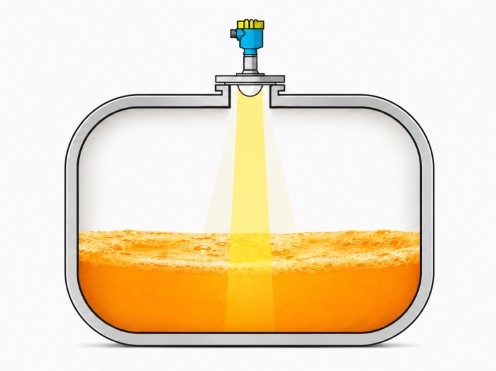
After installation, the radar level meter was commissioned under both empty-tank and operating conditions.
The mounting position was selected away from the filling inlet and at an appropriate distance from the tank wall, allowing the radar beam to point directly toward the liquid surface.
Once the instrument was put into operation, the level trend remained stable.
During filling and emptying, the radar continuously tracked changes in liquid level. The absence of a large horn antenna did not result in significant signal loss or unstable measurement.
Because the 80 GHz radar had a relatively narrow beam, interference from the tank wall and nearby structures could also be controlled effectively.
After echo mapping and parameter optimization, the instrument was able to distinguish the true liquid-level echo from fixed false reflections generated by surrounding structures.
The operating results demonstrated an important point:
For this ambient-temperature, near-atmospheric-pressure, short-range application with a stable liquid surface, a large horn antenna was not necessary for reliable level measurement.
Measurement performance depended on the overall combination of radar frequency, beam characteristics, antenna design, installation position, and signal-processing algorithms.
7. Does This Mean Horn Antennas Have No Value?
No.
Saying that a horn antenna is unnecessary in a simple ambient-temperature application does not mean horn antennas are obsolete or unsuitable for all radar level measurements.
One of the biggest mistakes in industrial instrumentation is turning the result of one application into a universal rule.
Horn antennas still have practical value.
For certain radar frequencies, specific vessel geometries, and particular measurement conditions, a properly designed horn antenna can provide excellent directivity and signal transmission characteristics.
The key question is not whether a horn antenna is “good” or “bad.”
The correct question is:
Does the actual application require one?
If the process involves a standard ambient-temperature storage tank, the measuring distance is moderate, the medium provides good radar reflection, and an 80 GHz radar level meter is being used, continuing to follow the traditional assumption that “a large horn is always more reliable” may result in unnecessary over-specification.
8. When Should a Higher-Specification Radar Antenna Be Considered?
Compared with a simple ambient-temperature storage tank, several demanding process conditions require more careful radar level meter selection.
High-Temperature Applications
When the process temperature is significantly higher, particularly when continuous high-temperature vapor is present, antenna materials, process seals, thermal isolation, and electronics protection become important considerations.
A standard ambient-temperature radar configuration should not automatically be used in these conditions.
Heavy Vapor or Foam
Vapor, condensation, and foam can affect radar signal propagation and reflection.
For these applications, engineers should evaluate radar frequency, antenna size, signal strength, echo-processing capability, and mounting position together.
Dusty Solid Silos
Cement, coal powder, fly ash, plastic powder, and similar bulk materials can generate significant dust during filling.
In addition, a solid material surface is usually less uniform than a liquid surface.
Such applications may require stronger beam focusing, an appropriately sized antenna, and in some cases an air-purge system or adjustable flange to optimize the antenna direction.
Low-Dielectric Materials
Certain powders, granules, and special liquids produce relatively weak radar reflections.
For weak-echo applications, temperature alone is not sufficient for equipment selection. Engineers should also consider dielectric properties, measuring distance, antenna gain, and signal-processing capability.
In other words:
Temperature is only one parameter in radar level meter selection. It should not be treated as the sole factor determining antenna design.
9. How Should a Radar Level Meter Be Selected for Ambient-Temperature Applications?
For relatively simple ambient-temperature storage tanks, several factors should be evaluated before deciding on the antenna type.
First, consider the measuring range.
For storage tanks measuring only several meters or a few tens of meters in height, modern 80 GHz radar technology can often provide sufficient range without requiring an oversized antenna.
Second, evaluate the properties of the measured medium.
Liquids with favorable dielectric characteristics and stable surfaces generally provide strong radar reflections. Low-dielectric materials require more careful evaluation.
Third, examine the internal tank structure.
If agitators, heating coils, supports, pipes, or other obstructions are present, a narrow radar beam and proper mounting location become especially important.
Fourth, check the process temperature and pressure.
Ambient-temperature and near-atmospheric-pressure applications generally do not require unnecessarily complex high-temperature or high-pressure structures. Conversely, genuinely demanding conditions require appropriate process connections, sealing materials, and instrument specifications.
Only after these conditions have been evaluated should the antenna design be finalized.
A more logical selection sequence is therefore:
Analyze the process conditions first, determine the required radar technology and performance specifications second, and select the antenna configuration last.
This is more effective than specifying a horn antenna first and then trying to find an instrument that can accommodate it.
10. More Features Do Not Automatically Mean Better Radar Level Measurement
A common issue in industrial instrumentation procurement is over-specification.
To reduce perceived risk, users may choose longer measuring ranges, larger antennas, higher temperature ratings, and more complicated mechanical structures.
At first glance, this may appear safer.
However, industrial instrumentation is not a case where “more” automatically means “better.”
A radar level meter installed on a storage tank operating at 30°C will not become more accurate simply because the instrument is capable of withstanding temperatures above 200°C.
Similarly, if a compact 80 GHz lens antenna already provides a stable liquid-level echo in an 8 m tank, adding a large metal horn will not necessarily produce a proportional improvement in measurement performance.
Instead, unnecessary antenna structures may increase:
- Instrument purchase cost
- Required process connection size
- Tank modification work
- Surface area exposed to condensation or buildup
- Installation complexity
- Maintenance and removal difficulty
The objective of good radar level meter selection is therefore not to maximize every specification.
It is to maximize the match between the instrument and the actual process conditions.
11. Case Conclusion: In Simple Ambient-Temperature Applications, the Real Question Is Not Whether There Is a Horn
Returning to this storage tank application, the process temperature was approximately 20–35°C, the operating pressure was close to atmospheric pressure, and the measuring distance was only about 8 m.
The liquid provided favorable radar reflections, the internal tank structure was relatively simple, and there were no severe problems involving vapor, foam, or dust.
Under these conditions, an 80 GHz FMCW radar level meter with a compact lens antenna was capable of providing stable, non-contact liquid level measurement.
Therefore, there was no need to specify a large horn antenna simply because it had been commonly used with previous generations of radar level instruments.
This application illustrates an important principle of radar level meter selection:
A larger antenna is not automatically better, and more features do not automatically make an instrument more reliable. The best solution is the one whose performance matches the actual process conditions.
As 80 GHz millimeter-wave radar technology continues to develop, radar level meters are moving toward smaller antennas, narrower beams, more compact structures, and more sophisticated echo-processing capabilities.
For many ambient-temperature and near-atmospheric-pressure applications—including water tanks, raw-material tanks, liquid storage tanks, and small or medium-sized process vessels—a compact lens antenna can already provide the performance required for reliable level measurement.
Therefore, the next time a radar level meter is selected, instead of asking:
“Why doesn’t it have a horn antenna?”
It may be more useful to ask:
What is the process temperature? What is the measuring range? What are the dielectric properties of the medium? Are vapor, foam, or dust present? Are there internal obstructions? What is the radar beam angle?
Once these questions have been answered, the conclusion may become clear:
In many ordinary ambient-temperature applications, the key is to select, install, and configure the radar level meter correctly—not to add a horn antenna that the process does not actually require.
Frequently Asked Questions About Radar Level Meter Antennas
1. Does an ambient-temperature radar level meter never need a horn antenna?
No. The need for a horn antenna depends on radar frequency, measuring range, medium characteristics, vessel geometry, installation conditions, and the overall antenna design. This case specifically discusses relatively simple ambient-temperature and near-atmospheric-pressure applications using 80 GHz radar technology.
2. Why can an 80 GHz radar level meter use a compact lens antenna?
80 GHz millimeter-wave radar operates at a high frequency and short wavelength. With a properly designed antenna, this makes it possible to achieve a narrow radar beam using a relatively compact antenna structure. A narrow beam helps concentrate the transmitted energy toward the target and reduces interference from tank walls and internal structures.
3. Does a larger radar antenna always mean a longer measuring range?
Not necessarily. Radar measuring capability depends on multiple factors, including operating frequency, antenna gain, dielectric properties of the medium, signal-processing algorithms, installation conditions, and the measurement environment. Measuring range should not be judged solely by the physical size of the antenna.
4. Is an 80 GHz radar level meter suitable for an ambient-temperature water tank?
In many cases, yes. For ambient-temperature, near-atmospheric-pressure water tanks with relatively stable liquid surfaces, 80 GHz non-contact radar level meters can offer narrow beam angles, compact installation, and reliable continuous measurement. The final selection should still consider measuring range, accuracy requirements, process connection, and vessel geometry.
5. Which applications require more attention to radar antenna configuration?
High-temperature or high-pressure processes, heavy vapor, thick foam, severe dust, low-dielectric materials, very long measuring ranges, and vessels with complex internal structures all require more careful antenna evaluation. In these applications, antenna size, materials, focusing capability, process connection, and auxiliary features should be selected according to the actual process conditions.