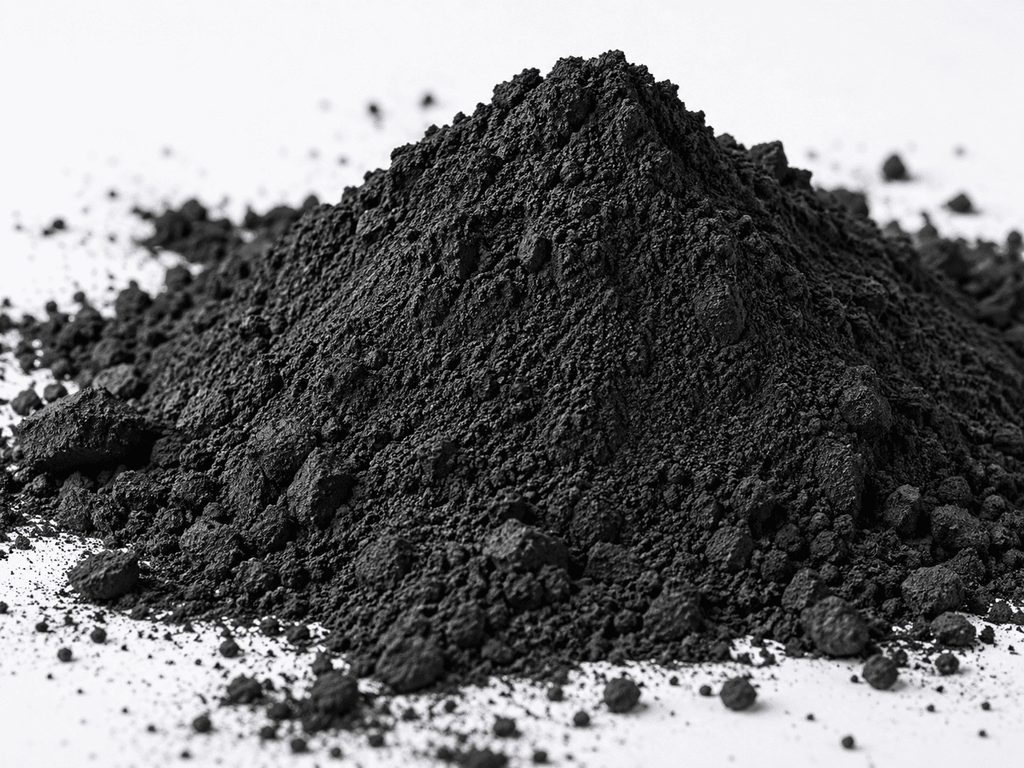
In carbon black, conductive carbon powder, battery material, rubber, plastics, and powder-processing applications, carbon powder is commonly stored in silos, buffer bins, day bins, and intermediate storage vessels.
At first glance, measuring the level of carbon powder may seem simple. In real industrial environments, however, operators often encounter unstable readings, false echoes, signal loss during filling, incorrect empty-silo readings, or false level indications caused by material buildup.
When carbon powder level measurement becomes unreliable, the consequences can extend far beyond inaccurate inventory data. It may lead to silo overfilling, material shortages, interrupted production, dosing errors, and frequent manual inspections.
So why is carbon powder more difficult to measure than ordinary granular materials? And what should you consider when selecting a carbon powder level sensor?
Challenge 1: Heavy Dust Makes Level Measurement Difficult During Filling
Carbon powder contains extremely fine particles. During pneumatic conveying or high-speed filling, large quantities of airborne dust can form inside the silo.
Some traditional level measurement technologies may be affected by dust, signal attenuation, or unstable echoes. As a result, the displayed level may fluctuate significantly, and in severe cases, the instrument may temporarily lose the material surface during filling.
This is one of the most common problems in carbon powder applications:
The level sensor works perfectly when the material is stationary, but the reading becomes unstable as soon as the silo starts filling.
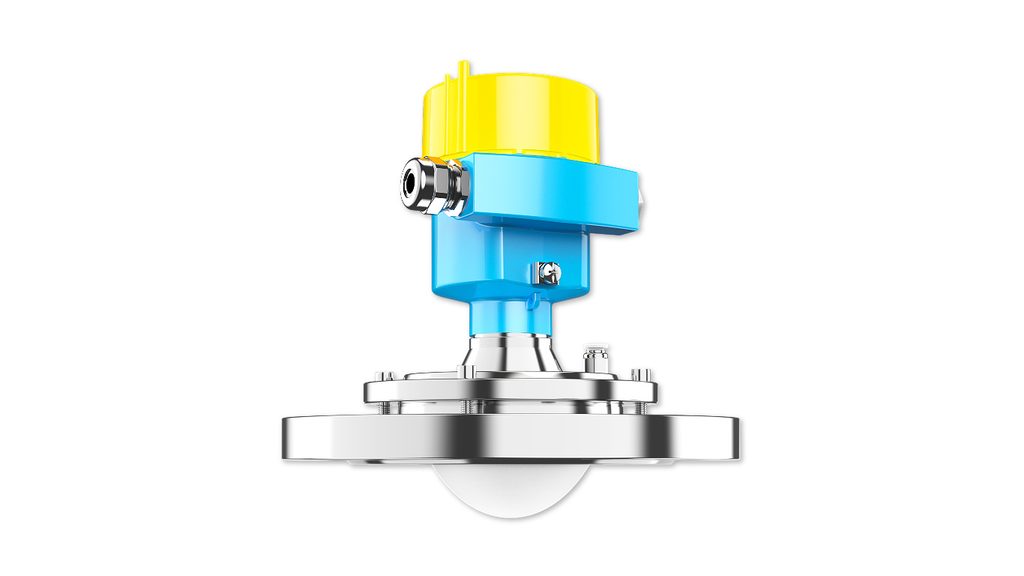
For applications requiring continuous level monitoring, a non-contact radar level sensor is often a more suitable option.
However, sensor selection should not be based on measuring range alone. Other important factors include beam angle, echo processing capability, signal strength, and the ability to detect weak reflections from low-density powder surfaces.
Challenge 2: Uneven Powder Surfaces Make a Single Measuring Point Less Representative
Liquid surfaces are usually relatively flat. Powder surfaces are very different.
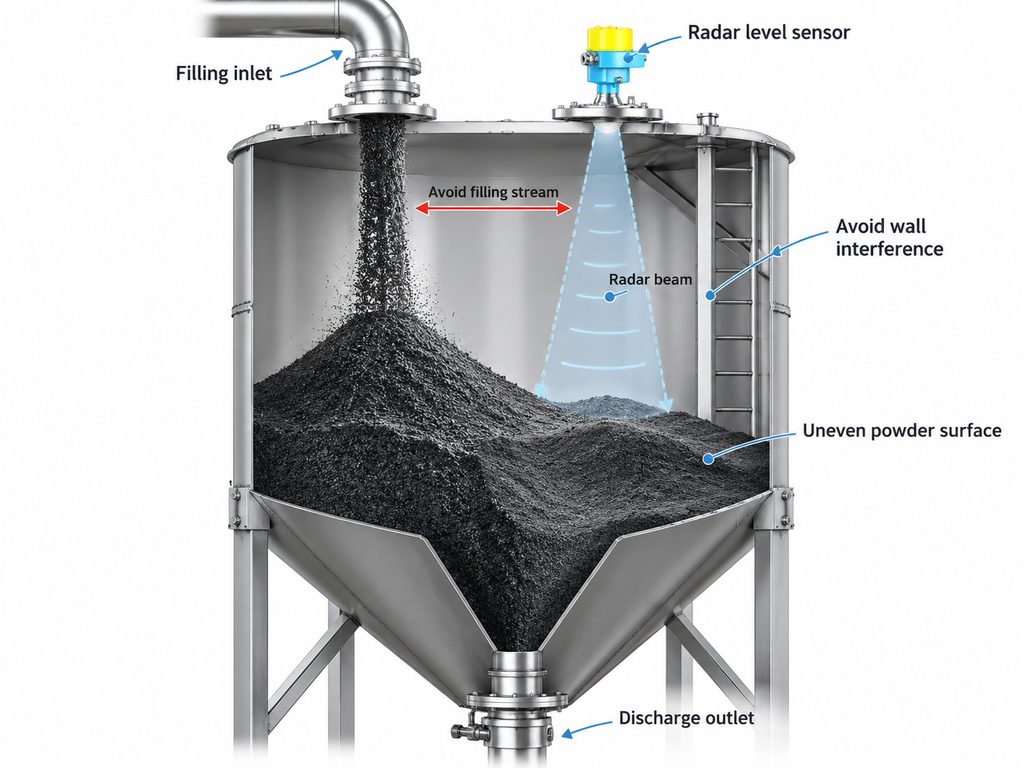
During filling, carbon powder may form a cone-shaped pile beneath the inlet. During discharge, a funnel-shaped depression may develop above the outlet. Different filling and discharging conditions can also create sloped surfaces, local buildup, or sudden material collapse.
Therefore, the level measured at one point may not represent the average material level inside the entire silo.
This is why the installation position of a carbon powder level sensor is extremely important.
If the sensor is installed directly above the filling inlet, it may detect falling material instead of the actual material surface.
If the sensor is installed too close to the silo wall, internal structures such as reinforcement beams, ladders, supports, or wall buildup may interfere with the measurement signal.
In practical applications, the installation position should be selected based on silo height, diameter, hopper geometry, filling location, and discharge position.
The radar beam should ideally avoid the filling stream and fixed internal obstacles.
Challenge 3: Lightweight Carbon Powder May Produce Weak Radar Echoes
Different types of carbon powder can vary significantly in particle size, bulk density, moisture content, and dielectric properties.
Some lightweight and loosely packed powders may produce relatively weak radar reflections.
At the same time, the shape of the powder surface continuously changes during filling and discharge, making echo identification even more challenging.
For this reason, selecting a carbon powder level meter should never be based on the assumption that:
“If the rated measuring range is long enough, the sensor will work.”
A sensor that performs well on liquids may not deliver the same performance on granular solids or low-density powders, even if the silo height is identical.
A better selection process should consider material properties, actual measuring distance, antenna design, process connection, beam angle, signal strength, and available measurement margin.
Challenge 4: Material Buildup Can Create False Level Readings
Carbon powder can easily adhere to surfaces and generate significant dust.
After long-term operation, buildup may occur on silo walls, process connections, flanges, mounting nozzles, and even around the sensor antenna.
If a thick layer of material accumulates near the sensor, or if significant caking develops inside the silo, the instrument may begin detecting fixed interference echoes.
Typical symptoms include:
- Level readings that remain artificially high
- Slow response to actual material changes
- False level alarms
- A level value that remains nearly constant even during discharge
This means that carbon powder level measurement should not be evaluated only by the accuracy achieved immediately after installation.
Long-term stability and maintenance requirements are equally important.
The installation should minimize direct exposure of the antenna to the incoming powder stream.
Depending on the application, it may also be necessary to consider suitable mounting nozzles, anti-buildup designs, or air-purge systems.
Challenge 5: Overfill Protection Should Not Rely on a Single Continuous Level Sensor
The main purpose of a continuous radar level sensor is to track the changing material level inside the silo.
However, for critical functions such as overfill protection, empty-silo protection, or process interlocks, relying on a single continuous level transmitter may not always provide the highest level of reliability.
For this reason, many carbon powder storage systems use independent high-level or low-level switches in addition to continuous level measurement.
For example, rotary paddle level switches are commonly used for point-level detection in powders.
Certain vibrating level switches can also be used for powders and granular materials, depending on the bulk density, buildup tendency, and fluidization characteristics of the carbon powder.
In this type of arrangement:
The continuous level sensor provides real-time inventory information, while the point level switch provides an independent safety alarm.
Using both technologies together can significantly improve system reliability.
Challenge 6: Explosion Protection and Static Electricity Cannot Be Ignored
Fine powders such as carbon powder and carbon black may create high concentrations of airborne dust during storage, conveying, and filling.
Some applications may also involve electrostatic buildup.
Therefore, selecting a carbon powder level sensor is not only about measurement range and accuracy.
Depending on the material safety data, hazardous-area classification, local regulations, and plant safety requirements, engineers may also need to consider:
- Explosion-proof or intrinsically safe certification
- Electrical connection requirements
- Grounding
- Static electricity control
- Installation requirements for hazardous dust environments
This is particularly important in pneumatic conveying systems, enclosed silos, and areas with high dust concentrations.
Explosion-protection requirements should be considered during the engineering and sensor-selection stage rather than after the instrument has already been purchased.
The required certification and protection level should always be determined according to the actual material SDS, hazardous-area classification, and applicable local standards.
Why Does a Carbon Powder Level Sensor Work Well at First but Become Unreliable Later?
In many cases, the level sensor itself has not suddenly failed.
Instead, the process conditions have changed.
For example:
A different grade of carbon powder may have a different bulk density.
Material may gradually accumulate on the silo wall.
The direction of the filling stream may have changed.
Dust may slowly build up around the sensor antenna.
Another common issue is that the instrument is commissioned only under empty-silo or static-level conditions.
The sensor may appear to work perfectly during initial testing, but problems begin once the plant starts continuous production.
A reliable carbon powder level measurement system should ideally be evaluated under several operating conditions, including:
- Empty silo
- Normal storage conditions
- Continuous filling
- Continuous discharge
- High dust concentration
- Changing material surfaces
Only when the sensor can reliably track the material surface under dynamic operating conditions can it be considered suitable for the application.
How Should You Select a Carbon Powder Level Sensor?
When selecting a level sensor for a carbon powder silo, several key parameters should be confirmed first.
These include silo dimensions, carbon powder bulk density, dust concentration, filling method, discharge method, internal obstacles, hazardous-area requirements, and electrical specifications.
For applications with heavy dust, irregular material surfaces, and a requirement for low maintenance, a non-contact radar level sensor is often a strong option.
For deep silos or vessels with complex internal structures, sensors with a narrow beam angle, high dynamic range, and advanced echo processing can offer additional advantages.
High-frequency radar technologies such as 80 GHz radar level sensors typically provide a narrower and more focused beam.
This can make it easier to avoid silo walls, internal supports, reinforcement structures, and other unwanted reflections.
However, radar frequency should never be the only selection criterion.
A reliable solution must also consider antenna design, signal processing, material dielectric properties, process conditions, and installation geometry.
For critical high-high or low-low level protection, an independent point level switch should also be considered.
Conclusion: Stable Measurement Matters More Than High Accuracy on a Datasheet
The real challenge of carbon powder level measurement is not simply whether the sensor can detect a signal.
The real question is whether it can continue providing reliable measurements throughout the entire process, including:
filling, discharge, heavy dust, material buildup, and continuously changing powder surfaces.
When selecting a carbon powder level sensor, engineers should not compare only measuring range, accuracy, and price.
Material characteristics, dust concentration, silo geometry, filling position, installation conditions, explosion-protection requirements, and long-term maintenance costs should all be considered together.
A properly selected level measurement system can help reduce false readings, prevent unnecessary alarms, minimize manual inspections, improve inventory control, and increase the reliability of the entire production process.
If your carbon powder silo is experiencing unstable level readings, signal loss during filling, buildup-related false alarms, incorrect empty-silo readings, or frequent maintenance of older level instruments, start by collecting the basic application information.
Useful information includes silo dimensions, process connection size, filling method, powder properties, operating conditions, and installation photos.
With this information, it becomes much easier to select a level measurement solution that is truly suitable for the application.