Imagine managing dozens of storage tanks, silos, water reservoirs, or chemical vessels across multiple locations.
You need to know the level inside each one—but sending technicians to check them manually is slow, expensive, and inefficient.
This is where a level sensor gateway becomes valuable.
Radar level sensors, ultrasonic level sensors, pressure transmitters, and other level instruments can accurately measure liquid or solid levels. However, measurement alone is no longer enough for modern industrial operations.
Companies increasingly want to view level data remotely, receive alarms, analyze historical trends, and connect field instruments to PLCs, SCADA systems, or cloud platforms.
An industrial IoT gateway makes this possible.
It acts as the bridge between field-level instruments and digital monitoring systems, allowing traditional sensors to become part of a connected Industrial Internet of Things ecosystem.
So, what exactly is a level monitoring gateway, how does it work, and when do you need one?
Let’s take a closer look.
What Is a Level Sensor Gateway?
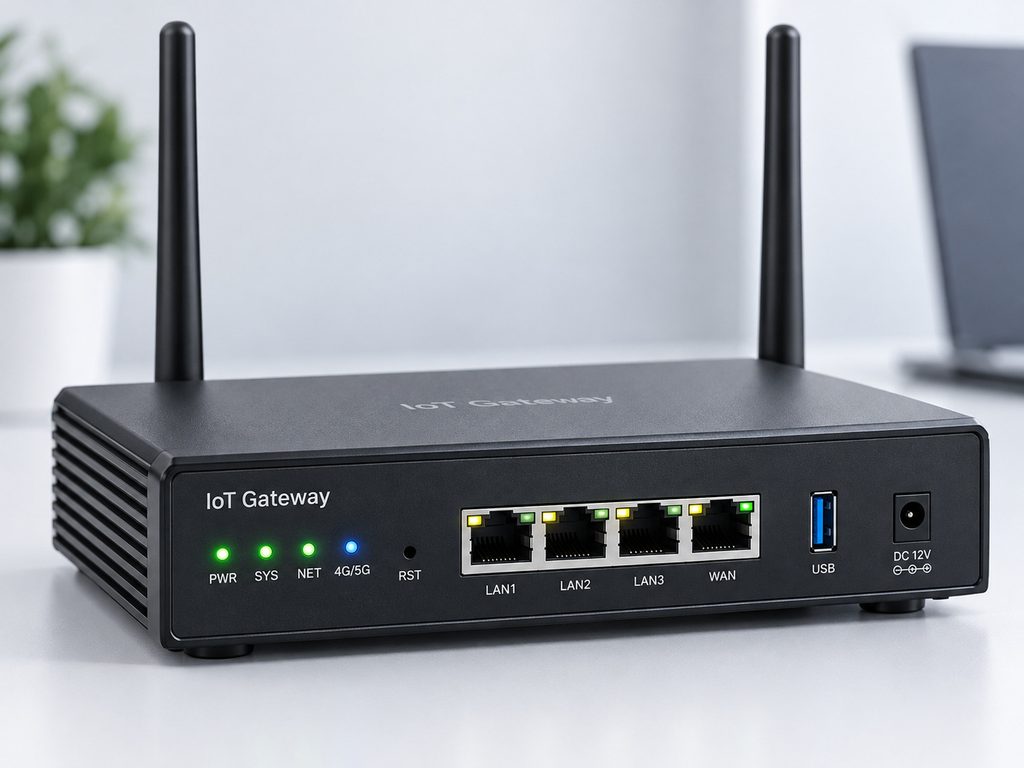
A level sensor gateway, also known as an industrial IoT gateway, is a communication device that connects level measurement instruments with higher-level monitoring or control systems.
A level sensor measures the actual process value.
For example, a radar level transmitter may detect that the liquid level inside a storage tank is currently 3.8 meters.
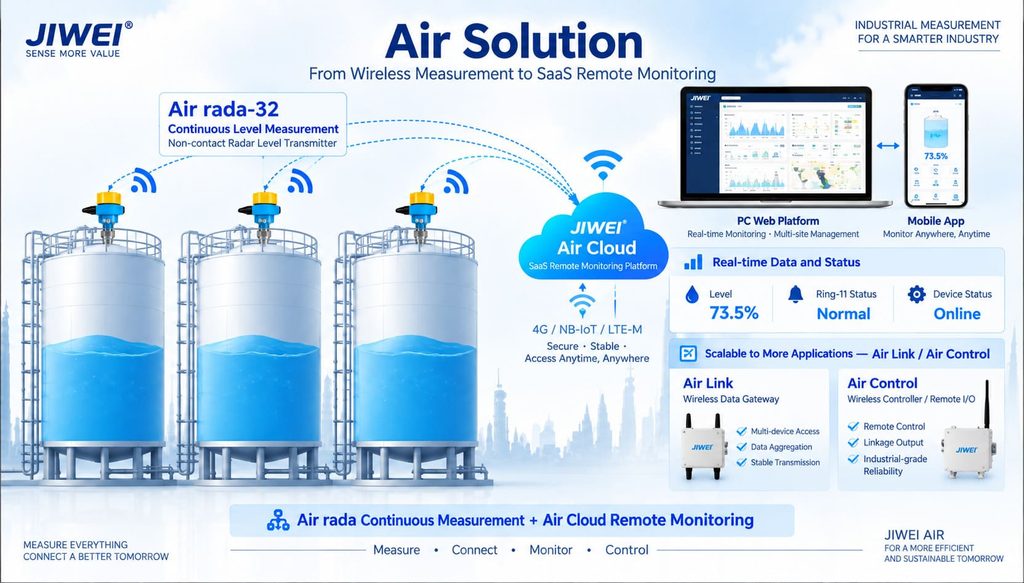
The gateway then collects that measurement and transmits it through Ethernet, Wi-Fi, 4G, 5G, LoRa, or another communication network to a cloud platform, SCADA system, server, or control center.
A typical remote level monitoring architecture may look like this:
Level Sensor → Industrial Gateway → Communication Network → Cloud Platform / SCADA → PC or Mobile Device
For example, imagine a chemical plant with 30 storage tanks.
Each tank may be equipped with a radar level sensor. If operators want to monitor every tank from a central control room—or even from a remote office—the sensors can send their data to an industrial gateway.
The gateway collects the information and uploads it to a monitoring platform.
Instead of walking from tank to tank, operators can see the entire site from one screen.
This is one of the most common ways traditional industrial instruments are connected to IoT systems.
Why Are Gateways Becoming More Important in Level Monitoring?
Traditional level measurement systems are often relatively closed.
A field instrument sends a signal to a PLC, and the PLC sends the information to a local control room.
For a small facility where all equipment is located in one place, this setup may work perfectly well.
However, modern industrial operations are becoming increasingly distributed and digital.
A water utility may need to monitor hundreds of reservoirs, pumping stations, or water tanks spread across a large geographic area.
A grain storage company may want real-time level information from multiple silos.
An oil or chemical company may need to monitor tank inventories across different facilities.
An environmental monitoring project may involve remote wastewater tanks, chemical dosing tanks, or underground storage vessels.
These applications all have one thing in common:
The measurement points are distributed, but the data needs to be centralized.
This is exactly the problem an industrial IoT gateway solves.
It connects field-level instruments to remote monitoring systems without requiring every sensor to communicate directly with the cloud.
What Does an Industrial IoT Gateway Actually Do?
An industrial gateway does much more than simply forward data.
Depending on the model and application, it may perform several important functions.
1. Data Acquisition
The first and most basic function of a gateway is collecting data from field instruments.
Common communication methods used by level measurement devices include:
- RS485
- Modbus RTU
- Modbus TCP
- 4–20 mA
- HART
- Analog signals
- Digital signals
Different devices may come from different manufacturers and use different communication protocols.
A compatible industrial gateway can read data from these instruments and collect information such as:
- Liquid level
- Solid material level
- Distance
- Temperature
- Pressure
- Device status
- Alarm conditions
In other words, the gateway becomes the central data entry point for the monitoring system.
2. Protocol Conversion
Protocol conversion is one of the most valuable functions of an industrial IoT gateway.
For example, a radar level transmitter may communicate using RS485 Modbus RTU, while the cloud platform may communicate using MQTT.
These two systems cannot communicate directly.
The gateway acts as the translator:
Modbus RTU → IoT Gateway → MQTT
This allows data from traditional industrial instruments to be transferred into modern IoT platforms.
Depending on the application, industrial gateways may also support protocols such as:
- Modbus TCP
- MQTT
- OPC UA
- HTTP
- TCP/IP
- Other industrial communication protocols
This makes it easier to integrate older field devices with modern digital infrastructure.
3. Remote Data Transmission
Not every industrial site has access to a reliable wired network.
Remote tanks, reservoirs, agricultural storage systems, wastewater stations, mining sites, and outdoor silos may be located far away from existing Ethernet infrastructure.
Installing cables over long distances can be expensive and impractical.
For this reason, industrial gateways often support multiple communication methods, including:
4G, 5G, Ethernet, Wi-Fi, LoRa, and other wireless technologies.
Consider a remote water storage tank.
A level sensor measures the water level.
The gateway reads the sensor data and sends it through a 4G network to a cloud server.
Operators can then check the water level from a computer, tablet, or smartphone without visiting the site.
This type of system is commonly known as remote level monitoring.
What Is the Difference Between a Level Sensor and a Gateway?
This is one of the most common questions from customers who are new to Industrial IoT systems.
The difference is simple:
The level sensor measures. The gateway communicates.
A radar level sensor, for example, uses electromagnetic waves to measure the distance between the sensor and the material surface. It then calculates the liquid or solid level.
The industrial gateway does not usually perform the measurement itself.
Instead, it reads the measurement result and transfers the data to another system.
A complete remote level monitoring solution typically consists of:
Level Sensor + Gateway + Network + Monitoring Software
Some modern sensors have wireless communication modules integrated directly into the instrument.
Even in these systems, however, the two fundamental functions remain the same:
one part performs the measurement, while another part handles communication.
Where Are Level Monitoring Gateways Used?
Industrial IoT gateways are used across many industries where level data must be transmitted remotely.
Tank Level Monitoring
Storage tank monitoring is one of the most common applications.
Diesel tanks, lubricant tanks, chemical tanks, water tanks, and other vessels can be equipped with radar level sensors or other level instruments.
A gateway can then transmit the level data to a cloud platform.
Operators can monitor:
- Real-time tank levels
- Inventory volume
- High-level alarms
- Low-level alarms
- Filling and emptying cycles
- Historical trends
This allows companies to manage inventory more efficiently and reduce unnecessary site inspections.
Water and Wastewater Treatment
Water treatment plants and wastewater facilities often contain many tanks, reservoirs, dosing systems, and open channels.
When measurement points are spread across a large site—or even across different locations—a 4G industrial gateway can simplify data transmission.
Instead of installing long communication cables, operators can collect remote level data wirelessly and view it from a centralized monitoring platform.
Silos and Bulk Solids
Industrial silos may contain grain, cement, plastic pellets, minerals, powders, or other bulk solids.
Radar level sensors are commonly used to measure material levels inside these silos.
The gateway can transfer the measurements to a central system, allowing operators to monitor multiple silos from one location.
This is especially useful for inventory management and production planning.
Agriculture and Water Management
Agricultural irrigation systems, reservoirs, wells, remote water tanks, and pumping stations are often located far from central control facilities.
A combination of level sensors and wireless IoT gateways can create a distributed monitoring network.
Operators can remotely monitor water levels and respond quickly to abnormal conditions.
How Can Gateways Support Predictive Management?
The value of a gateway goes beyond simply “sending data.”
Once level measurements are continuously transmitted to a monitoring platform, the information can be stored, analyzed, and used for better decision-making.
For example, imagine a raw material tank that consumes approximately two tons of material per day.
By analyzing historical level data, the system can estimate how many days of inventory remain.
It can also alert the purchasing team before the material reaches a critical level.
A wastewater tank provides another example.
If the water level begins rising faster than normal, the system may identify a potential overflow risk before the tank actually reaches the high-level alarm point.
This changes the role of level measurement.
Instead of simply answering:
“What is the level right now?”
the system can help answer:
“What is likely to happen next?”
That is one of the biggest advantages of combining level sensors with Industrial IoT technology.
What Should You Consider When Choosing a Level Monitoring Gateway?
Not every gateway is suitable for every application.
Before selecting one, several factors should be considered.
Communication Interfaces
First, confirm that the gateway supports the communication interface used by your level instruments.
For example, if your radar level transmitter communicates through RS485 Modbus RTU, the gateway should support both RS485 and Modbus RTU communication.
Network Availability
The available network at the installation site is another important consideration.
A factory with reliable local infrastructure may use Ethernet.
Remote outdoor installations may be better suited to 4G or 5G communication.
Number of Connected Devices
Some gateways are designed to communicate with only a few instruments, while others can collect data from many devices.
Make sure the gateway supports the number of sensors required by the project.
Industrial Environment
Industrial sites can be demanding.
Depending on the application, important specifications may include:
- Operating temperature
- IP protection rating
- Power supply requirements
- Surge protection
- Electromagnetic compatibility
- Data buffering during network outages
- Remote configuration
- Remote firmware upgrades
For chemical plants, oil storage facilities, and other hazardous areas, explosion protection and site safety requirements must also be considered.
Why Gateways Matter in the Future of Level Measurement
Level sensors answer one fundamental question:
How much material is inside the tank, silo, or vessel?
Industrial gateways answer another:
How can that information be used everywhere else?
As Industrial IoT, remote monitoring, and digital manufacturing continue to develop, level data is no longer limited to a local display or control room.
Today, the same measurement may need to be shared with:
- PLC systems
- SCADA platforms
- Cloud dashboards
- MES systems
- Inventory systems
- Maintenance teams
- Procurement departments
- Mobile applications
The industrial IoT gateway makes these connections possible.
Whether the application involves a single remote storage tank or hundreds of measurement points across multiple facilities, a gateway can transform isolated level measurements into connected, actionable data.
In modern level monitoring, the gateway is more than a communication device.
It is the bridge between physical measurement and digital intelligence.
Frequently Asked Questions
Does every level sensor need a gateway?
No.
If a level sensor only needs to communicate with a nearby PLC or local display, a gateway may not be necessary.
However, a gateway becomes especially useful when the application requires remote monitoring, cloud connectivity, centralized data management, or communication across multiple sites.
Can one gateway connect to multiple level sensors?
Yes.
The exact number depends on the gateway model, communication interface, protocol, and data acquisition rate.
For example, multiple Modbus RTU level sensors can often share the same RS485 communication bus.
When should I use a 4G gateway for level monitoring?
A 4G industrial gateway is particularly useful for sites without fixed network infrastructure.
Typical applications include:
- Remote storage tanks
- Water reservoirs
- Agricultural water tanks
- Wastewater stations
- Outdoor silos
- Remote pumping stations
Can a radar level sensor connect to an industrial gateway?
Yes.
As long as the radar level sensor provides a communication output supported by the gateway, such as RS485, Modbus RTU, 4–20 mA, or another compatible interface, the gateway can collect and transmit the measurement data.
Can an industrial gateway send data directly to the cloud?
Many industrial IoT gateways support protocols such as MQTT, HTTP, and Modbus TCP, allowing them to transmit measurement data directly to cloud servers or IoT platforms.
The exact communication method depends on both the gateway capabilities and the interface provided by the cloud platform.