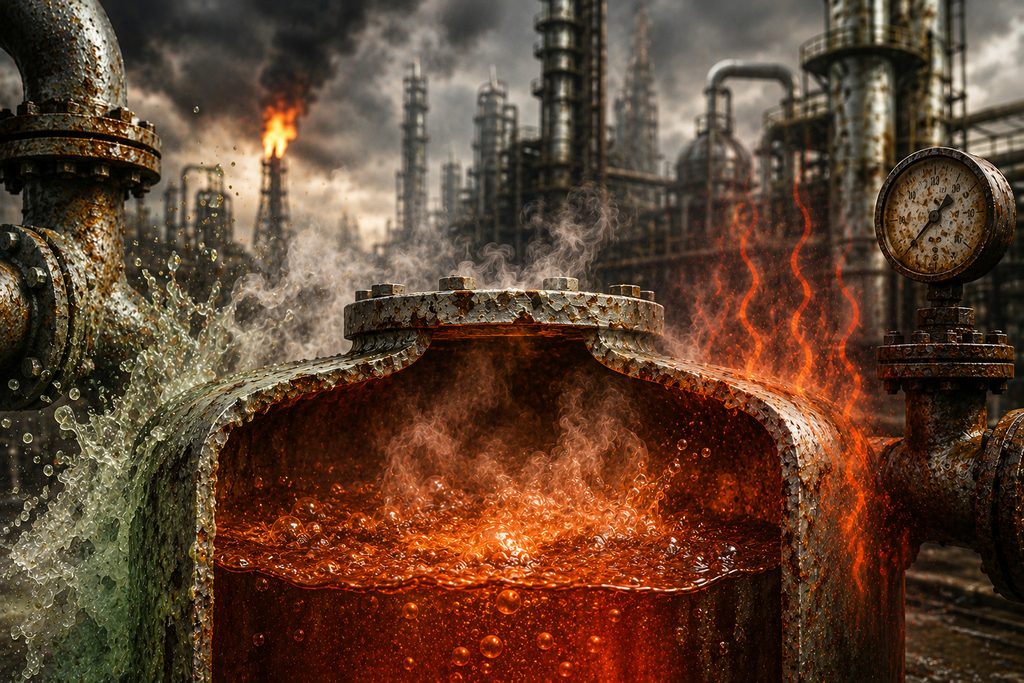
In petrochemical processing, fine chemicals, pesticides, pharmaceuticals, and high-temperature process systems, level switches often operate under conditions far more demanding than those found in ordinary storage tanks. In addition to pressure, corrosion, liquid viscosity, and process fluctuations, high temperature is one of the key factors affecting the long-term reliability of a level switch.
When the process temperature reaches 280°C (536°F), the tuning fork that comes into direct contact with the process medium must withstand not only continuous high temperatures, but also potential corrosion, pressure, mechanical vibration, and thermal stress caused by temperature changes.
For this reason, the reliability of a high-temperature tuning fork level switch cannot be determined solely by the temperature resistance of its electronics. The material of the tuning fork itself is equally important.
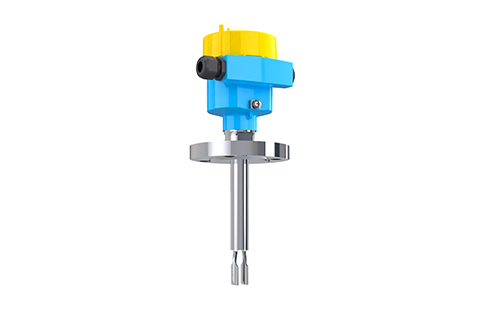
The Ring-11 tuning fork level switch can be used in high-temperature applications with process temperatures up to 280°C. For demanding applications involving both high temperatures and corrosive media, Hastelloy C-22 can be selected as the wetted material.
But why should Hastelloy be considered at temperatures as high as 280°C? What problems can it solve compared with conventional stainless steel?
To answer these questions, it is necessary to first understand how a tuning fork level switch works.
1. Why Is Tuning Fork Material So Important?
A tuning fork level switch is a point-level detection instrument. Its key sensing component is a precisely tuned vibrating fork.
The Ring-11 tuning fork level switch uses piezoelectric elements to excite the fork at a specific resonant frequency. When the fork is in air, it maintains its normal vibration characteristics. Once liquid reaches and covers the fork, the additional mass and damping effect of the liquid cause a measurable change in the fork’s vibration frequency.
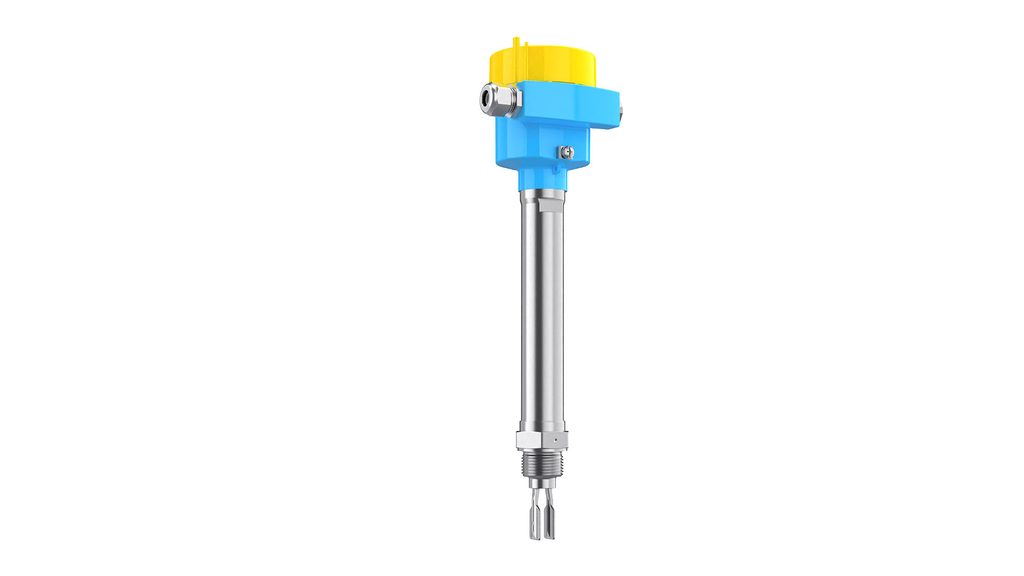
The electronics detect this frequency change and determine whether the fork is covered or uncovered, producing a corresponding switching signal.
In other words:
The tuning fork is both a wetted mechanical component and one of the most important sensing elements in the entire level detection system.
The Ring-11 features a compact fork approximately 40 mm long and operates at a vibration frequency of around 1200 Hz. Its precisely tuned design enables reliable detection of liquids with densities as low as approximately 0.5 g/cm³.
This means the fork is not simply an ordinary piece of metal.
Its material, dimensions, stiffness, surface condition, and long-term mechanical stability can all influence its vibration characteristics.
If the fork suffers severe corrosion, pitting, localized wall loss, or changes in mechanical properties after prolonged exposure to a high-temperature process, its original resonant characteristics may also change.
Therefore, selecting the right fork material for a 280°C high-temperature level switch is fundamentally about maintaining the long-term reliability of the vibration-based sensing system.
2. Why Does a 280°C Process Require Special Attention?
A common misunderstanding in level switch selection is:
If the melting point of a metal is far above 280°C, the material should be suitable for the application.
In industrial instrumentation, material selection is much more complicated.
A material that “will not melt at 280°C” is not necessarily a material that can “operate reliably for years at 280°C in a specific process medium.”
For a tuning fork level switch operating continuously at high temperature, several factors must be considered:
- Changes in mechanical properties at elevated temperatures
- Corrosion caused by the combined effects of heat and aggressive chemicals
- Fatigue associated with continuous mechanical vibration
- Thermal stresses caused by heating and cooling cycles
- Structural reliability under combined temperature and pressure
- Changes in resonant characteristics caused by corrosion of the fork surface
In chemical processing applications, 280°C rarely means “high temperature only.”
The actual operating condition may be:
280°C + corrosive medium + pressure + continuous operation + high-frequency mechanical vibration.
That combination represents the real challenge for the tuning fork material.
Therefore, determining whether a fork material is suitable for a 280°C process requires much more than comparing temperature ratings. Temperature, process medium, concentration, pressure, and mechanical loading must all be evaluated together.
3. Why Isn’t 316L Stainless Steel Always the Best Choice at 280°C?
316L stainless steel is one of the most widely used materials in industrial instrumentation.
It offers a good combination of mechanical properties, manufacturability, and corrosion resistance. For water, oils, and many common industrial liquids, 316L can provide excellent performance.
Therefore, a process temperature of 280°C does not automatically mean that 316L must be replaced with Hastelloy.
The need for a material upgrade becomes more significant when high temperature is combined with a highly corrosive process medium.
This distinction is important.
Saying that “Hastelloy must always be used at 280°C” would be technically inaccurate. Material selection should first consider the chemical properties of the process medium and then evaluate temperature, concentration, pressure, and other operating conditions.
316L stainless steel obtains much of its corrosion resistance from a passive surface film. However, in certain aggressive environments—particularly those involving chlorides, acidic media, or complex chemical mixtures—its resistance to localized corrosion may become insufficient.
Temperature can make the situation even more challenging.
As process temperature increases, many chemical reactions and corrosion mechanisms accelerate. A liquid that is relatively mild toward 316L at room temperature may behave very differently at 200°C or 280°C.
For a tuning fork that remains in contact with the process medium while continuously vibrating, this is particularly important.
4. The Real Challenge at 280°C: High Temperature Combined with Corrosion
For high-temperature tuning fork level switches, the most difficult condition is often not temperature alone but the combination of high temperature and corrosion.
Chemical reactors, evaporators, separators, high-temperature storage vessels, and process pipelines can all create such operating conditions.
As temperature increases, chemical activity may increase and corrosion reactions at the metal surface may accelerate. At the same time, equipment startup, shutdown, and process adjustments can expose the tuning fork to repeated heating and cooling cycles.
As a result, the fork may experience three major types of load simultaneously.
Chemical load
The fork is directly exposed to the process liquid and must resist general corrosion, pitting, crevice corrosion, and other forms of chemical attack.
Thermal load
Heating from ambient temperature to 280°C and subsequent cooling causes thermal expansion and contraction. The material and associated connections must remain reliable over repeated cycles.
Mechanical load
A tuning fork does not remain stationary during operation. Its measurement principle requires continuous mechanical vibration.
Therefore, the fork material used in a high-temperature tuning fork level switch must provide a suitable combination of corrosion resistance, thermal stability, and long-term mechanical reliability.
This is where Hastelloy can provide significant advantages in severe process conditions.
5. Why Choose Hastelloy C-22?
The Ring-11 tuning fork level switch can be supplied with Hastelloy C-22 for the fork and relevant wetted components.
Hastelloy C-22 is a nickel-based corrosion-resistant alloy. Its primary advantage is not simply that it can withstand higher temperatures than stainless steel. More importantly, it offers strong overall corrosion resistance across a wide range of aggressive chemical environments.
This characteristic is particularly valuable for a tuning fork level switch.
The objective is not merely to prevent the fork from being “corroded through.” It is also important to preserve the fork’s geometry, surface condition, and mechanical characteristics over long-term operation.
Improved Reliability in High-Temperature Corrosive Media
Corrosion rates can be strongly influenced by temperature.
For certain acidic, chloride-containing, or chemically complex process media, increasing temperature may reduce the corrosion resistance of conventional stainless steels.
Hastelloy C-22 offers excellent overall resistance to many aggressive environments. When the Ring-11 is installed in a process involving both high temperature and corrosive chemicals, a Hastelloy fork can therefore provide a more robust material solution.
Reduced Risk of Pitting and Crevice Corrosion
Localized corrosion deserves particular attention in industrial applications.
Uniform corrosion is often relatively easy to observe and predict. Pitting, however, may occur within very small areas. A component can appear relatively intact while deep localized corrosion has already developed.
This is especially undesirable for a continuously vibrating tuning fork.
Because the fork is subjected to repeated mechanical vibration, a localized corrosion pit or significant reduction in cross-section may create an area of stress concentration.
For this reason, using Hastelloy in a high-temperature corrosive application is not only about extending the time before material loss becomes severe. It is also about helping preserve the structural integrity of the vibrating fork.
Maintaining Stable Resonance Characteristics
This is one of the most important differences between a tuning fork level switch and a simple metal probe.
A tuning fork level switch determines liquid presence by detecting changes in vibration frequency.
The geometry, mass, stiffness, and material properties of the fork all influence its vibration behavior.
Consider what happens if the fork is gradually corroded over several years.
The precisely machined fork may become thinner. Localized corrosion pits may develop. One tine may experience more material loss than the other.
As a result, mass distribution and mechanical characteristics may change.
Ideally:
After years of operation, the tuning fork should remain as close as possible to its original mechanical condition.
Improving corrosion resistance therefore also helps protect the mechanical reference on which the tuning fork measurement principle depends.
6. Why Not Simply Use a Corrosion-Resistant Coating at 280°C?
In some corrosive applications, protective materials or coatings such as PFA, ECTFE, or other corrosion-resistant solutions may be applied over a stainless-steel substrate.
These approaches can provide significant benefits in appropriate applications.
However, material selection becomes more complicated as process temperature increases.
A coated system is effectively a combination of a substrate and a protective layer.
At elevated temperatures, several questions need to be considered:
What is the coating’s recommended continuous operating temperature?
How well do the thermal expansion characteristics of the coating and substrate match?
Will the coating remain intact after repeated heating and cooling cycles?
Could continuous fork vibration affect coating integrity over long-term operation?
Could the process medium reach the substrate through small defects or damaged areas?
A tuning fork level switch introduces another important factor: the sensing element continuously vibrates.
Therefore, when the process reaches 280°C and also contains highly corrosive media, using a corrosion-resistant alloy as the fork material itself can, where appropriate, reduce dependence on a surface barrier.
This does not mean that Hastelloy is always superior to coated solutions.
The correct engineering approach is always to select materials according to the chemical medium, concentration, process temperature, pressure, and operating conditions.
7. Hastelloy Helps Protect the Precision-Tuned Fork at 280°C
The Ring-11 tuning fork level switch features a compact fork approximately 40 mm long, with a resonant frequency of around 1200 Hz.
Its short-fork design allows installation not only in storage tanks and reactors but also in process piping and other locations where installation space is limited.
However, a compact fork also means that its mechanical structure is specifically engineered and precisely tuned.
From a vibration-system perspective, tuning fork frequency depends on factors such as material elasticity, geometry, stiffness, and mass distribution.
For this reason:
The fork material does more than resist the process medium—it directly participates in the measurement.
This is why a tuning fork should not be regarded as just another metal probe.
If corrosion causes significant material loss, or if localized attack affects the two fork tines differently, the original vibration system can be altered.
Using a more corrosion-resistant material such as Hastelloy C-22 helps minimize changes to the original mechanical condition of the fork when operating in aggressive process environments.
8. Hastelloy Is Not Used Because 280°C Will “Destroy” 316L
This point is important.
When users see a 280°C tuning fork level switch with a Hastelloy fork, they may assume that 316L simply cannot withstand this temperature.
That is not necessarily true.
Material selection depends on the combination of temperature and process chemistry—not temperature alone.
If the process medium is compatible with 316L, the material may remain a practical solution even at elevated process temperatures, provided pressure, mechanical loading, and all relevant design conditions are properly evaluated.
There is no engineering benefit in automatically selecting a more expensive alloy simply because its material grade appears superior.
Conversely, if the process medium is highly corrosive, Hastelloy or another corrosion-resistant solution may be necessary even when the process temperature is considerably below 280°C.
A more technically accurate conclusion is:
When the process temperature reaches 280°C and the medium is highly corrosive—or when conventional stainless steel cannot provide adequate long-term corrosion resistance under the specific temperature, concentration, and pressure conditions—Hastelloy C-22 becomes a particularly valuable option for the tuning fork.
This approach reflects the actual logic of industrial material selection.
9. Which 280°C Applications Are More Suitable for a Hastelloy Tuning Fork?
A high-temperature Hastelloy tuning fork level switch is particularly worth considering when both heat and corrosion are significant concerns.
High-Temperature Chemical Reactors
Chemical reactors may simultaneously involve high temperatures, pressure, and corrosive process media.
Level switches can be used for high-level alarms, low-level alarms, overfill protection, pump protection, or safety interlocks.
In these applications, a level switch failure may affect more than level indication—it can influence the safe operation of the entire process.
Fine Chemical Production
Fine chemical processes often involve complex media, and the same equipment may be exposed to different chemical compositions during different production stages.
The material may therefore need to resist not just one acid or alkaline solution, but a more complicated mixture of chemicals.
Pesticide and Chemical Intermediate Production
Some pesticide raw materials, intermediates, and solvent systems can be highly corrosive, while the process itself may require substantial heating.
When a tuning fork remains exposed to these conditions for long periods, the corrosion resistance of the fork material directly affects instrument service life and maintenance requirements.
High-Temperature Corrosive Process Piping
With a fork length of approximately 40 mm, the Ring-11 is suitable not only for vessels and reactors but also for applications where installation space is limited.
In high-temperature, corrosive process lines, a compact tuning fork combined with a corrosion-resistant alloy can provide both installation flexibility and improved wetted-material reliability.
10. How Should You Select a 280°C High-Temperature Tuning Fork Level Switch?
When selecting a tuning fork level switch for a high-temperature process, simply telling the manufacturer that “the maximum temperature is 280°C” is not enough.
Several important process parameters should be provided.
Process medium
This is one of the most important factors in material selection.
Medium concentration
The same chemical can have very different effects on a material at different concentrations.
Normal operating temperature and maximum temperature
Continuous operation at 280°C is different from a process that reaches 280°C only briefly.
Process pressure
Temperature and pressure should normally be considered together rather than evaluated independently.
Temperature cycling
A process that remains at a stable temperature can place different demands on materials compared with one that frequently heats up and cools down.
Corrosive characteristics and chloride content
These factors can significantly influence whether 316L, Hastelloy, or a coated solution is more appropriate.
Installation location
It is important to determine whether the level switch will be installed in a storage tank, reactor, vessel, or process pipeline. Flow direction, mechanical impact, available installation space, and other process conditions should also be considered.
Only after these conditions are understood can an appropriate decision be made between 316L stainless steel, Hastelloy C-22, or another corrosion-resistant solution.
11. High-Temperature Level Measurement Is About Long-Term Stability, Not Just “Withstanding 280°C”
One of the biggest differences between industrial instrumentation and a short laboratory test is the expected operating life.
A level switch that can survive several hours at 280°C is not necessarily capable of operating reliably for years in an industrial plant.
A dependable high-temperature tuning fork level switch must address the combined effects of:
long-term heat, continuous vibration, prolonged exposure to the process medium, and changing operating conditions.
For this reason, fork material selection should not focus solely on whether the instrument can operate today. It should also minimize the long-term risks associated with corrosion, localized material loss, mechanical degradation, and changes in vibration characteristics.
From this perspective, the role of Hastelloy C-22 becomes much clearer.
Its purpose is not simply to increase the temperature number shown on a specification sheet. Instead, it provides a more reliable material foundation for the critical sensing element when the instrument is used in demanding high-temperature and corrosive environments.
12. Conclusion: Why Use Hastelloy for a Ring-11 Tuning Fork Level Switch at 280°C?
Why should the fork of a Ring-11 tuning fork level switch use Hastelloy C-22 in demanding 280°C applications?
The answer can be summarized in one sentence:
The tuning fork is both a wetted component and a precision vibration sensing element. When 280°C high temperature is combined with corrosive process media, the fork must provide corrosion resistance, mechanical stability, and long-term vibration reliability at the same time.
The primary value of Hastelloy C-22 lies in its strong overall corrosion resistance in demanding chemical environments and its ability to help preserve the structural condition of the tuning fork over long-term operation.
For ordinary process media, 316L stainless steel remains a mature and cost-effective choice. In some applications, corrosion-resistant coatings may also provide an appropriate solution.
However, when the operating environment becomes a combination of high temperature + aggressive corrosion + pressure + continuous operation, material selection should not be based on initial purchase cost alone.
Long-term instrument stability, maintenance requirements, service life, process downtime, and the potential consequences of level switch failure all need to be considered.
Therefore, whether Hastelloy should be selected for a 280°C tuning fork level switch should never be determined by temperature alone. The decision should be based on the complete process conditions, including medium composition, concentration, temperature, pressure, corrosion characteristics, and operating cycle.
For truly demanding high-temperature and corrosive applications, giving the tuning fork itself stronger corrosion resistance is one of the key reasons why Hastelloy C-22 is an important material option for the Ring-11 tuning fork level switch.