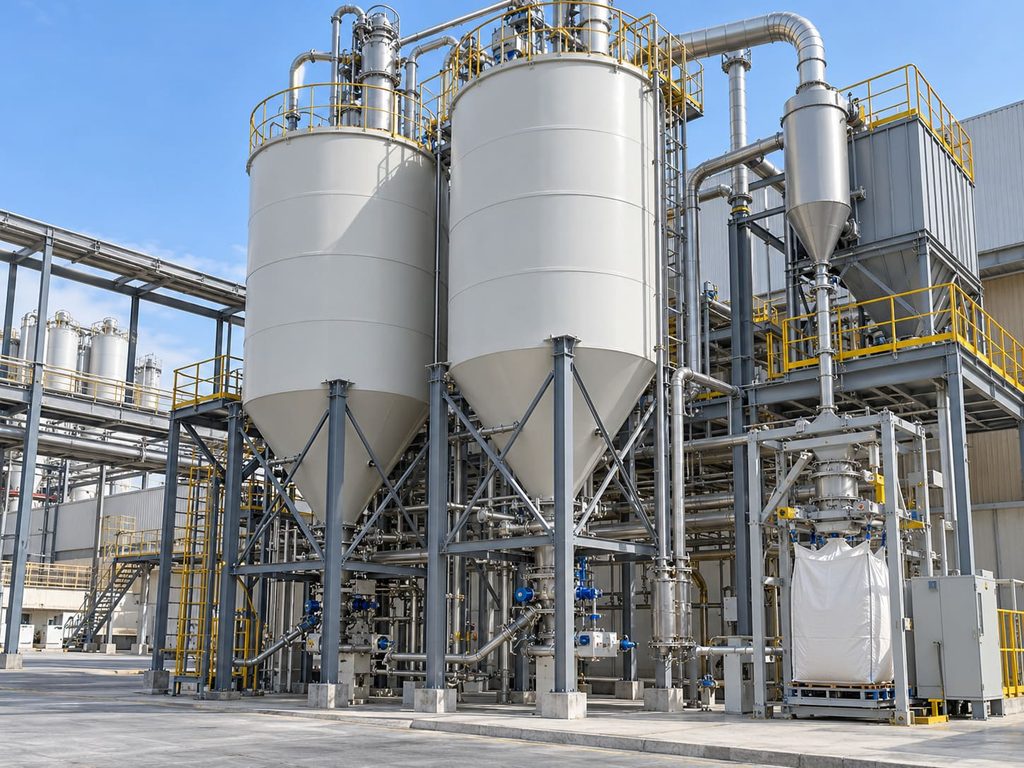
Pigments, fillers, functional additives, carbon materials, silica, polymer powders, and other fine bulk solids are widely used in coatings, plastics, rubber, electronics, battery materials, ceramics, and specialty chemical manufacturing.
These materials are often stored in silos or intermediate hoppers before weighing, dosing, mixing, or packaging.
From a process perspective, the level task may sound simple: know how much powder is in the silo and prevent overfilling or running empty.
From a measurement perspective, fine powders can be difficult.
Pneumatic filling can create dense dust clouds. The material surface can form steep slopes. Lightweight powders may have low bulk density. Product may build up on the wall. Some powders are cohesive and may bridge above the outlet. Others are abrasive or create static electricity.
A reliable measurement strategy therefore needs to distinguish continuous level measurement from point level detection and match each technology to the actual process requirement.
Continuous Level Versus Point Level
Continuous measurement provides a changing level value. It is useful for inventory indication, production planning, replenishment, and process control.
Point level detection only determines whether material has reached a specific position. It is used for high-level alarm, overfill protection, low-level alarm, empty indication, and feeding or conveying interlocks.
Many powder silos benefit from both.
A radar transmitter can provide continuous information from the top of the silo, while a vibrating level switch can provide a dedicated high-level or low-level signal.
Why Dust Is a Challenge
When powder enters a silo through pneumatic conveying, the headspace can temporarily contain a very high concentration of suspended particles.
Optical methods can be blocked by dust. Acoustic measurement can also become more difficult when the sound path is disturbed by dust, air movement, or changing conditions.
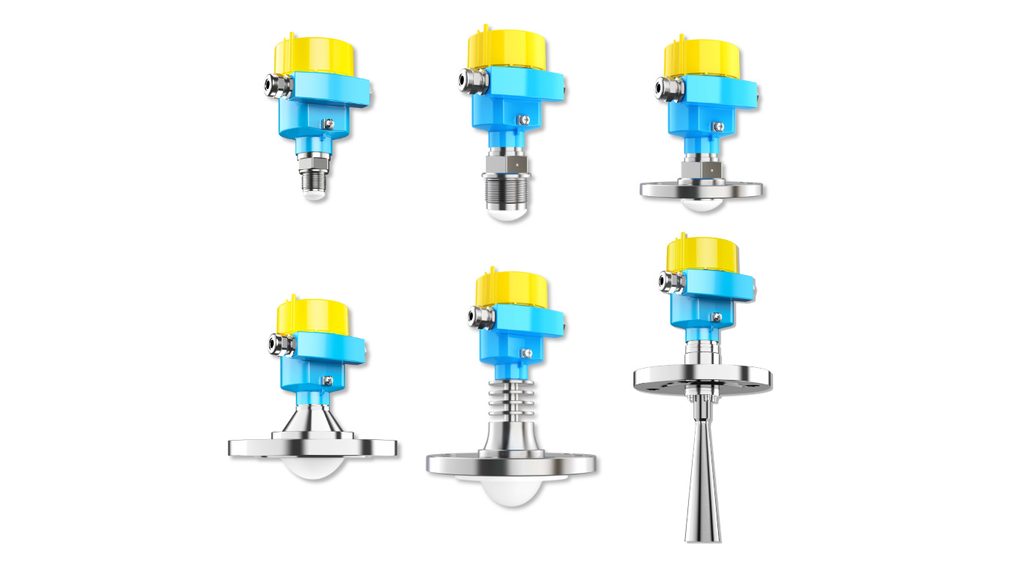
Radar uses electromagnetic waves and can be a strong choice for continuous measurement in dusty bulk-solid applications.
High-frequency radar can also produce a narrow beam, which helps in tall or narrow vessels and makes it easier to avoid support beams, filling pipes, and wall structures.
However, “dust tolerant” does not mean “installation independent.” If the radar is mounted directly in the filling stream or pointed at a metal chute, the resulting echoes can still create measurement problems.
Uneven Material Surfaces
Bulk solids do not usually form a flat surface.
During filling, material may pile into a cone. During discharge, a depression may form over the outlet. If the powder has poor flowability, ratholes or bridges can develop.
A radar level meter measures the distance to the surface within its beam. It does not directly weigh the silo.
This is important for inventory expectations.
If the plant converts level into volume or mass, the calculation may be influenced by the material profile and bulk density. For process indication, the measurement can still be highly useful, but the engineering team should avoid promising mass accuracy that the level measurement alone cannot provide.
Low Bulk Density Materials
Fine pigments, fumed silica, lightweight polymer powders, and some functional additives can have low bulk density.
For point level detection, the sensing technology must be sensitive enough for the material to create a reliable response.
A vibrating rod or solids tuning fork works by detecting the damping effect that material creates on the vibrating element. The minimum detectable density and the material’s flow characteristics should therefore be checked.
Jiwei Tube-11 is designed for many powder and granular point level applications. Jiwei Fork-11 is particularly relevant for fine and low-density powders where higher sensitivity may be required.
The final choice should be based on the actual bulk density and particle behavior, not only on the chemical name.
Pigment Packing Silos
Pigment production provides a useful example.
Finished pigment powder may be pneumatically conveyed into a packing silo. Filling creates heavy dust and air movement. The silo must be monitored so that the packing process receives a continuous supply while overfilling is avoided.
A common architecture is top-mounted radar for continuous level, a side-mounted vibrating level switch for high-level alarm, and a low-level switch near the lower section if the packaging machine requires a minimum material supply.
The high-level switch should be positioned away from the direct impact of the incoming powder stream.
If the silo is small, only point level switches may be needed. If inventory and replenishment are important, continuous radar becomes more valuable.
Where to Install the Radar
The mounting location should be chosen after understanding how the silo fills and empties.
Avoid the filling stream. Powder passing directly through the radar beam can create strong temporary reflections and may also coat the antenna area.
Avoid major metal structures. Reinforcing beams, ladders, chutes, and pipes can create fixed echoes.
Consider the material slope. The radar should observe a representative area of the surface rather than an extreme high point near the filling side or a deep depression above the outlet.
In some silos, a position between the center and wall can provide a more representative measurement. The exact location depends on the silo diameter, outlet position, and filling arrangement.
High-Level Switch Installation
A high-level switch is often mounted from the side of the silo.
The probe should extend far enough into the vessel to sense the material but should not be placed directly in the path of falling powder.
Material impact is especially important for dense or abrasive solids. Even a robust level switch can be damaged if it acts as a mechanical target for the filling stream.
For very fine powders, consider how buildup behaves after the level falls. The probe should be able to return to its free vibration state.
Low-Level Detection
Low-level switches are installed to indicate that the usable material inventory is nearly depleted.
The location should be selected carefully because the actual material profile near the outlet may be irregular.
If ratholing occurs, a switch on the wall may still be covered while the center has emptied, or it may become uncovered while material remains elsewhere.
The process team should place the switch based on the condition that matters operationally: minimum feed availability, protection of a screw feeder, packaging continuity, or another specific requirement.
Continuous Radar for New-Material Powders
Many new-material plants handle powders that are difficult to measure because they are lightweight, fine, dusty, or weakly reflective.
Examples include polymer powders, silica-based materials, carbon additives, ceramic powders, and certain precursor materials.
A high-frequency radar with good signal focusing can be useful for these applications, especially when the silo is tall or contains internal structures.
Jiwei JWrada models designed for bulk solids can be considered when the measuring range, temperature, pressure, antenna arrangement, and hazardous-area requirements match the application.
For low-reflectivity materials, actual application data and commissioning conditions should be reviewed.
Hazardous Dust
Some powders create combustible dust hazards.
In these applications, the level instrument must be selected according to the site’s dust hazardous-area classification and applicable project requirements.
The complete installation matters: instrument certification, enclosure, cable entry, grounding, wiring, and mechanical installation must all match the site design.
Do not present explosion protection as a generic product feature without checking the exact configuration and certificate.
Commissioning Under Real Filling Conditions
A powder radar should be observed during actual filling, not only when the silo is static.
During commissioning, record the empty or low-level echo profile, identify fixed echoes from the silo structure, verify the target surface echo at a known level, observe the signal during pneumatic filling, confirm behavior during discharge, and review the measurement near high and low operating levels.
If the value becomes unstable during filling, first inspect the echo profile and mounting geometry. Increasing damping may hide the symptom without solving the cause.
Maintenance Considerations
Non-contact radar has no moving measuring parts inside the silo, but the antenna area should still be inspected during planned shutdowns.
For vibrating switches, check for hardened buildup, mechanical bending, or abrasion.
The maintenance interval should reflect the actual powder. A free-flowing plastic granule may require very little attention, while a sticky fine powder may require periodic inspection.
Conclusion
Pigment and additive powder silos combine several difficult measurement conditions: heavy dust, uneven surfaces, low bulk density, buildup, pneumatic filling, and sometimes hazardous dust.
Continuous radar and point level switches solve different parts of the problem.
Radar provides ongoing level information for inventory and process control. Vibrating rod or tuning fork switches provide clear high- and low-level signals for alarms and interlocks.
The most reliable system begins with a realistic understanding of how the powder behaves during filling and discharge. Sensor technology, mounting position, sensitivity, and protective functions should then be selected around that behavior.
FAQ
Can radar measure through heavy powder dust?
Radar is widely used in dusty bulk-solid applications, but the installation still matters. The sensor should avoid direct filling streams and strong reflections from internal structures.
What is the best point level switch for low-density powder?
A sensitive solids tuning fork can be suitable for many low-density powders. The actual minimum bulk density and buildup behavior should be checked against the instrument specification.
Can level be converted directly into powder weight?
It can be estimated if vessel geometry and bulk density are known, but bulk-solid surfaces and density can vary. A level transmitter is not the same as a weighing system.
Why use both radar and a high-level switch?
Radar provides continuous level information, while the point level switch can provide a dedicated high-level signal for alarm or interlock logic.