As the petroleum storage and transportation industry in the Middle East continues to adopt digital and intelligent technologies, accurate oil tanker truck level monitoring has become increasingly important for transportation safety, inventory management, and fleet scheduling.
Traditional tanker trucks often rely on manual gauging, mechanical float devices, or pressure-based instruments to measure liquid levels. However, these methods may be affected by mechanical wear, changes in product density, vehicle vibration, and human error. As a result, they may not fully meet the requirements of modern petroleum logistics companies for real-time monitoring, remote management, and efficient fleet-wide maintenance.
To improve its tanker fleet monitoring capabilities, a petroleum logistics operator in the United Arab Emirates launched a digital upgrade project for its oil transportation vehicles. Following technical evaluation and field testing, Jiwei JWrada® 80GHz radar level transmitters were selected to provide reliable, non-contact level measurement for the fleet.
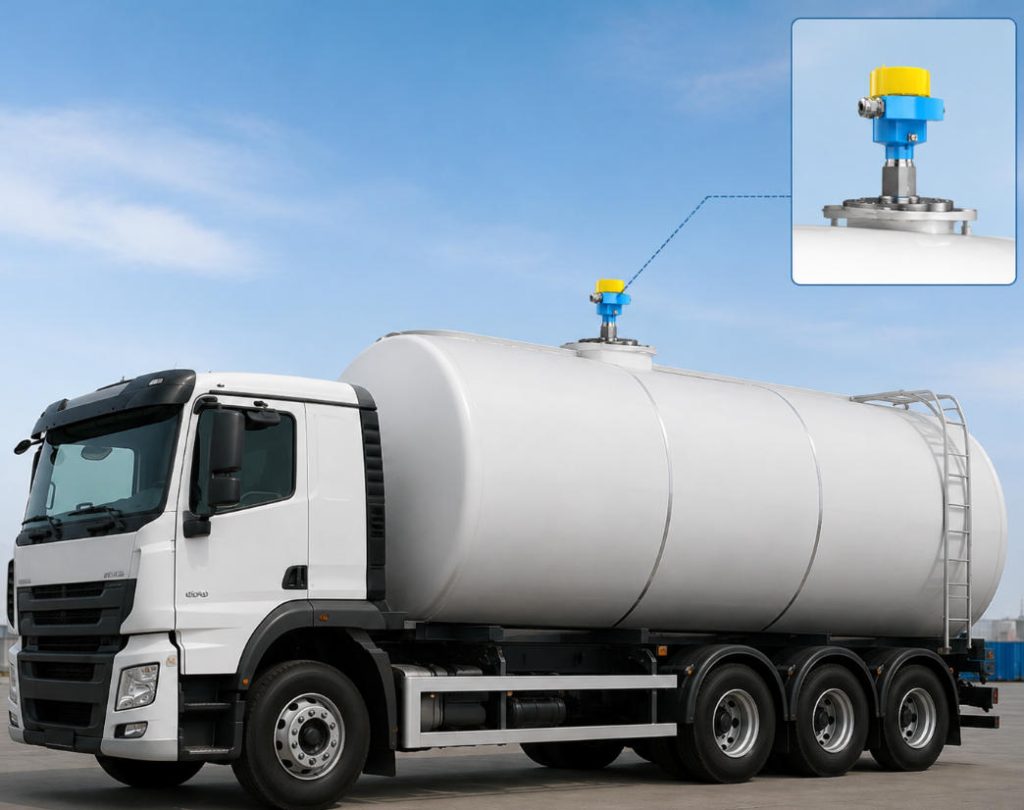
Challenges of Level Measurement on Oil Tanker Trucks
The fleet transports a range of petroleum products, including crude oil, diesel, gasoline, aviation fuel, and lubricating oil. Because these products can be flammable and volatile, and because the tanks remain in motion during transportation, the level instruments must operate reliably under demanding conditions.
1. Vehicle Vibration and Liquid Sloshing
Oil tanker trucks experience continuous vibration and sudden shocks during acceleration, braking, high-speed travel, and operation on uneven roads. At the same time, the liquid surface inside the tank moves and fluctuates, which can affect the signal stability of conventional level instruments.
2. High Temperatures and Harsh Outdoor Conditions
Summer temperatures in the UAE can be extremely high. Instruments installed on top of tanker trucks are also exposed to intense sunlight, dust, sand, and significant temperature variations between day and night.
For this reason, tanker truck level transmitters must provide strong environmental resistance and stable long-term performance.
3. Frequent Changes Between Petroleum Products
Different petroleum products have different densities and physical properties. Instruments that depend on liquid density may require recalibration or compensation whenever the transported product changes, increasing the maintenance workload for fleet operators.
4. Large-Scale Installation and Commissioning
Large tanker fleets may require dozens or even hundreds of level transmitters. Configuring each device individually by opening the enclosure, connecting cables, and manually entering parameters can be time-consuming and may lead to inconsistent settings.
5. Digital Fleet Management Requirements
The customer wanted to integrate tanker level data into a vehicle management or industrial control platform. Real-time level information would allow the operator to monitor loading, transportation, and unloading processes while supporting inventory reconciliation, fleet scheduling, and abnormal-condition management.
Why Use an 80GHz Radar Level Transmitter?
To address the challenges of level measurement in mobile oil tanks, the project adopted Jiwei JWrada® 80GHz high-frequency radar level transmitters.
The instrument emits millimeter-wave radar signals toward the liquid surface and receives the reflected echoes. It calculates the distance between the antenna and the liquid surface, then converts this distance into an accurate level measurement.
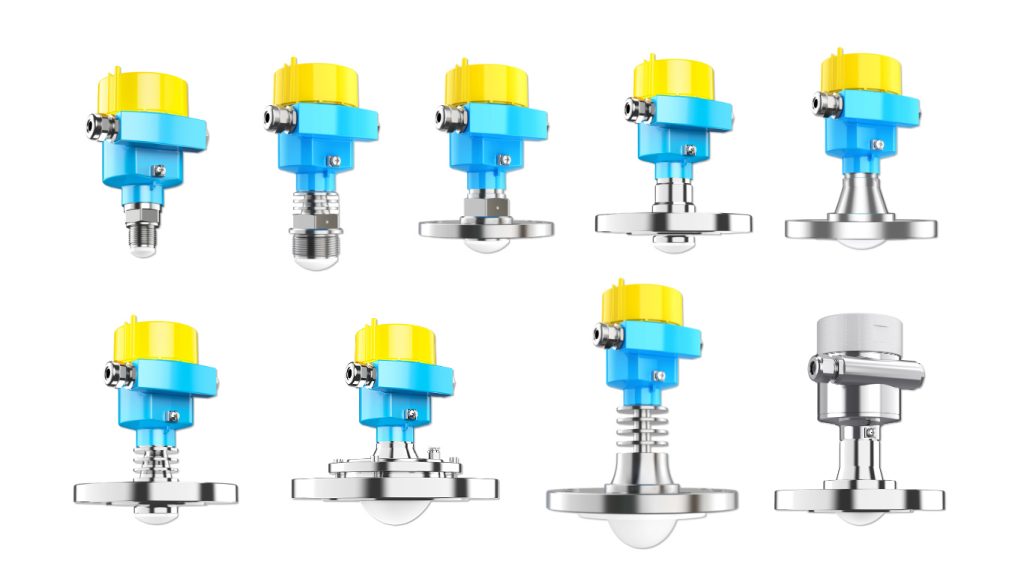
Narrow Beam Angle for Long and Confined Tanks
An 80GHz FMCW radar level transmitter provides concentrated signal energy, a narrow beam angle, and strong echo resolution.
The JWrada® radar level transmitter offers a beam angle of approximately 3°. This narrow beam helps reduce interference from tank walls, internal structures, and installation components, making the instrument suitable for the long and confined geometry of oil tanker truck compartments.
Non-Contact Measurement Reduces Maintenance
The radar level transmitter is mounted on top of the tank, and its antenna does not need to come into direct contact with the petroleum product.
Compared with mechanical floats, guide rods, and other contact-based measurement technologies, non-contact radar measurement reduces maintenance problems caused by mechanical wear, product buildup, contamination, and corrosion.
For products such as gasoline, diesel, crude oil, and aviation fuel, the non-contact design also helps reduce maintenance frequency and improve long-term instrument reliability.
Measurement Is Independent of Liquid Density
Radar level measurement calculates distance based on the travel time of electromagnetic waves. Its measuring principle is not dependent on liquid density.
When an oil tanker truck switches from one petroleum product to another, the radar transmitter generally does not require the density compensation commonly associated with pressure-based level measurement.
This feature reduces parameter adjustment requirements and makes the instrument more suitable for multi-product transportation fleets.
Intelligent Signal Processing Filters Liquid Movement
During transportation, the liquid surface inside the tank may move continuously. Jiwei JWrada® radar level transmitters use advanced echo recognition and signal-processing algorithms to analyze vibration noise, false echoes, and liquid surface fluctuations.
These functions help the instrument identify the true liquid surface signal and maintain stable level output under mobile operating conditions.
Bluetooth Commissioning Improves Installation Efficiency
Traditional industrial instrument commissioning often requires technicians to open the enclosure, connect a handheld communicator, or use a computer to configure parameters.
For fleet-wide tanker truck projects, this process can be complicated and time-consuming.
JWrada® radar level transmitters feature integrated Bluetooth communication. Using the Jiwei Smart Control application or JW Tools, technicians can configure the instrument from a smartphone.
Available functions include:
- Setting the measuring range;
- Configuring empty-tank and full-tank distances;
- Viewing radar echo curves;
- Adjusting alarm and output parameters;
- Performing fault diagnosis;
- Backing up and restoring instrument settings.
Wireless commissioning reduces the need to open the instrument enclosure or connect physical cables. It also allows technicians to complete configuration more conveniently when working on top of a tanker truck or when the tank already contains petroleum products.
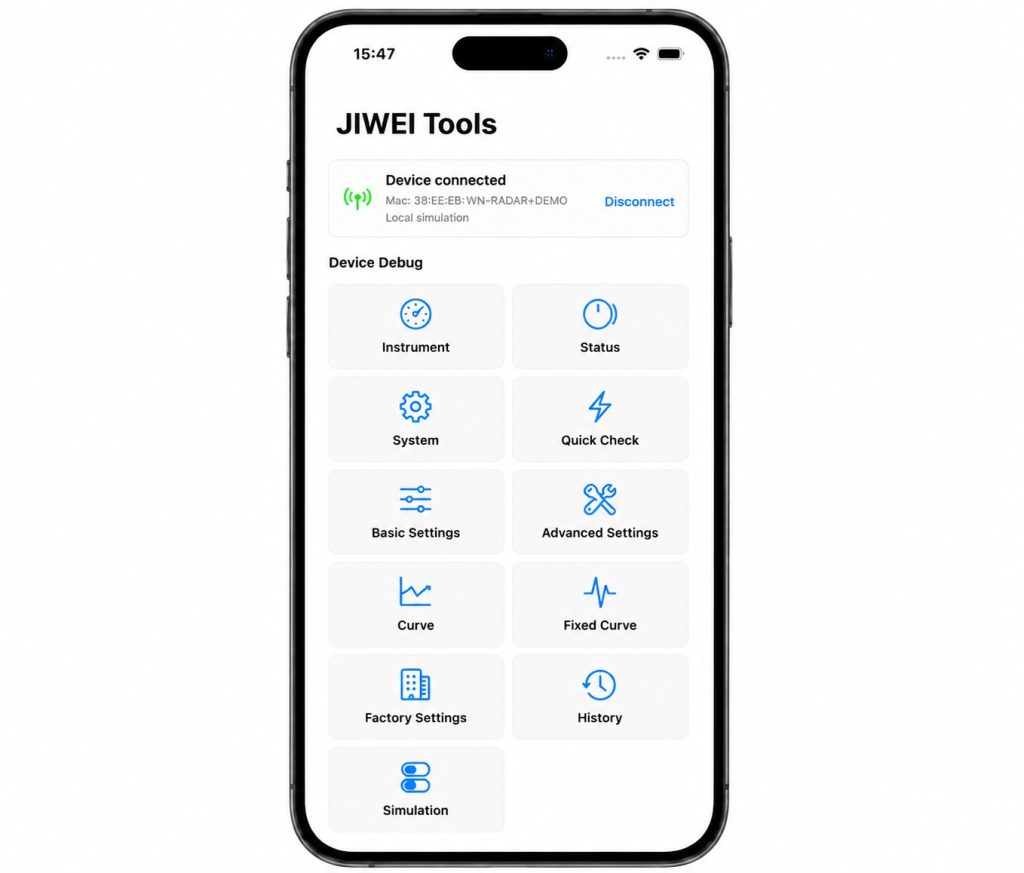
Batch Parameter Copying Simplifies Fleet Deployment
Many tanker trucks in this project use similar tank dimensions and installation structures.
After completing the range, echo, output, and communication settings for the first radar level transmitter, technicians can save the configuration through the Bluetooth tool and copy it to other transmitters of the same model.
Batch parameter copying provides three key benefits:
- It shortens the commissioning time for multi-vehicle projects.
- It reduces configuration errors caused by repeated manual data entry.
- It ensures consistent instrument settings and measurement standards across similar vehicles.
For large oil tanker fleets, this standardized deployment method reduces field engineering work and simplifies future maintenance and fleet expansion.
Project Results
After the JWrada® radar level transmitters were put into operation, they provided continuous and stable level data for the customer’s petroleum transportation management system.
Real-Time Tank Level Visibility
Drivers and fleet managers can use level data to monitor changes in the amount of petroleum product inside each tank, improving visibility during loading, transportation, and unloading.
Improved Petroleum Inventory Management
Level measurements can support transportation analysis, product quantity verification, vehicle scheduling, and inventory management. This reduces reliance on manual records and manual tank gauging.
Lower Instrument Maintenance Costs
Non-contact radar measurement does not require moving components such as floats, chains, or mechanical linkages. This helps reduce failures and maintenance requirements associated with mechanical wear.
Enhanced Transportation Safety
Continuous level monitoring helps operators identify abnormal level changes and provides useful data for preventing overfilling, product overflow, and unexpected product loss during transportation.
Integration with Fleet Management Systems
Depending on the selected output and communication interface, the radar level transmitter can be connected to a PLC, SCADA system, vehicle-mounted terminal, or industrial IoT platform.
This provides the essential measurement data required for remote tanker truck monitoring and digital fleet management.
How to Select a Radar Level Transmitter for an Oil Tanker Truck
When selecting a radar level transmitter for an oil transportation vehicle, the following factors should be evaluated:
- Tank height, diameter, and internal structure;
- Instrument mounting position and process connection;
- Type and dielectric properties of the transported product;
- Degree of vehicle vibration and liquid surface movement;
- Ambient temperature and outdoor protection requirements;
- Output signal and communication protocol;
- Hazardous-area and explosion-protection requirements;
- Bluetooth commissioning and batch configuration requirements.
Correct instrument selection and mounting position help minimize interference from tank walls, reinforcing structures, filling pipes, and other internal components. They also improve radar echo quality and measurement stability.
Conclusion
As petroleum logistics operations become increasingly digital, oil tanker truck level measurement is gradually moving away from manual and mechanical methods toward intelligent, non-contact measurement technologies.
The Jiwei JWrada® 80GHz radar level transmitter offers a narrow beam angle, non-contact measurement, intelligent vibration-resistant signal processing, Bluetooth commissioning, and batch parameter copying.
These features provide an efficient level monitoring solution for oil tanker trucks operating in the UAE and help petroleum logistics companies improve data visibility, maintenance efficiency, and transportation safety.
This project also demonstrates that 80GHz radar level transmitters are suitable not only for stationary storage tanks but also for mobile petroleum transportation equipment such as tanker trucks.
Frequently Asked Questions
Can a radar level transmitter be installed on an oil tanker truck?
Yes. Radar level transmitters use non-contact measurement and can be applied to crude oil, diesel, gasoline, aviation fuel, lubricating oil, and other petroleum products.
For mobile applications, an industrial radar transmitter with strong vibration resistance and advanced echo-processing capabilities should be selected.
Is an 80GHz radar level transmitter suitable for a long and narrow tank?
Yes. An 80GHz radar level transmitter typically has a narrow beam angle, which helps reduce interference from tank walls and internal structures.
This makes it suitable for long, narrow, or structurally complex tanker compartments.
Is recalibration required when the transported petroleum product changes?
Radar level measurement is not dependent on liquid density. Therefore, density compensation is generally not required when switching between different petroleum products.
However, the instrument settings should still be checked according to the dielectric properties of the product, tank geometry, and field echo conditions.
What are the advantages of Bluetooth commissioning?
Bluetooth commissioning allows technicians to configure parameters, view echo curves, and diagnose faults using a smartphone.
It reduces the need to open the instrument enclosure, connect cables, or carry a separate handheld communicator, making it particularly useful for large tanker truck installation projects.
Can the radar level transmitter be connected to a fleet monitoring platform?
Yes. Depending on its output and communication options, the radar level transmitter can be connected to a PLC, SCADA system, vehicle-mounted terminal, or IoT platform.
This enables remote data collection, level visualization, and abnormal-condition monitoring.