
Magnetic Level Indicator for Syrup Tanks selection requires matching the instrument to the vessel, liquid, and operating conditions. Learn how magnetic level indicators are used in food processing and syrup storage tanks, including viscosity limitations, sanitary requirements, and maintenance.
1. Magnetic Level Indicator for Syrup Tanks: Application Overview
Food processing facilities use storage tanks, preparation vessels, mixing equipment, and cleaning systems throughout production.
Liquid level monitoring is important for managing raw materials, maintaining continuous processing, and preventing tank overflow.
In syrup production, for example, accurate level information helps operators manage storage and transfer operations.
Low liquid levels may cause transfer pumps to lose suction, while excessive levels can result in spills or interfere with preparation processes.
Magnetic level indicators can be considered for suitable food processing applications because they provide direct local indication and optional remote monitoring.
However, food-contact applications require special attention to hygienic design and cleanability.

2. Challenges of Syrup Level Measurement
Syrup differs from water in several important ways.
High Viscosity
Syrup viscosity can increase significantly as temperature decreases or concentration increases.
Highly viscous liquids may restrict float movement inside a magnetic level indicator chamber.
This can cause delayed or inaccurate level indications.
Crystallization
Some sugar solutions may crystallize under certain temperature and concentration conditions.
Crystals can accumulate inside the measuring chamber and interfere with float movement.
Material Buildup
Sticky liquids may adhere to internal surfaces.
Over time, accumulated deposits can affect the performance of the instrument and increase cleaning requirements.
Therefore, syrup level measurement requires careful evaluation of viscosity, temperature, concentration, and cleaning procedures.
3. Typical Food Processing Applications
Low-Viscosity Syrup Storage Tanks
For syrup that remains sufficiently fluid and does not crystallize easily, a magnetic level indicator may provide suitable local level monitoring.
A remote transmitter can be added when centralized monitoring is required.
Auxiliary Liquid Storage Tanks
Food processing facilities also use tanks for process water, cleaning solutions, and auxiliary liquids.
Magnetic level indicators may be suitable for these applications when material compatibility and hygiene requirements are satisfied.
Concentrated Syrup Tanks
Highly concentrated syrup may become viscous or crystallize at lower temperatures.
These applications require additional evaluation of float movement and chamber blockage risks.
If the liquid exceeds the instrument’s viscosity limits, another measurement technology may be preferable.
For application context, review JIWEI’s food and beverage applications alongside the instrument specifications.
4. Selecting a Magnetic Level Indicator for Food Applications
Instrument selection should consider both measurement performance and hygiene.
Important parameters include liquid density, viscosity, temperature, measuring range, and the possibility of crystallization.
For food-contact applications, the wetted materials and mechanical design must meet the applicable food safety requirements.
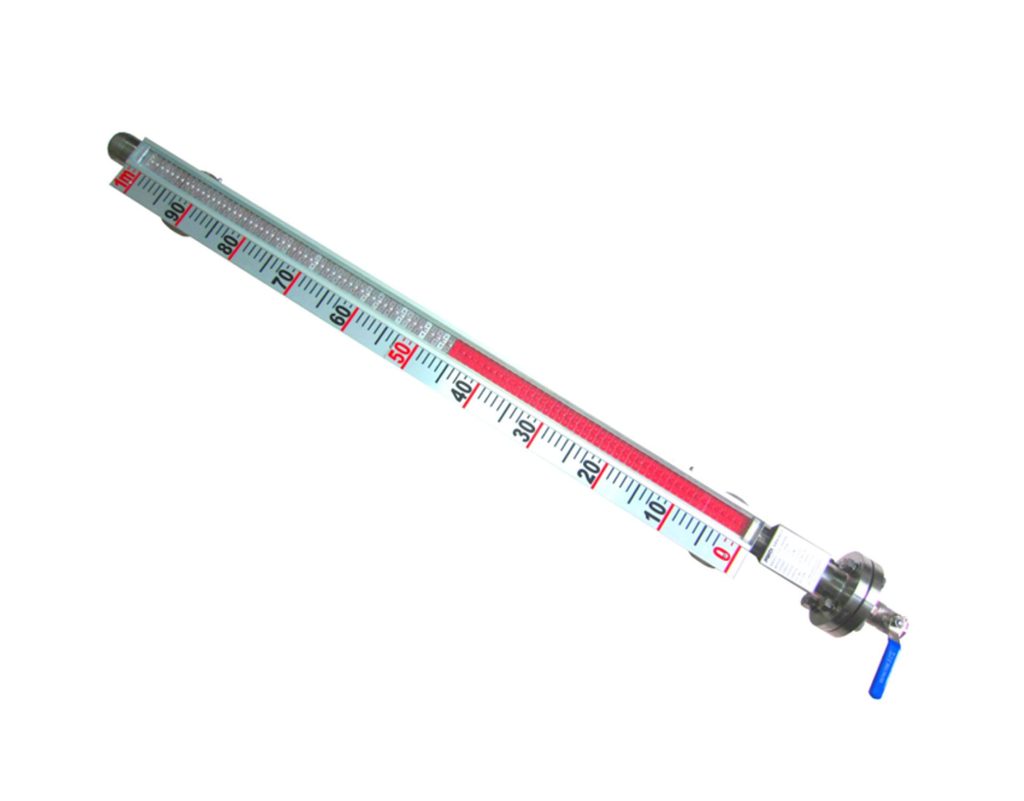
The Flap-11A magnetic level indicator can be evaluated for certain industrial liquid applications, but standard industrial construction should not automatically be considered sanitary.
For highly viscous syrup, the instrument should be evaluated under the most demanding expected operating conditions.
5. Sanitary Design and Cleaning Requirements
Food processing equipment must be cleaned effectively to reduce product residue and contamination risks.
A conventional magnetic level indicator includes a measuring chamber, float, and process connections that may create areas where liquid can remain.
For direct food-contact applications, cleanability must be evaluated carefully.
If the system uses CIP cleaning, the instrument must be suitable for the cleaning chemicals, temperatures, and flow conditions.
High-temperature cleaning may also affect seals, floats, and indicator components.
Stainless steel construction alone does not guarantee compliance with hygienic design requirements.
6. Remote Monitoring and Automation
Modern food production lines frequently use PLC systems for process control.
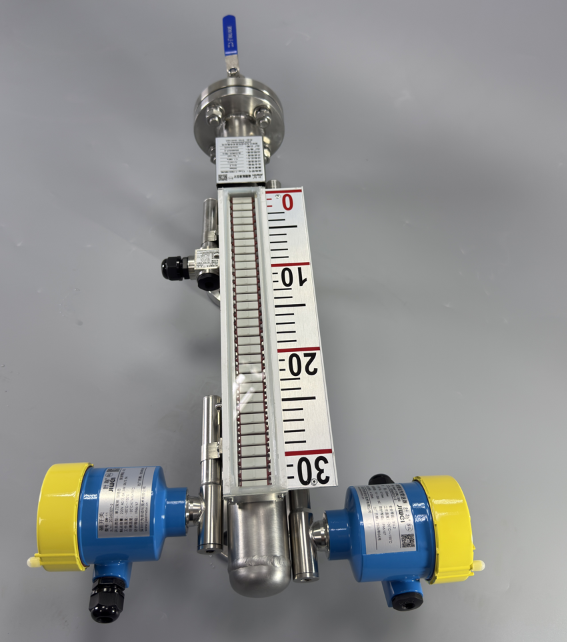
Magnetic level indicators equipped with remote transmitters can provide continuous level information.
Level switches may also be used for high- and low-level alarms.
However, magnetic level indicators may not provide the accuracy required for precision batching or custody-transfer measurement.
Where accurate ingredient dosing is critical, an appropriate weighing or precision measurement system may be more suitable.
7. Maintenance and Troubleshooting
Maintenance should focus on deposits, crystallization, cleaning effectiveness, and float movement.
Operators should verify that the flap display changes correctly with the actual liquid level.
If the indication becomes unresponsive, possible causes include a stuck float or blocked process connection.
Cleaning procedures should be documented where required by the food safety management system.
For frequently crystallizing products, the instrument’s suitability should be reassessed if repeated blockage occurs.
8. Frequently Asked Questions
Can a magnetic level indicator measure syrup?
Yes, if the syrup’s viscosity, density, temperature, and crystallization behavior are compatible with the instrument.
Are sanitary magnetic level indicators required for food tanks?
Direct food-contact applications must meet applicable food safety and hygienic design requirements.
What happens if syrup crystallizes inside the measuring chamber?
Crystallization may restrict float movement and cause inaccurate or unchanged level readings.
9. Conclusion
Food processing applications require level measurement solutions that balance operational performance with hygiene.
Magnetic level indicators can provide practical local monitoring for suitable low-viscosity liquids and auxiliary storage tanks.
For concentrated syrup and other sticky liquids, careful evaluation of viscosity, crystallization, and cleaning requirements is essential.