Physical blowing agents used in XPS board production can vary depending on equipment configuration and product requirements.
Possible media include CO₂, ethanol, DME, HFO/HFC compounds, butane, pentane, or LPG, which are introduced into the extrusion process through dedicated metering and injection systems.
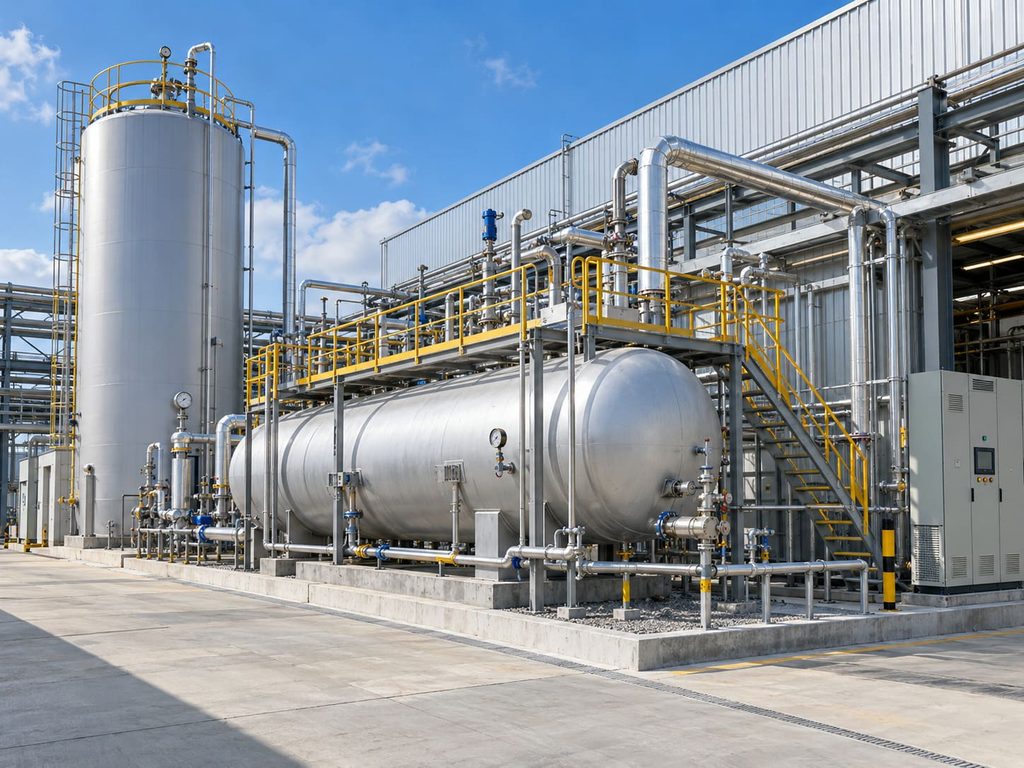
For production lines using butane, LPG, or other flammable liquefied hydrocarbons, storage tank level is not only an inventory measurement.
It is also related to continuous blowing agent supply, overfill prevention, and hazardous-area safety management.
Unlike a normal atmospheric water tank, a blowing agent tank may be sealed, pressurized, and filled with a volatile vapor phase.
Instrument selection must therefore consider more than measuring range and accuracy.
Medium properties, design pressure, operating temperature, hazardous-area classification, process connection, and safety interlock requirements must all be evaluated.
Pressure, Vapor Space, and Safety Requirements Exist at the Same Time
A liquefied hydrocarbon tank normally contains a vapor space above the liquid.
As temperature and pressure change, the physical condition of the medium may also vary.
Horizontal tanks introduce another challenge.
The relationship between liquid height and actual volume is nonlinear.
The same change in liquid level can represent different volume changes depending on where the liquid surface is located within the tank.
If the control system simply assumes that 50% level means 50% remaining volume, inventory calculations may be inaccurate unless the tank geometry is properly converted.
Traditional float-based instruments contain mechanical moving parts.
Differential pressure measurement requires proper consideration of liquid density and impulse line configuration.
For applications seeking non-contact measurement with remote continuous monitoring, radar level measurement can be an effective option.
Using JWrada® 80 GHz Radar for Non-Contact Level Measurement
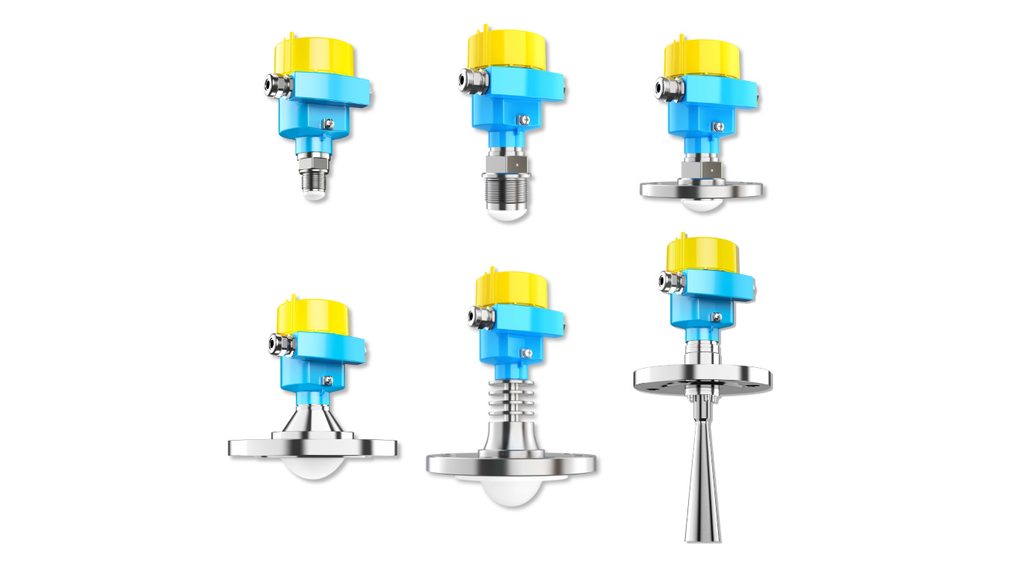
JWrada® radar level meters use 80 GHz FMCW technology.
The antenna transmits electromagnetic waves toward the liquid surface and receives the reflected signal.
The instrument calculates the distance between the antenna and the liquid surface and converts it into a level value.
Because the method is non-contact, the antenna does not need to move mechanically with the liquid surface and does not rely on hydrostatic pressure for level calculation.
Depending on the application, radar level meters can be supplied in hazardous-area versions and can transmit continuous data to a PLC or DCS through 4–20 mA/HART or RS485/Modbus.
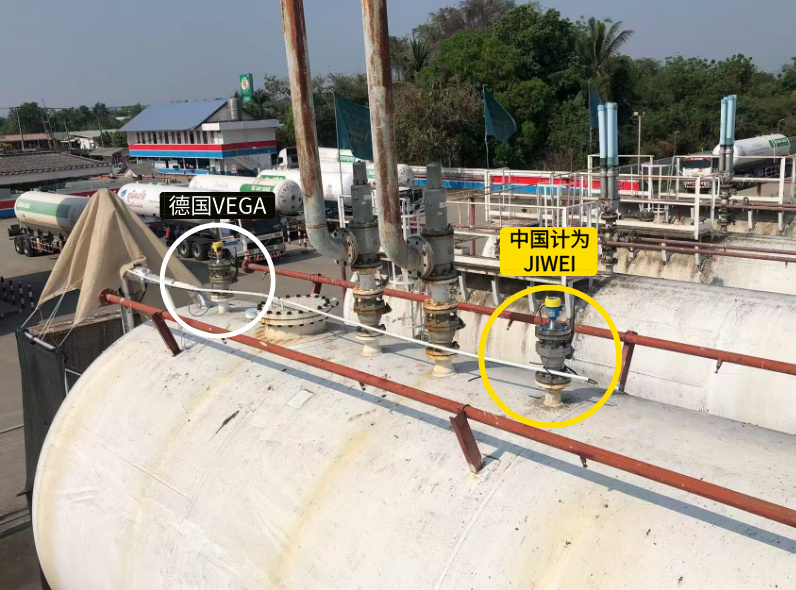
JWrada® products have been applied to horizontal LPG storage tanks where short measuring ranges, vapor space, and complex internal reflections need to be considered.
For an XPS plant, the continuous level signal can be used to display remaining blowing agent inventory, create low-level replenishment reminders, and support storage management.
However, whether a particular radar model is suitable for a specific blowing agent must still be confirmed according to medium properties, tank pressure, operating temperature, material compatibility, and hazardous-area classification.
A Short Measuring Range in a Horizontal Tank Does Not Mean the Application Is Simple
Many liquefied hydrocarbon storage tanks use a horizontal cylindrical design.
Compared with a vertical vessel, the curved top of a horizontal tank may create more complex radar reflections.
Internal piping, supports, or other structural components can create additional false echoes.
The radar mounting nozzle should be positioned where the antenna has a clear view of a stable liquid surface.
The filling inlet, major internal structures, and strong reflecting surfaces should be avoided wherever possible.
The diameter and length of the mounting nozzle must also meet the instrument requirements.
A nozzle that is too narrow or too long can create additional reflections, which may become especially significant in a short-range tank.
During commissioning, echo conditions should be checked at several liquid levels.
Fixed false echoes should be identified and the instrument parameters adjusted according to the actual tank geometry.
Tank Inventory Should Not Be Calculated From Level Percentage Alone
If the radar indicates a liquid height of 50%, this does not automatically mean that every horizontal cylindrical tank contains exactly 50% of its usable volume.
For accurate inventory management, the relationship between liquid height and vessel volume should be calculated according to tank diameter, cylindrical length, and head geometry.
The radar level meter provides the liquid height.
The PLC, DCS, or supervisory system can then convert this value into actual volume using a tank strapping table or geometric calculation.
This allows the measurement data to support replenishment planning, inventory management, and consumption analysis more accurately.
Continuous Radar Should Not Be the Only Overfill Protection Layer
Blowing agent storage tanks can involve significant process safety requirements.
A continuous radar level meter can provide process monitoring, but critical high-high level protection should be designed according to applicable project safety requirements, standards, and HAZOP analysis.
The fact that one radar can generate several software alarm points does not automatically mean that independent protection layers can be removed.
For example, a normal high-level alarm may be used to request the end of filling, while an independent high-high level device may initiate an emergency shutdown or isolation action.
Low and low-low level signals can be used for replenishment alarms, pump protection, or blowing agent supply interlocks.
The required safety integrity and interlock architecture should be determined jointly by the process, instrumentation, electrical, and safety engineering teams.
Explosion Protection Is More Than a Mark on the Instrument Housing
Butane, LPG, and similar media are flammable.
In addition to confirming the hazardous-area certification of the instrument itself, the installation area, electrical cable entries, wiring, grounding, and process connections must also comply with project requirements.
Maximum process pressure and temperature should be verified during instrument selection.
A radar level meter should never be selected for a blowing agent tank simply because it is capable of measuring liquids.
For a pressurized vessel, the process connection, sealing arrangement, and mechanical design are also important parts of instrument selection.
Storage Tank Level and Blowing Agent Flow Are Two Different Measurements
A radar level meter indicates how much blowing agent remains in the storage tank.
It does not replace pressure, temperature, or mass flow measurement in the blowing agent injection system.
Stable injection flow is critical to the XPS foaming process.
For media such as CO₂, the physical state can change significantly with pressure and temperature.
Tank level is therefore only one measurement point within the complete blowing agent control system.
A more complete architecture measures tank level, tank pressure, temperature, conveying equipment status, mass flow, and extruder operating signals independently.
The PLC or DCS can then use these signals to create a comprehensive control and alarm strategy.
When inventory is low, tank pressure is abnormal, or injection flow deviates from the target, operators can identify the actual source of the problem rather than assuming that every abnormal condition is caused by an incorrect level reading.
Application Value
Reliable blowing agent level data helps XPS manufacturers plan replenishment in advance and reduce the risk of production interruption caused by an unexpected shortage.
It can also reduce the need for personnel to enter hazardous areas simply to confirm the remaining tank inventory.
For plants where one storage system supplies several XPS production lines, continuous level trends can also be compared with board output to identify abnormal blowing agent consumption.
However, safety must always remain the first priority in this type of application.
Only when the instrument is correctly selected, properly installed, and integrated into a complete safety and interlock system can radar level measurement provide its full operational value.
Frequently Asked Questions
Can the same radar level meter be used for every XPS blowing agent?
No. Different media may have very different dielectric properties, pressures, temperatures, and hazardous-area requirements. Each application should be checked individually.
Can a radar level meter replace a mass flow meter?
No. A radar level meter measures storage tank level and inventory. A mass flow meter measures the blowing agent injection rate. They perform different functions.
Is one continuous radar level meter enough for an LPG or butane tank?
The requirement for independent high-high level protection should be determined by the project safety design and applicable standards. For critical overfill protection, relying on only one continuous measuring signal is generally not recommended.