No-Bake sand casting, also known as resin sand casting or air-set sand casting, is widely used for producing medium and large castings with complex geometries and high dimensional requirements.
It is commonly applied in the production of machine tool castings, pump and valve components, mining machinery, construction equipment, energy equipment, marine castings, and other heavy industrial components.
Compared with many traditional molding processes, No-Bake casting offers excellent flexibility, good mold strength, and the ability to manufacture large castings without baking the mold.
However, as foundries move toward higher productivity, better casting quality, lower labor dependence, and stricter environmental standards, traditional manually operated No-Bake production systems are becoming increasingly difficult to manage.
This is why more foundries are investing in automatic No-Bake sand molding lines.
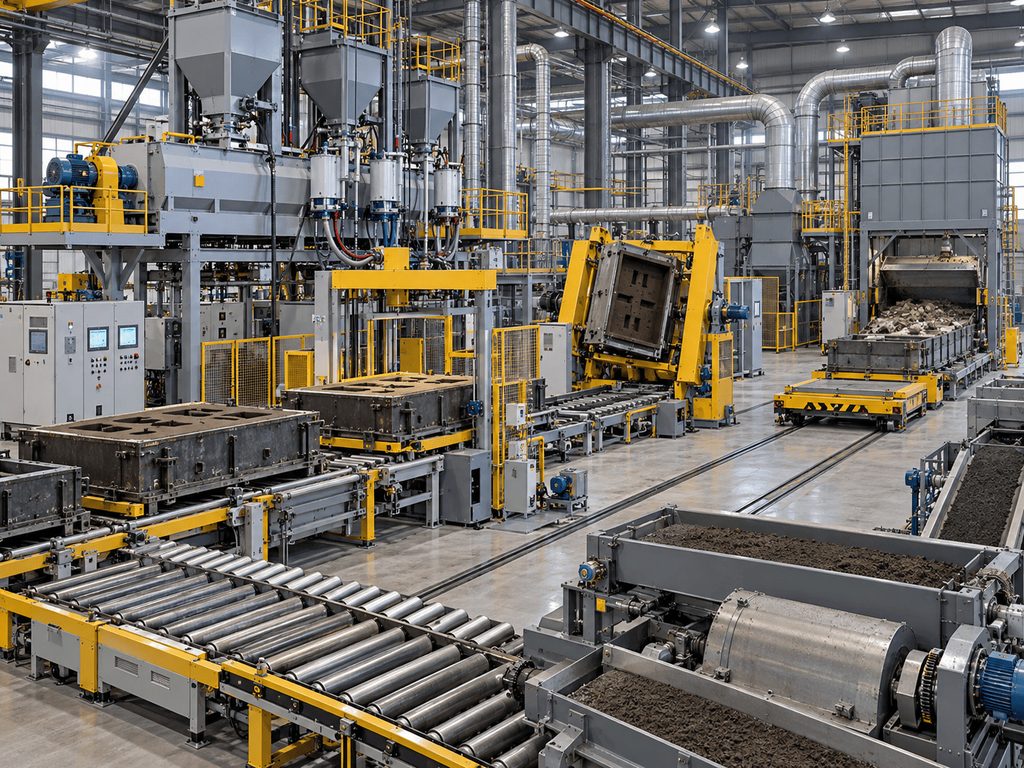
But installing a No-Bake molding line is not simply about connecting a sand mixer, vibrating table, flask turnover machine, sand reclamation system, and conveyor.
The real performance of the system depends on how well each process works together.
Below are some of the most common problems foundries face when operating a No-Bake molding line.
1. High Resin and Catalyst Consumption Increases Production Costs
One of the biggest operating costs in No-Bake sand casting is the continuous consumption of resin and catalyst.
In many traditional foundries, resin addition is adjusted manually or controlled by a relatively simple dosing system.
The problem is that sand conditions constantly change.
Sand temperature, ambient temperature, reclaimed sand quality, moisture, production rate, and storage conditions can all affect the curing behavior of the molding sand.
If too little resin is added, the mold may not achieve sufficient strength. This can result in mold damage during pattern withdrawal, handling, assembly, or pouring.
If too much resin is used, production costs increase unnecessarily.
Excessive resin can also increase gas generation during pouring, potentially contributing to casting defects such as gas porosity.
For this reason, modern No-Bake sand mixing systems increasingly use accurate resin and catalyst dosing technology.
By monitoring sand flow and automatically adjusting chemical addition, foundries can maintain stable mold strength while reducing unnecessary resin consumption.
For a high-output foundry, even a small reduction in resin percentage can create significant annual savings.
2. Unstable Reclaimed Sand Quality Affects Mold Performance
Sand reclamation is another critical part of a No-Bake molding line.
After pouring and shakeout, used sand normally goes through several processes before it can be reused.
These may include:
- Sand crushing
- Screening
- Magnetic separation
- Cooling
- Dust removal
- Mechanical reclamation
- Sand storage
If reclaimed sand is not properly processed, its quality may become unstable.
Residual resin films can remain on the sand grains, while excessive fines can increase the dust content of the system.
Sand temperature is another major issue.
When reclaimed sand returns to the mixer at an excessively high or unstable temperature, the curing speed of the resin system may change.
This directly affects bench life, strip time, mold strength, and production rhythm.
As a result, the same resin recipe may produce different mold properties during different shifts or at different times of the day.
A reliable No-Bake sand molding line therefore requires more than a good continuous mixer.
The reclamation, cooling, dust collection, and sand storage systems must also be designed to match the required molding capacity.
In many foundries, insufficient sand reclamation capacity eventually becomes a bottleneck for the entire production line.
3. Heavy Flask Handling Creates Efficiency and Safety Problems
No-Bake casting is frequently used for medium and large castings, which means that flasks and molds can be extremely heavy.
In traditional foundries, mold handling may depend heavily on overhead cranes and manual operation.
Flasks may need to be lifted, transferred, turned over, assembled, and moved to the pouring area manually.
This creates several problems.
First, crane-based handling is relatively slow and depends strongly on operator experience.
Second, repeated lifting and positioning can reduce the accuracy of mold alignment.
Third, frequent crane operation around heavy molds increases safety risks inside the foundry.
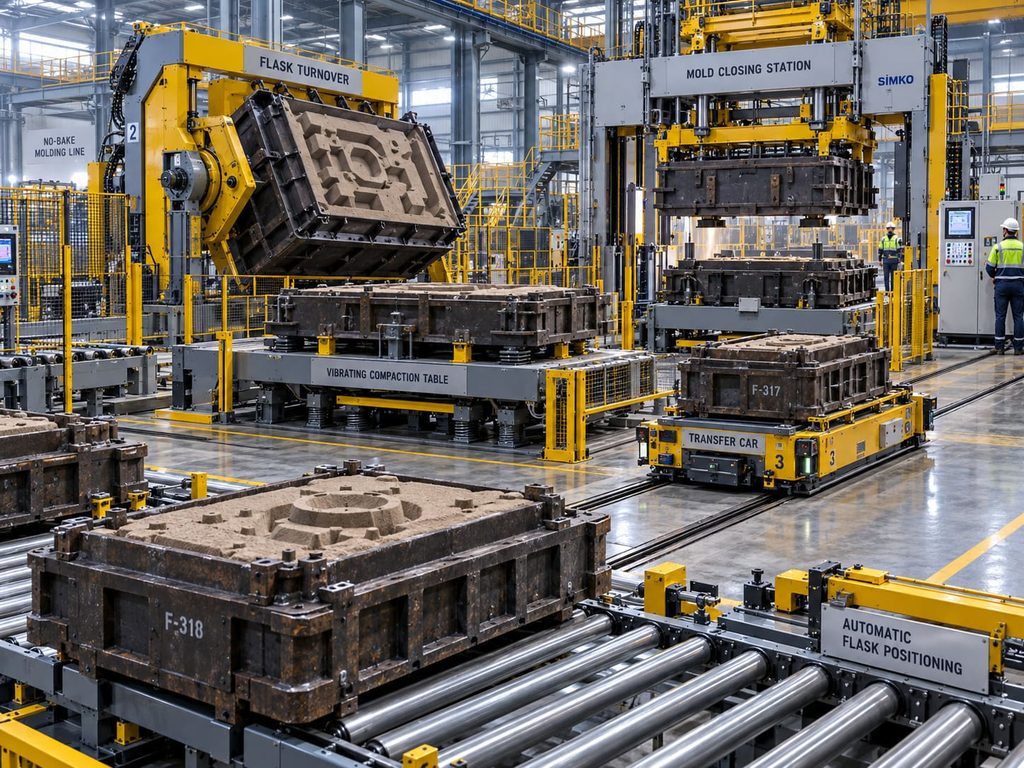
Modern No-Bake molding lines therefore often use automated or mechanized mold handling equipment, including:
- Roller conveyor systems
- Transfer cars
- Flask turnover machines
- Mold closing stations
- Vibrating compaction tables
- Automatic positioning devices
- Mold transport systems
Replacing frequent crane handling with controlled mechanical transportation can improve productivity while reducing manual intervention.
For large casting foundries, flask handling automation is often just as important as the molding equipment itself.
4. Mold Quality Depends Too Much on Manual Operation
No-Bake sand molding provides excellent flexibility, but excessive reliance on manual operation can create quality variation.
For example, differences in sand filling, vibration time, compaction, pattern withdrawal, mold handling, and flask positioning can all influence the final mold quality.
For low-volume production, these differences may be manageable.
However, as foundries move toward repeat production and higher-value castings, customers increasingly expect better dimensional consistency.
This is one of the main reasons foundries invest in an automatic No-Bake molding line.
Standardized sand filling, vibration, pattern stripping, mold turnover, and mold assembly can reduce operator-related variation.
Automation helps ensure that the same process is repeated under more consistent conditions.
This is especially important for:
- Export castings
- Precision industrial castings
- Machine tool castings
- Pump and valve castings
- Castings requiring extensive machining
- High-value engineered components
Improved molding consistency can also reduce machining allowances and lower the risk of dimensional rejection.
5. Dust, VOCs, and Poor Workshop Conditions Remain Major Concerns
Environmental control has become an increasingly important issue in modern foundries.
No-Bake production generates dust at several stages, particularly during shakeout, crushing, sand conveying, screening, and reclamation.
Resin and catalyst systems may also produce odors and volatile emissions during mixing, curing, and pouring.
If the molding line is poorly enclosed or the dust collection system is inadequate, working conditions can deteriorate quickly.
Dust can also enter bearings, sensors, electrical cabinets, motors, and other machine components.
Over time, this may increase equipment failures and maintenance requirements.
For this reason, environmental protection should not be treated as an optional add-on when designing a No-Bake foundry molding line.
Dust extraction points should be integrated into the production line from the beginning.
Important areas may include:
- Sand reclamation equipment
- Shakeout stations
- Sand transfer points
- Elevators
- Screening systems
- Mixing stations
- Sand storage systems
Closed conveying systems and properly designed dust collectors can significantly improve workshop conditions.
Automation can also reduce the amount of time operators spend in high-dust, high-temperature, or high-noise production areas.
6. Poor Equipment Coordination Can Reduce Overall Line Efficiency
A common problem in foundry automation projects is that equipment is purchased in different stages.
A foundry may first install a new sand mixer.
Later, it adds conveyors.
After that, it installs a flask turnover machine, reclamation equipment, or an automated control system.
Each individual machine may work properly, but the complete production line may still suffer from poor coordination.
For example, if the mixer produces sand faster than the molding station can use it, operators may experience unnecessary waiting or material losses.
If the sand reclamation system has insufficient capacity, the entire production line may be limited by reclaimed sand availability.
If one transfer station or turnover machine fails, upstream and downstream processes may also stop.
Therefore, evaluating a No-Bake molding line should not be limited to the specifications of individual machines.
The entire process must be balanced.
A properly designed system should consider:
- Flask size
- Casting dimensions
- Casting weight
- Required molds per hour
- Sand consumption
- Sand reclamation capacity
- Pouring cycle
- Cooling time
- Plant layout
- Material flow
A successful No-Bake molding line is a coordinated production system rather than a collection of separate machines.
7. Difficult Maintenance Can Cause Expensive Production Downtime
Foundries are demanding industrial environments.
Dust, vibration, abrasive sand, heat, and continuous operation all create heavy wear on equipment.
Components such as mixer blades, conveyor rollers, bearings, elevators, crushers, reclaimers, and vibrating equipment may require regular inspection and replacement.
The maintenance problem becomes more serious when equipment is difficult to access.
A machine may only require a relatively simple repair, but if technicians cannot easily reach the wear parts, production downtime can become much longer.
For this reason, foundries should consider more than just purchase price and production speed when selecting No-Bake foundry equipment.
Important factors include:
- Ease of maintenance
- Availability of spare parts
- Standardized mechanical components
- Accessibility of wear parts
- Lubrication design
- Electrical system layout
- Remote technical support
- Supplier after-sales service
For continuous-production foundries, equipment reliability and maintainability can have a greater impact on profitability than a small increase in nominal production speed.
8. Lack of Production Data Makes Process Optimization Difficult
Many traditional foundries still rely heavily on manual production records.
This creates problems when something goes wrong.
If mold strength suddenly decreases or resin consumption increases, management may have difficulty determining the root cause.
Was the problem caused by sand temperature?
Was the reclaimed sand quality unstable?
Did the resin ratio change?
Was the sand flow incorrect?
Was there an equipment problem?
Without reliable production data, troubleshooting becomes much more difficult.
Modern automatic No-Bake molding systems increasingly use PLCs, sensors, data collection systems, and production management software to monitor important process parameters.
These may include:
- Sand consumption
- Sand temperature
- Resin consumption
- Catalyst percentage
- Mixer output
- Mold production cycle
- Equipment operating hours
- Alarm records
- Downtime
- Production quantity
These data can help foundries identify process abnormalities and improve production stability.
They can also support preventive maintenance and long-term process optimization.
For foundries moving toward smart manufacturing, the No-Bake molding line is no longer just mechanical equipment.
It is becoming an important source of production data.
How to Choose the Right No-Bake Sand Molding Line
There is no single No-Bake molding line configuration that is suitable for every foundry.
Different casting plants have different product structures, casting weights, flask dimensions, production volumes, and automation requirements.
Before selecting a new molding line, foundries should define several important parameters.
These include:
- Maximum casting dimensions
- Maximum casting weight
- Flask dimensions
- Required molds per hour
- Annual production capacity
- Sand-to-metal ratio
- Reclaimed sand percentage
- Resin system
- Required automation level
- Existing factory layout
- Available floor space
- Future expansion plans
The best No-Bake molding line is not necessarily the system with the highest level of automation.
The right solution should balance investment cost, production capacity, casting quality, labor requirements, maintenance, and long-term operating expenses.
Conclusion
No-Bake sand casting remains one of the most important molding processes for producing medium and large industrial castings.
However, modern foundries face increasing pressure from labor costs, raw material prices, environmental requirements, energy consumption, and higher customer quality expectations.
As a result, the performance of a No-Bake sand molding line has become increasingly important.
Resin consumption, reclaimed sand quality, flask handling, mold consistency, dust control, equipment coordination, maintenance, and production data management are among the most important issues foundries need to address.
An efficient No-Bake molding line should not simply connect several individual machines.
It should integrate sand mixing, molding, flask transportation, mold turnover, mold closing, shakeout, sand reclamation, dust collection, and control systems into one coordinated production process.
When these production challenges are properly addressed, an automated No-Bake molding system can help foundries improve productivity, stabilize casting quality, reduce labor requirements, lower operating costs, and achieve a better long-term return on investment.
For foundries planning a new production line or upgrading an existing resin sand molding system, evaluating the complete process rather than focusing only on individual equipment is the key to building a reliable and efficient No-Bake casting operation.