
Natural gas is an important part of the modern energy system. It is widely used for residential heating and cooking, industrial production, power generation, chemical manufacturing, and transportation.
For most consumers, using natural gas is as simple as turning on a valve or switching on a gas appliance. Behind this convenience, however, is a complex production chain. Before natural gas reaches homes, factories, or power plants, it must be located underground, accessed by drilling, brought to the surface, processed, and transported through a carefully controlled infrastructure system.
So, how is natural gas extracted, and what are the main steps in the natural gas extraction process?
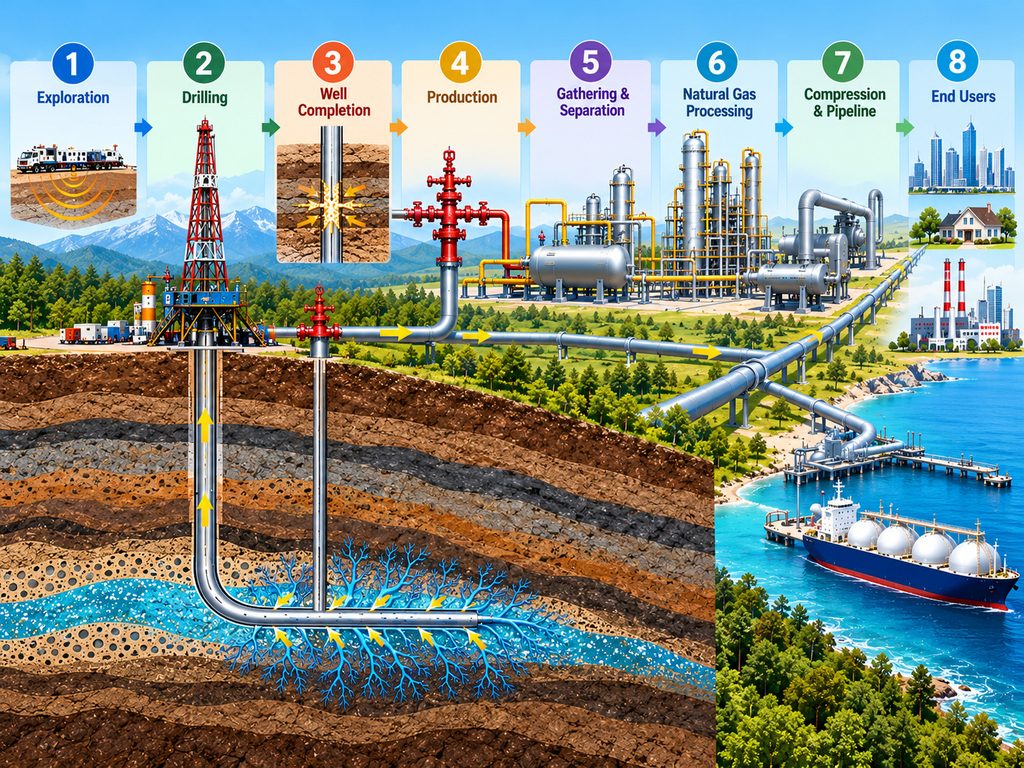
In general, natural gas production involves several major stages: geological exploration, drilling, well logging and reservoir evaluation, well completion, gas production, gathering, processing, compression, and transportation.
The exact technologies used may vary depending on whether the resource is conventional natural gas, shale gas, tight gas, coalbed methane, or another type of gas deposit. However, the fundamental production process remains broadly similar.
1. Geological Exploration: Finding Natural Gas Underground
The first step in natural gas extraction is not drilling. Before a well can be drilled, geologists and engineers must first identify underground formations that may contain commercially recoverable natural gas.
Natural gas is often found in subsurface rock formations with suitable porosity and permeability. Geological conditions must also allow hydrocarbons to accumulate and remain trapped over long periods of time.
To identify potential natural gas reservoirs, exploration teams combine several techniques, including geological surveys, geophysical exploration, and geochemical analysis.
One of the most important techniques is seismic exploration.
During a seismic survey, controlled energy is used to generate waves that travel through underground rock formations. Because different rock layers have different physical properties, seismic waves are reflected and refracted in different ways.
Sensors record these signals, and specialists process the resulting data to build models of underground geological structures.
By interpreting seismic data together with other geological information, exploration teams can estimate the location, depth, size, and structural characteristics of potential natural gas reservoirs. This information is then used to select promising drilling locations.
However, seismic exploration alone cannot prove that a commercially viable natural gas reservoir exists. Drilling is normally required to confirm the presence and characteristics of the resource.
2. Drilling: Creating a Path to the Natural Gas Reservoir
Once a promising drilling location has been identified, the project moves into the drilling stage.
In simple terms, a natural gas well creates a controlled pathway between the underground reservoir and the surface.
A drilling rig rotates a drill bit that cuts through layers of rock, gradually extending the well deeper underground. Natural gas wells can reach depths of several thousand meters, although the actual depth varies considerably depending on the geology and location of the target formation.
Drilling fluid, sometimes called drilling mud, plays an important role during this process.
It helps carry rock cuttings from the bottom of the well back to the surface, cools and lubricates the drill bit, helps stabilize the wellbore, and contributes to pressure control.
As drilling progresses, sections of steel casing are typically installed inside the well. Cement is then placed between the casing and the surrounding formation.
The combination of casing and cement helps strengthen the well, isolate different underground formations, protect certain subsurface zones, and provide a secure structure for future natural gas production.
Natural gas drilling, therefore, is much more than simply drilling a deep hole. It is a highly engineered process involving geology, mechanical systems, fluid management, pressure control, and well safety.
3. Well Logging and Reservoir Evaluation
After drilling reaches the target formation, engineers need to determine whether the reservoir contains enough recoverable natural gas to justify further development.
A range of well logging and formation evaluation techniques can be used to measure the physical properties of underground rock formations.
These measurements may be combined with core samples, drilling data, pressure tests, fluid samples, and production testing to develop a more complete understanding of the reservoir.
Important parameters may include reservoir thickness, porosity, permeability, gas saturation, formation pressure, temperature, and natural gas composition.
Engineers and geoscientists use this information to estimate how much gas may be present, how easily it can flow through the rock, and how the reservoir might perform during long-term production.
If testing indicates that the well has sufficient production potential and the project is commercially viable, development can proceed. If the expected reserves or production rates are too low relative to development costs, the project may need to be reconsidered.
Reservoir evaluation therefore acts as an important bridge between exploration and commercial natural gas production.
4. Well Completion: Allowing Natural Gas to Enter the Well
Drilling a well does not automatically mean that natural gas can immediately be produced.
Before commercial production begins, the well normally undergoes a process known as well completion.
The purpose of well completion is to establish a safe, controlled, and efficient connection between the natural gas reservoir and the wellbore.
Different completion methods are used depending on reservoir conditions and well design.
In some wells, for example, the casing is perforated in the section adjacent to the gas-bearing formation. These perforations create pathways through which natural gas can flow from the reservoir into the well.
For low-permeability formations such as shale and some tight gas reservoirs, natural fractures and pore spaces may not provide enough flow for economical production. In these cases, reservoir stimulation techniques such as hydraulic fracturing may be used.
During hydraulic fracturing, fluid is pumped into the target formation under controlled high pressure to create or extend fractures in the rock. Proppant materials are typically introduced to help keep these fractures open, improving the pathways through which natural gas can flow toward the wellbore.
Not every natural gas well requires large-scale hydraulic fracturing. Completion strategies depend on the geological characteristics of the reservoir, well design, production objectives, economics, and applicable operating requirements.
5. Gas Production: Bringing Natural Gas to the Surface
Once the well has been completed, it can enter the production stage.
Underground natural gas reservoirs often contain substantial pressure. During the early stages of production, this reservoir pressure may be sufficient to push natural gas through the formation, into the wellbore, and upward toward the surface.
At the surface, the wellhead is equipped with valves, pressure-control equipment, monitoring instruments, and safety systems. A wellhead assembly commonly referred to as a Christmas tree is used to control and regulate the flow of gas from the well.
Operators continuously monitor important parameters such as pressure, temperature, gas production rate, and water production.
If operating conditions become abnormal, control and safety systems can be used to reduce production or shut in the well.
Over time, reservoir pressure generally declines as natural gas is produced. The production rate of a well may also decrease.
Depending on the characteristics of the reservoir and the well, operators may use techniques such as liquid unloading or compression to help maintain efficient gas production.
Natural gas production is therefore not simply a matter of opening a valve and allowing the gas to flow indefinitely. It requires continuous monitoring and adjustment throughout the productive life of the well.
6. Gas Gathering and Separation
Natural gas flowing directly from a well is usually not ready to enter a long-distance transmission pipeline.
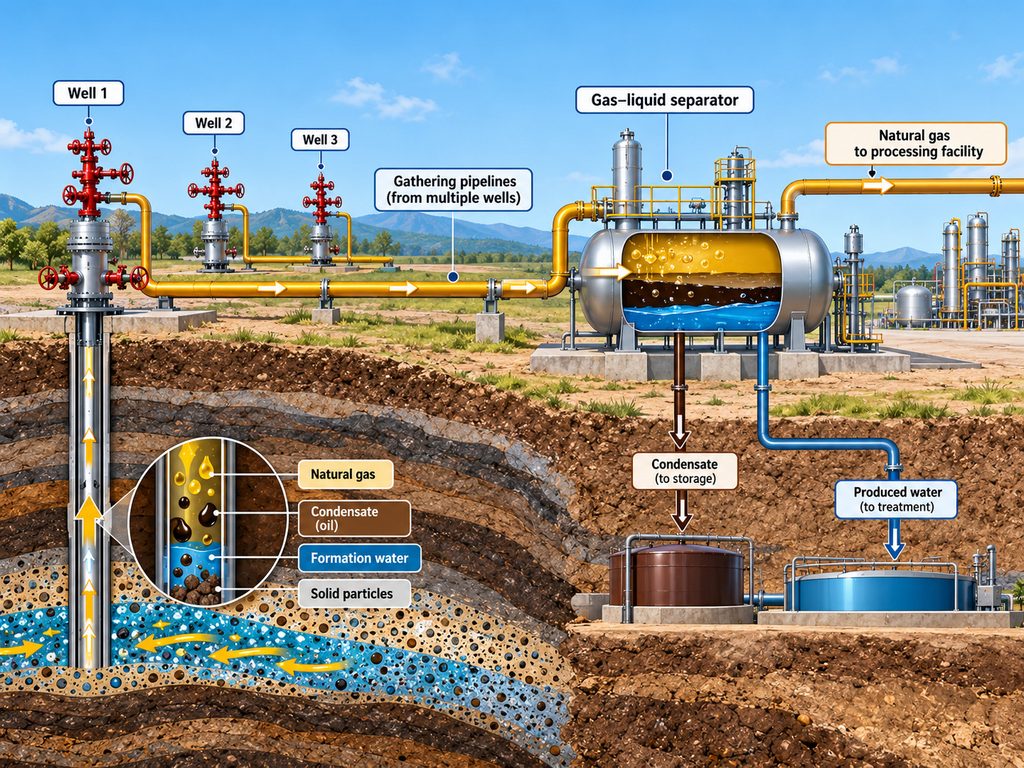
The fluid produced at the wellhead may contain not only methane and other gaseous hydrocarbons but also formation water, condensate, solid particles, and various impurities.
For this reason, wellhead production is generally sent through gathering pipelines to surface processing equipment.
One of the first steps is often gas-liquid separation.
Separators use differences in the physical properties of gas and liquids to separate natural gas from water, hydrocarbon condensate, and other liquids.
Natural gas produced from multiple wells may also be collected through a network of gathering pipelines and delivered to a central gathering station or processing facility.
This network forms an important connection between individual gas wells and the larger natural gas processing and transportation system.
7. Natural Gas Processing: Preparing Gas for Transportation and Use
Even after initial separation, raw natural gas may still contain water vapor, carbon dioxide, hydrogen sulfide, heavier hydrocarbons, and other components that must be removed or controlled.
The required processing steps depend on the composition of the raw gas and the specifications that the final gas must meet.
Natural Gas Dehydration
Water vapor can create operational problems in pipelines. Under certain combinations of pressure and temperature, water and natural gas can form solid gas hydrates that may restrict pipeline flow.
Water can also contribute to corrosion under certain conditions.
For these reasons, natural gas commonly undergoes dehydration to reduce its water content before entering transmission systems.
Acid Gas Removal
Some raw natural gas contains significant amounts of carbon dioxide and hydrogen sulfide. These components may need to be removed through processes commonly referred to as gas sweetening or acid gas removal.
Hydrogen sulfide requires particularly careful handling because it is highly toxic and can also contribute to corrosion.
Facilities processing sour gas therefore require appropriate equipment, monitoring systems, operating procedures, and safety controls.
Natural Gas Liquids Recovery
Raw natural gas can also contain heavier hydrocarbons such as ethane, propane, butanes, and heavier components.
Depending on the composition of the gas and the processing objectives, some of these components can be separated and recovered as natural gas liquids (NGLs).
After dehydration, acid gas removal, separation, and other necessary treatment processes, the natural gas can be conditioned to meet applicable quality and pipeline specifications.
8. Compression and Pipeline Transportation
After processing, natural gas is ready to enter the transportation system.
One of the primary methods of transporting large volumes of natural gas over land is through high-pressure transmission pipelines.
As natural gas travels through a pipeline, friction and other factors cause pressure to decrease. Compressor stations are therefore installed at appropriate points along major pipeline systems to increase gas pressure and maintain efficient flow.
When natural gas reaches regional distribution systems, its pressure is reduced and carefully controlled before the gas is delivered to cities, industrial facilities, commercial buildings, and residential consumers.
Metering equipment is also used throughout the system to measure gas volumes and monitor operating conditions.
Pipeline transportation is not the only way to move natural gas over long distances.
When large quantities of natural gas need to be transported across oceans or between regions without pipeline connections, the gas can be converted into liquefied natural gas (LNG).
At an LNG facility, natural gas is purified and cooled to approximately -162°C (-260°F), at which point it becomes a liquid. Liquefaction greatly reduces its volume, making large-scale marine transportation practical.
The LNG can then be loaded onto specialized carriers and transported to receiving terminals, where it is generally converted back into gaseous form before entering a pipeline network.
Summary of the Natural Gas Extraction Process
The complete natural gas extraction process involves much more than drilling a well.
It begins with geological and geophysical exploration to identify potential underground gas reservoirs. Exploration wells and formation evaluation are then used to determine whether the resource has sufficient production potential.
If development proceeds, wells are drilled and completed to establish controlled pathways between the reservoir and the surface. Depending on reservoir characteristics, stimulation methods such as hydraulic fracturing may also be required.
Once production begins, natural gas flows from the underground formation into the well and is brought to surface facilities.
The produced gas then passes through gathering and separation systems before undergoing the necessary processing steps, which may include dehydration, acid gas removal, impurity removal, and natural gas liquids recovery.
Finally, processed natural gas is compressed and transported through transmission pipelines or, in some cases, converted into LNG for marine transportation.
In simple terms, the basic natural gas production chain can be summarized as:
Exploration → Drilling → Reservoir Evaluation → Well Completion → Gas Production → Gathering and Separation → Gas Processing → Compression and Transportation
Although conventional natural gas, shale gas, tight gas, and coalbed methane require different extraction techniques, this general sequence represents the fundamental structure of modern natural gas production.
As drilling technology, subsurface imaging, digital monitoring, automation, and reservoir engineering continue to develop, natural gas operations are becoming increasingly precise and data-driven.
At the same time, well integrity, operational safety, methane emissions management, water management, and environmental protection have become important considerations throughout the life cycle of modern natural gas projects.
Frequently Asked Questions About Natural Gas Extraction
1. Is natural gas simply pumped out of the ground?
Not necessarily. Many natural gas reservoirs contain enough formation pressure for gas to flow naturally from the reservoir into the wellbore and toward the surface, particularly during the early stages of production.
As reservoir pressure declines, operators may use compression, liquid unloading, or other production techniques to help maintain gas flow.
2. How deep is a natural gas well?
There is no standard depth for a natural gas well.
Gas reservoirs can occur at depths ranging from hundreds of meters to several thousand meters or more. The required drilling depth depends primarily on local geology and the location of the target reservoir.
3. Is shale gas extracted in the same way as conventional natural gas?
The overall production process is similar, but some of the key technologies differ.
Conventional natural gas is often found in reservoir rocks with sufficient permeability for gas to move relatively easily toward a well.
Shale formations generally have very low permeability. As a result, shale gas development commonly combines horizontal drilling and hydraulic fracturing to create larger effective flow pathways between the reservoir rock and the well.
4. Can natural gas be used immediately after it comes out of a well?
Usually not.
Raw natural gas may contain water, condensate, carbon dioxide, hydrogen sulfide, heavier hydrocarbons, and other impurities. It generally requires separation and processing before it can meet the specifications required for pipeline transportation and commercial use.
5. What are the main steps from natural gas extraction to final use?
In simplified form, the process includes exploration, drilling, reservoir evaluation, well completion, gas production, gathering, separation, processing, compression, transportation, and final distribution.
Each stage involves specialized equipment, engineering procedures, monitoring systems, and safety controls. Together, these stages form the complete production and supply chain that moves natural gas from underground reservoirs to end users.