Choosing a radar level sensor for a carbon powder silo requires more than checking the maximum measuring range on a datasheet.
Carbon powder can generate heavy dust, form uneven surfaces, build up on vessel walls, and create very different profiles during filling and discharge.
These conditions affect what the radar sees and how stable the measurement will be.
A suitable instrument must match the material, silo geometry, installation position, process connection, required output, and environmental conditions.
The best radar for one powder silo may not be the best choice for another.
This guide explains the main selection factors and why each one matters.
Start With the Application, Not the Frequency
Radar frequency is important, but it should not be the first or only selection criterion.
Before comparing instruments, collect the basic application data:
- Silo height and diameter
- Measuring distance
- Hopper shape
- Filling inlet position
- Discharge outlet position
- Internal ladders, beams, pipes, and supports
- Carbon powder properties and flow behavior
- Expected dust level
- Process temperature and pressure
- Hazardous-area requirements
- Available process connection
- Required output and communication protocol
This information defines the measurement problem.
Once the application is clear, radar frequency, antenna type, beam angle, and signal-processing capability can be evaluated in context.
Why Carbon Powder Is a Challenging Radar Target
A liquid normally presents a flat surface.
Carbon powder does not.
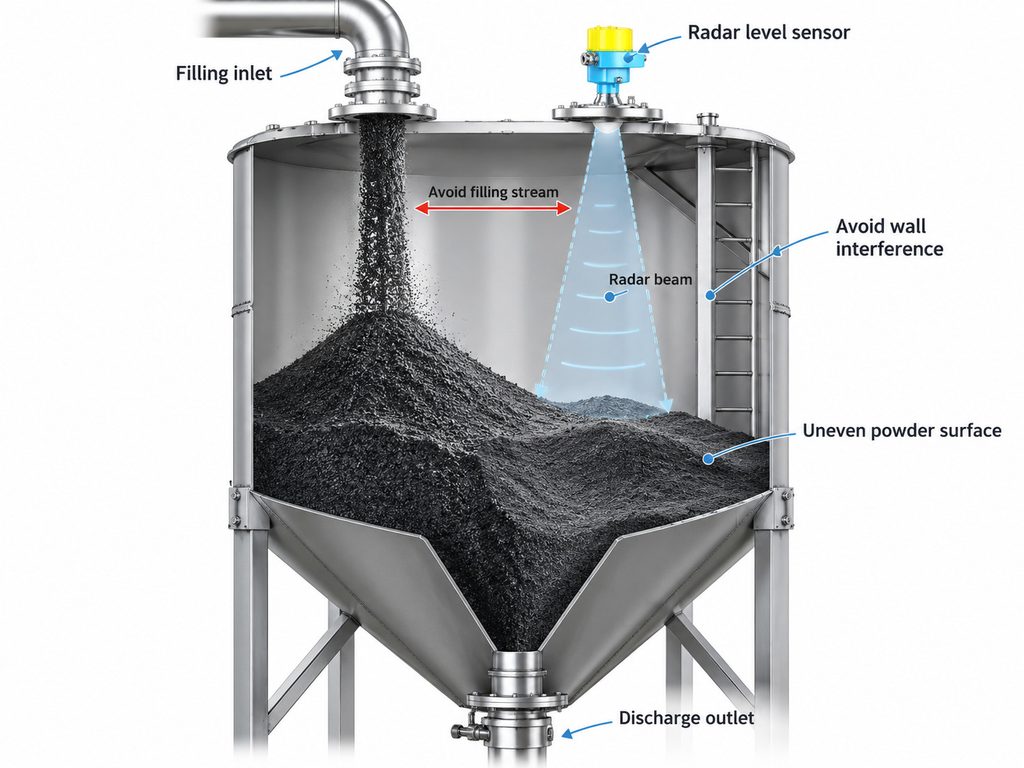
During filling, the material may create a steep cone below the inlet.
During discharge, a central or off-center depression may appear above the outlet.
The surface can become sloped or irregular, and its shape can change when material settles or collapses.
Fine carbon powder may also create a dense dust cloud during pneumatic conveying.
Powder can accumulate around the vessel wall and process connection.
The radar sensor therefore needs to distinguish the useful surface echo from reflections generated by the nozzle, wall, internal structures, and changing surface geometry.
This is why application-specific signal quality is often more important than a headline accuracy number measured under ideal conditions.
Consider the Advantages of a Narrow Beam
Beam angle is one of the most important parameters in a powder silo.
A narrow radar beam concentrates the transmitted energy into a smaller measurement area.
This can help the sensor avoid the silo wall, ladders, reinforcement beams, filling pipes, and other internal structures.
The benefit becomes more significant as measuring distance increases because the beam footprint grows with distance.
A narrow beam can also provide more flexibility when the sensor must be mounted away from the vessel center to avoid the filling stream.
High-frequency radar, including instruments around 80 GHz, is often used because it can provide a tightly focused beam with a relatively compact antenna.
This can be useful in tall, narrow, or internally crowded silos.
However, a narrow beam does not automatically guarantee good measurement.
It still needs to be aimed at a representative part of the powder surface.
Is 80 GHz Radar Better for Carbon Powder?
80 GHz radar can offer important advantages in many bulk-solids applications.
Its high operating frequency can support a small beam angle, helping reduce unwanted reflections from vessel internals.
Modern sensors may also provide high signal sensitivity and echo-processing functions for difficult powder applications.
Both VEGA and Siemens describe 80 GHz radar as useful for dusty solids and applications where narrow beam focusing simplifies installation around vessel structures.
This makes 80 GHz radar attractive for carbon powder silos with heavy dust, narrow geometry, long measuring distances, or multiple internal structures.
But higher frequency should not be treated as a universal answer.
The complete instrument design matters:
- Antenna size and design
- Signal quality
- Dynamic range
- Process connection
- Aiming capability
- Signal-processing software
- Resistance to buildup
- Application configuration
A correctly selected and installed radar will usually perform better than a more advanced sensor installed in the wrong position.
Check the Required Measuring Range
Calculate the required range from the antenna reference point to the lowest material surface that must be measured.
Do not use only the nominal silo height.
The transmitter may be mounted on a nozzle above the roof, while the hopper bottom may extend well below the cylindrical section.
The maximum published range should not be treated as the only selection criterion.
Actual performance depends on material reflection, antenna design, dust, geometry, and signal conditions.
For a tall carbon powder silo, choose an instrument with suitable range margin instead of operating at the edge of its stated capability.
Evaluate Antenna and Process Connection Options
The antenna is the interface between the transmitter and the vessel.
For powder applications, it should provide a clear signal path and suit the available opening.
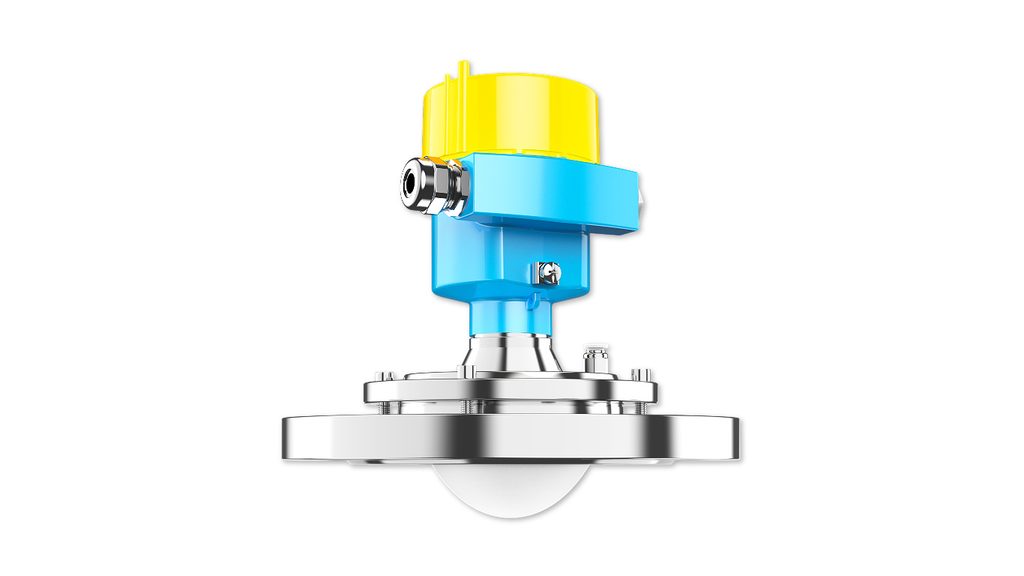
Depending on the instrument, options may include horn antennas, lens antennas, encapsulated designs, or other bulk-solids configurations.
The process connection must also match the existing flange, thread, nozzle, and mechanical requirements.
A long, narrow nozzle can create internal reflections.
If the antenna sits too far inside the nozzle, the signal may be partially blocked or distorted.
Before ordering, compare the proposed nozzle dimensions with the manufacturer’s installation limits.
It is easier to choose the correct antenna or modify a nozzle before installation than to troubleshoot persistent false echoes later.
Look at Aiming Capability
In a powder silo, the best measurement point may not be directly below the mounting flange.
An aiming flange or adjustable mounting system can be useful when the surface slopes strongly, the outlet is off-center, or internal structures restrict the beam path.
Aiming can also help keep the beam away from the filling stream while directing it toward a useful measurement area.
If an adjustable system is used, document the final direction after commissioning so maintenance work does not accidentally change the beam path.
Consider Dust and Buildup Resistance
Carbon powder silos can be extremely dusty during filling.
Non-contact radar is widely used in dusty bulk-solids applications because no long probe needs to remain in contact with the stored powder.
That reduces mechanical loading on the sensor.
Fine material can still settle on the antenna or process connection.
For severe buildup conditions, review whether the sensor design and mounting arrangement support suitable anti-buildup measures or air purging.
The installation should also prevent the incoming powder stream from directly striking the antenna.
Maintenance requirements should be considered during selection, not only after the system has operated for months.
Check Temperature, Pressure, and Hazardous-Area Requirements
A radar sensor must suit the process environment as well as the measurement task.
Confirm process and ambient temperature, pressure, enclosure requirements, and outdoor conditions where applicable.
Fine combustible dust may create hazardous-area requirements in some facilities.
The required explosion-protection certification depends on the material, area classification, and local regulations.
Do not assume every version of a radar product carries the same approvals.
Confirm the exact ordered configuration, and make sure wiring, grounding, and cable entries meet site requirements.
Select the Right Output and System Integration
The sensor must communicate with the plant control or inventory system.
Common requirements may include:
- 4–20 mA
- HART
- Fieldbus
- Relay functions
- Digital connectivity
The right choice depends on the plant architecture.
Consider how the signal will be used.
Will the level be displayed locally, sent to a PLC, converted to volume, used for alarms, or integrated into a remote inventory platform?
Defining the required interface before ordering avoids unnecessary changes later.
Do Not Ignore Point Level Protection
Continuous radar shows how the level changes over time.
Critical overfill or low-level protection may require an independent point level switch depending on the plant risk assessment.
For carbon powder, the point level technology should be selected according to bulk density, buildup tendency, and material behavior at the switch location.
The protection architecture should be based on process risk and applicable standards rather than convenience alone.
Compare Application Performance, Not Only Datasheet Accuracy
A very small stated accuracy can look attractive, but powder measurement is often dominated by surface geometry rather than electronic accuracy.
If the powder surface is strongly sloped, a few millimeters of transmitter accuracy may not substantially improve the accuracy of the calculated inventory.
More useful questions are:
Can the sensor track the surface during filling?
Can it operate in the expected dust?
Can the beam avoid the wall and internal structures?
Can it still see the powder at low level?
Can the mounting arrangement prevent direct material impact?
Can diagnostics help identify buildup or false echoes?
These application questions are often more meaningful than comparing one accuracy number with another.
A Practical Selection Checklist
Before purchasing a radar level sensor for carbon powder, confirm:
- Silo dimensions
- Measuring range
- Inlet and outlet positions
- Expected powder profile
- Dust conditions
- Internal obstructions
- Nozzle dimensions
- Process temperature
- Process pressure
- Area classification
- Power supply
- Required signal output
Then compare the beam angle, antenna type, aiming options, signal-processing capability, buildup management, measuring range, environmental rating, certifications, and commissioning tools.
For difficult applications, provide the vessel drawing and process information to the instrument supplier before ordering.
Conclusion
The right radar level sensor for a carbon powder silo is the one that fits the real process, not simply the model with the longest range or highest frequency.
Carbon powder creates an uneven, moving surface in a dusty environment.
Reliable measurement depends on a focused and well-positioned beam, a suitable antenna and process connection, enough signal margin, correct environmental approvals, and commissioning under actual conditions.
80 GHz radar can be especially useful when a narrow beam is needed to avoid internal structures in challenging bulk-solids silos.
But frequency is only one part of the decision.
Start with silo geometry and material behavior, then select the radar technology around the application.
That approach leads to more stable measurement, easier commissioning, and fewer problems after the system enters production.