Cement silos are an essential part of cement production, storage, packaging, and bulk loading systems. Cement is typically transported into storage silos by pneumatic conveying and discharged from the bottom according to production or loading requirements.
To keep these processes operating safely and continuously, the control system must know whether the material has reached a predefined high or low level.
A reliable cement silo level switch therefore plays an important role in process automation.
If a high-level switch fails to detect that the silo is nearly full, continued pneumatic conveying may lead to overfilling, material leakage, excessive pressure on the dust collection system, or unnecessary stress on upstream conveying equipment.
Likewise, unstable low-level detection may cause downstream equipment such as packing machines, bulk loading systems, or conveyors to operate without sufficient material.
For this reason, level switches in cement silos are not simply monitoring devices. They can become part of the plant’s automatic filling, emptying, alarm, and interlock system.
In one cement storage application, the plant required a reliable point level detection solution for finished cement silos. The measuring environment included heavy dust, material buildup, pneumatic conveying, and frequent material movement.
After evaluating the operating conditions, the Tube-11 vibrating rod level switch was selected for high and low level detection.
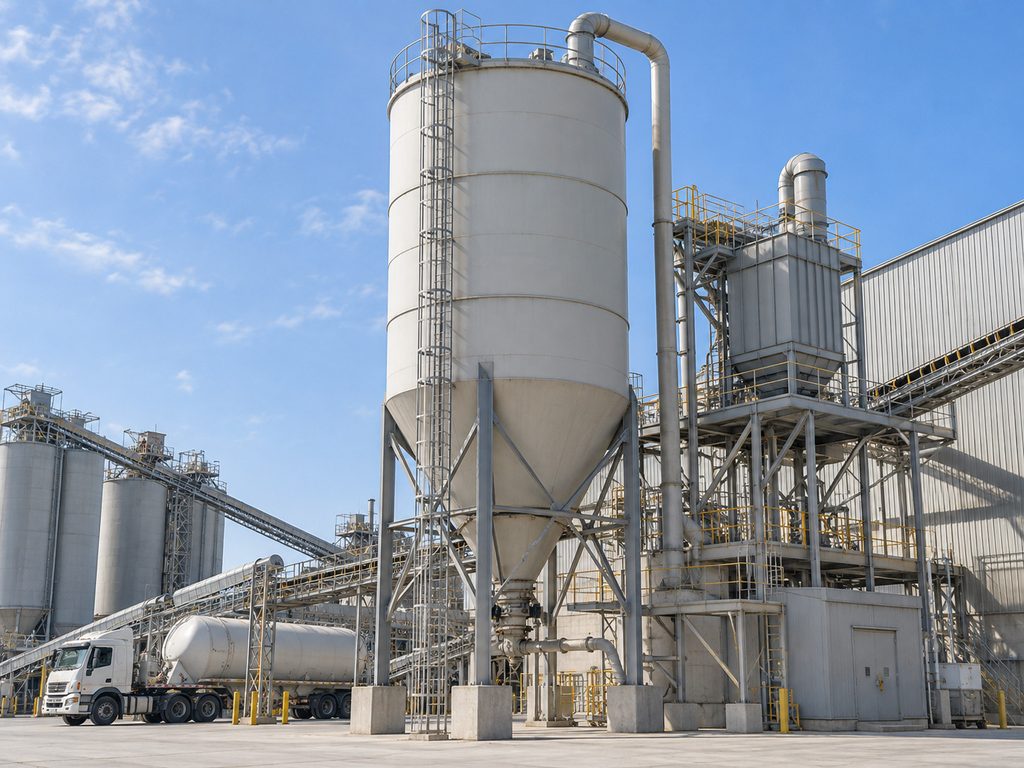
Challenges of Cement Silo Level Measurement
Although cement powder appears to be a relatively simple bulk material, measuring its level reliably can be challenging.
Several characteristics of cement storage applications can affect the performance of conventional level switches.
1. Heavy Dust Inside the Silo
Pneumatic conveying generates large amounts of airborne cement dust.
During filling, fine particles are carried throughout the silo by high-velocity air. The dust concentration inside the vessel can become extremely high, particularly near the filling point and upper section of the silo.
Some measurement technologies can be affected by dust accumulation, contamination, or optical obstruction.
For this reason, a cement silo level sensor should be suitable for long-term operation in dusty environments without requiring frequent cleaning.
The Tube-11 detects the presence of material through changes in vibration rather than through optical transmission, making the technology well suited to dusty bulk solid applications.
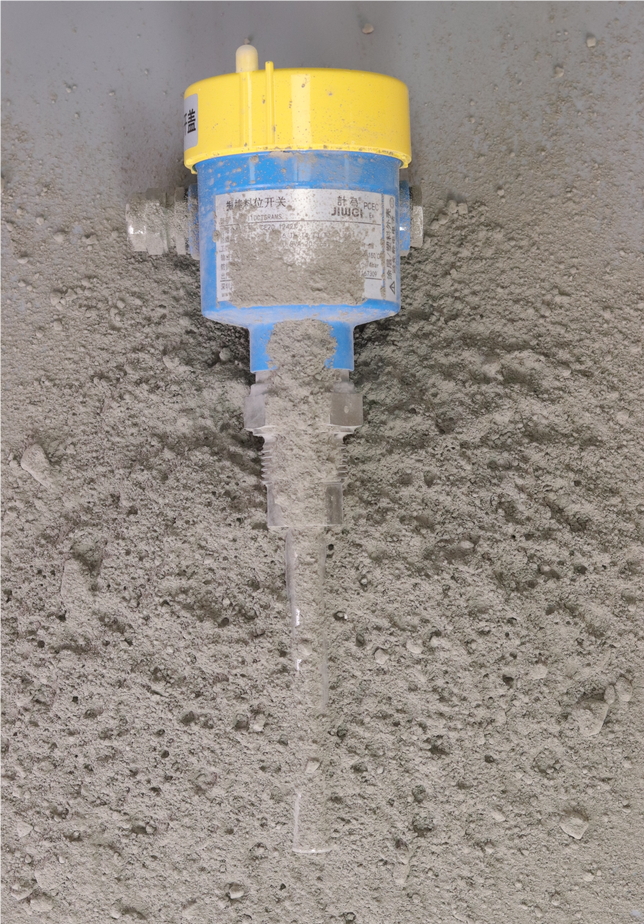
2. Cement Buildup on the Sensor
Cement is a fine powder and can adhere to silo walls, process connections, and sensing elements.
Over time, accumulated material can create problems for some types of level switches. If the instrument cannot distinguish between actual material coverage and residual buildup, false alarms may occur.
For example, material remaining on a probe after the silo level has dropped may cause a conventional sensor to continue indicating a covered condition.
This is why resistance to material buildup is an important factor when selecting a cement silo level switch.
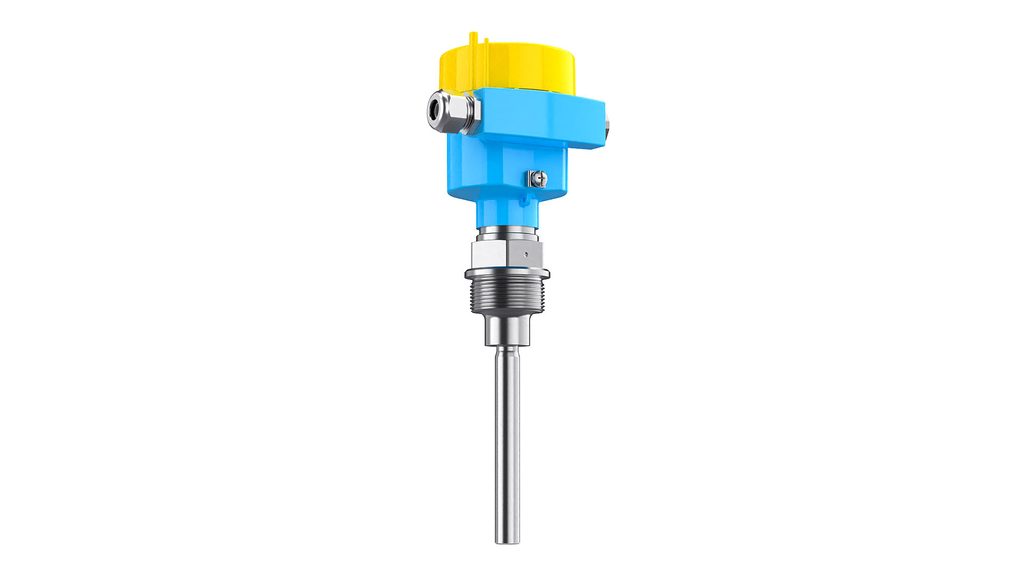
The Tube-11 uses a dual-tube vibrating probe design. Its detection principle is based on changes in the vibration characteristics of the sensing element when it is surrounded by material.
This approach helps reduce the influence of normal dust and material adhesion encountered in cement storage applications.
3. Pneumatic Conveying Creates Strong Material Disturbance
Cement is commonly transferred into storage silos by pneumatic conveying.
During the filling process, the incoming material and conveying air can create turbulence, dust clouds, and strong material movement.
If a level switch is installed directly in the material inlet stream, the sensing probe may be continuously exposed to impact from falling or flowing material.
This can cause unstable switching behavior and may also increase mechanical stress on the sensor over time.
For this reason, proper installation is just as important as selecting the correct measuring technology.
The level switch should normally be installed away from the direct filling stream whenever possible.
4. Continuous Production Requires Reliable Detection
Modern cement production lines often operate continuously or for extended production cycles.
Frequent false alarms can interrupt material handling and require maintenance personnel to inspect the silo.
In this type of application, measurement repeatability and long-term reliability are often more important than complex measurement functions.
For high and low point level detection, the plant typically requires a device that is:
- Reliable in dusty environments
- Resistant to normal material buildup
- Simple to install
- Easy to integrate with PLC or DCS systems
- Suitable for continuous industrial operation
- Low in routine maintenance requirements
These requirements make vibrating point level technology particularly suitable for many cement silo applications.
Why Was the Tube-11 Vibrating Rod Level Switch Selected?
The Tube-11 is designed for point level detection of powders and granular bulk solids.
Unlike a continuous level transmitter, it does not measure the exact amount of cement stored inside the silo.
Instead, it answers a simpler but operationally critical question:
Has the material reached this specific level?
During normal operation, the vibrating probe oscillates at its characteristic frequency.
When cement powder reaches and surrounds the probe, the material dampens the vibration. The electronics detect this change and convert it into a switching signal.
This signal can then be sent to the PLC or DCS.
The control system can use the level status to activate alarms, stop filling equipment, open or close valves, switch to another silo, or initiate other interlock functions.
Because the measuring principle is based primarily on vibration behavior rather than optical detection, the device is suitable for powder applications where dust concentration can be extremely high.
The Tube-11 features a dual-tube vibrating probe and can detect bulk materials with densities as low as approximately 0.02 g/cm³, depending on the configuration and application conditions.
This makes it suitable for a wide range of industrial powders and bulk solids, including:
- Cement
- Lime powder
- Fly ash
- Mineral powder
- Fine chemical powders
- Plastic granules
- Other dry bulk solids
For cement storage systems, the technology provides a practical solution for high-level, low-level, and overfill alarm applications.
High-Level Detection in a Cement Silo
In this application, one Tube-11 level switch is installed near the upper section of the cement silo.
Its primary function is to provide a cement silo high level alarm.
As cement enters the silo through the pneumatic conveying system, the material level gradually rises.
When the cement reaches the Tube-11 probe, the vibration of the sensing element changes.
The electronics recognize the covered condition and switch the output.
The high-level signal is then transmitted to the plant control system.
Depending on the automation strategy, the PLC or DCS can use this signal to:
- Activate a high-level alarm
- Stop the cement conveying system
- Close the corresponding filling valve
- Prevent further material from entering the silo
- Switch filling to another storage silo
- Start a predefined process interlock
This converts silo overfill protection from an operator-dependent process into an automated control function.
For cement plants operating multiple storage silos, reliable high-level detection can also help optimize silo selection and material distribution.
Low-Level Detection in a Cement Silo
A second Tube-11 can be installed in the lower section of the silo for low-level detection.
As cement is discharged to packing machines, bulk loading equipment, or downstream production systems, the material level gradually decreases.
When the cement falls below the vibrating probe, the sensor changes from the covered state to the uncovered state.
The control system can then generate a low-level signal.
This information may be used to:
- Alert operators that the silo requires refilling
- Start an automatic filling sequence
- Prevent downstream equipment from running without sufficient material
- Change material supply to another silo
- Optimize silo filling and discharge sequences
Combining high and low level switches therefore allows the plant to create a simple but effective automatic silo control system.
Installation Guidelines for Tube-11 in Cement Silos
Correct installation is essential for reliable cement silo level detection.
Even a properly selected sensor may perform poorly if it is installed in an unsuitable position.
Several installation considerations are especially important in cement applications.
Avoid the Direct Filling Stream
The Tube-11 should not normally be installed directly below or immediately in front of the cement inlet.
Continuous impact from incoming cement can create unnecessary mechanical load on the probe and may also affect switching stability.
Where possible, the sensor should be installed in an area where the material level represents the actual bulk level rather than the temporary movement of the filling stream.
Consider Probe Angle for Side Installation
Cement powder can accumulate on horizontal surfaces.
When the Tube-11 is mounted from the side of the silo, installing the probe with an appropriate downward inclination can help material slide away from the sensing element.
For certain side-mounted applications, an installation angle of approximately 20 degrees downward may help reduce material buildup.
The actual installation angle should still be determined according to silo geometry and process conditions.
Protect the Sensor from Strong Material Impact
In some silos, structural limitations make it difficult to completely avoid the filling stream.
If the probe may be exposed to strong material impact, a protective shield can be installed above the sensing element.
However, the shield must be designed carefully.
A poorly designed protection plate can itself become a surface where cement accumulates, creating a local buildup zone around the sensor.
The protection system should therefore shield the probe without creating a material pocket.
Selecting the Correct High and Low Level Positions
The high-level switch should not automatically be installed as close to the silo roof as possible.
Similarly, the low-level switch should not necessarily be positioned directly above the discharge outlet.
The correct mounting position depends on several factors, including:
- Silo height
- Silo diameter
- Effective storage volume
- Maximum filling rate
- Discharge rate
- Required safety margin
- Material flow pattern
- Silo cone design
- Pneumatic conveying characteristics
- PLC or DCS control logic
For overfill protection, the high-level alarm should provide sufficient time for the conveying system to stop before the silo reaches its absolute maximum capacity.
In applications requiring additional safety protection, a separate high-high level switch can also be installed.
This creates multiple levels of protection:
Normal process level control → High level alarm → High-high independent overfill protection
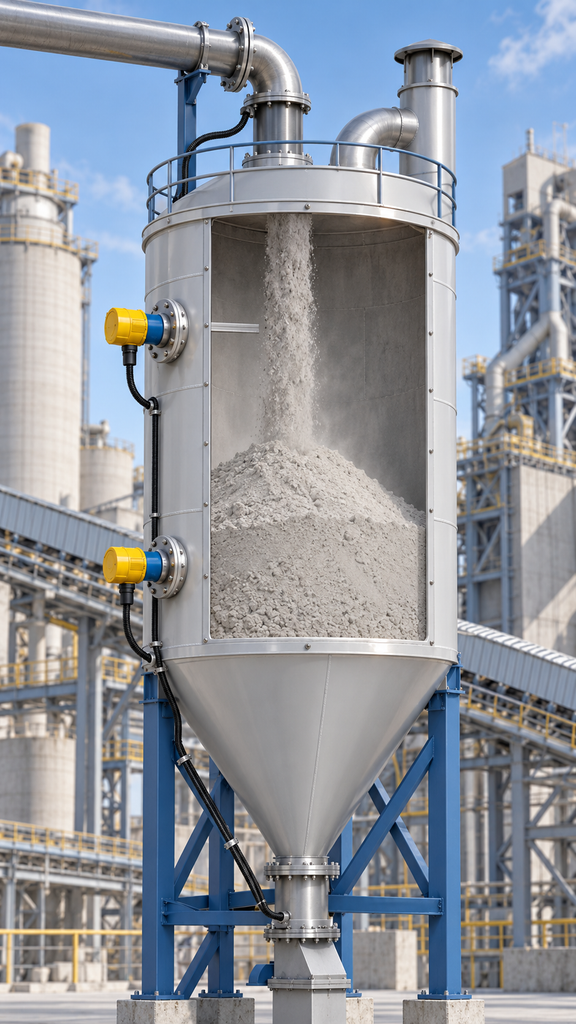
Benefits of Using Tube-11 for Cement Silo Level Detection
After installation, the Tube-11 provides high and low point level signals to the existing plant control system.
Compared with manual inspection, automatic level detection provides real-time information about important material conditions inside the silo.
This allows filling, storage, and discharge processes to be integrated into automated plant control.
The vibrating rod design also eliminates the need for traditional rotating mechanical components commonly found in rotary paddle level switches.
Fewer moving transmission components can reduce maintenance requirements associated with mechanical wear or jamming.
For cement applications, the main benefits include:
- Reliable point level detection in dusty environments
- Suitable for fine powder applications
- High and low level monitoring
- Cement silo overfill protection
- Low-level material alarms
- Easy PLC and DCS integration
- Reduced dependence on manual inspection
- Low routine maintenance requirements
- Simple integration into existing silo automation systems
The real value of a reliable level switch extends beyond simply detecting cement.
It helps the plant reduce overfill risk, improve material handling automation, reduce unnecessary manual inspections, and provide dependable input signals for process interlocks.
Tube-11 Vibrating Rod Level Switch vs. Radar Level Transmitter
A vibrating rod level switch and a radar level transmitter perform different functions.
The Tube-11 is primarily used for point level detection.
It determines whether the material has reached a predefined position.
A radar level transmitter, in contrast, is typically used for continuous level measurement and can provide a real-time indication of the material level throughout the silo.
For applications requiring inventory monitoring, level trends, or continuous process visualization, radar technology may therefore be appropriate.
For applications requiring only high-level or low-level detection, a vibrating rod level switch can provide a simpler solution.
In many modern cement storage systems, the two technologies can also be used together.
A common arrangement is:
Radar Level Transmitter for Continuous Measurement + Tube-11 for Independent High-Level Protection
The radar transmitter continuously monitors the cement level and provides information to the operator or inventory management system.
The Tube-11 acts as an independent point level device at a critical high-level position.
If the continuous measurement system is affected by abnormal process conditions or another fault occurs, the independent level switch can still provide a separate overfill protection signal.
This combination improves the overall reliability of the cement silo level measurement system.
What Should Be Considered When Selecting a Cement Silo Level Switch?
The material name alone is not enough to determine the correct level switch configuration.
Before selecting a Tube-11 for a cement silo, several process conditions should be confirmed.
Important parameters include:
- Normal operating temperature
- Maximum process temperature
- Silo pressure or vacuum
- Material bulk density
- Required high or low level function
- Side or top mounting
- Installation connection
- Silo dimensions
- Material inlet position
- Degree of material impact
- Dust explosion protection requirements
- Power supply
- Required output signal
- PLC or DCS interface
- Fail-safe control requirements
For standard cement storage applications, the appropriate configuration can be selected according to the actual process temperature and installation conditions.
For high-temperature materials or special industrial environments, the process temperature and probe configuration should be carefully verified before installation.
Frequently Asked Questions About Cement Silo Level Detection
Can a vibrating rod level switch work in a dusty cement silo?
Yes.
A vibrating rod level switch detects material by monitoring changes in the vibration of the sensing element rather than relying on optical transmission.
As a result, it is well suited to many high-dust powder applications.
However, the installation location remains important. The probe should be positioned away from direct material impact whenever possible.
Can the Tube-11 be used as a cement silo high level switch?
Yes.
The Tube-11 can be installed at a predefined high-level position in a cement silo.
When cement reaches the vibrating probe, the switch changes its output state and can send a signal to the PLC or DCS.
The signal can then be used for a high-level alarm, filling shutdown, valve control, or overfill protection.
Can the Tube-11 be used for low-level detection?
Yes.
When installed in the lower section of a silo, the Tube-11 can detect when the cement level falls below the sensing point.
The resulting low-level signal can be used for refilling control, material shortage alarms, or downstream equipment protection.
How many level switches should be installed in a cement silo?
The number depends on the control requirements.
A simple overfill protection system may require only one high-level switch.
A more complete control system may use:
- One high-level switch
- One low-level switch
For applications requiring additional protection, a separate high-high level switch can also be installed.
Is a vibrating rod level switch better than a radar level sensor?
The two technologies are designed for different measurement tasks.
A vibrating rod level switch provides point level detection, while radar typically provides continuous level measurement.
For many cement silos, using both technologies together can provide continuous process information plus independent high-level protection.
Conclusion
Reliable cement silo level detection is more challenging than it may initially appear.
Heavy dust, material buildup, pneumatic conveying, continuous filling, and material impact can all affect the long-term performance of level measurement equipment.
The Tube-11 vibrating rod level switch provides a practical solution for high and low point level detection in cement silos and other bulk powder storage applications.
Its vibrating probe technology makes it suitable for detecting cement, lime powder, fly ash, mineral powders, and other dry bulk solids.
By installing the level switch at properly selected high and low positions and integrating its output with a PLC or DCS, cement plants can automate:
- High-level alarms
- Low-level alarms
- Overfill protection
- Filling control
- Discharge control
- Silo switching
- Process interlocks
For plants that also require continuous inventory monitoring, the Tube-11 can be combined with a radar level transmitter to create a more complete cement silo level measurement system.
With correct product selection and proper installation, a reliable vibrating rod level switch can help reduce overfill risk, improve automation, minimize routine inspection, and support stable cement storage and material handling operations.