1. Introduction: Why Soybean Meal Level Monitoring Matters in Feed Mills
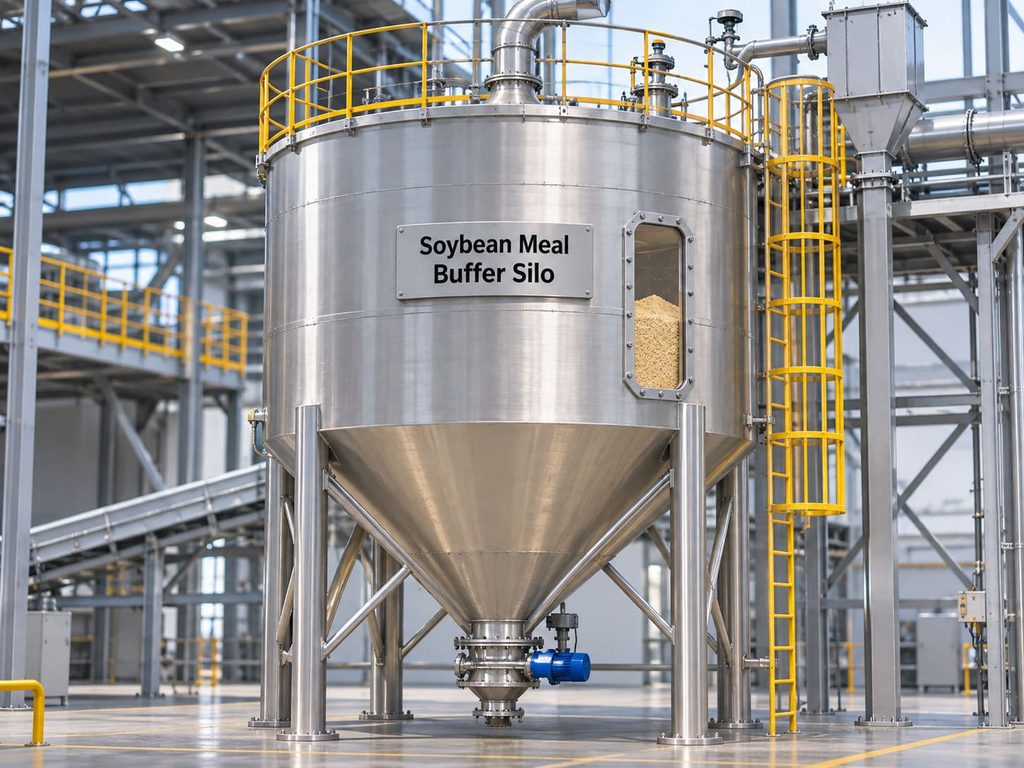
Soybean Meal Silo level measurement helps feed mills coordinate material transfer and inventory.
Soybean meal is one of the most widely used protein ingredients in animal feed manufacturing. It is an important component in feed formulations for poultry, livestock, and aquaculture.
In modern feed mills, soybean meal is usually received in bulk, stored in silos, and transferred through conveyors to grinding, batching, and mixing equipment.
Buffer silos play an important role in maintaining a continuous material supply between storage and downstream processing.
If the soybean meal level is not monitored reliably, the production line may experience unexpected material shortages, inefficient replenishment, or interruptions during batching.
However, measuring bulk soybean meal is not always straightforward.
The material may generate dust during conveying, develop uneven surfaces, and form bridges or stagnant regions under certain storage conditions.
The JWrada-34 radar level meter provides a non-contact measurement option for suitable soybean meal storage and buffer silo applications.
This article examines how the instrument can be evaluated for feed mill operations and discusses the key engineering considerations for installation and commissioning.
2. Measurement Challenges in Soybean Meal Silos
2.1 Dust During Material Transfer
Soybean meal is a relatively fine bulk material.
During pneumatic or mechanical conveying, dust may become suspended inside the silo.
High dust concentrations can influence radar signal quality, depending on particle properties and process conditions.
Radar technology is generally less dependent on air movement than ultrasonic measurement, but extremely dusty environments still require application evaluation.
2.2 Irregular Material Surfaces
Soybean meal may accumulate in a cone during filling.
During discharge, a central funnel or uneven surface can develop.
Consequently, the measured level at one point may not represent the average material height across the silo.
The installation position should be selected according to the silo filling and discharge arrangements.
2.3 Bridging and Material Flow Problems
Soybean meal can exhibit flow problems depending on moisture content, particle size, storage duration, and silo geometry.
Bridging may occur when material forms a stable structure above the discharge opening.
In this situation, the material level measured by the radar may remain relatively high even though the discharge system is not receiving material properly.
This is an important distinction: a radar level meter measures surface distance and cannot directly identify every form of internal material blockage.
Additional flow detection or discharge monitoring may be required.
2.4 Changes in Bulk Density
Soybean meal bulk density can change due to compaction, moisture, particle size, and handling conditions.
The radar measures level rather than weight.
Accurate inventory estimation therefore requires additional information about silo geometry and material density.
3. Why Consider the JWrada-34 Radar Level Meter?
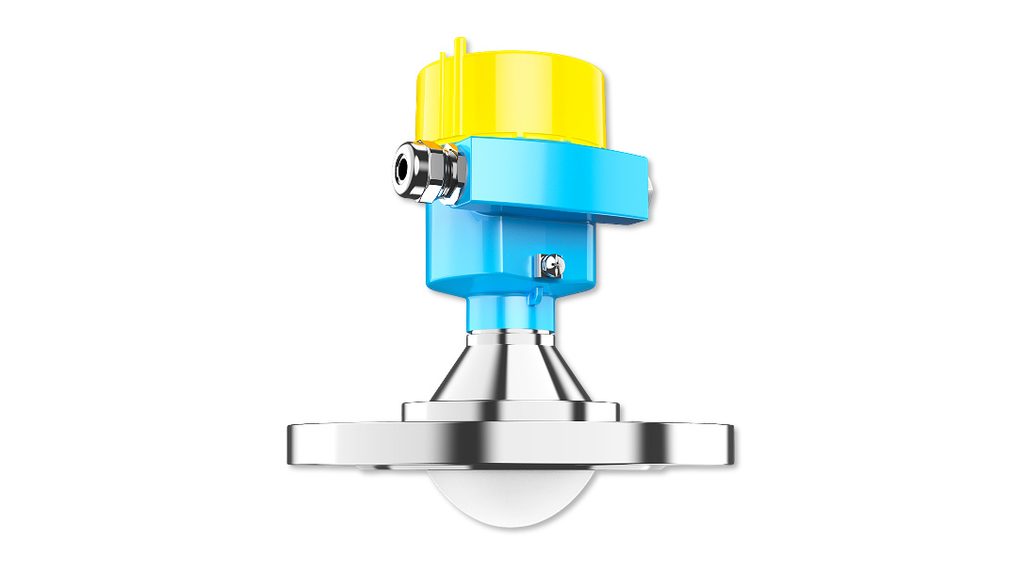
The JWrada-34 uses 80 GHz FMCW radar technology for non-contact level measurement.
Its published specifications include:
- Operating frequency: 80 GHz.
- Maximum measuring range: 150 m.
- Measurement accuracy up to ±1 mm under specified conditions.
- 76 mm lens antenna.
- Intelligent echo processing.
- False-echo learning and multi-echo separation.
- Dynamic target tracking.
- 4–20 mA/HART and RS485/Modbus communication options, depending on configuration.
3.1 Non-Contact Measurement
The instrument is mounted above the stored soybean meal.
It does not require an immersed probe or mechanical float.
This can reduce maintenance associated with moving components exposed to fine powder.
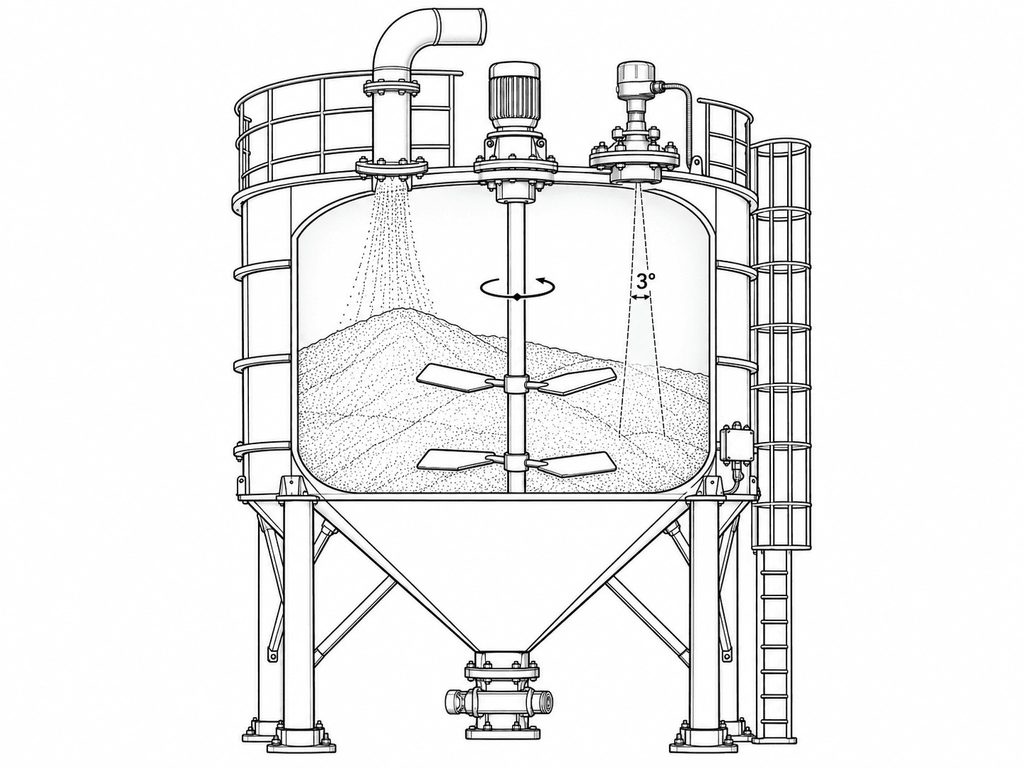
3.2 Focused Radar Beam
The 80 GHz radar technology supports a concentrated beam.
When correctly installed, this helps reduce unwanted reflections from nearby silo structures.
3.3 Echo Processing for Bulk Materials
The JWrada-34 incorporates functions designed to identify the real material surface among multiple reflections.
This can be useful when the silo contains internal supports or other structures.
The actual surface echo should be verified during filling and discharge operations.
3.4 Automation Integration
Compatible configurations can provide 4–20 mA/HART or RS485/Modbus communication.
This enables integration with feed mill PLC systems for material inventory monitoring and replenishment management.
4. Typical Application Scenario
Consider an animal feed manufacturing plant that stores soybean meal in an intermediate buffer silo before transferring it to an automated batching system.
The factory wants to monitor material availability and coordinate replenishment with upstream storage.
A representative application is shown below.
| Parameter | Example Condition |
|---|---|
| Material | Soybean meal |
| Vessel | Vertical buffer silo |
| Silo height | Approximately 18 m |
| Filling method | Mechanical conveying |
| Discharge method | Screw conveyor |
| Environment | Powder dust |
| Measurement method | Top-mounted radar |
| Control system | PLC |
| Output | 4–20 mA/HART |
| Instrument | JWrada-34 |
These are illustrative engineering assumptions, not verified customer installation data.
The nominal distance is within the instrument’s published maximum measuring range.
Actual suitability should be confirmed based on silo geometry, material properties, dust conditions, and installation restrictions.
5. Installation Recommendations
5.1 Avoid the Material Inlet
The radar should not be installed directly above the filling stream.
Incoming soybean meal may create dust clouds and an unstable surface.
5.2 Consider the Discharge Geometry
The position of the radar should be selected with reference to the discharge opening and expected material flow pattern.
The measurement point should provide useful information about the stored material rather than a localized pile that does not represent the overall inventory.
5.3 Avoid Internal Obstructions
Support beams, ladders, and other metal structures should be considered when selecting the installation position.
5.4 Provide Inspection Access
The antenna should remain accessible for periodic inspection, especially in applications with significant dust accumulation.
6. Commissioning and Measurement Verification
The instrument should be configured according to the actual silo dimensions.
After setting the empty distance and operating range, technicians should verify the radar echo under different conditions.
These should include normal filling, material discharge, low material level, and high material level.
The true surface echo should be identified before false-echo learning is performed.
The displayed level should also be compared with an independent reference measurement at representative material levels.
If bridging is suspected, the radar reading should be compared with discharge flow information rather than being interpreted as proof that material is flowing normally.
7. PLC Integration and Feed Mill Automation
The JWrada-34 can provide continuous level data for feed mill automation systems.
Raw Material Inventory Monitoring
Operators can monitor soybean meal levels from a central control room.
Batching Coordination
The level signal can support material availability checks before a batching sequence begins.
Replenishment Alerts
Low-level thresholds can notify operators when the buffer silo requires replenishment.
Discharge Management
The level signal can be combined with screw conveyor status and other process information to help identify unusual operating conditions.
8. Expected Operational Benefits
A suitable installation may provide:
- Continuous soybean meal level monitoring.
- Reduced manual inspection.
- Better visibility of buffer silo inventory.
- Support for automated batching.
- Improved replenishment planning.
- Easier integration with feed mill control systems.
Actual performance should be confirmed through commissioning records and operational data.
9. Frequently Asked Questions
Q1: Can JWrada-34 measure soybean meal?
It can be evaluated for soybean meal silo applications. Final suitability depends on material properties, dust concentration, silo dimensions, and installation conditions.
Q2: Can it detect soybean meal bridging?
Not directly. It measures the material surface. Bridging should be evaluated using additional flow or discharge monitoring information.
Q3: Does dust affect radar measurement?
Heavy dust may influence signal quality under certain conditions. Application testing and proper installation are recommended.
Q4: Can the instrument calculate soybean meal weight?
It measures level, not weight. Weight estimation requires bulk density and silo geometry information.
Q5: Can it connect to an automated feed batching system?
Yes. Compatible communication configurations can provide level information to PLC and DCS systems.
10. Conclusion
Soybean meal buffer silos are important components of automated animal feed production.
Dust, uneven material surfaces, changing bulk density, and potential bridging can complicate level monitoring.
The JWrada-34 80 GHz radar level meter offers a non-contact measurement option for suitable soybean meal storage applications.
With appropriate installation, echo verification, and PLC integration, the instrument can support better inventory visibility and more coordinated material handling in feed mills.