Hydrogen peroxide is widely used in chemical processing, electronics manufacturing, pulp and paper production, textile bleaching, wastewater treatment, pharmaceutical production, and many other industrial applications.
Because hydrogen peroxide is a strong oxidizing agent, storing and handling it requires careful attention to equipment materials, contamination control, process safety, and instrumentation reliability.
One important part of a hydrogen peroxide storage system is reliable level detection.
In many installations, continuous level transmitters are used to monitor the amount of liquid inside a tank. However, critical points such as high-high level alarms, overflow protection, low-level alarms, and pump dry-run protection often require an independent point level switch.
For these applications, a corrosion-resistant tuning fork level switch can provide a simple and reliable solution.
Unlike float switches, tuning fork level switches have no moving mechanical parts. They detect whether liquid is present by monitoring changes in the vibration frequency of the tuning fork.
When appropriate wetted materials are selected, this technology can be used for hydrogen peroxide and many other corrosive chemical liquids.
This article explains how a corrosion-resistant tuning fork level switch can be applied to hydrogen peroxide tank level detection, including its operating principle, material selection, installation considerations, and practical advantages.

Why Is Hydrogen Peroxide Level Detection Challenging?
Hydrogen peroxide, commonly referred to as H2O2, has very different characteristics from ordinary water.
Its strong oxidizing properties place higher requirements on storage tanks, piping, valves, seals, and level instrumentation.
Depending on concentration and operating conditions, hydrogen peroxide may react with incompatible materials or contaminants. Its decomposition can also accelerate when exposed to certain impurities, metals, elevated temperatures, or unsuitable surfaces.
For this reason, instruments installed directly in a hydrogen peroxide tank must be selected carefully.
A typical hydrogen peroxide storage system may require several types of level protection.
For example:
- A high-level switch can prevent overfilling.
- A high-high level switch can provide an independent emergency alarm.
- A low-level switch can indicate when the tank is nearly empty.
- A low-low level switch can stop a transfer pump and prevent dry running.
These switching points are particularly important in automated chemical storage and dosing systems.
Although a continuous level transmitter can provide real-time level information, many facilities still use an independent hydrogen peroxide level switch for critical alarm and interlock functions.
This provides an additional layer of protection if the continuous measurement system experiences a fault.
Typical Hydrogen Peroxide Tank Application
Consider a hydrogen peroxide storage tank used in a chemical processing plant.
Hydrogen peroxide is delivered into the tank and later transferred to a production process through a pump.
Two point level switches may be installed on the tank.
The upper switch is used for high-level or high-high-level detection.
When the liquid reaches the predefined level and covers the tuning fork, the switch changes its output status. The PLC or DCS can then stop the filling pump, close an inlet valve, or activate an alarm.
The lower switch is installed near the minimum operating level.
When the hydrogen peroxide level falls below the tuning fork, the instrument changes its switching state. The control system can then stop the outlet pump to prevent dry running.
In this configuration, the level switch does not measure the exact height of the liquid.
Instead, it answers a much simpler but extremely important question:
Is liquid present at this specific point?
This makes a tuning fork level switch particularly suitable for safety-related high- and low-level detection.
How Does a Tuning Fork Level Switch Detect Hydrogen Peroxide?
A tuning fork level switch works according to the vibration principle.
Inside the instrument, piezoelectric elements excite the fork and cause it to vibrate at its natural resonant frequency.
When the fork is in air, it vibrates at a defined frequency.
When hydrogen peroxide rises and covers the fork, the surrounding liquid changes the vibration characteristics of the fork. The resonant frequency decreases.
The electronic circuit continuously monitors this frequency change.
Once the measured frequency reaches the switching threshold, the electronics determine that the fork is covered by liquid and change the output signal.
When the liquid level falls and the tuning fork becomes exposed again, the vibration returns toward its original condition and the output switches back.
This operating principle offers several advantages for chemical tank level detection.
It does not depend on a float moving up and down, and it does not require the liquid to have a specific electrical conductivity.
This makes tuning fork technology useful for many different liquid applications.
Why Corrosion Resistance Matters in Hydrogen Peroxide Service
Material compatibility is one of the most important considerations when selecting a hydrogen peroxide level switch.
Standard tuning fork switches often use stainless steel wetted parts. Stainless steels such as 304L and 316L are widely used in hydrogen peroxide systems under appropriate conditions.
However, material suitability cannot be determined by material grade alone.
Several factors must be considered, including:
- Hydrogen peroxide concentration
- Process temperature
- Pressure
- Product purity
- Presence of contaminants
- Surface condition
- Cleaning procedures
- Seal material
- Duration of exposure
For more demanding chemical applications, a tuning fork level switch with corrosion-resistant coating or lining can provide additional protection.
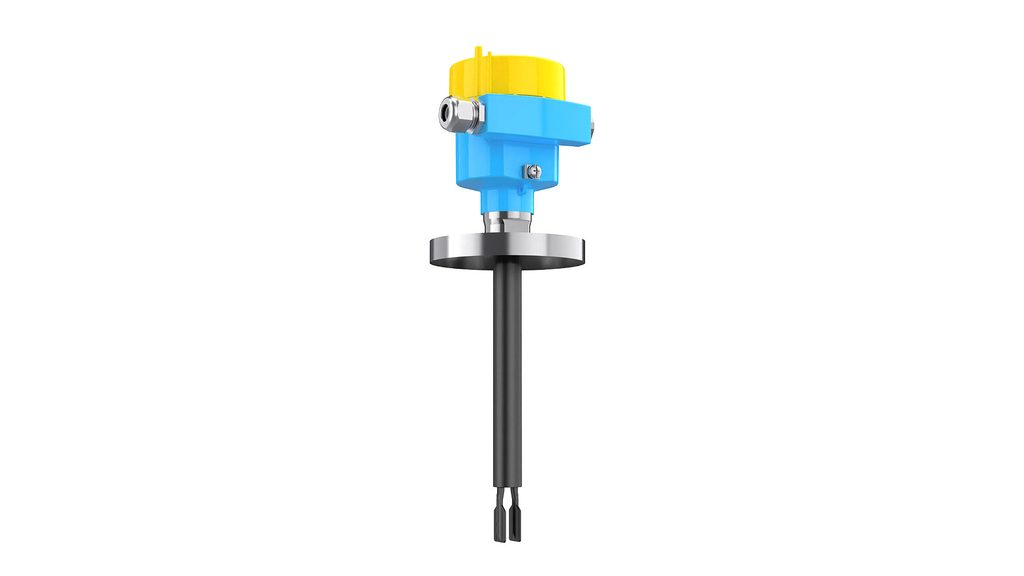
The Ring-11 corrosion-resistant tuning fork level switch can be configured with corrosion-resistant wetted surfaces such as PFA, ECTFE, or enamel coating, depending on the chemical application.
Among these materials, fluoropolymers such as PFA are widely recognized for their high chemical resistance.
For hydrogen peroxide applications, however, final material selection should always be based on the actual hydrogen peroxide concentration, temperature, pressure, purity requirements, and overall process conditions.
Simply choosing an instrument labeled “corrosion resistant” is not enough.
The entire wetted assembly must be evaluated.
Key Advantages of a Corrosion-Resistant Tuning Fork Level Switch
1. No Moving Mechanical Parts
Traditional float switches rely on a moving float mechanism.
In some applications, mechanical movement can be affected by deposits, wear, or obstruction.
A tuning fork level switch detects liquid through vibration and therefore does not require a float to move.
This relatively simple measuring principle can improve long-term reliability in chemical storage applications.
2. Suitable for Point Level Detection
A tuning fork level switch is designed specifically for detecting whether liquid has reached a defined position.
This makes it highly suitable for:
- High-level alarms
- High-high level shutdowns
- Low-level alarms
- Low-low level protection
- Pump dry-run protection
- Overfill prevention
These are exactly the functions commonly required in hydrogen peroxide storage systems.
3. Less Dependent on Electrical Properties of the Liquid
Conductive level switches require the process liquid to provide sufficient electrical conductivity.
A tuning fork switch works differently.
It detects the change in mechanical vibration when the fork is covered by liquid.
Therefore, conductivity is not the primary measurement condition.
This allows the same technology to be used with a wide variety of chemical liquids.
4. Compact Fork Design
The Ring-11 uses a compact fork of approximately 40 mm in length.
A short tuning fork is useful in applications where installation space is limited.
It can also reduce intrusion into the tank compared with long probe-type point level sensors.
The compact design makes the instrument suitable for side mounting on storage tanks, process vessels, and some pipelines.
5. Multiple Corrosion-Resistant Material Options
For aggressive chemical environments, wetted parts can be selected according to process requirements.
Available corrosion-resistant options may include materials or coatings such as:
- PFA
- ECTFE
- Enamel
- 316L stainless steel for compatible applications
This provides more flexibility than using a single wetted material for every process.
6. Multiple Electrical Output Options
Depending on the control system, the tuning fork level switch may be configured with different electrical outputs, including relay, two-wire, NAMUR, or transistor outputs.
This allows integration with PLC, DCS, alarm systems, and safety interlock circuits.
High-Level Detection in a Hydrogen Peroxide Tank
One of the most common applications is high-level protection.
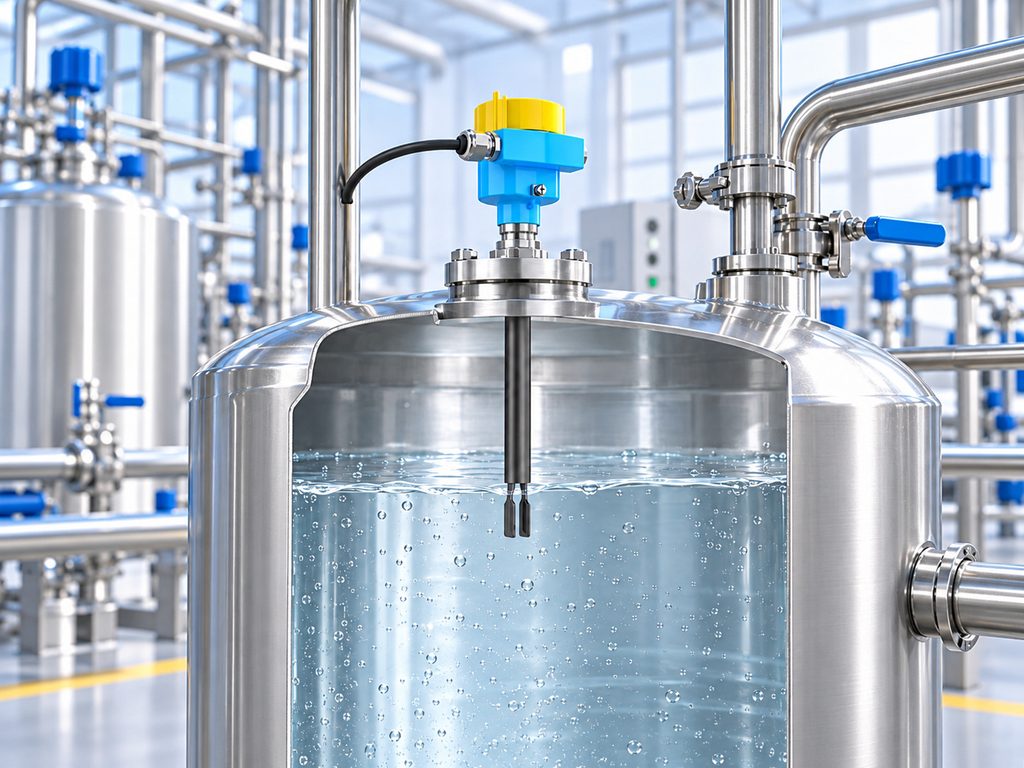
The tuning fork switch is mounted near the maximum allowable liquid level.
During filling, the hydrogen peroxide level gradually rises.
When the liquid reaches the tuning fork, the change in vibration is detected and the output switches.
The signal can then be used to:
- Stop the filling pump
- Close the inlet valve
- Activate a high-level alarm
- Trigger a high-high level interlock
- Send a warning to the control room
Using an independent point level switch for this function can provide additional protection against tank overfilling.
For critical applications, the switch can be used together with a separate continuous level transmitter.
The transmitter provides normal process monitoring, while the tuning fork switch provides an independent high-level alarm.
Low-Level and Pump Protection
The same technology can also be used for low-level detection.
A second tuning fork level switch can be installed near the lower part of the tank.
Under normal conditions, the fork remains covered by hydrogen peroxide.
As the tank level decreases, the liquid eventually falls below the fork.
The instrument detects the change and sends a low-level signal to the control system.
This signal can be used to stop the transfer pump.
Preventing pump dry running is important because operating a pump without sufficient liquid can cause overheating, seal damage, cavitation, or premature equipment failure.
A low-level switch therefore protects both the process and the pumping equipment.
Installation Considerations for Hydrogen Peroxide Tanks
Correct installation is essential for reliable operation.
Avoid the Direct Filling Stream
A tuning fork level switch should not normally be installed directly in the path of a high-velocity filling stream.
Constant liquid impact may affect measurement stability and can also create unnecessary mechanical stress.
Whenever possible, the switch should be installed away from the inlet pipe.
Consider the Direction of Liquid Flow
If the instrument is installed where the liquid is moving, the tuning fork should be oriented according to the manufacturer’s installation recommendations.
Correct orientation helps reduce the effect of flow on the fork.
Protect the Corrosion-Resistant Surface
If the tuning fork uses a PFA, ECTFE, enamel, or other protective surface, care must be taken during transportation and installation.
Mechanical damage to a corrosion-resistant coating can expose the underlying material.
The fork should therefore not be scraped, hit, bent, or used as a support point during installation.
Check All Wetted Materials
Do not evaluate only the fork material.
For hydrogen peroxide service, the entire process connection should be reviewed, including:
- Tuning fork
- Process connection
- Coating or lining
- Gasket
- Seal
- Flange surface
- Installation accessories
All materials that may contact hydrogen peroxide must be suitable for the actual process conditions.
Continuous Level Measurement Plus Point Level Protection
For many chemical storage tanks, the most effective solution is not to choose between a continuous level transmitter and a point level switch.
Instead, both can be used together.
For example:
Continuous Level Transmitter
Used for:
- Real-time tank level monitoring
- Inventory management
- Process control
- Level trending
Tuning Fork Level Switch
Used for:
- High-high level alarm
- Independent overfill protection
- Low-low level shutdown
- Pump dry-run protection
This configuration provides measurement redundancy and separates routine process monitoring from critical safety switching.
If the continuous level signal becomes unreliable, the independent point level switch can still provide a discrete alarm at the critical level.
Maintenance Considerations
A corrosion-resistant tuning fork level switch generally requires relatively little maintenance.
However, periodic inspection is still recommended.
Operators should check:
- The condition of the tuning fork
- The integrity of the corrosion-resistant coating
- Process connection tightness
- Seal condition
- Product buildup
- Crystal formation
- Abnormal deposits
If deposits accumulate on the fork, the vibration characteristics may change.
The inspection frequency should therefore be determined according to the actual process and contamination level.
For hydrogen peroxide systems, cleanliness is particularly important.
Oil, grease, metal contamination, or incompatible residues should be avoided because contaminants may accelerate hydrogen peroxide decomposition.
Practical Benefits in Hydrogen Peroxide Storage Systems
Installing a corrosion-resistant tuning fork level switch for hydrogen peroxide can improve both process automation and equipment protection.
Instead of relying entirely on manual observation, the storage system can automatically detect critical level conditions.
A high-level switch can help prevent overfilling.
A low-level switch can protect the transfer pump.
The signal can be integrated into a PLC or DCS to perform actions such as:
- Audible and visual alarms
- Automatic pump shutdown
- Valve closure
- Interlock activation
- Event recording
- Remote monitoring
The purpose of the instrument is not to provide complex continuous measurement.
Its value lies in reliably identifying a critical switching point.
For chemical tanks containing corrosive or oxidizing liquids, this simple function can form an important part of the overall process protection strategy.
How to Select a Hydrogen Peroxide Level Switch
Before selecting a tuning fork level switch for hydrogen peroxide service, the following process information should be confirmed:
Hydrogen peroxide concentration
Different concentrations may require different wetted materials.
Maximum operating temperature
Chemical compatibility can change significantly as temperature increases.
Operating pressure
The process connection and instrument pressure rating must meet the tank conditions.
Tank material and connection type
Threaded, flanged, or other process connections should match the vessel design.
Required switching point
The mounting location should correspond accurately to the required high or low alarm level.
Electrical output
The output must be compatible with the PLC, DCS, relay circuit, or safety system.
Area classification
If the installation is located in a hazardous area, the appropriate explosion protection or intrinsic safety configuration should be selected.
Wetted material
PFA, ECTFE, stainless steel, enamel, or other materials should be selected according to the complete chemical service conditions.
Providing this information during instrument selection helps reduce compatibility problems and improves long-term reliability.
Conclusion
Hydrogen peroxide is a strong oxidizing chemical that places demanding requirements on storage equipment and process instrumentation.
Reliable tank level protection therefore requires more than simply detecting the presence of liquid.
The instrument must also use wetted materials that are suitable for the specific concentration, temperature, pressure, purity, and operating conditions.
A corrosion-resistant tuning fork level switch detects liquid by monitoring changes in the resonant frequency of the tuning fork when it becomes immersed.
Because the technology has no moving float mechanism and is well suited to point level detection, it can be used for critical functions such as:
- Hydrogen peroxide high-level alarms
- High-high level protection
- Low-level alarms
- Pump dry-run protection
- Chemical tank overfill prevention
With suitable corrosion-resistant materials such as PFA, ECTFE, enamel, or compatible stainless steel, a tuning fork level switch can provide a practical solution for hydrogen peroxide and other corrosive chemical liquids.
For best results, instrument selection should always begin with the actual process conditions.
Hydrogen peroxide concentration, operating temperature, pressure, tank connection, electrical output, and wetted material compatibility should all be confirmed before installation.
When correctly selected and installed, a corrosion-resistant tuning fork level switch can provide a simple, reliable, and effective layer of protection for hydrogen peroxide storage and handling systems.