Introduction: Why Is Accurate Level Measurement Important in Honey Production?
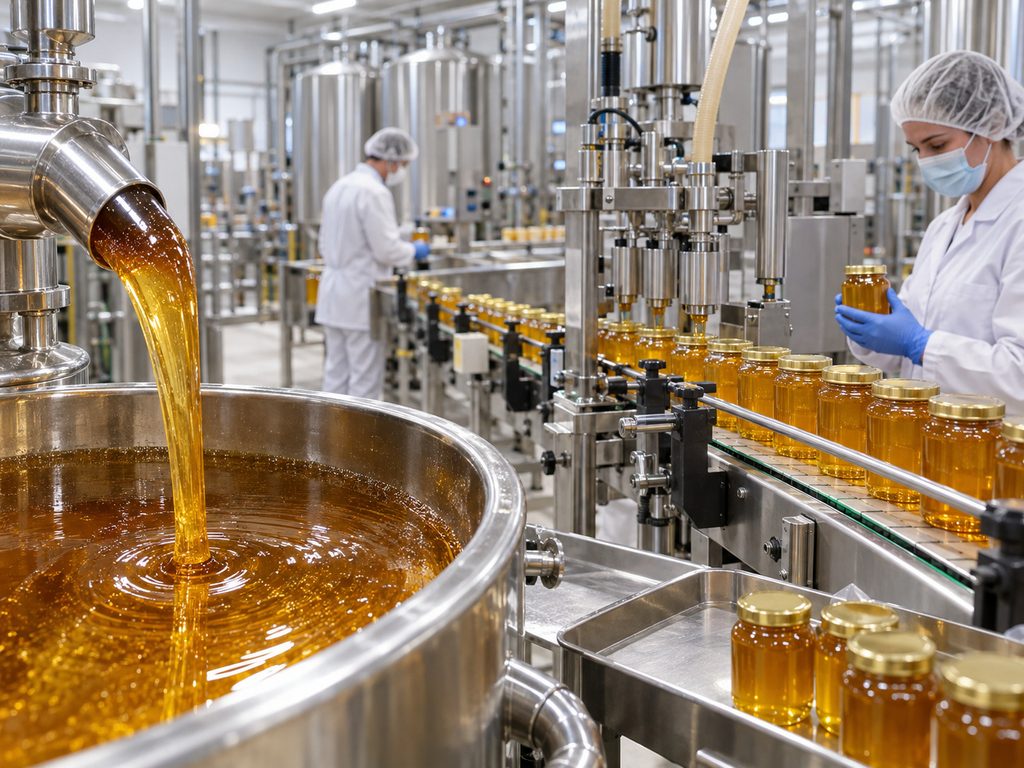
With the continuous improvement of automation in the food processing industry, honey manufacturers are placing increasing demands on raw material storage, production control, and filling processes. Accurate liquid level data is essential for production scheduling, inventory management, automatic dosing, and stable operation of the entire manufacturing process. Radar Level Transmitter
However, honey is significantly different from common liquids such as water and oil. Due to its high viscosity, poor flowability, and strong adhesion characteristics, honey creates challenges for conventional level measurement instruments. Traditional contact-type level sensors may experience measurement errors, material buildup, and frequent maintenance during long-term operation.
Therefore, selecting a reliable level measurement solution that can operate under high-viscosity food processing conditions has become an important requirement for modern honey production facilities.
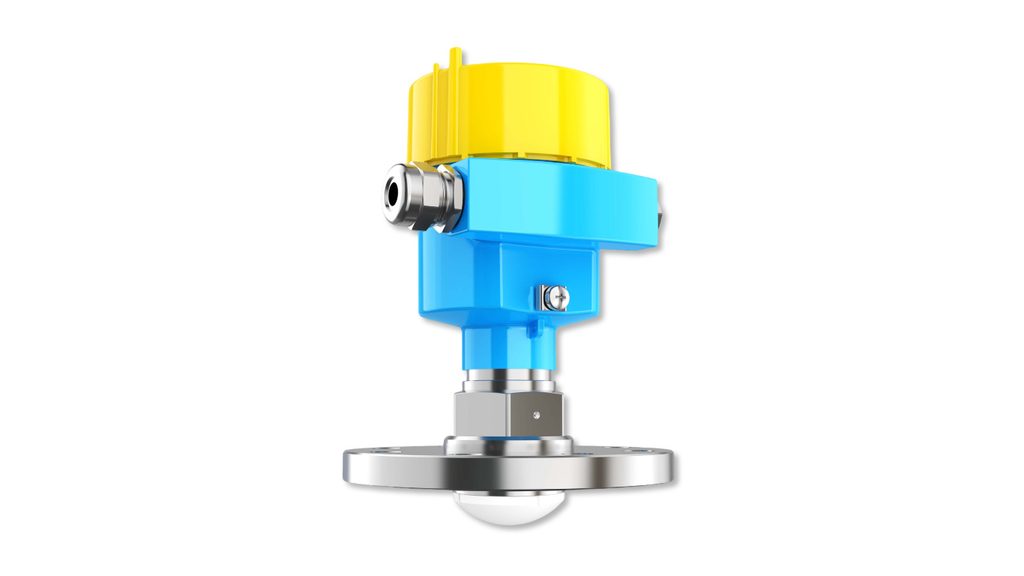
The JWrada-32 radar level transmitter provides an advanced solution for honey storage tank applications. Based on 80GHz millimeter-wave radar technology, non-contact measurement principles, and intelligent echo processing algorithms, it delivers stable and accurate level monitoring even in challenging industrial environments.
1. Challenges of Honey Tank Level Measurement
1.1 High Honey Viscosity Causes Material Adhesion Problems
Honey contains high concentrations of sugars and natural components, resulting in relatively high viscosity. During storage and processing, honey tends to adhere to equipment surfaces.
For conventional contact level instruments, such as:
- Magnetic level gauges;
- Tuning fork level switches;
- Hydrostatic level transmitters;
long-term contact with honey may cause material buildup on sensing components.
As honey accumulates on the measuring parts, instrument response may become slower, and inaccurate level readings may occur.
For continuous food production facilities, frequent cleaning and maintenance increase labor costs and may interrupt normal production schedules.
1.2 Strict Hygiene Requirements in Food Processing
Food processing industries have strict requirements for equipment cleanliness and safety.
Honey production tanks often require regular cleaning procedures, including CIP (Clean-in-Place) operations. When level instruments are directly exposed to the product, cleaning becomes more complicated, and maintenance requirements increase.
Therefore, reducing direct contact between measurement devices and food materials is an important consideration for improving equipment reliability and maintaining hygiene standards.
1.3 Liquid Surface Fluctuations Affect Measurement Stability
During honey processing, storage tanks may experience various operating conditions, including:
- Raw honey feeding;
- Mixing and blending;
- Heating processes;
- Material transfer;
- Filling operations.
These processes can create liquid surface turbulence. In addition, internal structures such as agitators, heating elements, and tank supports may generate signal interference.
Therefore, level measurement equipment must have strong signal processing capabilities to maintain reliable readings under changing conditions.
2. Advantages of JWrada-32 Radar Level Transmitter for Honey Measurement
2.1 Non-Contact Measurement Reduces Honey Adhesion Issues
The JWrada-32 radar level transmitter uses radar measurement technology. Installed on the top of the storage tank, it emits high-frequency electromagnetic waves toward the honey surface and calculates the distance based on the radar signal travel time.
Since the instrument does not directly contact honey during measurement, it effectively reduces problems such as:
- Honey buildup on sensors;
- Product contamination risks;
- Frequent cleaning requirements.
Compared with traditional contact-type instruments, non-contact radar measurement is more suitable for food applications requiring high hygiene standards and low maintenance operation.
2.2 80GHz Millimeter-Wave Radar Technology Improves Measurement Reliability
The JWrada-32 adopts advanced 80GHz millimeter-wave radar technology, which provides:
- Narrower beam angle;
- Stronger signal focusing capability;
- Better interference resistance.
In honey storage tanks, internal structures such as agitators and tank walls may affect radar signals. The highly focused radar beam helps reduce interference from unwanted reflections while improving the recognition of the actual liquid surface echo.
This makes the instrument suitable for complex storage environments where stable measurement performance is required.
2.3 Intelligent Echo Processing Ensures Stable Level Data
Industrial storage tanks rarely provide ideal measurement conditions.
During honey production, factors such as:
- Liquid surface movement;
- Mixing operation;
- Internal tank structures;
- Multiple reflections;
may affect radar signals.
The JWrada-32 uses intelligent echo processing technology to identify effective liquid level signals and improve measurement stability in complex environments.
Reliable level data allows manufacturers to achieve better control of:
- Automatic material supply;
- Inventory monitoring;
- Production scheduling.
2.4 Multiple Communication Options Enable Easy System Integration
Modern honey processing plants usually rely on PLC, DCS, and digital management systems.
The JWrada-32 supports common industrial communication methods, including:
- 4–20mA output;
- HART communication;
- RS485/Modbus communication.
The transmitter can be easily integrated into existing automation systems, enabling real-time monitoring of honey storage levels and supporting digital production management.
3. Application Case: JWrada-32 Radar Level Transmitter in Honey Storage Tanks
Project Background
A food processing company specializing in honey products operates multiple stainless-steel storage tanks for raw honey storage, filtration, blending, and filling processes.
The company required continuous monitoring of honey levels to improve production efficiency and inventory management.
However, the existing level measurement system encountered several problems.
Existing Problems
1. Frequent Maintenance Requirements
Because honey has high viscosity, traditional contact measuring devices accumulated honey residue after extended operation.
Operators needed to regularly remove and clean the equipment, increasing maintenance workload.
2. Unstable Level Measurement Results
During production, mixing and material transfer caused liquid surface fluctuations.
The existing measurement method sometimes produced unstable readings, making it difficult for operators to accurately determine the actual honey volume inside the tank.
3. Limited Production Management Efficiency
Without reliable real-time level data, operators had to manually check storage conditions, which affected production planning and raw material management.
4. JWrada-32 Radar Level Measurement Solution
To solve these challenges, the company installed JWrada-32 radar level transmitters on honey storage tanks.
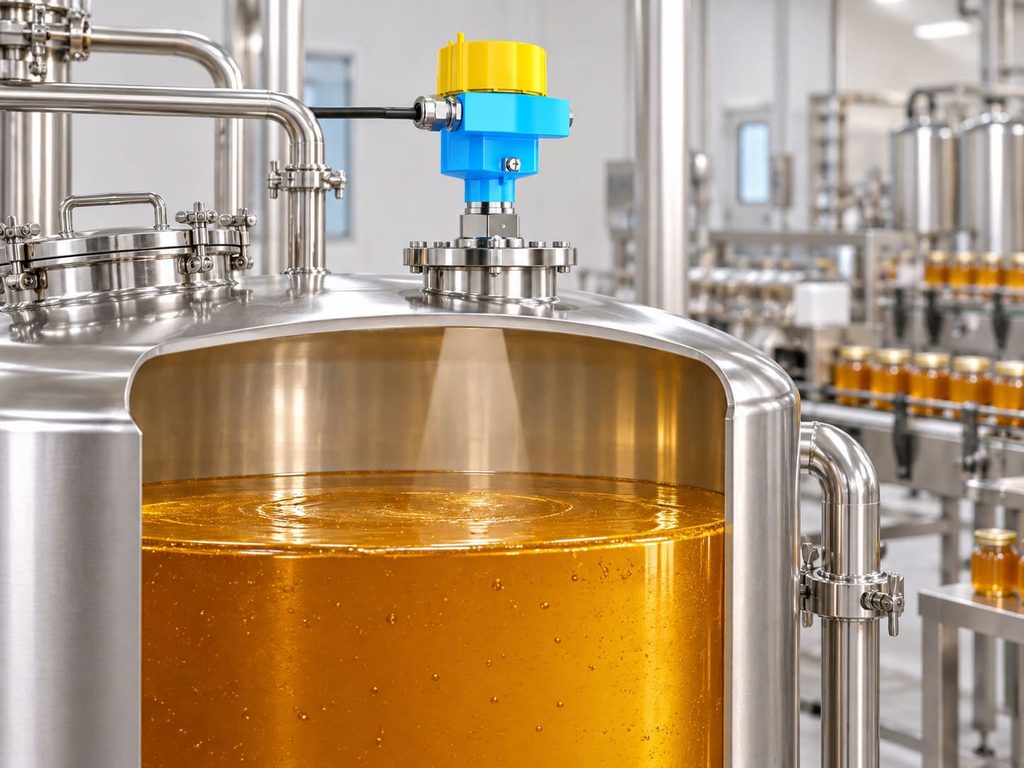
4.1 Top-Mounted Installation for Continuous Monitoring
The radar transmitter was installed on the upper part of the storage tank and continuously measured the honey surface level.
Compared with traditional contact measurement technologies, this installation method provides:
- No direct contact with honey;
- Reduced cleaning requirements;
- Improved operational reliability.
4.2 Optimized Configuration for Honey Storage Conditions
According to the tank dimensions, installation position, and operating conditions, measurement parameters were optimized, including:
- Tank height settings;
- Measuring range;
- Signal output configuration;
- Echo processing parameters.
After adjustment, the radar transmitter achieved stable detection of the honey surface.
4.3 Integration with Automation Control Systems
The measured level signal was transmitted to the factory control system through industrial communication interfaces.
Operators can now monitor:
- Current honey level;
- Remaining raw material quantity;
- Filling status;
- Production consumption.
This improved the company’s production automation and digital management capabilities.
5. Application Benefits
5.1 Reduced Maintenance Frequency
Because the radar transmitter operates without direct contact with honey, problems caused by material buildup are significantly reduced.
The equipment requires less cleaning and maintenance compared with traditional contact-type instruments.
5.2 Improved Measurement Accuracy and Stability
The combination of 80GHz radar technology and intelligent echo processing provides reliable level measurement performance under complex operating conditions.
Production personnel can obtain continuous and accurate tank level information.
5.3 Improved Production Management Efficiency
Stable level monitoring helps manufacturers:
- Optimize raw material management;
- Improve production planning;
- Reduce manual inspection;
- Enhance automation efficiency.
6. Other Food Industry Applications of JWrada-32 Radar Level Transmitter
In addition to honey storage tanks, radar level measurement technology can also be applied in various food processing environments, including:
- Syrup storage tanks;
- Cooking oil tanks;
- Beverage ingredient tanks;
- Sauce and seasoning tanks;
- Dairy processing tanks;
- Food additive storage systems.
For applications involving viscous liquids, strict hygiene requirements, or continuous online monitoring, radar level transmitters provide a reliable and efficient measurement solution.
Conclusion: Reliable Radar Level Measurement Improves Honey Production Automation
Although honey tank level measurement appears simple, the high viscosity of honey, strict hygiene requirements, and complex production conditions create significant challenges for conventional measurement methods.
The JWrada-32 radar level transmitter addresses these challenges through advanced 80GHz millimeter-wave radar technology, non-contact measurement, intelligent echo processing, and flexible communication options.
By providing accurate and stable level monitoring, it helps honey manufacturers reduce maintenance requirements, improve production efficiency, and achieve smarter process management.
As the food manufacturing industry continues moving toward automation and digitalization, reliable radar level measurement technology will play an increasingly important role in honey processing, food storage, and intelligent production systems.