
What Is an 80 GHz Radar Level Transmitter?
In the level measurement industry, the term “80 GHz radar” has become extremely common.
Whether measuring liquids in storage tanks or bulk solids such as cement, minerals, grain, plastic pellets, or powders in silos, you will often see products marketed as 80 GHz radar level transmitters, 80 GHz radar level sensors, or 80 GHz radar level meters.
This can easily lead to a seemingly logical assumption:
An 80 GHz radar level transmitter continuously transmits an electromagnetic wave at exactly 80 GHz.
For most modern industrial radar level instruments based on FMCW technology, however, this interpretation is not correct.
The term “80 GHz” is better understood as referring to the instrument’s general millimeter-wave operating frequency range or frequency class. It does not necessarily mean that the radar transmits one single, fixed signal at exactly 80.000 GHz at all times.
In fact, many 80 GHz radar level transmitters use FMCW — Frequency Modulated Continuous Wave — technology.
The key word here is “modulated.”
Instead of remaining at one fixed frequency, the transmitted frequency changes continuously over a defined frequency range according to a controlled pattern. This process is generally called a frequency sweep or chirp.
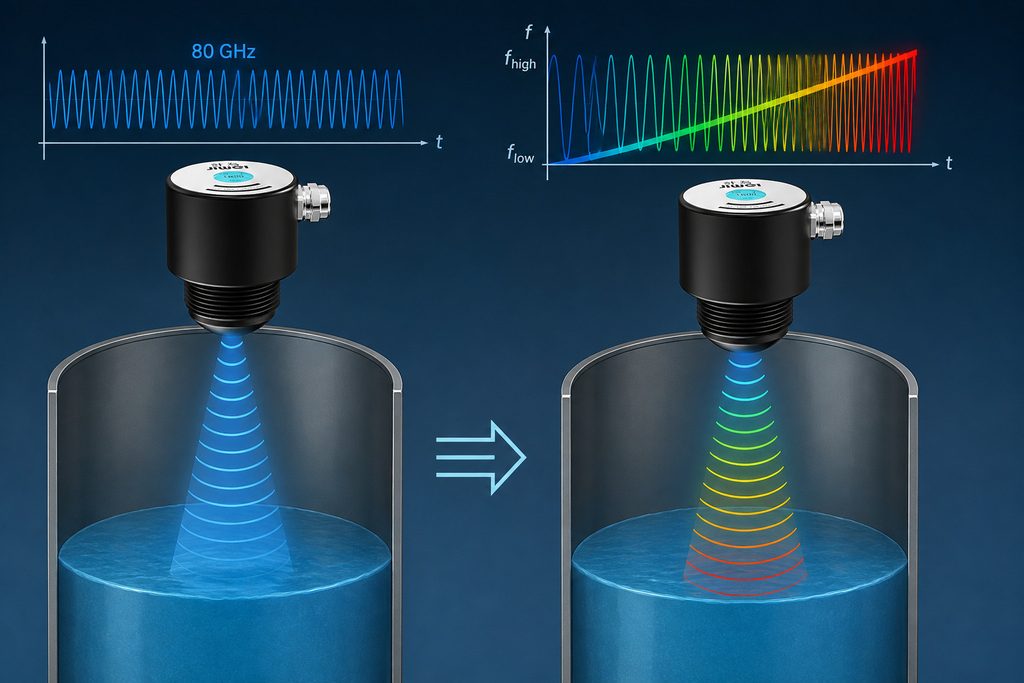
80 GHz Is Not a Frequency Point That Never Moves
To understand this correctly, it is useful to distinguish between three concepts:
Operating frequency range, nominal or center frequency, and instantaneous transmit frequency.
When manufacturers describe an instrument as an “80 GHz radar,” they are generally identifying it as belonging to the high-frequency millimeter-wave class of radar level measurement technology.
At a particular instant, however, the frequency actually being transmitted — the instantaneous frequency — may not be exactly 80 GHz.
Consider a simplified FMCW sweep:
79.0 GHz → 79.2 GHz → 79.4 GHz → 79.6 GHz → … → 80.6 GHz → 80.8 GHz → 81.0 GHz
The entire sweep takes place around the 80 GHz region, but the instantaneous transmitted frequency is continuously changing.
It is important to emphasize that 79–81 GHz is only an example used to illustrate the FMCW principle. It should not be interpreted as the mandatory operating frequency range of every 80 GHz radar level transmitter.
Actual start frequency, stop frequency, sweep bandwidth, and operating frequency range can vary depending on the manufacturer, RF chipset, product design, model, and regional radio-frequency regulations.
For example, Siemens has described the SITRANS LR560 as a 78 GHz FMCW radar level transmitter. Its technical documentation also explains that FMCW radar transmits continuous waves whose frequency is continuously increased during the sweep.
Therefore, terms such as 78 GHz radar, 80 GHz radar, and W-band radar may appear in industrial level measurement literature without necessarily representing fundamentally different distance-measurement principles.
Why Does an 80 GHz Radar Continuously Change Its Frequency?
The answer lies at the heart of FMCW distance measurement.
An FMCW radar can determine distance by analyzing the frequency difference between the transmitted signal and the reflected signal.
Imagine a radar level transmitter mounted at the top of a storage tank.
The radar transmits electromagnetic waves toward the liquid or material surface. When the waves reach the surface, part of the energy is reflected back toward the radar antenna.
Because electromagnetic waves require a finite amount of time to travel to the target and return, the echo received by the radar corresponds to a signal that was transmitted slightly earlier.
Now consider what happens when the radar frequency is continuously increasing.
Suppose the radar transmitted a signal at 79.5 GHz.
That signal travels to the material surface, is reflected, and returns to the instrument. By the time it comes back, the radar may already be transmitting at 79.6 GHz.
We therefore have:
Current transmitted signal: 79.6 GHz
Returned earlier signal: 79.5 GHz
A frequency difference exists between the two.
This difference is commonly called the beat frequency.
In an FMCW radar system, this beat frequency contains information about the propagation delay and therefore about the distance between the radar and the reflecting surface.
Siemens’ explanation of FMCW level measurement similarly describes the frequency difference between the transmitted and received signals as being related to the time of flight.
From this perspective, frequency sweeping is not merely a secondary feature of an 80 GHz radar.
It is a fundamental part of how an FMCW radar measures distance.
A Simple Way to Understand FMCW Frequency Sweeping
One way to visualize FMCW radar is to imagine a sound whose pitch continuously rises.
Instead of producing the same tone all the time, the source produces something like:
Low pitch → higher pitch → even higher pitch → continuously increasing pitch
Now imagine a wall some distance away.
The sound travels to the wall, reflects, and returns as an echo.
Because propagation takes time, the echo you hear now corresponds to a sound that was transmitted slightly earlier. Meanwhile, the source is already producing a higher-frequency sound.
By comparing:
the frequency being transmitted now
with
the frequency of the returning echo,
you obtain a frequency difference.
For an ideal linear frequency sweep, a more distant target creates a longer propagation delay, which in turn produces a corresponding beat frequency.
Inside an industrial FMCW radar level transmitter, electronic mixing, sampling, signal processing, and algorithms are used to extract these frequency components and convert them into distance information.
The instrument can then calculate the liquid level or bulk-solid level.
Of course, an actual industrial radar level transmitter is much more sophisticated than this simplified analogy.
Its signal-processing system may also need to deal with false echoes, multiple reflections, antenna interference, tank walls, ladders, heating coils, agitators, filling streams, changing material surfaces, and many other process conditions.
But if you understand one basic idea —
the transmitted frequency is sweeping while the echo returns with a time delay —
you have understood one of the central principles behind FMCW radar level measurement.
So What Does the “80” in 80 GHz Actually Represent?
In industrial terminology, “80 GHz radar” is a convenient way of identifying a class of radar technology.
It tells engineers that:
the instrument operates in the millimeter-wave region around the 80 GHz frequency range.
It does not necessarily mean:
the instrument transmits exactly 80 GHz at every moment.
This naming convention is not unique to level measurement.
Automotive radar systems, for example, are commonly described as 77 GHz radar, even though FMCW automotive radar systems can operate over a broader frequency range rather than at one single fixed frequency.
Texas Instruments documentation on 76–81 GHz FMCW millimeter-wave radar also explains the relationship between RF sweep bandwidth and radar range resolution.
Therefore, when evaluating an 80 GHz radar level sensor, it is more useful to consider parameters such as:
- Actual operating frequency range
- FMCW sweep bandwidth
- Frequency sweep linearity
- Antenna design
- Beam angle
- Measuring range
- Measurement accuracy and repeatability
- Signal-to-noise performance
- False-echo suppression
- Weak-echo detection capability
- Digital signal-processing algorithms
Together, these factors provide a much more complete picture of radar performance than the “80 GHz” label alone.
Operating Frequency and Sweep Bandwidth Are Not the Same Thing
This is another important distinction when discussing 80 GHz radar level transmitters.
A higher operating frequency does not automatically mean a larger sweep bandwidth. Likewise, a larger sweep bandwidth does not automatically mean that an instrument will always provide better measurement accuracy.
The operating frequency tells us roughly where in the RF spectrum the radar operates.
The bandwidth, on the other hand, tells us how much frequency range is covered during the sweep.
Consider a simplified example.
Radar A sweeps from:
79 GHz to 81 GHz
Its sweep bandwidth is approximately 2 GHz.
Radar B sweeps from:
77 GHz to 81 GHz
Its sweep bandwidth is approximately 4 GHz.
Both can be associated with high-frequency millimeter-wave radar technology around the 80 GHz region, but their sweep bandwidths are clearly different.
For an ideal FMCW radar, theoretical range resolution is commonly expressed approximately as:
ΔR ≈ c / (2B)
where:
ΔR = range resolution
c = speed of electromagnetic wave propagation
B = effective sweep bandwidth
Therefore, all else being equal, a larger effective bandwidth can improve the radar’s ability to distinguish between two reflecting targets located close to each other.
Texas Instruments also describes FMCW range resolution as being inversely related to RF sweep bandwidth.
However, another misconception should be avoided:
Theoretical range resolution is not the same thing as the measurement accuracy specified for a radar level transmitter.
Actual measurement performance can also be affected by sweep linearity, signal-to-noise ratio, antenna characteristics, frequency stability, signal-processing algorithms, calibration, installation, and real process conditions.
For this reason, comparing only “80 GHz” or “4 GHz bandwidth” is not sufficient to conclude that one radar level transmitter must be more accurate than another.
Why Do 80 GHz Radar Level Transmitters Usually Have a Narrow Beam?
Another major reason for the widespread adoption of 80 GHz radar in level measurement is its short wavelength.
At approximately 80 GHz, the free-space wavelength is only a few millimeters.
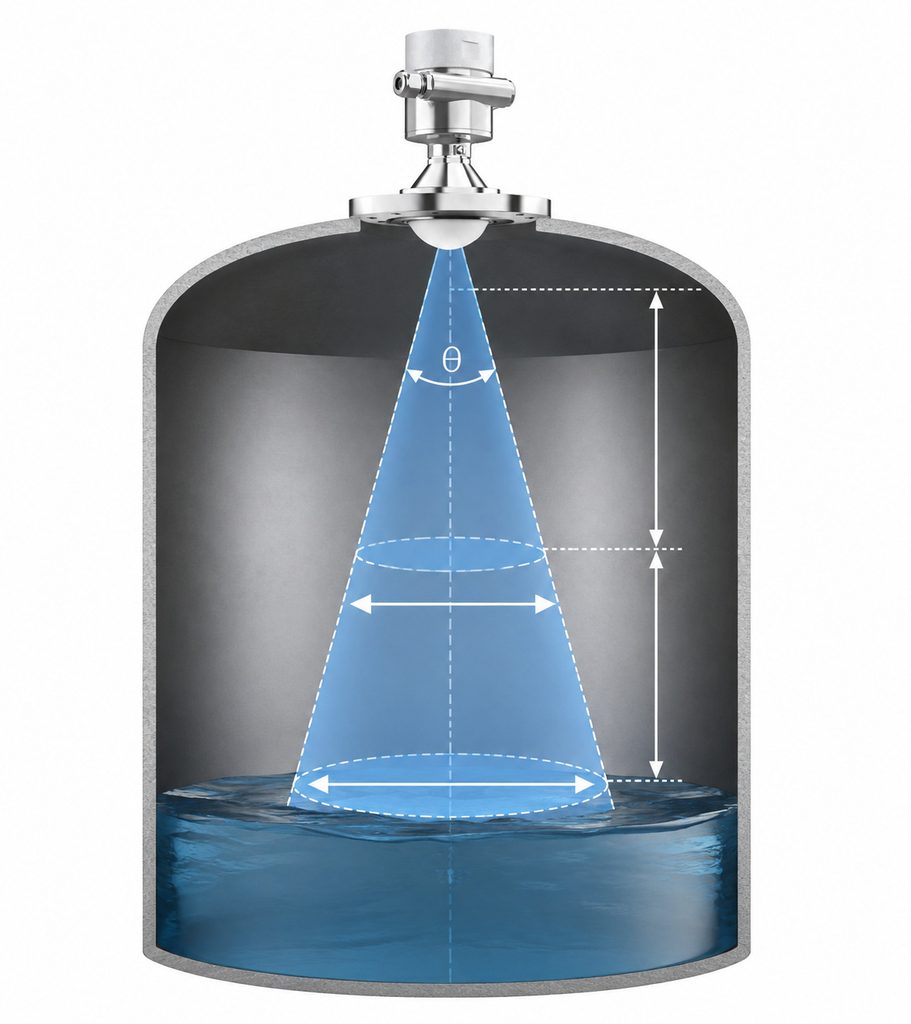
For a similar antenna size, a higher operating frequency makes it possible to achieve a narrower radar beam.
This can be highly beneficial in complicated tanks and bulk-solid silos.
A process vessel may contain:
- Agitators
- Ladders
- Reinforcement structures
- Heating coils
- Filling pipes
- Internal supports
- Other mechanical obstructions
If the radar beam is wide, more of these structures may fall inside the illuminated area and generate unwanted reflections.
A narrower beam allows the radar energy to be directed more precisely toward the actual material surface. This reduces the likelihood that tank walls and internal structures will create significant interfering echoes.
Endress+Hauser, for example, highlights a narrow beam of approximately 3° as one of the advantages of its 80 GHz radar technology. Siemens also emphasizes the advantages of narrow-beam 80 GHz radar in difficult installation environments.
This is one reason why 80 GHz radar level transmitters can be particularly attractive for narrow vessels, small process connections, tall silos, and tanks containing internal obstructions.
Does a Higher Frequency Mean 80 GHz Is Always Better Than 26 GHz?
No.
80 GHz radar offers significant advantages, including compact antennas, narrow beam angles, and access to modern high-frequency millimeter-wave technology.
It has become one of the most important technologies in non-contact radar level measurement.
But industrial instrumentation should never be selected by comparing only one number.
Real applications may involve factors such as:
- Dielectric properties of the medium
- Foam
- Condensation
- Antenna buildup
- Heavy dust
- Process temperature
- Process pressure
- Measuring distance
- Tank geometry
- Internal obstructions
- Surface turbulence
- Material angle of repose
- Reflection characteristics of the target
Depending on the application, these factors can significantly influence the performance of a radar level measurement system.
Endress+Hauser has also noted in its application guidance that 80 GHz technology can be an excellent solution for many applications, while other conditions may justify considering 26 GHz, 6 GHz, or even a different measurement principle.
The correct engineering approach is therefore:
Analyze the application first, then select the appropriate technology.
A larger GHz number alone does not automatically mean better measurement performance.
Why Would a Fixed 80 GHz Signal Not Represent Typical FMCW Level Measurement?
If a radar continuously transmitted a completely fixed single-frequency continuous wave, its operating principle would not be the same as the typical FMCW distance-measurement method discussed here.
Remember what FMCW stands for:
Frequency Modulated Continuous Wave.
The “FM” part means frequency modulated.
The radar intentionally changes its transmitted frequency according to a defined pattern. A delayed echo then returns while the current transmitted frequency has already changed.
By comparing the current transmitted signal with the delayed received signal, the radar obtains a beat frequency from which distance information can be extracted.
Therefore, when describing an 80 GHz radar level transmitter based on FMCW technology, a more technically accurate statement would be:
“The instrument operates in the millimeter-wave frequency range around 80 GHz and uses FMCW frequency sweeping to measure distance.”
Rather than:
“The instrument continuously transmits a fixed 80 GHz signal.”
The difference between these two statements may appear small, but technically they describe very different concepts.
When Selecting an 80 GHz Radar Level Transmitter, Do Not Look at “80 GHz” Alone
Understanding this distinction also has practical value for end users, instrumentation engineers, system integrators, and purchasing departments.
Today, a large number of products are marketed as 80 GHz radar level transmitters.
If the comparison stops at the question “Is it 80 GHz?”, it becomes very difficult to identify meaningful differences between products.
A better approach is to evaluate the radar according to the actual application and examine parameters such as:
operating frequency range, sweep bandwidth, measuring range, beam angle, dead zone, accuracy, repeatability, antenna design, process connection, temperature and pressure ratings, hazardous-area certifications, and echo-processing capability.
This becomes especially important in demanding applications such as:
large bulk-solid silos, low-dielectric media, heavy dust, tanks with agitators, condensation, buildup, weak reflective surfaces, and vessels containing multiple internal obstructions.
In these applications, the RF front end, antenna system, signal processing, and application algorithms should be considered as one complete measurement system.
“80 GHz” matters.
But it is the beginning of understanding a radar level transmitter — not the end.
Frequently Asked Questions About 80 GHz Radar Frequency
Is an 80 GHz radar level transmitter always transmitting at exactly 80 GHz?
No. In an 80 GHz radar level transmitter using FMCW technology, the transmitted frequency typically changes according to a defined sweep pattern over a designed frequency range. “80 GHz” is generally a convenient description of its operating frequency class rather than a statement that the transmitter remains fixed at exactly 80 GHz.
Do all 80 GHz radar level transmitters use the same frequency sweep range?
No. The actual operating frequency range and effective sweep bandwidth can vary between manufacturers, models, RF chipsets, product designs, and regulatory regions. The frequency range of one 80 GHz radar should not automatically be assumed to apply to every other 80 GHz radar.
Why does an 80 GHz radar need to sweep its frequency?
In FMCW radar, the difference between the current transmitted signal and the delayed reflected signal produces a beat frequency. This beat frequency contains information related to the propagation delay and therefore the distance to the target.
Is 80 GHz always the exact center frequency?
Not necessarily. In general industry language, “80 GHz” can be understood as identifying the frequency region in which this class of radar operates. The exact definition of nominal frequency, center frequency, start frequency, stop frequency, and operating band should always be checked in the manufacturer’s technical specifications.
Does 80 GHz automatically mean higher measurement accuracy?
No. Measurement accuracy depends on much more than the nominal operating frequency. Sweep bandwidth, sweep linearity, signal quality, antenna design, RF stability, digital signal processing, calibration, installation, and actual process conditions can all affect measurement performance.
Conclusion: To Understand 80 GHz Radar, Understand Frequency Band and Frequency Sweep
The “80 GHz” in an 80 GHz radar level transmitter does not mean:
the instrument continuously transmits one fixed signal at exactly 80 GHz.
For modern 80 GHz radar level transmitters using FMCW technology, a more accurate explanation is:
The instrument operates in a millimeter-wave frequency range around 80 GHz. Its transmitted frequency is swept continuously over a defined range according to the FMCW principle. The radar then analyzes the frequency difference between the transmitted signal and the delayed reflected signal to determine distance and ultimately calculate liquid level or bulk-solid level.
Three concepts should therefore be clearly separated:
80 GHz tells us approximately where in the frequency spectrum the radar operates.
Frequency sweep range and bandwidth tell us how the transmitted frequency changes and how much frequency spectrum is covered.
FMCW tells us how the radar uses that frequency modulation to obtain distance information.
This is why “80 GHz radar” and “fixed-frequency 80 GHz transmission” are not the same concept.
For engineers and users in the level measurement industry, the most important point is not simply the “80 GHz” printed on a product datasheet.
What ultimately matters is the complete radar system behind that number — including its RF architecture, sweep bandwidth, antenna design, beam angle, signal-processing capability, measurement algorithms, and ability to handle real process conditions.
Understanding this distinction provides a much clearer picture of how an 80 GHz radar level transmitter actually works — and helps avoid one of the most common misconceptions when comparing radar level measurement technologies.