1. Project Background: Loose Powder Production Requires Stable and Reliable Powder Level Detection
1.1 Process Characteristics of Cosmetic Loose Powder Manufacturing
Loose powder, also known as setting powder or finishing powder, is a typical powder-based product in the cosmetics industry. Its main raw materials usually include mica powder, talc powder, silica, starch-based powders, soft-focus powders, pigments, and surface-treated powders. Compared with ordinary granular materials, loose powder is finer, lighter, lower in density, easy to disperse, easy to absorb moisture, easy to accumulate, and prone to adhesion. Therefore, higher requirements are placed on powder conveying, level detection, and automated control during production.
In the manufacturing process of loose powder, powder raw materials usually go through several stages, including raw material storage, weighing and feeding, pre-mixing, fine mixing, grinding and dispersion, screening, temporary storage, filling, and packaging. Every stage requires continuous material supply, clear silo status, and stable equipment operation. If a powder silo runs short of material, the mixing ratio may become unstable. If a hopper is overfilled, powder overflow and dust dispersion may occur. If the filling machine hopper does not have enough material, filling weight fluctuation, empty-container operation, or product rework may result.
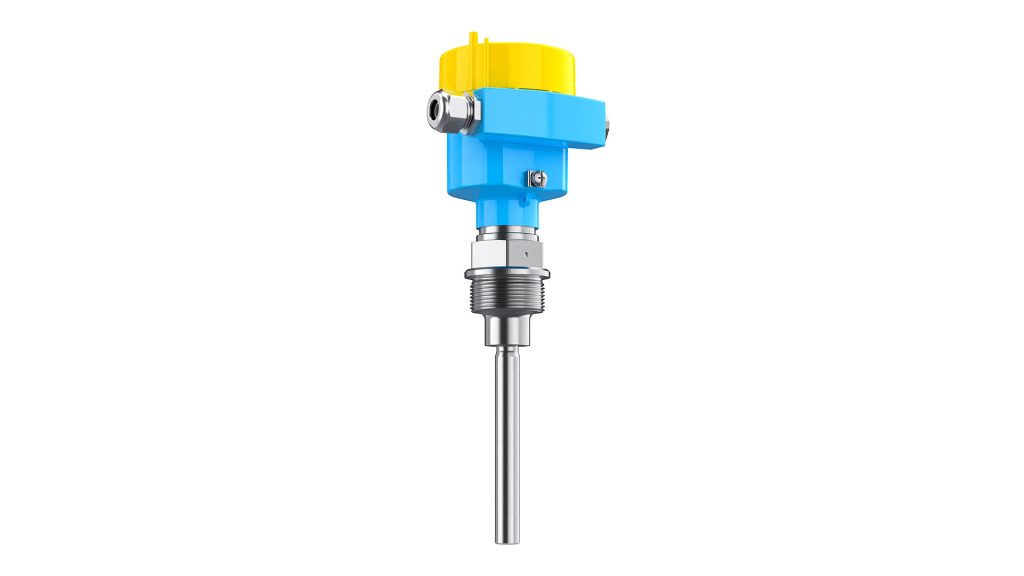
Therefore, a cosmetic loose powder production line requires not only efficient mixing and filling equipment, but also reliable level switches to monitor key silos, hoppers, and buffer bins in real time. The Tube-11 vibrating rod level switch is designed for point level detection of solid materials such as granules and powders. It can be used in loose powder manufacturing for high level alarms, low level alarms, overflow prevention, shortage protection, and automatic feeding interlock control.

1.2 Level Control Challenges at the Customer Site
A cosmetics manufacturer mainly produces translucent loose powder, oil-control loose powder, soft-focus finishing powder, and tinted setting powder. Its production line includes raw material powder silos, pre-mixing hoppers, mixer feeding hoppers, screening buffer bins, automatic conveying systems, and loose powder filling machines. Because loose powder is fine and low in density, dust is easily generated during production. Some surface-treated powders may also slightly adhere to hopper walls, cone outlets, and detection components.
The customer previously used a combination of manual inspection and ordinary level switches to judge material levels. However, several problems occurred during actual operation. First, manual observation was not timely enough, especially for enclosed silos and filling machine hoppers where operators could not accurately see the internal material level. Second, ordinary mechanical level switches were not stable enough when detecting lightweight powder, resulting in delayed action or false alarms. Third, powder adhesion and dust accumulation affected detection accuracy and increased maintenance frequency. Finally, when the filling machine hopper ran short of material, filling shortage or interrupted filling could occur, affecting product quality and production efficiency.
To solve these issues, the customer decided to install Tube-11 vibrating rod level switches at key points on the loose powder production line to achieve more stable powder level detection and automated control.
2. Application Condition Analysis: Why Loose Powder Level Detection Is More Difficult
2.1 Loose Powder Has Low Density and Requires High Detection Sensitivity
Loose powder is a low-density powder. This is especially true for soft-focus powders, oil-control powders, lightweight silica powders, and certain modified powders, which are loose and fluffy in bulk form. When such materials come into contact with a level detection element, the resistance generated is relatively small. If the level switch does not have sufficient sensitivity, the instrument may fail to respond even when the material has already reached the detection point.
The Tube-11 vibrating rod level switch features high sensitivity and can detect media with densities as low as 0.02 g/cm³, making it suitable for low-density and lightweight powder level detection. In loose powder production, this advantage helps manufacturers more accurately identify the material status in powder silos, hoppers, and buffer bins, reducing problems such as material shortage, overfilling, and misjudgment.
2.2 Dust Dispersion Makes Manual Judgement Unreliable
During loose powder production, dust may be generated in feeding, mixing, screening, and filling processes. Although cosmetics workshops usually have strict cleanliness requirements, dust suspension and powder accumulation may still occur inside localized equipment in powder-based production. Dust not only affects manual observation, but may also interfere with some detection methods.
The Tube-11 vibrating rod level switch works based on the vibration detection principle. When the probe is in a free vibration state, the electronic unit outputs one switch signal. When powder comes into contact with the probe, the vibration state changes, and the electronic unit identifies this change and outputs the corresponding signal. This method does not rely on manual observation or transparent sight windows, making it suitable for automatic level detection in enclosed loose powder production equipment.
2.3 Powder Adhesion Can Easily Cause False Alarms
Loose powder is extremely fine, and some raw materials are surface-treated to improve skin feel, adhesion, and smoothness. These powders may leave residue on silo walls, hopper cone sections, or around the probe. If a level switch lacks anti-adhesion capability, residual powder layers may be incorrectly judged as actual material presence, causing delayed low level alarms or delayed automatic feeding.
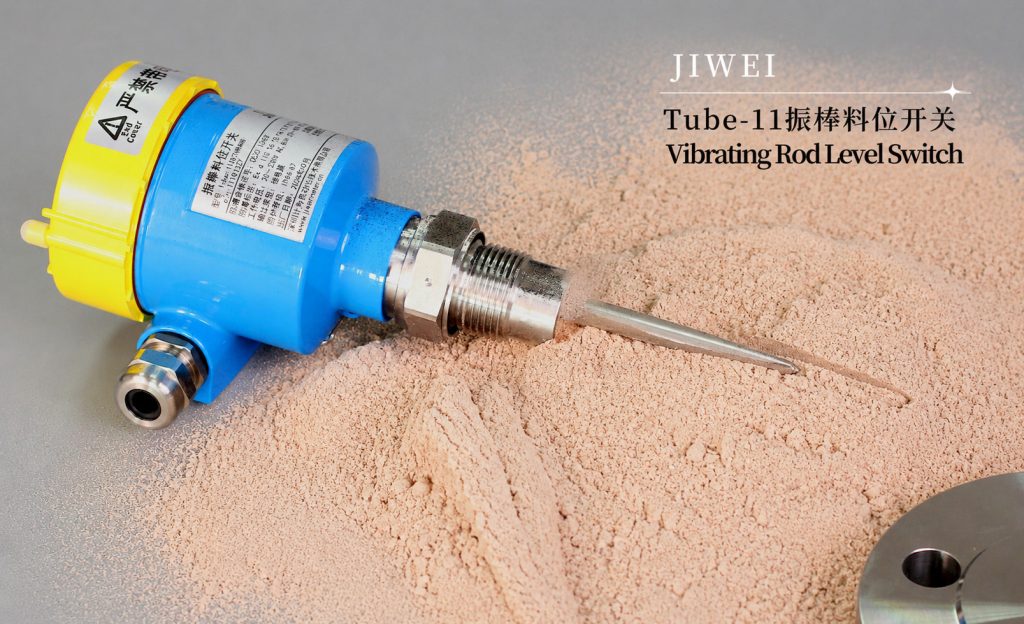
The Tube-11 vibrating rod level switch offers high adhesion tolerance and an anti-adhesion design, making it suitable for sticky or easily adhering materials. At the loose powder manufacturing site, even when slight powder adhesion occurs, it helps reduce false alarms caused by material buildup and improves the reliability of level detection.
3. Product Advantages of the Tube-11 Vibrating Rod Level Switch
3.1 Dual-Tube Probe Design for Powder and Granule Level Detection
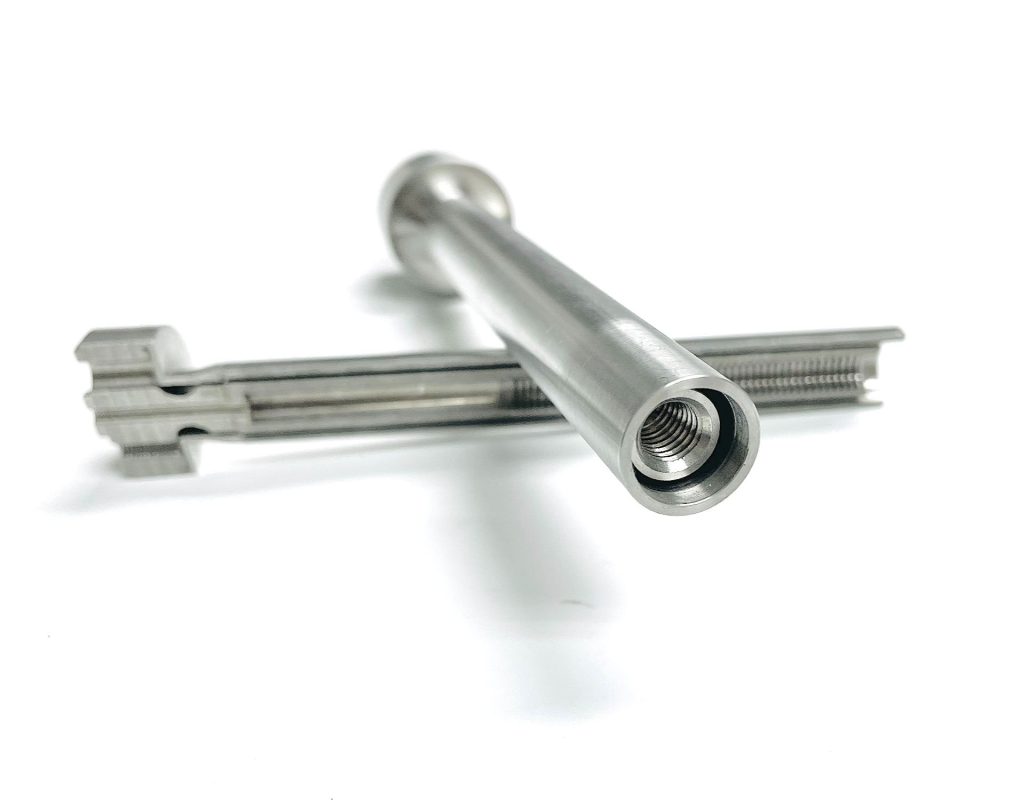
The Tube-11 vibrating rod level switch adopts a dual-tube probe design consisting of internally and externally nested tubes. Compared with ordinary single-rod structures, the dual-tube probe improves vibration detection stability and sensitivity, making it more suitable for point level detection of granules, powders, and lightweight solid materials.
In loose powder manufacturing, the dual-tube probe design better adapts to the characteristics of fine, lightweight, and loose powders. Whether detecting mica powder, talc powder, silica powder, pigments, or mixed loose powder semi-finished products, the Tube-11 can provide stable point level detection and timely level signals for the production line.
3.2 High Sensitivity for Reliable Detection of Low-Density Powders
Many powders used in cosmetic loose powder production have low density, making them difficult for ordinary level switches to detect reliably. The Tube-11 vibrating rod level switch features a precisely tuned probe and high detection sensitivity, allowing it to detect media with densities as low as 0.02 g/cm³. This enables it to cover most lightweight powder working conditions.
This feature is especially important for loose powder production. It helps customers detect material shortage risks in low level conditions and quickly output alarm signals at high level positions to prevent powder overflow and equipment blockage.
3.3 High Temperature Resistance for Wider Process Adaptability
Although most loose powder production processes operate at room temperature, some powder raw materials may involve drying, hot air conveying, thermal cleaning, or special processes. The standard Tube-11 vibrating rod level switch can withstand temperatures up to 250°C, while an ultra-high-temperature version can be selected for temperatures up to 400°C, providing strong adaptability to demanding conditions.
For cosmetics manufacturers, higher temperature resistance not only meets the needs of current loose powder production lines, but also provides more flexibility for future process expansion. For example, if the manufacturer later adds heat-treated powders, post-drying powder storage, or high-temperature cleaning processes, the Tube-11 can still operate reliably.
3.4 Anti-Adhesion Design Reduces the Impact of Powder Residue
Loose powder is prone to adhesion, which is a common challenge in powder level detection. The Tube-11 vibrating rod level switch is suitable for sticky or easily adhering materials and offers strong anti-adhesion capability. When applied in loose powder silos, mixer hoppers, and filling machine buffer bins, it can reduce the influence of powder residue on detection results.
Improved anti-adhesion capability means fewer false alarms, less manual cleaning, and better production continuity. This is especially important for cosmetics production workshops where cleanliness and stable operation are essential.
3.5 Intelligent Self-Diagnosis for Easier Maintenance and Troubleshooting
The Tube-11 vibrating rod level switch is equipped with intelligent self-diagnosis, helping users identify fault locations accurately. For a loose powder production line with multiple machines, hoppers, and detection points, this function allows maintenance personnel to quickly determine the source of a problem and reduce unnecessary disassembly and downtime.
If wiring abnormalities, probe faults, or electronic unit problems occur on site, maintenance personnel can respond more efficiently, improving equipment management and reducing production losses caused by downtime.
3.6 Calibration-Free Installation and Plug-and-Play Operation
The Tube-11 vibrating rod level switch supports calibration-free installation. It can be used immediately after installation, with simple operation and convenient commissioning. This is highly practical for upgrading cosmetic loose powder production lines. Manufacturers can add high and low level detection points to powder silos, hoppers, buffer bins, or filling machines without major equipment modifications.
Calibration-free installation shortens project commissioning time and reduces dependence on operator experience, making the Tube-11 suitable for both new production lines and automation upgrades of existing lines.
3.7 Cable-Type Option for Long-Distance Measurement
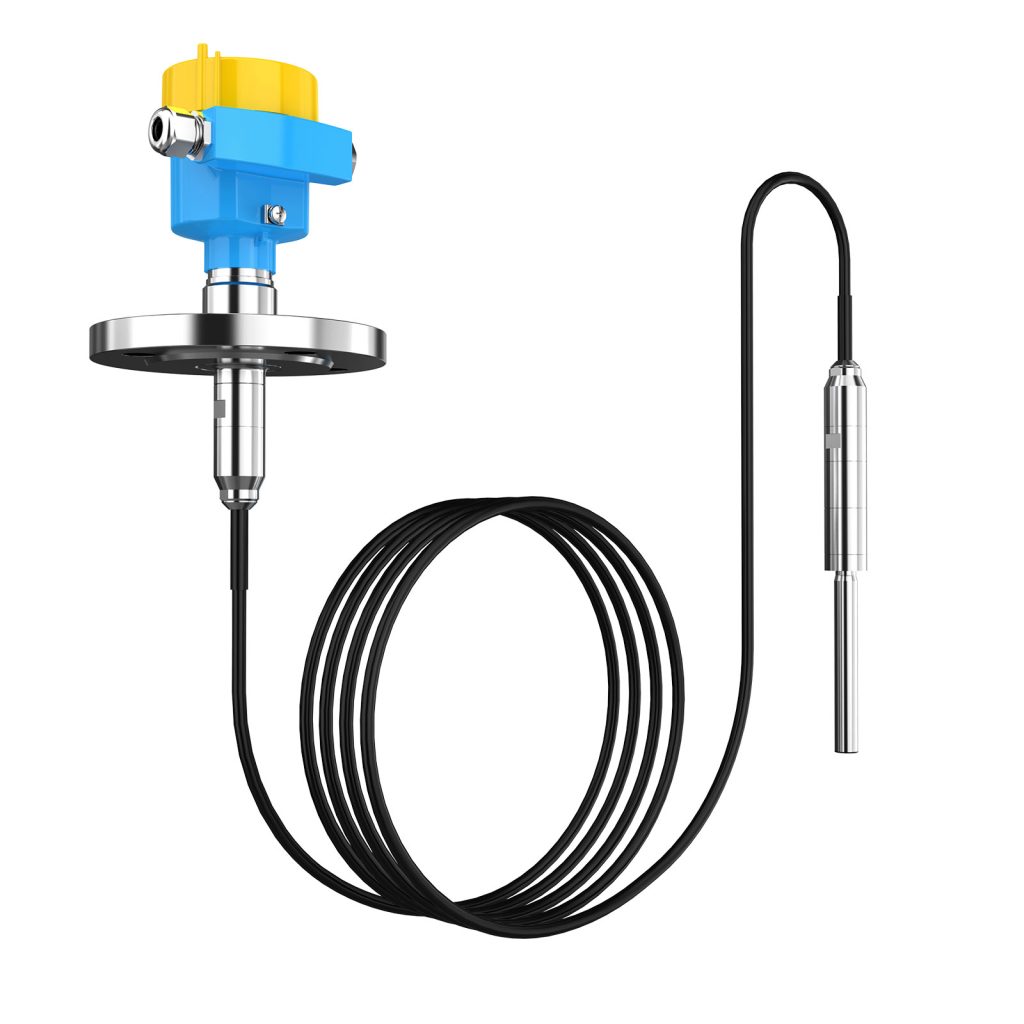
In some large-capacity powder silos or deep storage bins, the detection point may be far from the mounting opening. The Tube-11 vibrating rod level switch can be configured with a cable-type structure using a flexible cable connection, with a maximum length of up to 20 meters, making it suitable for long-distance level measurement.
For centralized storage of loose powder raw materials, large powder buffer bins, or tall silos, the cable-type Tube-11 can be flexibly arranged according to the silo height to achieve high level, low level, or designated point level detection.
4. Specific Applications of the Tube-11 in Loose Powder Manufacturing
4.1 High and Low Level Detection in Raw Material Powder Silos
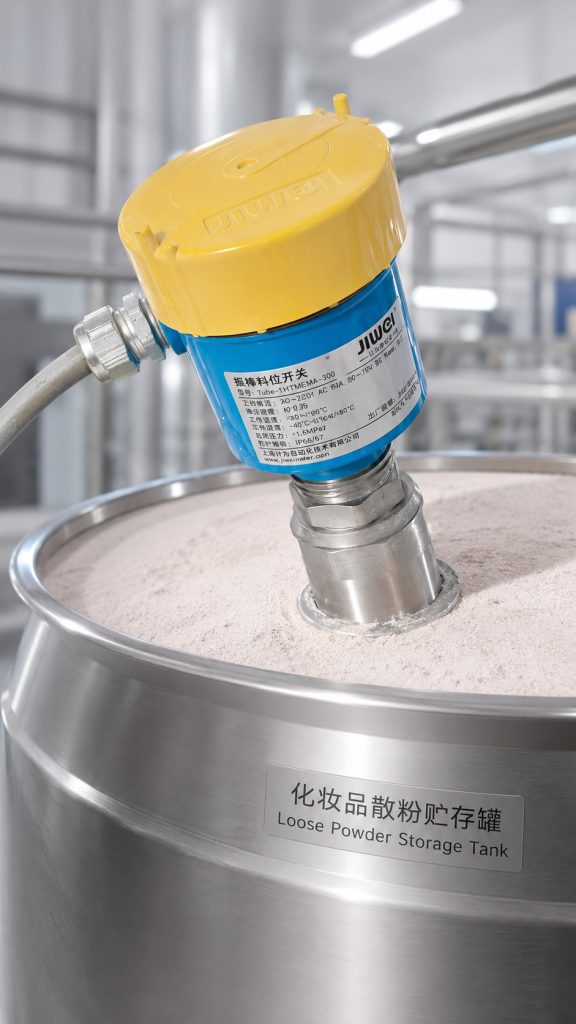
At the front end of loose powder production, raw materials such as mica powder, talc powder, silica powder, starch-based powders, and pigments are usually stored separately in different powder silos. The customer installed Tube-11 vibrating rod level switches in the main raw material silos for high level and low level alarms.
When the powder reaches the high level position, the Tube-11 outputs a signal, and the system prompts operators to stop feeding, preventing material overflow and dust dispersion. When the powder drops below the low level position, the system reminds operators to replenish material in time, preventing empty silos from interrupting subsequent weighing and mixing processes.
4.2 Automatic Feeding Control for Mixer Hoppers
The color uniformity and skin feel consistency of loose powder are closely related to mixing stability. If the mixer feeding hopper runs short of material, batch proportions and mixing efficiency may be affected. If too much material is fed, blockage or powder accumulation may occur.
The customer installed a Tube-11 vibrating rod level switch on the side wall of the mixer feeding hopper. When the material level falls below the set position, the system automatically starts the feeding equipment. When the level reaches the high position, the system stops feeding. In this way, material supply to the mixer becomes more continuous, manual intervention is reduced, and batch stability in loose powder production is improved.
4.3 Overfill Prevention and Empty Bin Protection in Screening Buffer Bins
After mixing, loose powder usually needs to be screened to remove lumps and coarse particles, ensuring a fine and smooth powder texture. The screened material then enters a buffer bin before being sent to the filling process. If the buffer bin level is too high, screening efficiency may be affected. If the level is too low, downstream filling may become discontinuous.
After the Tube-11 is installed in the screening buffer bin, it provides high level alarms and low level interlock control. When the buffer bin approaches full capacity, the system prompts the upstream process to slow down or temporarily stop feeding. When the buffer bin level becomes too low, the system reminds operators to replenish material or adjust the production rhythm, ensuring smooth connection between screening and filling.
4.4 Shortage Protection for Automatic Filling Machine Hoppers
Loose powder filling requires high weight accuracy. If the filling machine hopper runs short of material, insufficient filling, filling fluctuation, or empty-container operation may occur. The customer installed a Tube-11 vibrating rod level switch on the automatic filling machine hopper for low level detection and shortage protection.
When the powder level in the hopper falls below the set position, the Tube-11 immediately outputs a signal. The control system then sends a replenishment prompt and can be linked with the feeding equipment. If replenishment is not completed in time, the system can pause the filling machine to prevent nonconforming products from entering the downstream packaging process.
5. Application Results: Improved Stability of the Loose Powder Production Line
5.1 Less Manual Inspection and Higher Production Efficiency
After installing the Tube-11 vibrating rod level switch, the customer no longer needed to frequently open silos to check material levels. The level status of key silos and hoppers can now be fed back through the control system, and operators only need to replenish or adjust materials according to alarm signals.
This approach reduces the workload of manual inspection and lowers the risk of dust leakage and cross-contamination, making loose powder production cleaner and more efficient.
5.2 Reduced Risks of Material Shortage, Overfilling, and False Alarms
By installing Tube-11 level switches in raw material silos, mixer hoppers, screening buffer bins, and filling machine hoppers, the production line formed a more complete high and low level protection logic. High level detection prevents overfilling and powder overflow, while low level detection prevents empty bins, material interruption, and equipment idling.
The high sensitivity and anti-adhesion design of the Tube-11 also reduce false actions in lightweight powder detection, improving production continuity.
5.3 Improved Filling Stability and Product Quality
The filling process is a key quality control point in loose powder production. After the Tube-11 was used for shortage protection in the filling machine hopper, the system could remind operators to replenish material before insufficient powder affected filling stability.
According to customer feedback, after level control became more stable, the filling line operated more continuously, filling weight abnormalities and rework caused by material shortage were significantly reduced, and finished product consistency improved.
5.4 Lower Maintenance Costs
Loose powder is fine and prone to adhesion, making equipment maintenance an important part of production management. The Tube-11 vibrating rod level switch features anti-adhesion capability, intelligent self-diagnosis, and calibration-free installation, reducing the workload of frequent disassembly, repeated commissioning, and blind troubleshooting.
Maintenance personnel can locate problems more quickly, production line downtime is shortened, and equipment operation management becomes easier.
6. Case Summary: Tube-11 Provides Reliable Level Control for Loose Powder Production
6.1 From Manual Judgement to Automated Detection
By applying Tube-11 vibrating rod level switches at key points on the loose powder production line, the cosmetics manufacturer upgraded from manual level observation to automated level detection. Whether in raw material powder silos, mixer hoppers, screening buffer bins, or automatic filling machine hoppers, the Tube-11 provides clear, timely, and reliable level signals to the control system.
6.2 Suitable for More Cosmetic Powder Applications
In addition to loose powder manufacturing, the Tube-11 vibrating rod level switch can also be used in compact powder raw materials, eye shadow powder, blush powder, body powder, facial mask powder, fragrance powder, and other cosmetic powder production processes. For fine powders, lightweight powders, low-density powders, easily dispersed powders, and powders prone to adhesion, proper selection and installation can significantly improve the reliability of level detection.
6.3 Supporting the Automation Upgrade of Cosmetics Production
The cosmetics industry is moving toward automated, refined, and stable production. Although loose powder manufacturing may appear to be a simple process of powder mixing and filling, it actually involves high requirements for raw material management, powder conveying, level control, clean production, and filling stability.
With its dual-tube probe design, high sensitivity, high temperature resistance, anti-adhesion design, intelligent self-diagnosis, calibration-free installation, and optional cable-type structure, the Tube-11 vibrating rod level switch provides a reliable high and low level detection solution for loose powder production lines. Its application not only helps manufacturers reduce manual inspection and production abnormalities, but also provides strong support for product quality stability and on-site safety management.
Conclusion
In cosmetic loose powder manufacturing, stable powder level detection is an important factor in ensuring continuous production, reducing material waste, and improving product quality. The Tube-11 vibrating rod level switch can adapt to the working conditions of loose powder, including low density, lightweight material, dust dispersion, and powder adhesion. It plays an important role in raw material powder silos, mixer hoppers, screening buffer bins, and filling machine hoppers.
By applying the Tube-11 vibrating rod level switch, cosmetics manufacturers can achieve high level alarms, low level alarms, automatic feeding, overflow prevention, shortage protection, and filling interlock control, further improving the automation level and operational stability of loose powder production lines. For cosmetics manufacturers upgrading powder production lines, the Tube-11 vibrating rod level switch is a reliable, practical, and long-term valuable level detection solution.