1. Introduction: Why Accurate Level Measurement Matters in Concrete Admixture Storage
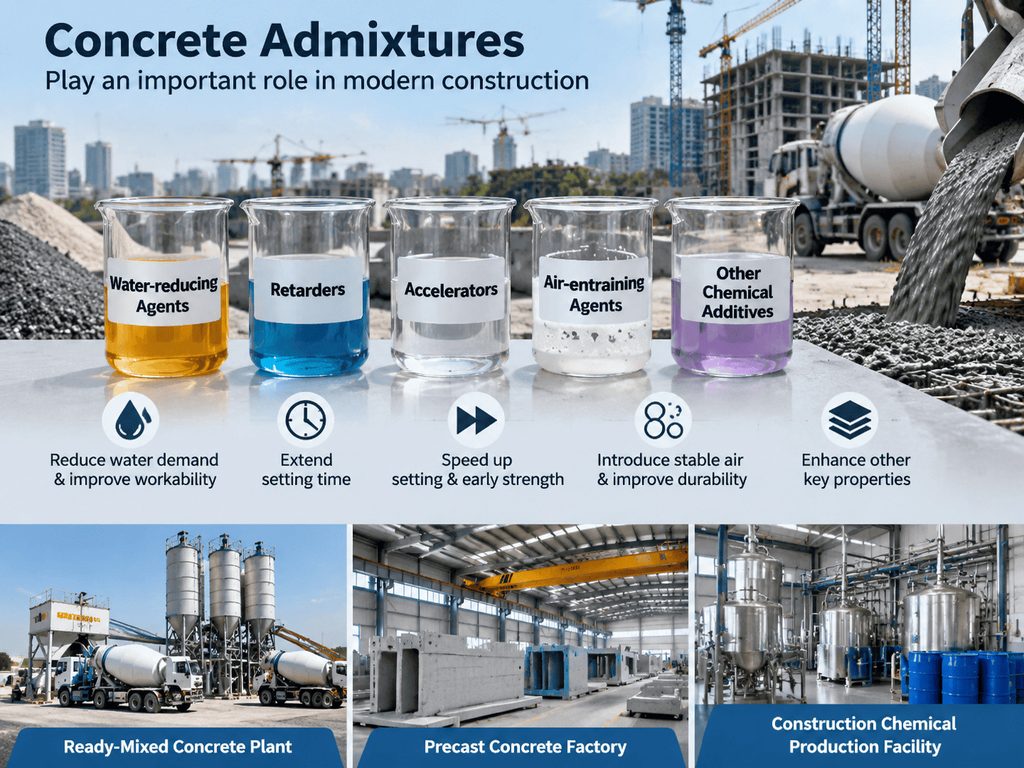
Concrete admixtures play an important role in modern construction. Water-reducing agents, retarders, accelerators, air-entraining agents, and other chemical additives are widely used in ready-mixed concrete plants, precast concrete factories, and construction chemical production facilities.
Many of these materials are stored in vertical tanks before being transferred to dosing systems or production lines. Maintaining accurate liquid level information is essential for inventory management, production scheduling, material replenishment, and process automation.
However, measuring the level of concrete admixtures is not always straightforward.
Certain admixtures, particularly polycarboxylate-based superplasticizers, may have relatively high viscosity. Depending on their formulation and storage conditions, they may also produce foam during pumping, mixing, or circulation. Residues can accumulate on tank walls and conventional contact-type measuring components.
These conditions may increase maintenance requirements and affect measurement reliability.
For facilities looking to improve tank monitoring, the JWrada-32 radar level meter provides a non-contact measurement option. Based on 80 GHz FMCW radar technology, it measures the distance between the instrument and the liquid surface without requiring a probe or float to remain immersed in the product.
This article examines a typical concrete admixture storage application and explains the engineering considerations involved in selecting, installing, and commissioning the JWrada-32.
2. Common Level Measurement Challenges in Concrete Admixture Tanks
2.1 Viscous Liquids and Material Buildup
Concrete admixtures have different physical and chemical properties depending on their formulations.
Some liquid additives are relatively fluid, while others have higher viscosity or contain suspended components. During long-term operation, splashing and condensation may also cause deposits to form around tank openings and internal structures.
Traditional float-based or probe-based instruments may require additional cleaning when their sensing components become coated with material.
A non-contact radar instrument avoids direct immersion of the sensing element. This helps reduce the possibility of measurement problems caused by buildup on immersed probes or mechanical floats.
Nevertheless, the radar antenna itself should be protected from excessive splashing, condensation, and material contamination.
2.2 Foam Formation During Filling and Circulation
Admixture tanks are commonly connected to transfer pumps, mixing systems, and circulation pipelines.
When liquid enters the tank at a high flow rate, surface turbulence may occur. Depending on the chemical formulation, bubbles and foam may develop near the liquid surface.
Foam can affect radar measurements because the electromagnetic signal may interact with the foam layer instead of producing a strong reflection from the actual liquid surface.
The degree of influence depends on foam thickness, density, moisture content, and stability.
For this reason, the installation location should be selected away from direct filling streams and areas with persistent turbulence whenever possible.
2.3 Interference from Internal Tank Structures
Industrial storage tanks may contain support beams, circulation pipes, agitator assemblies, and other metallic components.
These structures can reflect radar signals and produce unwanted echoes.
If an instrument cannot distinguish the actual liquid surface from fixed structural reflections, the displayed level may become unstable or incorrect.
Proper positioning and echo analysis are therefore essential parts of the installation process.
2.4 Changes in Medium Properties
Different admixture formulations may have different dielectric properties.
The strength of a radar reflection depends partly on the dielectric characteristics of the measured medium. Therefore, the suitability of a radar instrument should be evaluated using the actual liquid formulation rather than relying only on the general product category.
If a production facility stores several different admixtures in separate tanks, each tank should be assessed individually.
3. Why Consider the JWrada-32 80 GHz Radar Level Meter?
The JWrada-32 is an industrial radar level meter designed for continuous measurement of liquids and selected bulk solids.
It uses 80 GHz frequency-modulated continuous-wave technology to calculate the distance to the target surface by analyzing the frequency difference between transmitted and received radar signals.
Its main technical characteristics include:
- Operating frequency: 80 GHz.
- Maximum measuring range: 60 m.
- Measurement accuracy: up to ±1 mm under specified conditions.
- Beam angle: approximately 3° or greater, according to the published specification.
- Antenna material: 316L stainless steel with PTFE.
- Signal options: 4–20 mA/HART and RS485/Modbus, depending on configuration.
- Bluetooth communication for configuration and commissioning.
- Intelligent echo processing, including false-echo learning and multi-echo separation.
The actual performance depends on the selected configuration, installation arrangement, medium properties, and operating conditions.
3.1 Non-Contact Measurement
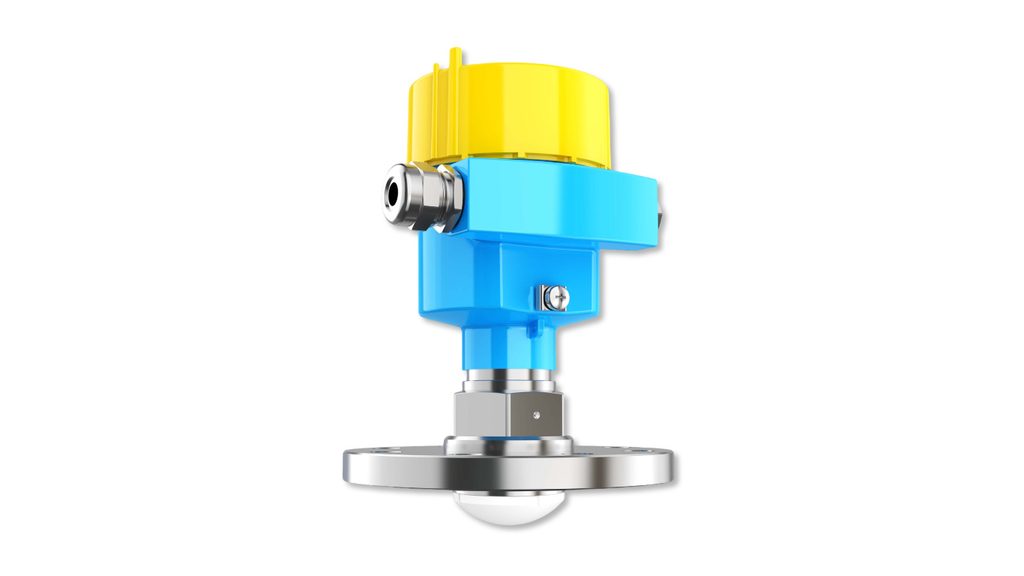
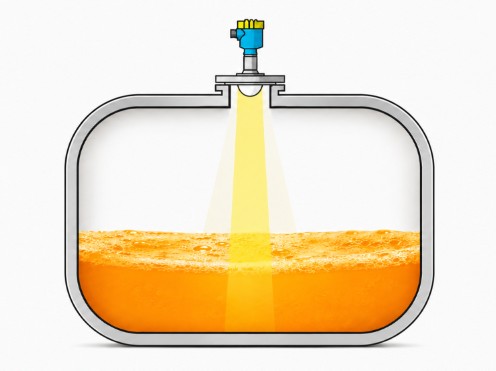
The instrument is mounted above the liquid surface and does not require direct contact with the concrete admixture.
This is particularly useful when the liquid has a tendency to coat immersed components or when mechanical wear and cleaning are concerns.
Because there are no moving floats or immersed mechanical sensing parts, routine maintenance associated with those components can be reduced.
3.2 Focused Radar Beam
The 80 GHz radar frequency supports a relatively concentrated beam.
In a tank containing pipes, supports, or other internal structures, a suitable mounting location helps reduce unwanted reflections.
The beam angle and the clearance around the measurement path should still be checked during engineering design.
A narrow beam does not eliminate all interference, especially when the instrument is installed close to a tank wall or directly above a metal structure.
3.3 Intelligent Echo Processing
The JWrada-32 incorporates intelligent echo processing functions designed to identify false echoes, separate multiple reflections, and track dynamic targets.
These functions are useful when the tank contains fixed obstructions or when the liquid surface changes during filling and discharge.
During commissioning, technicians should review the echo profile and confirm which reflection corresponds to the actual liquid surface.
False-echo suppression should only be performed after the genuine target echo has been correctly identified.
3.4 Industrial Communication
For automated concrete admixture production, the liquid level signal should be available to the plant control system.
Depending on the selected configuration, JWrada-32 can provide 4–20 mA/HART or RS485/Modbus communication.
This allows the measurement data to be integrated into a PLC, DCS, or other compatible automation platform.
Operators can then monitor tank levels, configure alarms, and use the data for replenishment planning.

4. Typical Application Scenario
Consider a concrete admixture manufacturing facility that stores several liquid additives in vertical tanks.
The plant wants to replace manual level checks with continuous monitoring.
A typical engineering scenario may include the following conditions:
| Parameter | Example condition |
|---|---|
| Medium | Polycarboxylate superplasticizer solution |
| Tank type | Vertical closed storage tank |
| Tank height | Approximately 6 m |
| Operating pressure | Near atmospheric pressure |
| Operating temperature | Ambient temperature |
| Measurement method | Top-mounted non-contact radar |
| Control system | PLC |
| Output | 4–20 mA/HART |
| Instrument | JWrada-32 |
These values are illustrative design assumptions rather than verified customer project data.
For this application, the JWrada-32’s 60 m maximum measuring range is more than sufficient in terms of nominal distance.
However, the final selection must also consider the actual liquid properties, foam behavior, tank geometry, nozzle dimensions, and required measurement range.
The maximum specified range should never be interpreted as a guaranteed operating distance under every process condition.
5. Installation Recommendations
5.1 Select an Appropriate Top-Mounting Position
The radar instrument should ideally be installed at a position where the beam can reach the liquid surface without obstruction.
Avoid locations directly above filling pipes, strong circulation flows, and areas where foam consistently accumulates.
If the tank contains an agitator, the shaft and blades should be considered when determining the measurement path.
5.2 Check the Mounting Nozzle
A long or narrow mounting nozzle may generate unwanted reflections.
The antenna position should follow the instrument installation instructions and be checked against the nozzle dimensions.
The antenna should not be recessed in a way that allows the nozzle wall to obstruct the radar beam.
5.3 Consider Condensation and Splashing
Although the radar measurement is non-contact, the antenna surface can still be affected by condensation or liquid splashing.
Where these conditions occur, the installation design should consider the orientation of the antenna, protective arrangements, and accessibility for inspection.
5.4 Verify Material Compatibility
Concrete admixtures may contain different chemical components.
The compatibility of the antenna, sealing materials, process connection, and other potentially exposed components should be verified against the actual formulation.
The use of PTFE and 316L components does not automatically guarantee compatibility with every chemical mixture.
6. Commissioning and Parameter Configuration
After installation, the instrument must be configured according to the actual tank dimensions.
The first step is to establish the measurement reference point and determine the distance between the instrument reference and the tank bottom.
The empty distance, measuring range, and level scaling should then be configured.
For a 4–20 mA system, the control engineer should define the relationship between the output signal and the operating level range.
For example, the plant may configure 4 mA to represent the minimum operating level and 20 mA to represent the maximum normal operating level.
The configured range should reflect the usable tank volume rather than simply copying the instrument’s maximum measuring distance.
During commissioning, technicians should:
- Confirm the instrument mounting position.
- Check the configured tank dimensions.
- Verify the actual surface echo.
- Review false echoes caused by internal structures.
- Test the output signal at the PLC.
- Observe the level trend during filling and discharge.
- Adjust damping according to process dynamics.
- Verify high- and low-level alarm thresholds.
Damping should be selected carefully. Excessive filtering can delay the response to rapid level changes, while insufficient filtering may allow normal surface fluctuations to create unnecessary alarms.
7. PLC Integration and Process Automation
Once the radar level meter is connected to the control system, the measured level can support several operational functions.
Tank Inventory Monitoring
Operators can view the level of each storage tank from a central control interface.
This makes it easier to identify tanks requiring replenishment and to coordinate the delivery of raw materials.
Pump Protection
Low-level information can be used as an input to pump control logic.
For example, the PLC may generate a low-level warning or prevent a transfer pump from operating under specified conditions.
The control logic must be designed and validated according to the pump and process requirements.
Filling Management
High-level alarms can help operators identify when a tank is approaching its normal filling limit.
Where automatic filling is required, the control system can use the radar measurement as part of the filling sequence.
For applications with significant overflow risks, an independent high-high level protection device should be considered based on the process risk assessment.
Historical Data Analysis
Continuous measurement provides a level trend that can help production personnel review consumption patterns, identify unexpected changes, and improve material planning.
8. Expected Operational Benefits
A properly engineered JWrada-32 installation can provide several potential benefits in concrete admixture storage:
- Reduced dependence on manual tank inspections.
- Less exposure to measurement problems associated with immersed mechanical components.
- Continuous level information for inventory management.
- Easier integration with PLC-based filling and transfer systems.
- Improved visibility of abnormal level changes.
- Support for more consistent production planning.
These are expected application benefits, not measured results from a verified customer installation.
A real project case study should include commissioning records, reference measurements, maintenance logs, and operational observations before claiming specific improvements.
9. Frequently Asked Questions
Q1: Can the JWrada-32 measure polycarboxylate superplasticizer?
It can be evaluated for this application as a non-contact radar level measurement solution. The final suitability depends on the formulation’s dielectric properties, foam characteristics, temperature, and tank installation conditions.
Q2: Does foam affect radar level measurement?
Yes. Thick or persistent foam may weaken or alter the reflection from the actual liquid surface. The application should be tested or evaluated using the real process conditions.
Q3: Does the instrument need to contact the admixture?
No. It is designed for top-mounted non-contact measurement.
Q4: Can it connect to a PLC?
Yes. Compatible configurations support 4–20 mA/HART or RS485/Modbus communication.
Q5: Is JWrada-32 suitable for all chemical storage tanks?
No. Each application requires an assessment of chemical compatibility, pressure, temperature, dielectric properties, hazardous-area requirements, and installation geometry.
10. Conclusion
Concrete admixture storage requires dependable level information to support material inventory, replenishment, and automated production.
Viscosity, surface foam, filling turbulence, and internal tank structures can make conventional measurement methods difficult to maintain.
The JWrada-32 80 GHz radar level meter offers a non-contact measurement approach with intelligent echo processing and industrial communication options.
When the instrument is correctly selected, installed, and commissioned, it can provide continuous level data for concrete admixture tanks and support more efficient plant operations.
The most important factor is not simply choosing a high-frequency radar instrument. It is matching the instrument configuration to the actual medium, tank geometry, and process requirements.