
1. Temperature Sensors: The Cold-and-Hot Detectives of the Modern World
Some people are extremely sensitive to temperature. Set the air conditioner to 26°C, and they say it is too hot. Lower it to 25°C, and suddenly they are wrapped in a blanket questioning your humanity.
But in homes, factories, vehicles, hospitals, farms, and smart devices, there is something even more sensitive, more reliable, and far less dramatic: the temperature sensor.
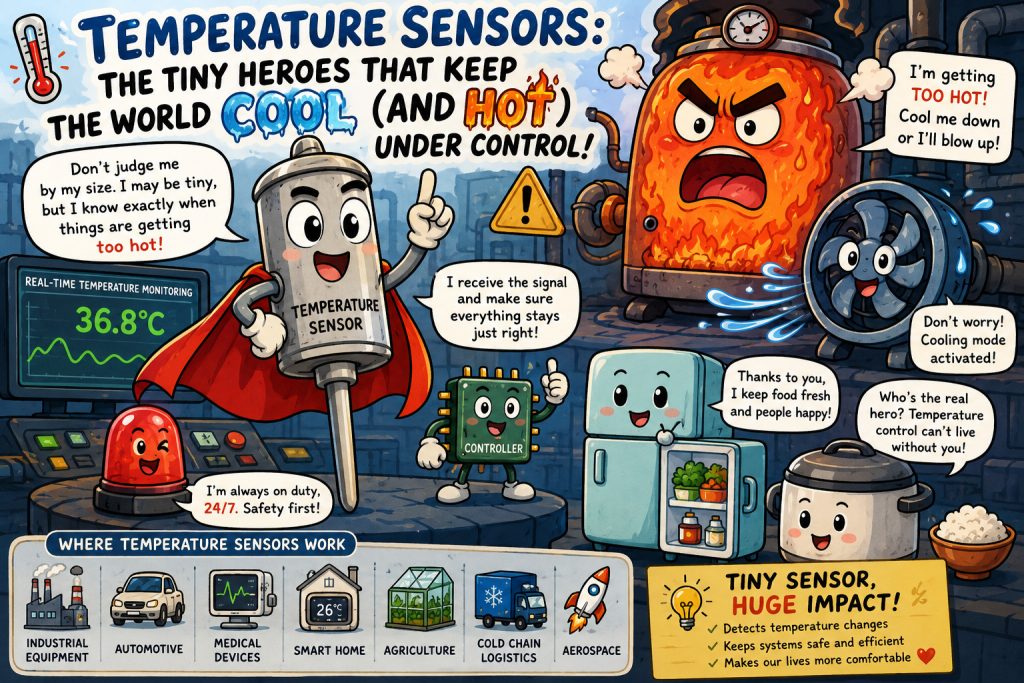
A temperature sensor is a device that detects temperature changes and converts them into electrical signals, digital signals, or other readable outputs. In simpler words, it is like the “temperature nerve ending” inside a machine. It tells the system, “Hey boss, it is getting a little hot here,” or “Careful, the battery is starting to lose its temper.”
Without temperature sensors, many devices would be like humans without thermometers. They would overheat without knowing it, freeze without reacting, and eventually perform the tragic final act known as “system failure.”
From refrigerators and air conditioners to rice cookers, electric vehicles, smart watches, medical devices, and industrial furnaces, temperature sensors are everywhere. They rarely get attention, but they often decide whether a system runs smoothly or suddenly becomes a smoke machine with poor timing.
2. How Does a Temperature Sensor Work? When Temperature Changes, It Changes Too
The main job of a temperature sensor is to turn temperature changes into signals that machines can understand. Humans use skin to feel hot and cold. Temperature sensors use physical properties of materials.
That may sound complicated, but the idea is simple: when temperature changes, certain materials also change. Their resistance, voltage, current, frequency, or other measurable properties may vary. The sensor detects these changes, and the circuit or chip converts them into temperature readings.
Common temperature sensing principles include several major types.
One type is based on resistance changing with temperature. Thermistors and platinum resistance temperature detectors are examples. As temperature rises or falls, their resistance changes. By measuring the resistance, the system can estimate the temperature. It is a bit like people whose mood changes instantly when the room gets too warm.
Another type is based on temperature difference generating voltage. A thermocouple works this way. It is made from two different metals joined together. When there is a temperature difference between the two ends, a small voltage is generated. By measuring this tiny voltage, the system can calculate the temperature. It is like a miniature metal-powered gossip system whispering, “Something is hot over there.”
A third type uses semiconductor characteristics that change with temperature. Digital temperature sensors often work this way. These sensors may include the sensing element, signal processing circuit, and communication interface in one compact package. Instead of making the controller guess, they simply report, “It is now 28.6°C. You are welcome.”
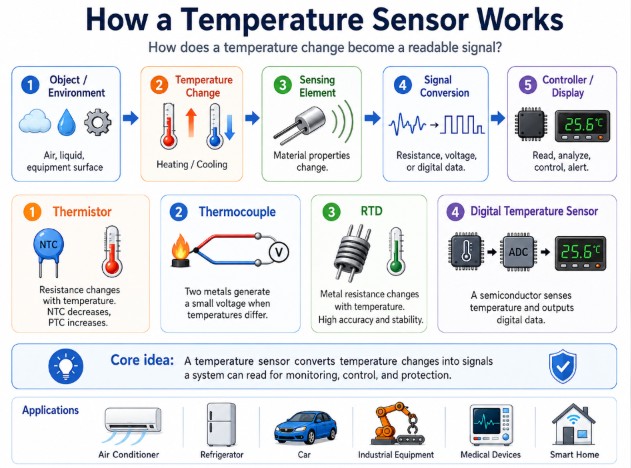
So no, temperature sensors do not rely on magic. They rely on materials, electronics, and signal processing. They may look small and quiet, but inside, they are doing serious scientific work.
3. Common Types of Temperature Sensors: The Main Characters in the Temperature World
The temperature sensor family is large, and every member has its own personality. Some are cheap and tough. Some are precise and elegant. Some survive extreme heat. Some are born for smart electronics.
Choosing the wrong sensor is like sending a sprinter to run a marathon. Technically possible, emotionally damaging, and probably not recommended.
3.1 Thermocouple Temperature Sensors: The Tough Veterans of High-Temperature Measurement
Thermocouples are among the most widely used temperature sensors, especially in high-temperature environments. They are made by joining two different metal wires together. When the junction experiences a temperature difference, a voltage is produced.
Their biggest advantages are a wide temperature range, fast response, simple structure, and strong resistance to high temperatures. You will often find them in industrial furnaces, boilers, engines, metallurgy equipment, and other hot places where ordinary components would resign immediately.
Of course, thermocouples are not perfect. They output a very small voltage signal, so they usually require cold-junction compensation and signal amplification. Their accuracy can also be affected by installation, wiring, environment, and signal processing.
In the world of temperature sensors, the thermocouple is the one wearing work boots, a hard hat, and a look that says, “I have seen things.”
3.2 Thermistor Temperature Sensors: The Affordable and Sensitive Little Genius
A thermistor is a resistor whose resistance changes significantly with temperature. The two common types are NTC and PTC. NTC means resistance decreases as temperature increases. PTC means resistance increases as temperature increases.
Thermistors are highly sensitive, compact, inexpensive, and widely used in household appliances, electronic devices, battery packs, temperature control switches, air conditioners, refrigerators, rice cookers, and water heaters.
However, thermistors are not very linear, and their temperature range is usually limited. Their long-term stability may also be weaker than high-precision platinum RTDs.
A thermistor is like a friend who reacts very quickly but may be a little emotional. When things get hot, it changes dramatically. You just need the right circuit and algorithm to understand what it is trying to say.
3.3 RTD Platinum Resistance Temperature Sensors: The Straight-A Students of Precision Measurement
RTD stands for resistance temperature detector. Common examples include PT100 and PT1000. “PT” refers to platinum. “100” or “1000” means the resistance is about 100 ohms or 1000 ohms at 0°C.
Platinum RTD temperature sensors are known for high accuracy, good stability, and relatively linear output. They are often used in industrial automation, laboratories, medical equipment, food processing, and environmental monitoring.
Their disadvantages are higher cost, sometimes slower response, and more demanding measurement circuit design.
If the temperature sensor world had a top student who always sat in the front row, submitted neat homework, and performed reliably in every exam, it would probably be the platinum RTD. It may not be the cheapest, but when accuracy matters, it is very trustworthy.
3.4 Semiconductor Temperature Sensors: The Digital Natives of Electronics
Semiconductor temperature sensors are highly integrated and can output either analog or digital signals. Many digital temperature sensors communicate with microcontrollers through interfaces such as I²C, SPI, or 1-Wire.
They are especially suitable for smart hardware, computers, smartphones, IoT devices, wearable devices, and power management systems. Their advantages include small size, convenient use, easy integration, and sometimes built-in alarm functions.
Their main limitation is that their temperature range is usually not as wide as industrial sensors. If you ask one to work beside a steel furnace, it may send its final message: “I was not built for this.”
3.5 Infrared Temperature Sensors: Measuring Temperature Without Touching
Infrared temperature sensors measure temperature by detecting infrared radiation emitted by objects. Their biggest advantage is non-contact measurement.
They are useful for moving objects, very hot objects, dangerous targets, or objects that are difficult to touch directly. Forehead thermometers, thermal imaging systems, food inspection equipment, and electrical equipment inspection tools often use infrared temperature measurement.
However, infrared temperature sensors can be affected by surface material, emissivity, distance, viewing angle, and ambient temperature. They are not magic laser truth machines. If the surface is reflective, the distance is wrong, or the angle is poor, the reading may be misleading.
They are like detectives of the temperature world. They can observe from a distance, but they still need a clear view and good conditions.
4. Where Are Temperature Sensors Used? Almost Everywhere, Actually
Temperature sensors may look insignificant, but they are busy in more places than most people imagine. They are not side characters. In many systems, they are key players.
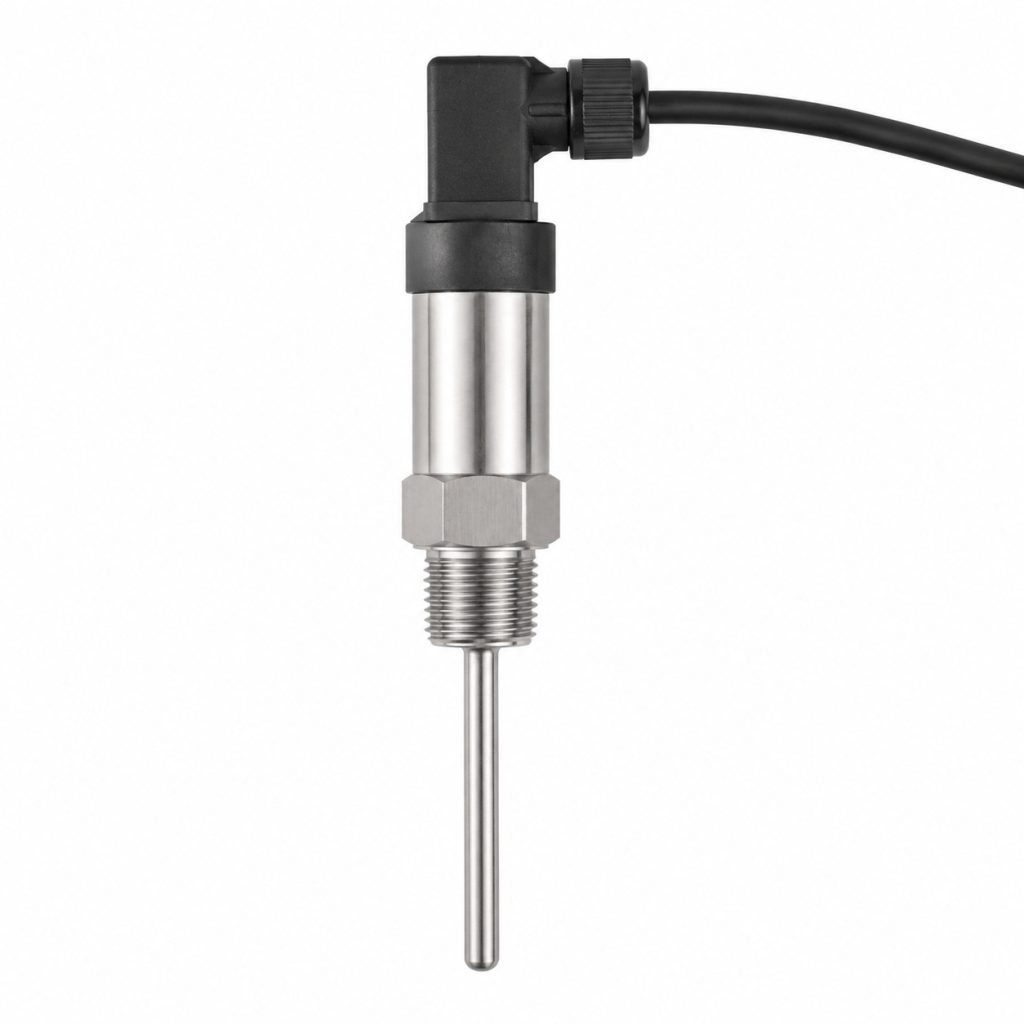
In home appliances, temperature sensors help refrigerators maintain proper cooling, air conditioners detect room temperature, rice cookers decide when the rice is ready, and water heaters prevent your relaxing shower from becoming a seafood-boiling experience.
In the automotive industry, temperature sensors monitor engine temperature, coolant temperature, intake air temperature, exhaust temperature, and battery temperature. In electric vehicles, battery temperature management is especially important. If the battery is too cold, performance drops. If it is too hot, safety risks increase. Temperature sensors are like strict teachers inside the battery pack, watching every cell to make sure nobody misbehaves.
In industrial automation, temperature sensors are used in boilers, reactors, heat treatment furnaces, injection molding machines, pipelines, and storage tanks. Many industrial processes are highly temperature-sensitive. A difference of just a few degrees may affect product quality or even create safety hazards.
In medical equipment, temperature sensors are used in thermometers, incubators, blood storage systems, surgical equipment, and physical therapy devices. Medical applications require accuracy and stability because this is not a place where “close enough” is good enough.
In agriculture and food industries, temperature sensors are used in greenhouses, cold chain logistics, food processing, and grain storage. In cold chain transportation, losing temperature control can turn “fresh delivery” into “mysterious biological experiment.”
In smart homes and IoT systems, temperature sensors help devices understand environmental changes and automatically adjust operation. Smart thermostats, environmental monitors, smart air conditioners, and even smart flowerpots use temperature sensing. When even a flowerpot understands the room temperature better than you do, that is technology gently hurting your pride.
5. How to Choose a Temperature Sensor: Do Not Let Price Be the Only Boss
Many people choose a temperature sensor by asking one question: “Which one is cheapest?”
This is understandable, but not always wise. If you only look at price, you may later pay for it through poor accuracy, unstable performance, short service life, and maintenance problems.
When selecting a temperature sensor, consider the following factors.
First, consider the temperature range. Are you measuring room temperature, refrigerator temperature, body temperature, or furnace temperature? Different sensors are designed for different ranges. Asking a regular semiconductor temperature sensor to measure 800°C is like asking slippers to do the job of firefighting boots.
Second, consider accuracy. Some applications need very high precision, such as medical devices, laboratories, and precision manufacturing. Others only need approximate values, such as basic environmental monitoring. Higher accuracy usually means higher cost and stricter circuit or calibration requirements.
Third, consider response speed. If temperature changes quickly, such as in engines, heaters, or dynamic industrial processes, you need a fast-responding sensor. Otherwise, by the time the sensor reacts, the situation may have upgraded from “temperature abnormal” to “everyone please evacuate.”
Fourth, consider the installation method. Will the sensor be inserted into liquid, attached to a metal surface, mounted inside a pipe, or suspended in air? Installation affects both accuracy and response speed. Many temperature readings are wrong not because the sensor is bad, but because the installation location was chosen with the confidence of a coin toss.
Fifth, consider the environment. Humidity, corrosion, vibration, electromagnetic interference, high pressure, dust, and extreme heat can all affect sensor performance. Industrial environments are especially unforgiving. They are basically survival reality shows for sensors.
Sixth, consider the output signal and interface. Does the sensor output resistance, voltage, current, or digital data? Is it compatible with your controller? Does it require a transmitter or signal conditioning circuit? These questions should be answered before purchase, not after you discover the connector does not match and begin staring silently at your life choices.
6. Why Do Temperature Sensors Become Inaccurate? It May Not Be Their Fault
When a temperature sensor gives inaccurate readings, many people immediately say, “The sensor is broken!”
That may be true, but not always. Blaming the sensor first is like blaming the mouse when your computer freezes. Possible, but not guaranteed.
Temperature measurement errors may come from several sources.
Poor installation location is one common cause. For example, you want to measure the water tank temperature, but the sensor is installed in a dead corner with poor circulation. Or you want to monitor the core temperature of a device, but the sensor is attached to the edge of the outer shell. A sensor can only measure the temperature where it is located. It cannot read your mind.
Poor contact can also cause errors. If there is an air gap, dirt, oil, looseness, or insulating material between the sensor and the target surface, the reading may be inaccurate. This is especially important for surface-mounted temperature measurement.
Environmental interference should not be ignored. Electromagnetic interference, long wiring, unstable power supply, and moisture intrusion can all affect signals. Thermocouples and resistance-based sensors are especially sensitive to signal handling. If the data jumps around like it drank three cups of coffee, check the wiring and shielding.
Lack of calibration is another issue. Sensors may drift after long-term use, especially in high-temperature, corrosive, or harsh environments. Calibration is like a health check. You may not need it every day, but ignoring it forever is not a strategy.
Wrong sensor selection can also cause inaccurate results. Using a low-accuracy sensor for high-precision control, a narrow-range sensor for extreme temperatures, or a normal sensor in a corrosive environment is asking for trouble.
So when a temperature sensor seems inaccurate, do not fire it immediately. Check installation, wiring, environment, calibration, and selection first. The sensor might not be lazy. It might just be misunderstood.
7. Future Trends of Temperature Sensors: Getting Smaller, Smarter, and More Connected
In the past, temperature sensors mainly measured temperature. Today, they are becoming smarter. They can measure, communicate, trigger alarms, support diagnostics, and participate in system management.
One major trend is digitalization. Digital temperature sensors directly output digital signals, reducing interference during transmission and making it easier to connect with microcontrollers, IoT platforms, and smart systems.
Another trend is miniaturization and low power consumption. Wearable devices, smart hardware, and wireless sensor networks require smaller and more energy-efficient sensors. After all, a smartwatch, earbud, or medical patch cannot carry a sensor the size of a brick.
A third trend is multi-function integration. Many sensors now combine temperature, humidity, pressure, gas detection, light sensing, and other functions. A tiny chip can perform multiple environmental sensing tasks, making it the “multi-talented employee” of the sensor world.
A fourth trend is intelligent diagnostics and predictive maintenance. In industrial systems, temperature data can help detect abnormal equipment conditions. Overheated bearings, abnormal motor temperature rise, and local heating in battery packs may all be early signs of failure. Temperature sensors are no longer just recorders. They can help systems detect problems before small issues become expensive disasters.
As IoT, artificial intelligence, electric vehicles, and smart manufacturing continue to develop, temperature sensors will become even more important. They may remain physically small, but their role in systems will only grow.
8. How to Maintain Temperature Sensors: They Are Not Eternal Measuring Machines
Temperature sensors are hardworking, but they still need maintenance. In industrial, medical, cold chain, and laboratory applications, poor maintenance can affect accuracy and even create safety risks.
First, inspect the sensor regularly. Look for corrosion, damage, looseness, deformation, water ingress, or cracks. Many problems are visible. The issue is that nobody looks until something goes wrong.
Second, check wiring and connectors. Loose terminals, oxidation, and poor contact can cause unstable signals. When sensor readings jump wildly, do not assume the sensor has lost its mind. The connector may simply be loose.
Third, keep the sensor clean. Oil, dust, scale, crystals, and dirt can affect measurement. For insertion and surface sensors, contamination may cause the sensor to measure the temperature of the dirt rather than the actual target.
Fourth, calibrate when necessary. In high-precision applications, calibration is essential. It confirms whether the sensor is still reliable. A sensor that has not been calibrated for years may slowly change from “precision instrument” to “creative storyteller.”
Fifth, avoid using sensors beyond their rated limits. Every sensor has its own temperature range, pressure rating, protection level, and environmental limits. Long-term overload is like forcing a person to work overtime every day without rest. Eventually, something will fail.
9. Frequently Asked Questions About Temperature Sensors
1. What is the difference between a temperature sensor and a thermometer?
A thermometer usually displays temperature directly for humans to read. A temperature sensor converts temperature changes into signals that machines can collect, control, and analyze. Simply put, a thermometer tells people; a temperature sensor tells machines.
2. Can a temperature sensor measure human body temperature?
Yes, but the sensor must be suitable for body temperature measurement and meet requirements for accuracy, safety, and response speed. Medical temperature measurement devices require proper design and calibration. You cannot simply grab an industrial sensor and say, “Come here, let me check your fever.”
3. How long does a temperature sensor last?
That depends on the sensor type, working temperature, environment, and usage frequency. Sensors in ordinary electronics may last for many years, while sensors used in high-temperature, corrosive, or vibrating environments may have shorter service lives.
4. Is a more expensive temperature sensor always better?
Not necessarily. The right sensor is better than the expensive sensor. Using a high-end platinum RTD for simple room temperature monitoring may be unnecessary. Using a cheap thermistor for a high-precision laboratory process may be risky. Selection should always depend on the actual application.
5. Why do two temperature sensors show different readings in the same environment?
Possible reasons include different accuracy levels, installation positions, response times, calibration status, airflow, thermal radiation, or contact conditions. Temperature measurement is not always as simple as “put it there and read the number.” Location and method matter.
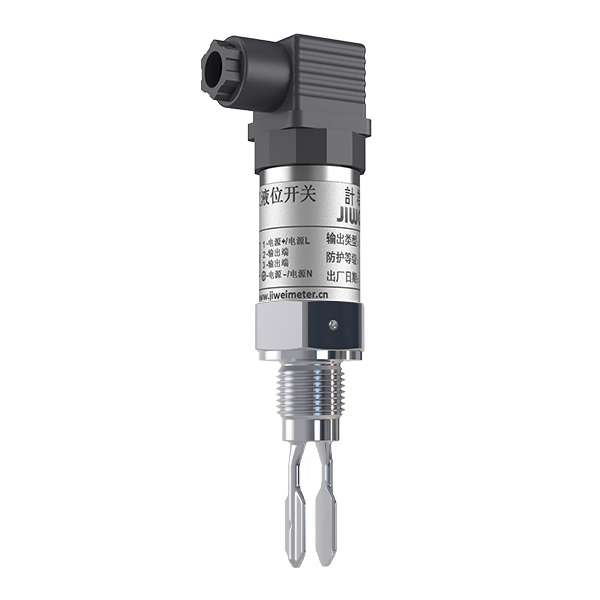
10. Conclusion: Small Sensor, Big Responsibility
A temperature sensor is a key device that detects temperature changes and outputs usable signals. It is widely used in home appliances, vehicles, industrial systems, medical equipment, agriculture, cold chain logistics, smart homes, and IoT applications.
Common temperature sensors include thermocouples, thermistors, RTD platinum resistance sensors, semiconductor temperature sensors, and infrared temperature sensors. Each type has its own advantages, limitations, and suitable applications.
To choose the right temperature sensor, you should consider temperature range, accuracy, response speed, installation method, environment, and output interface. To get accurate readings, you should also pay attention to installation, wiring, calibration, and maintenance.
Although temperature sensors are small, they act as temperature detectives, safety guards, and stability supervisors in modern systems. When a device overheats, they are the first to raise the alarm. When an air conditioner adjusts room temperature, they quietly provide the data. When a battery needs protection, they watch closely in the background.
So the next time you enjoy the comfort of an air conditioner, refrigerator, water heater, rice cooker, car, or smart device, remember to appreciate the humble temperature sensor.
It may not speak, but it is constantly helping the world keep track of heat and cold.
And if it could speak, its first sentence would probably be:
“Please stop installing me in the wrong place. Thank you.”