
UPS, EPS, STS, and ATS are commonly found in industrial facilities, data centers, hospitals, fire protection systems, commercial buildings, and other critical power distribution systems.
Because all four devices are related to power continuity and backup power, they are often confused with one another.
However, they serve very different purposes.
The easiest way to understand the difference is:
UPS and EPS mainly answer the question: “How can the load continue operating after the normal power source fails?”
ATS and STS mainly answer the question: “When two power sources are available, how do we transfer the load from one source to the other?”
In simple terms:
UPS — keeps critical loads continuously powered.
EPS — provides emergency power after the normal supply fails.
ATS — automatically transfers loads between two power sources.
STS — rapidly transfers loads between two power sources.
In this guide, we will compare UPS vs EPS vs STS vs ATS in terms of working principle, transfer time, energy storage, typical applications, load types, and selection criteria.
1. What Is a UPS?
UPS stands for Uninterruptible Power Supply or Uninterruptible Power System.
Its primary purpose is to maintain power to critical equipment when the utility supply becomes unstable or fails completely.
UPS systems are commonly used for:
- Servers
- Data centers
- PLC systems
- DCS systems
- Communication equipment
- Network equipment
- Computers
- Industrial control systems
- Critical instrumentation
- Sensitive electronic equipment
How Does a UPS Work?
The exact operating principle depends on the UPS topology.
For a typical online double-conversion UPS, incoming AC power is first converted to DC power through a rectifier. The DC power is then converted back to regulated AC power through an inverter before being supplied to the load.
The battery system is connected to the DC bus and acts as the energy storage source.
When the incoming AC supply fails, the battery continues supplying DC power to the inverter, allowing the inverter to maintain AC output to the connected load.
Because the inverter is already supplying the load during normal operation, an online double-conversion UPS does not require the conventional transfer from utility power to battery power when the input supply suddenly fails.
This is one reason online UPS systems are widely used for servers, control systems, telecommunications equipment, and other loads that cannot tolerate even a brief interruption.
What Problem Does a UPS Solve?
A UPS is not only concerned with whether electricity is available after a power failure.
Depending on the UPS topology and design, it can also address:
- Power continuity
- Voltage regulation
- Power quality
- Backup runtime
- Frequency variations
- Voltage disturbances
- Protection of sensitive loads
Therefore, if a load cannot tolerate a short power interruption, a UPS is often one of the first solutions to consider.
2. What Is an EPS?
EPS generally stands for Emergency Power Supply.
Its main purpose is to provide power to designated emergency loads when the normal power source becomes unavailable.
EPS systems are commonly used for:
- Emergency lighting
- Evacuation lighting
- Fire protection systems
- Safety equipment
- Emergency building systems
- Certain emergency motors and other critical loads
Under normal conditions, the load is typically powered by the normal power source.
When the normal supply fails, the EPS uses batteries and an inverter or other power conversion equipment to provide emergency power to the connected load.
At first glance, this sounds similar to a UPS.
Both UPS and EPS systems may contain batteries, chargers, inverters, bypass circuits, and control systems.
However, their primary design objectives are different.
3. UPS vs EPS: What Is the Difference?
The difference between UPS and EPS is not simply whether the equipment contains a battery.
The main difference lies in the purpose of the system and the type of load it is designed to support.
| Comparison | UPS | EPS |
|---|---|---|
| Full Name | Uninterruptible Power Supply | Emergency Power Supply |
| Primary Purpose | Maintain continuous power to critical loads | Supply emergency loads after normal power fails |
| Energy Storage | Typically yes | Typically yes |
| Main Focus | Power continuity, power quality, backup runtime | Emergency runtime, load capacity, starting capability |
| Typical Loads | Servers, PLCs, DCS, communication equipment, sensitive electronics | Emergency lighting, evacuation systems, fire protection and emergency loads |
| Sensitivity to Power Interruption | Usually very high | Depends on the load and system requirements |
For example, even a very short power disturbance can cause some servers, controllers, or communication systems to restart or malfunction.
Such loads are therefore commonly protected by a UPS.
Emergency lighting, on the other hand, is primarily concerned with ensuring that lighting remains available or enters emergency operation when the normal power supply fails.
Its operating requirements are therefore different from those of a server UPS.
One important point is:
You cannot identify a UPS simply because you see a power cabinet containing batteries.
EPS systems can also use batteries.
To determine whether a system is a UPS or EPS, you should examine its intended application, load characteristics, electrical topology, transfer logic, and system design.
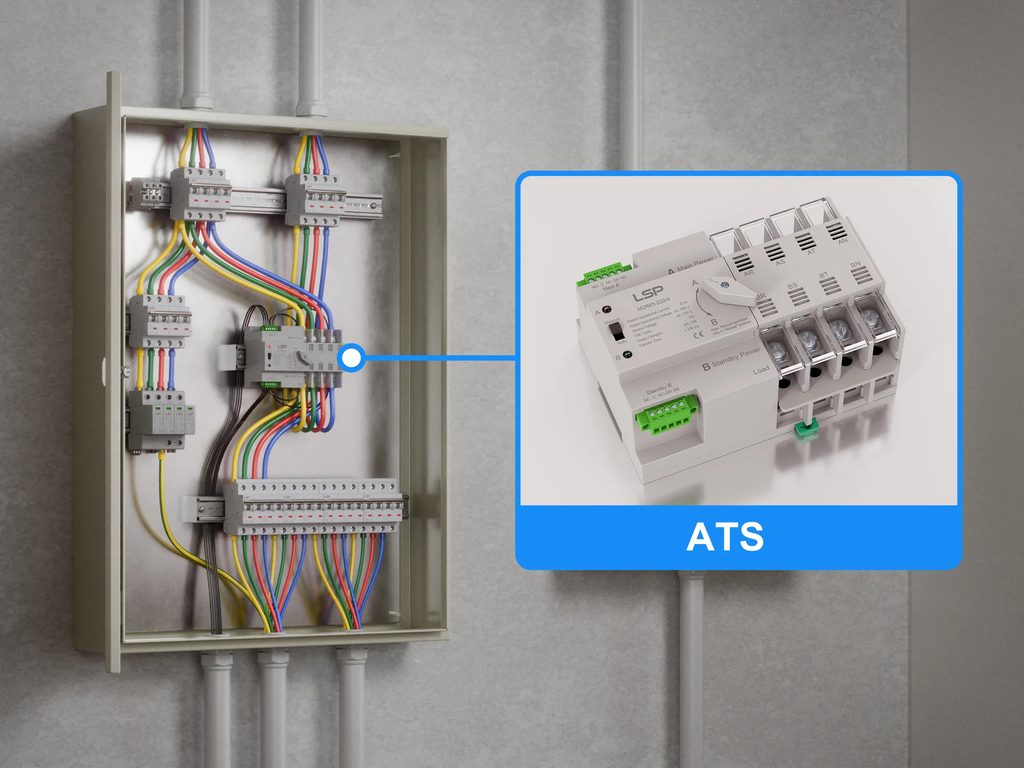
4. What Is an ATS?
ATS stands for Automatic Transfer Switch or, depending on the equipment and applicable terminology, Automatic Transfer Switching Equipment.
Unlike a UPS or EPS, an ATS does not normally provide stored backup energy.
Its main job is to:
Monitor two power sources and automatically transfer the load from one source to another according to predefined conditions.
For example, suppose an industrial facility has two available power sources.
Under normal conditions, Source A supplies the load.
If Source A experiences a power failure, undervoltage, or another unacceptable condition, and Source B is available and within acceptable parameters, the ATS can transfer the load from Source A to Source B.
A typical configuration might be:
Utility A + Utility B → ATS → Load
Another common configuration is:
Utility + Generator → ATS → Load
This leads to one very important distinction:
An ATS is not a backup power source.
It does not generate electricity and normally does not contain an energy storage system capable of powering the load for an extended period.
If both Source A and Source B are unavailable, an ATS alone cannot continue powering the load.
5. What Is an STS?
STS stands for Static Transfer Switch or Static Transfer System.
Like an ATS, an STS transfers a load between two AC power sources.
The key difference is that an STS typically uses power semiconductor devices, such as thyristors, to perform high-speed source transfers.
Because the primary transfer operation does not rely on conventional mechanical switching contacts, an STS can typically achieve transfer times in the millisecond range.
This makes static transfer switches particularly suitable for:
- Data centers
- Telecommunications facilities
- Server rooms
- Financial systems
- Industrial control systems
- Sensitive electronic equipment
- Other mission-critical loads
Consider a facility with two independent UPS systems, UPS A and UPS B, but a critical server has only one power input.
A possible configuration is:
UPS A + UPS B → STS → Single-cord Critical Load
Under normal conditions, UPS A may supply the load.
If Source A becomes unacceptable and the required transfer conditions are satisfied, the STS rapidly transfers the load to UPS B.
This architecture can improve power availability for critical single-input loads.
6. ATS vs STS: What Is the Difference?
ATS and STS are often confused because both devices can transfer a load between two power sources.
The major differences are their switching technology, transfer speed, and intended load types.
| Comparison | ATS | STS |
|---|---|---|
| Primary Function | Automatic transfer between two power sources | High-speed transfer between two power sources |
| Provides Backup Energy | No | No |
| Typical Switching Technology | Mechanical switches, contactors, circuit breakers, or similar devices | Power semiconductors such as thyristors |
| Transfer Speed | Depends on equipment design and control logic | Typically in the millisecond range |
| Main Design Focus | Reliable automatic source transfer | High-speed transfer with minimal load interruption |
| Typical Applications | Power distribution, generator backup systems, commercial buildings, industrial facilities | Data centers, telecommunications, critical IT loads, sensitive electronic equipment |
It is important not to assume that every ATS is necessarily slow.
ATS transfer time can vary considerably depending on the switching mechanism, transfer mode, sensing logic, programmed delays, source conditions, and equipment design.
Some automatic transfer systems can complete certain transfer operations within tens of milliseconds or less, while other systems intentionally take much longer.
Therefore, when comparing ATS vs STS, the more useful question is:
What is the maximum power interruption time that the load can tolerate, and can the selected transfer device meet that requirement?
If the load can tolerate a brief interruption, an appropriate ATS may be sufficient.
If the load is highly sensitive to even a short interruption, an STS, UPS, or combined UPS + STS architecture may need to be considered.
7. UPS vs EPS vs ATS vs STS Comparison Table
The following table provides a quick overview of the four systems.
| Device | UPS | EPS | ATS | STS |
|---|---|---|---|---|
| Main Function | Continuous power | Emergency power | Automatic source transfer | High-speed source transfer |
| Typically Uses Batteries | Yes | Yes | No | No |
| Can Provide Stored Backup Energy | Yes | Yes | No | No |
| Designed to Transfer Between Two Sources | May include bypass functions, but this is not its primary definition | Not its primary function | Yes | Yes |
| Transfer Characteristics | Online UPS can maintain continuous inverter output | Depends on system design | Depends on product and transfer logic | Typically millisecond-level |
| Typical Loads | IT equipment, PLCs, DCS, communication and sensitive equipment | Emergency lighting, fire protection and emergency loads | Power distribution and generator backup systems | Servers, telecommunications and critical electronic loads |
| Key Selection Factors | Capacity, runtime, power quality, overload capability | Emergency runtime, load characteristics, starting capability | Current rating, source conditions, transfer logic, transfer time | Transfer time, source synchronization, load characteristics |
A simple way to remember the difference is:
UPS and EPS answer: “How do we keep supplying power after the normal source fails?”
ATS and STS answer: “How do we transfer between two available power sources?”
Once this distinction is clear, the four devices become much easier to understand.
8. Why Are UPS and STS Sometimes Used Together?
Many data centers and telecommunications facilities do not rely on a single type of power protection equipment.
UPS and STS systems can be used together because they solve different problems.
For example:
UPS A →
STS → Single-input Server
UPS B →
In this configuration, two independent UPS systems provide two conditioned power sources.
The STS monitors both sources and rapidly transfers the load if the preferred source becomes unacceptable and the alternate source satisfies the required conditions.
In other words:
The UPS answers: “Can we maintain a stable source of power?”
The STS answers: “Which available source should supply the load?”
Because they perform different functions, UPS and STS systems can complement each other in high-availability power architectures.
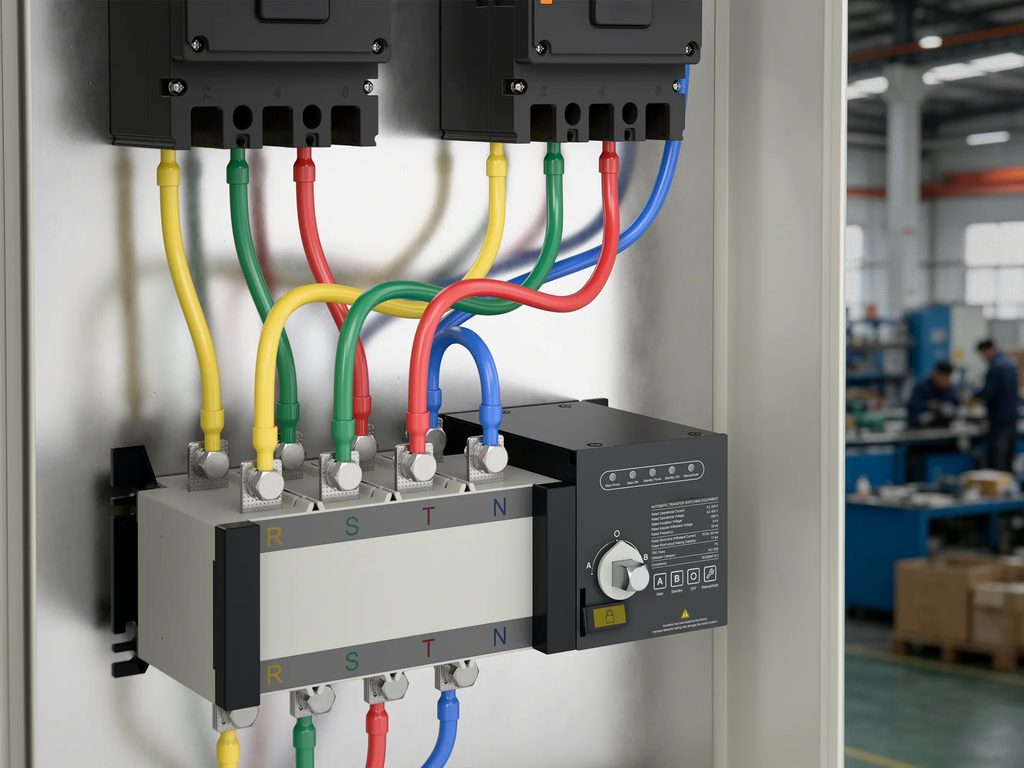
9. Why Is an ATS Often Used with a Diesel Generator?
Another very common power architecture is:
Utility + Diesel Generator → ATS → Load
Under normal operating conditions, the utility supplies the load.
When utility power fails, the system sends a start command to the diesel generator.
The generator then starts and builds up its output voltage and frequency.
Once the generator output reaches acceptable conditions, the ATS transfers the load from the utility source to the generator.
After utility power returns and remains stable for the required period, the ATS can transfer the load back to the utility according to its programmed sequence.
This explains why a facility equipped with an ATS may still experience a power interruption during a utility outage.
The ATS only transfers between power sources.
The diesel generator itself requires time to start and establish stable output power.
If a critical load cannot tolerate this interruption, a UPS or another ride-through solution may be required to bridge the gap between utility failure and generator availability.
10. How to Choose Between UPS, EPS, ATS, and STS
It is usually not helpful to ask:
“Which is better: UPS, EPS, ATS, or STS?”
They are not direct substitutes for one another.
A better selection process starts with a few practical questions.
1. Can the Load Tolerate a Power Interruption?
If even a brief power interruption could cause a system restart, communication failure, data loss, control system shutdown, or production interruption, a continuous power solution such as a UPS should be considered.
2. What Is the Maximum Acceptable Transfer Time?
This is one of the most important factors when selecting between ATS, STS, UPS, and different system architectures.
The shorter the allowable interruption, the more demanding the power architecture becomes.
3. Where Does the Backup Power Come From?
The backup source could be:
- Batteries
- A second utility source
- A diesel generator
- A second UPS
- Another independent power source
Different backup sources require different power system architectures.
4. What Type of Load Is Being Powered?
Servers, PLCs, DCS systems, instrumentation, motors, pumps, fans, and lighting systems have very different electrical characteristics.
For motor loads in particular, the designer may need to consider:
- Starting current
- Inrush current
- Power factor
- Starting method
- Overload capability
- Voltage drop
- Motor acceleration requirements
Therefore, UPS or EPS capacity should not be selected solely according to the load’s nameplate kW or kVA rating.
11. Common Mistakes When Selecting UPS, EPS, ATS, and STS
Mistake 1: Assuming Every System with Batteries Is a UPS
This is incorrect.
EPS systems can also contain batteries and inverter equipment.
The system should be identified according to its intended function, load type, electrical topology, and operating logic.
Mistake 2: Assuming an ATS Prevents All Power Interruptions
An ATS does not normally contain an energy storage system capable of maintaining the load during an outage.
If the alternate source is not yet available, or if both sources fail simultaneously, the ATS cannot generate power on its own.
Mistake 3: Assuming STS Is Always Better Than ATS
Not necessarily.
The major advantage of an STS is high-speed source transfer, but not every electrical load requires millisecond-level transfer.
For many conventional distribution, industrial, and building loads, an appropriately selected ATS may fully satisfy the application requirements.
Mistake 4: Selecting a UPS Based Only on Power Rating
UPS sizing involves more than simply matching kW or kVA.
Other factors may include:
- Load characteristics
- Power factor
- Starting current
- Inrush current
- Required backup runtime
- Overload capability
- Redundancy requirements
- Future expansion
A 10 kW server load and a 10 kW motor load, for example, can impose very different requirements on a UPS system.
12. Frequently Asked Questions About UPS, EPS, STS, and ATS
What Is the Main Difference Between UPS and EPS?
A UPS primarily focuses on maintaining continuous power and protecting critical loads from power disturbances. It is commonly used for servers, PLCs, DCS systems, telecommunications equipment, and sensitive electronics.
An EPS is primarily intended to supply designated emergency loads after the normal power source fails. Typical applications include emergency lighting, evacuation systems, fire protection systems, and other emergency loads.
What Is the Main Difference Between ATS and STS?
Both ATS and STS systems transfer loads between two power sources.
An STS typically uses power semiconductor devices such as thyristors to achieve very fast source transfers, making it suitable for loads that are highly sensitive to short interruptions.
An ATS commonly uses mechanical switching devices, although its exact transfer time depends on the product design, switching mechanism, sensing logic, and programmed delays.
Can an ATS Replace a UPS?
In most applications, no.
An ATS does not normally store energy. It simply transfers the load between two available power sources.
A UPS, by contrast, can use stored battery energy to continue supplying the load when its normal input source fails.
Can an STS Replace a UPS?
Not directly.
An STS solves the problem of rapidly transferring a load between two available sources.
It is not normally an energy storage system.
A UPS solves a different problem by maintaining power to the load when the incoming source fails.
Can UPS and STS Be Used Together?
Yes.
This configuration is common in data centers, telecommunications facilities, and other high-availability environments.
For example, two independent UPS systems can supply the two inputs of an STS. The STS can then supply a critical single-input load and transfer it between the two UPS sources when necessary.
Does an ATS Have a Battery?
A conventional ATS does not use a battery as a backup energy source for the connected load.
Its purpose is to transfer the load between available power sources, such as two utility feeds or a utility source and a generator.
Which Is Faster, ATS or STS?
STS systems are generally designed specifically for high-speed transfers and typically operate in the millisecond range.
ATS transfer time varies significantly depending on the switching technology, source conditions, control logic, and intentional delays.
For this reason, the selection should be based on the maximum interruption time the load can tolerate, rather than simply assuming one technology is always better.
13. Conclusion: How to Remember the Difference Between UPS, EPS, STS, and ATS
The difference between UPS, EPS, ATS, and STS becomes much easier to understand when you focus on the problem each device is designed to solve.
A simple way to remember them is:
UPS — keep critical loads continuously powered.
EPS — provide power to emergency loads after normal power fails.
ATS — automatically switch between power sources.
STS — rapidly switch between power sources.
For an actual project, however, equipment should not be selected based on the device name alone.
Start by answering four questions:
Can the load tolerate a power interruption?
What is the maximum interruption time it can tolerate?
Where will the backup power come from?
What are the electrical characteristics of the load?
Once these questions are answered, it becomes much easier to determine whether the application requires a UPS, EPS, ATS, STS, or a combination of these technologies.
For servers, PLCs, DCS systems, industrial instrumentation, motors, fans, pumps, and other critical loads, the final design should also consider rated power, starting current, inrush current, backup runtime, transfer time, redundancy, and overall system reliability.