Introduction: Why Is Level Management So Important in Ammonium Bicarbonate Production?
Ammonium bicarbonate is a widely used nitrogen fertilizer with a mature production process, relatively low manufacturing cost, and fast fertilizing effect. As fertilizer plants continue to improve automation and process control, higher requirements are being placed on continuous operation, production safety, and intelligent material management.
During the production, packaging, and storage of ammonium bicarbonate, storage silos, buffer hoppers, and finished-product bins play an important role in material handling. Operators need reliable level information to prevent production interruptions caused by an empty silo and to avoid overfilling, blockage, or material overflow when the product reaches a high level.
However, ammonium bicarbonate is a typical powder material, and its physical characteristics can make level measurement more difficult.
Common challenges include:
- Fine particles that may generate dust during conveying and filling;
- Material accumulation and buildup inside storage silos;
- Possible adhesion caused by changes in ambient humidity;
- Reduced measurement reliability when conventional level detection methods are affected by dust or buildup.
For this reason, selecting a reliable ammonium bicarbonate level detection solution is an important step in improving process continuity and reducing maintenance requirements in fertilizer plants.
For powder and granular material applications, vibrating rod level switches are increasingly used because of their simple operating principle, good adaptability, and suitability for point-level detection in bulk solids.

1. What Makes Ammonium Bicarbonate Level Detection Difficult?
1.1 Dust Can Affect Measurement Reliability
During conveying, filling, and discharging, ammonium bicarbonate can generate a certain amount of dust.
In dusty environments, some traditional level detection technologies may experience problems such as:
- False alarms caused by dust accumulation;
- Material buildup on the sensing element;
- Wear of mechanical moving parts;
- Increased maintenance frequency.
In continuously operating fertilizer production lines, a level switch must therefore provide more than basic detection accuracy. It also needs to remain stable under long-term exposure to industrial dust and changing operating conditions.
1.2 Material Adhesion May Cause False Switching
Ammonium bicarbonate is generally handled as a powder or crystalline material. When environmental humidity increases or the material remains stored for a long period, a certain amount of product may adhere to silo walls or accumulate around the sensing probe.
If the level switch is highly sensitive to buildup, several problems may occur.
For example:
- The sensor may indicate “material present” even after the actual level has dropped;
- A high-level signal may remain active because material is still attached to the probe;
- The control system may receive an incorrect level status.
Therefore, a suitable ammonium bicarbonate silo level switch should have good resistance to material buildup and should be able to distinguish normal coating from actual material coverage whenever possible.
1.3 Powder Density Places Higher Demands on Detection Sensitivity
Compared with dense bulk materials such as minerals, cement, or metal powders, ammonium bicarbonate can place different demands on a point-level sensor.
For some conventional detection technologies, powder characteristics may result in:
- Weak signal changes;
- Unstable detection;
- Sensitivity to changes in material condition;
- Difficulty maintaining consistent switching performance.
A level switch used for ammonium bicarbonate storage therefore needs sufficient sensitivity for powder and granular solid applications.
2. Why Is a Vibrating Rod Level Switch Suitable for Ammonium Bicarbonate Silos?
A vibrating rod level switch is a point-level detection instrument designed primarily for bulk solids such as powders and granules.
Its working principle is relatively straightforward.
Under normal conditions, the sensing rod is excited at a specific vibration frequency. When no material is in contact with the probe, it continues vibrating normally.
As the ammonium bicarbonate level rises and covers the sensing element, the vibration characteristics change. The electronic unit detects this change and converts it into a switching signal.
The signal can then be used for:
- High-level alarms;
- Low-level alarms;
- Conveyor start-stop control;
- Automatic filling;
- Empty-bin protection;
- Overfill prevention.
One important advantage of vibrating rod technology is that it does not rely primarily on changes in the dielectric constant of the material.
This makes it suitable for many powder applications where electrical properties may vary or where material conditions are difficult to control precisely.
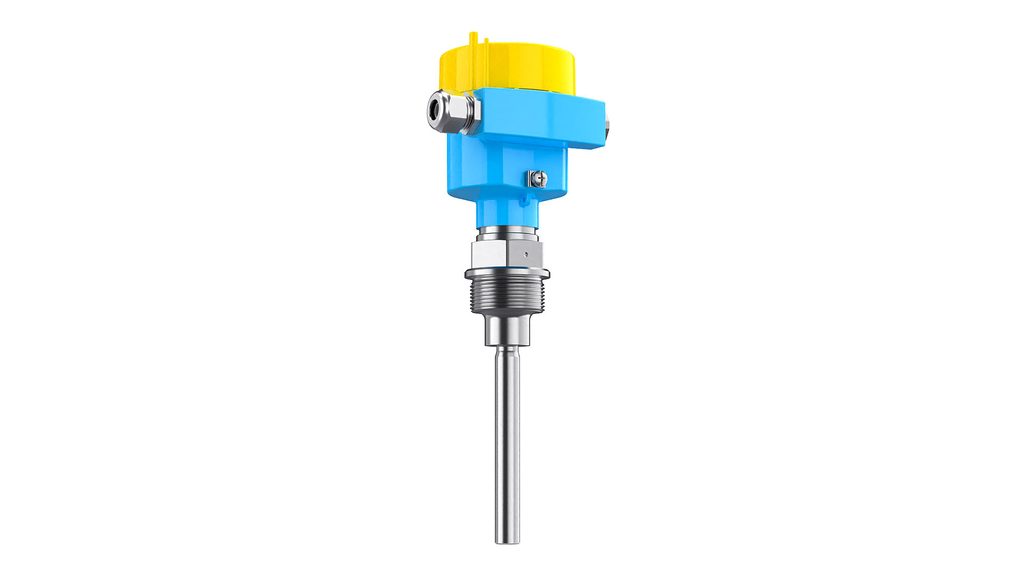
3. Advantages of the Tube-11 Vibrating Rod Level Switch in Ammonium Bicarbonate Applications
3.1 Suitable for Powder Material Detection
Ammonium bicarbonate is a typical powder material, so sensor sensitivity is an important consideration.
The Tube-11 vibrating rod level switch is designed for point-level detection of powder and granular bulk solids and can be used in applications involving relatively light materials.
In ammonium bicarbonate production facilities, typical installation points may include:
- Finished-product storage silos;
- Intermediate buffer hoppers;
- Packaging machine feed bins;
- Conveying system transfer hoppers;
- Process storage bins.
Depending on the installation position, the switch can perform either high-level or low-level detection.
For example, a high-level Tube-11 can help prevent overfilling, while a low-level switch can help maintain continuous feeding to downstream equipment.
3.2 Buildup Resistance Improves Long-Term Stability
Material buildup is one of the most common challenges in powder level detection.
When ammonium bicarbonate adheres to the sensing element, conventional point-level sensors may misinterpret residual material as an actual high-level condition.
A properly designed vibrating rod probe can reduce the influence of light coating and buildup on the sensing element.
This can help lower the risk of false alarms and improve long-term measurement stability.
For fertilizer plants operating continuously, reduced false switching can provide several practical benefits:
- Fewer unnecessary shutdowns;
- Reduced manual inspections;
- More stable material handling;
- Lower maintenance workload.
3.3 Dual-Tube Probe Design Supports Stable Operation
The Tube-11 uses a dual-tube sensing structure designed for industrial bulk-solid applications.
In fertilizer production environments, level switches may be exposed to:
- Dust;
- Equipment vibration;
- Continuous production cycles;
- Temperature changes;
- Humidity variations;
- Material impact during filling.
A robust sensing structure can improve mechanical stability and help the instrument maintain reliable operation under these conditions.
This is especially important for storage silos and buffer bins where sensors are expected to operate continuously with limited maintenance.
3.4 Corrosion-Resistant Wetted Materials for Fertilizer Environments
Although ammonium bicarbonate is not typically considered an extremely aggressive material, fertilizer production environments may still contain:
- Ammonia-containing atmospheres;
- Moist air;
- Chemical dust;
- Condensation;
- Other process contaminants.
Long-term exposure to these conditions may affect instruments made from unsuitable materials.
The use of corrosion-resistant materials such as 316L stainless steel for wetted parts can improve resistance to process environments and support longer-term instrument operation.
Material compatibility should nevertheless always be confirmed according to actual process composition, temperature, humidity, and installation conditions.
3.5 Simple Installation and Commissioning
Maintenance efficiency is an important consideration in industrial plants.
Compared with measurement technologies that require complex calibration or extensive parameter configuration, vibrating rod level switches are relatively straightforward to install and commission.
Their practical advantages may include:
- Simple installation;
- Easy setup;
- Limited calibration requirements;
- Convenient integration with control systems;
- Reduced routine maintenance.
This makes vibrating rod technology particularly suitable for high- and low-level alarm applications where continuous level measurement is not required.
4. Typical Tube-11 Applications in Ammonium Bicarbonate Storage Systems
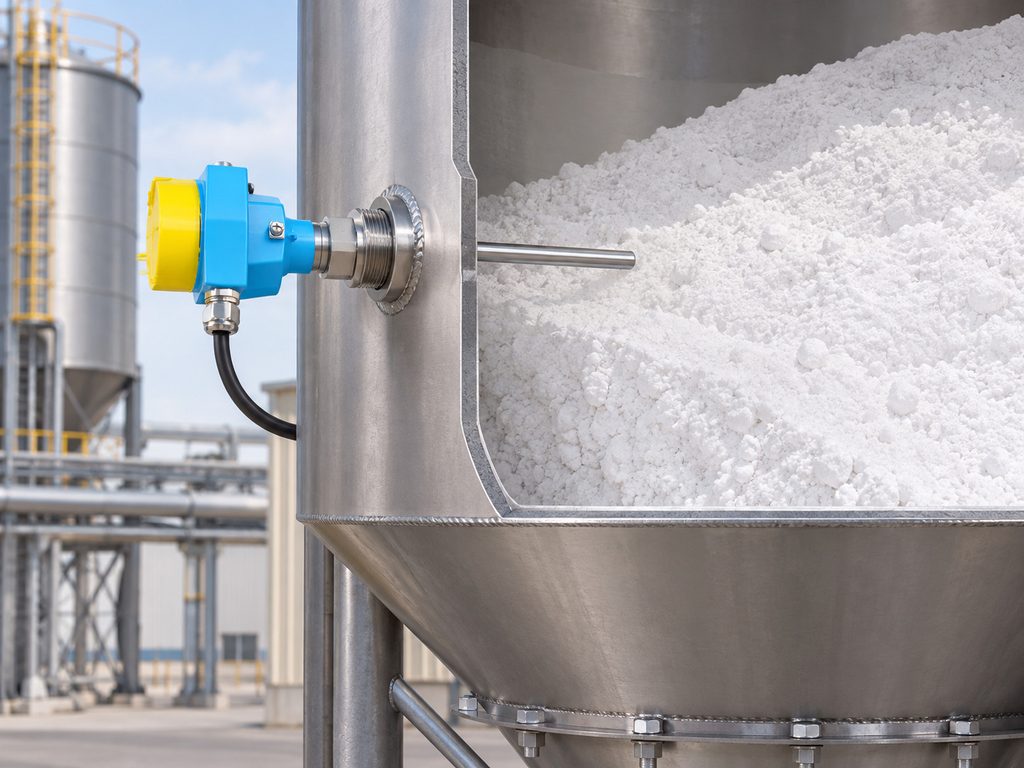
Application 1: High- and Low-Level Control in Finished-Product Silos
After production, ammonium bicarbonate may be transferred into finished-product silos before packaging or further handling.
In this application, vibrating rod level switches can be installed at different heights inside the silo.
High-Level Detection
When the material reaches the upper detection point, the level switch can send a signal to the control system.
The system can then:
- Stop upstream conveying equipment;
- Stop the feeding process;
- Activate a high-level alarm;
- Prevent overfilling.
This helps reduce the risk of material overflow and unnecessary cleanup.
Low-Level Detection
A second Tube-11 can be installed near the lower section of the silo.
When the material falls below this point, the signal may be used to:
- Start the upstream feeding system;
- Issue a low-level alarm;
- Protect downstream equipment from insufficient material supply.
Combining high- and low-level switches provides a simple method for automatic silo level control.
5. Application in Packaging Line Buffer Hoppers
Packaging lines require stable and continuous product supply.
If the buffer hopper feeding a packaging machine becomes empty, several problems may occur:
- Packaging interruptions;
- Reduced production efficiency;
- Frequent operator intervention;
- Unstable filling cycles.
Installing a vibrating rod level switch in the hopper allows the control system to determine whether sufficient ammonium bicarbonate is available.
When the material reaches the low-level point, the switch can trigger the feeding conveyor or upstream equipment.
When the material reaches the high-level point, feeding can be stopped.
This creates a simple automatic material replenishment loop.
As a result, the packaging equipment can maintain a more stable operating condition without relying entirely on manual observation.
6. Empty-Silo Protection in Conveying Systems
In continuous fertilizer production, material shortage in one section of the process may affect downstream equipment.
For example, if the upstream conveying system stops unexpectedly, a hopper may gradually become empty.
Without low-level detection, downstream equipment could continue running without sufficient material.
This may lead to:
- Unstable production;
- Reduced process efficiency;
- Packaging interruptions;
- Unnecessary equipment operation.
A low-level vibrating rod switch can provide an early indication of material shortage.
The switching signal can be connected to a PLC, DCS, alarm system, or equipment interlock logic.
This allows operators or the automation system to respond before the process is significantly affected.
7. Vibrating Rod Level Switch vs. Other Level Detection Technologies
Different technologies can be used for ammonium bicarbonate level measurement. The correct choice depends on whether the application requires continuous level measurement or only point-level detection.
| Detection Technology | Main Characteristics | Suitability for Ammonium Bicarbonate |
|---|---|---|
| Rotary paddle level switch | Mechanical rotating principle | Suitable for many solids, but moving parts may require maintenance |
| Capacitance level switch | Detects changes in electrical properties | Performance can be influenced by dielectric properties and buildup |
| Radar level transmitter | Provides continuous level measurement | Suitable when continuous measurement is required, but may be unnecessary for simple alarms |
| Vibrating rod level switch | Point-level detection with a vibration-based principle | Well suited for high- and low-level detection of many powders and granules |
For applications that only need to determine whether material has reached a specific position, a vibrating rod level switch offers a practical solution.
Typical examples include:
- Full-bin alarms;
- Empty-bin alarms;
- High-level protection;
- Low-level protection;
- Automatic feeding control.
When only a switching signal is required, installing a continuous level transmitter may add unnecessary complexity.
For this reason, point-level instruments such as the Tube-11 can be a practical choice for many ammonium bicarbonate storage and conveying applications.
8. Installation Considerations for Ammonium Bicarbonate Silos
Instrument performance depends not only on sensor technology but also on correct installation.
For ammonium bicarbonate applications, several factors should be considered.
Avoid Direct Material Impact
The vibrating rod should generally not be installed directly in the main filling stream.
If material continuously falls onto the probe, the sensor may experience unnecessary mechanical loading.
If necessary, the sensor can be installed away from the primary filling point or protected by an appropriate deflector.
Consider the Material Flow Pattern
Powder materials do not always form a perfectly flat surface inside a silo.
Depending on silo geometry and feeding conditions, the material may form:
- Conical piles;
- Uneven surfaces;
- Rat holes;
- Bridging;
- Local buildup.
For this reason, the installation position should represent the actual control point rather than an assumed average material level.
Select High- and Low-Level Positions According to Process Logic
A high-level switch should provide sufficient time for the upstream conveying system to stop before overfilling occurs.
Similarly, a low-level switch should be positioned so that downstream equipment still has enough material available to complete the required shutdown or replenishment sequence.
In other words, sensor positions should be determined according to the dynamics of the process rather than simply selecting the highest and lowest physical points in the silo.
9. Why Reliable Level Detection Matters in Fertilizer Production
As fertilizer plants move toward greater automation and digitalization, silo management is becoming increasingly important.
Reliable level detection contributes to several aspects of plant operation.
It can help:
- Reduce manual inspections;
- Improve process continuity;
- Prevent silo overfilling;
- Detect material shortages;
- Support automatic feeding;
- Improve equipment interlocking;
- Reduce unnecessary production interruptions.
The value of a level switch is therefore not limited to detecting whether material is present.
Its switching signal becomes part of the overall process control system.
For example, the Tube-11 output can be integrated with PLC or DCS logic to automatically control conveying equipment and generate alarms.
This transforms a simple point-level signal into an important part of an automated material-handling system.
10. How to Select a Level Switch for Ammonium Bicarbonate
When selecting a level switch for ammonium bicarbonate, users should consider more than the material name alone.
Important process information includes:
- Bulk density;
- Particle size;
- Material flowability;
- Moisture level;
- Operating temperature;
- Process pressure;
- Dust concentration;
- Expected material buildup;
- Installation orientation;
- Required insertion length;
- Electrical output requirements;
- Hazardous-area classification, if applicable.
The actual operating environment should always be considered when selecting materials, process connections, and electrical configurations.
For example, a sensor installed in a small packaging hopper may require a different probe length and mounting arrangement from one installed in a large finished-product silo.
Correct selection is therefore based on the complete process condition rather than simply choosing a level switch according to the material name.
11. The Role of Point-Level Detection in Smart Fertilizer Plants
The modernization of fertilizer production is increasing demand for reliable field instrumentation.
Modern plants are increasingly using automated control systems to manage:
- Material conveying;
- Storage;
- Mixing;
- Packaging;
- Process alarms;
- Equipment interlocks.
Within these systems, point-level switches provide simple but important process information.
A high-level switch can prevent overfilling.
A low-level switch can trigger automatic replenishment.
A second independent switch can even be used as an additional safety alarm where required by the process design.
Because the signal is straightforward and easy to integrate with control systems, vibrating rod level switches remain relevant even in highly automated plants.
Conclusion: Reliable Level Detection Supports Stable Ammonium Bicarbonate Production
Ammonium bicarbonate storage and handling present several challenges for level detection, including powder dust, material buildup, varying flow conditions, and the need for long-term operational stability.
For applications that require high-level alarms, low-level alarms, empty-bin protection, or automatic feeding control, vibrating rod technology provides a practical point-level detection solution.
The Tube-11 vibrating rod level switch is designed for powder and granular bulk-solid applications. Its vibration-based sensing principle, robust probe structure, resistance to material buildup, and corrosion-resistant construction make it suitable for many fertilizer storage and conveying applications.
When installed correctly and selected according to actual process conditions, the Tube-11 can help improve the reliability of ammonium bicarbonate silo level detection, reduce unnecessary manual intervention, and support stable automated production.
For fertilizer plants seeking a straightforward solution for ammonium bicarbonate level detection, powder silo high-level alarms, low-level protection, or bulk solid material control, vibrating rod level switches provide a practical approach that balances reliability, simplicity, and ease of integration.