Liquid level detection in industrial equipment does not always require a large or complex level instrument.
In small water tanks, coolant reservoirs, lubrication systems, pipelines, laboratory equipment, and compact OEM machines, users often only need to answer one simple question:
Has the liquid reached a certain point?
For example:
- Is the water tank full?
- Has the coolant dropped below the safe level?
- Does the lubrication reservoir need refilling?
- Is there liquid inside the pipeline?
- Has a small vessel reached its high-level alarm point?
In these applications, using a continuous level transmitter may increase cost, installation complexity, commissioning time, and maintenance requirements without providing much additional value.
This is why a compact level switch can be a more practical solution.
A tuning fork level switch detects liquid by monitoring changes in vibration frequency. It does not rely on the mechanical movement of a float and normally does not require complicated field calibration. This makes it particularly suitable for point level detection in equipment where installation space is limited.
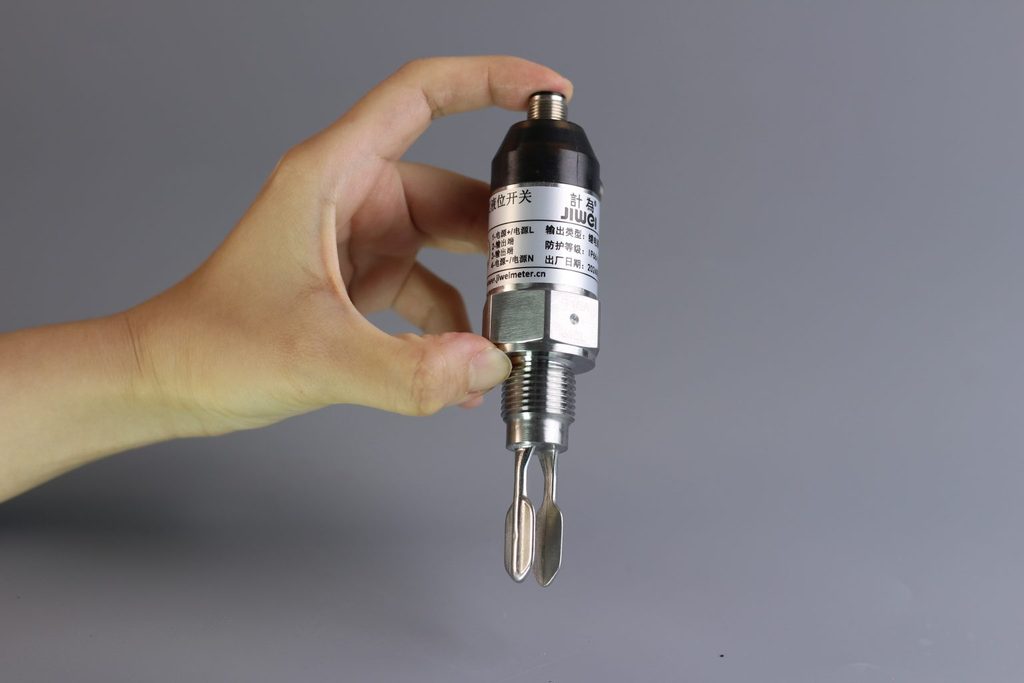
The Jiwei Ring-21 compact tuning fork level switch uses a short-fork design. The total length is approximately 160.5 mm, the maximum diameter is approximately 31.5 mm, and the tuning fork itself is only about 38 mm long.
It is mainly designed for point level detection in small vessels, pipes, compact industrial equipment, and other non-hazardous applications where installation space is limited.
So where is a compact tuning fork level switch most useful? How is it different from a float level switch? What parameters should be confirmed before selection? And what should engineers pay attention to during installation?
This guide explains the main selection and application considerations for the Ring-21.
What Is a Compact Tuning Fork Level Switch?
A tuning fork level switch is a point level detection instrument.
Unlike radar, ultrasonic, hydrostatic, or other continuous level measurement technologies, it does not continuously measure liquid height.
Instead, it determines whether liquid is present at a specific fixed position.
Typical functions include:
- high-level alarm;
- low-level alarm;
- overflow prevention;
- pump dry-run protection;
- automatic refill control;
- drain control;
- liquid/no-liquid detection in pipelines;
- equipment interlocks.
In many compact machines and process systems, users do not actually need to know that the level is “62.5%.”
They only need a reliable ON/OFF signal.
This is the main reason compact liquid level switches are widely used.
How Does the Ring-21 Tuning Fork Level Switch Work?
The Ring-21 uses a vibration-based liquid detection principle.
A piezoelectric element inside the instrument drives the tuning fork at a fixed resonant frequency.
When the fork is in air, it maintains its normal vibration condition.
When liquid rises and covers the fork, the surrounding medium creates damping. This changes the vibration characteristics of the fork.
The electronic circuit detects this change and switches the output accordingly.
The Ring-21 operates at a vibration frequency of approximately 1200 Hz.
A simple way to understand the principle is:
Fork in air — one vibration condition.
Fork covered by liquid — another vibration condition.
The control system does not need to know the exact liquid height.
It only uses the switching signal to control a pump, valve, PLC, relay, alarm, or other automation system.
Because this method does not require a float to move up and down, the sensing element can be made much more compact.
Why Are Compact Level Switches Better for Small Equipment?
On a large storage tank, adding several centimeters of instrument length is rarely a major concern.
In small industrial equipment, however, space can be extremely limited.
Examples include:
- compact coolant tanks inside machinery;
- lubrication oil reservoirs;
- circulation water systems;
- OEM equipment tanks;
- laboratory vessels;
- pilot-scale process systems;
- small-diameter pipelines;
- liquid systems inside machinery cabinets.
These applications have one thing in common:
There is often very little space available for the level switch.
The Ring-21 has a total length of approximately 160.5 mm, a maximum diameter of approximately 31.5 mm, and a sensing fork length of only about 38 mm.
A shorter probe reduces the amount of space required inside the vessel or pipeline.
It also reduces the risk of mechanical interference with internal structures.
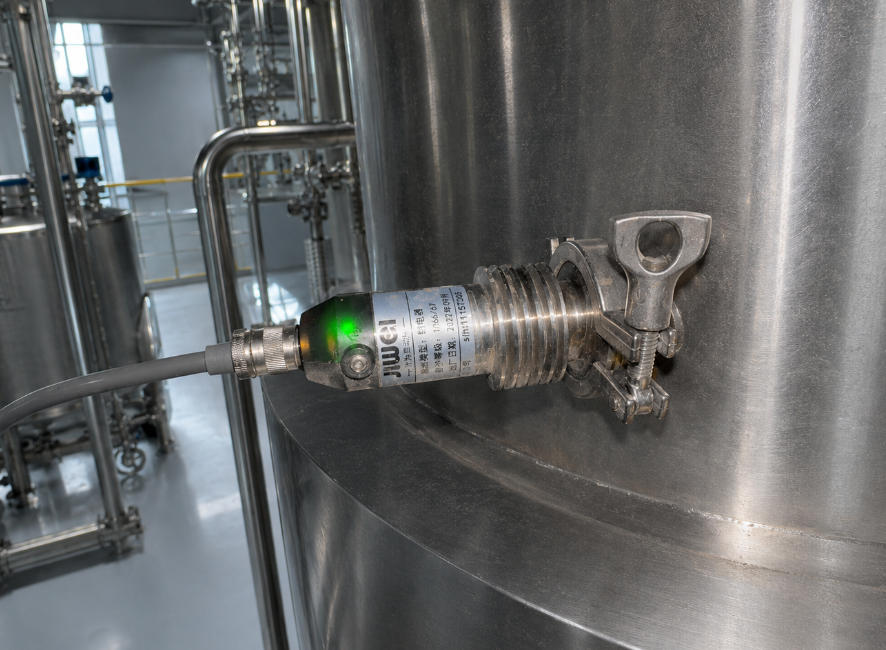
For equipment manufacturers, this compact form factor makes the level switch easier to integrate into the overall machine design without redesigning the entire tank or piping system.
Key Features of the Ring-21 Compact Tuning Fork Level Switch
1. 38 mm Short Fork for Limited Installation Space
The Ring-21 tuning fork is approximately 38 mm long.
In small tanks and pipelines, longer probes may interfere with internal structures or require more installation clearance.
The short-fork design helps reduce this limitation.
This is particularly useful in retrofit projects where the original vessel has very little space available.
2. Maximum Diameter of Approximately 31.5 mm
Instrument body size is also important in compact installations.
The Ring-21 has a maximum diameter of approximately 31.5 mm, making it suitable for areas where surrounding piping, enclosures, brackets, or machine structures restrict available space.
3. Suitable for Liquids with Density Above 0.7 g/cm³
A vibration level switch depends on the liquid creating enough damping to produce a detectable change in the fork vibration.
The Ring-21 is suitable for liquids with a density greater than approximately 0.7 g/cm³.
This parameter should always be confirmed before selection.
Water-based liquids usually meet this requirement easily.
However, lightweight oils, low-density solvents, or other special liquids may require closer evaluation.
The fact that a medium is a liquid does not automatically mean it is suitable.
4. Process Temperature Range from -50°C to 150°C
The Ring-21 is designed for process temperatures from approximately -50°C to 150°C.
This allows it to cover applications such as:
- ambient-temperature water tanks;
- industrial cooling systems;
- warm process liquids;
- many utility and machine-fluid applications.
Actual selection should still be based on the normal operating temperature and the highest possible process temperature.
Average temperature alone is not enough.
5. Process Pressure Range from -1 to 40 bar
The process pressure range is approximately -1 to 40 bar.
This means the instrument can be considered not only for atmospheric tanks but also for certain pressurized vessels and pipeline applications, depending on the exact process connection and model configuration.
Pressure, however, is only one selection parameter.
Temperature, medium compatibility, electrical output, and installation method must also be checked.
6. 316L Stainless Steel Wetted Construction
The Ring-21 uses 316L stainless steel for the process connection and wetted structure.
316L provides good compatibility with many common industrial liquids and water-treatment applications.
However, “stainless steel” does not mean the instrument is suitable for every corrosive chemical.
For strong acids, strong alkalis, chloride-rich liquids, or aggressive chemicals, compatibility should be checked according to actual concentration and temperature.
Typical Applications for the Ring-21 Compact Level Switch
1. High- and Low-Level Alarms in Small Industrial Water Tanks
Water tanks are one of the most common applications for compact level switches.
Many systems need two important control points:
High level — to stop filling and prevent overflow.
Low level — to prevent pump dry running or equipment operation without sufficient water.
The Ring-21 can be installed at the required control height.
When liquid reaches the fork, the switch sends a signal to the PLC, relay, or other control system.
The system can then:
- stop a filling pump;
- close an inlet valve;
- start a drain pump;
- generate a high-level alarm.
For low-level detection, it can trigger:
- a refill command;
- a low-level alarm;
- pump shutdown;
- equipment protection logic.
For tanks that only require high- and low-level control, this can be more direct than continuous level measurement.
2. Coolant Reservoir Protection
Machine tools, machining systems, cooling equipment, and some HVAC circulation systems often include compact coolant reservoirs.
If the coolant level becomes too low, possible consequences include:
- reduced cooling performance;
- pump suction loss;
- rising equipment temperature;
- interruption of production.
A compact level switch can be installed near the minimum allowable liquid level.
When the coolant drops below that point, the system can trigger an alarm or automatic refill sequence.
Because the Ring-21 uses a short sensing fork, it is especially suitable for small coolant tanks installed inside machinery.
3. Low-Level Alarm in Lubrication Oil Reservoirs
Bearings, gears, and mechanical moving parts rely on lubrication systems for safe operation.
Insufficient oil may cause:
- increased friction;
- higher bearing temperature;
- accelerated wear;
- equipment failure or shutdown.
Many lubrication systems do not require millimeter-level continuous measurement.
They simply need a reliable indication that the oil has fallen below the safe level.
For lubrication oils with suitable density and material compatibility, a tuning fork level switch can be used as a low-level alarm device.
Because oil densities vary, the actual medium must be checked to confirm that it exceeds the Ring-21 minimum density requirement of 0.7 g/cm³.
4. Liquid / No-Liquid Detection in Pipelines
Another useful application is pipeline status detection.
Some process systems do not need to measure flow rate.
They only need to know:
Is liquid currently present inside the pipe?
Typical examples include:
- pump inlet dry-run protection;
- empty-pipe detection;
- cleaning system liquid confirmation;
- process liquid supply monitoring.
The Ring-21’s 38 mm short-fork design can be advantageous in applications with limited pipe diameter or restricted installation space.
However, the sensor should not be exposed unnecessarily to high-velocity direct impact.
The maximum medium velocity is approximately 6 m/s, and the actual installation should also consider pipe diameter, flow direction, and turbulence.
5. Laboratory and Pilot-Scale Equipment
Laboratory systems and pilot plants often have:
- small vessels;
- dense piping layouts;
- limited installation space;
- multiple monitoring points;
- relatively simple control logic.
In these applications, a high-cost continuous level transmitter may not be necessary.
A stable point level signal may be sufficient.
Compact tuning fork level switches are therefore suitable for:
- laboratory liquid tanks;
- pilot reactors;
- test equipment reservoirs;
- compact circulation systems;
- liquid supply modules.
6. OEM Equipment Integration
Many machine builders need to integrate liquid level protection directly into their products.
OEM applications often require instruments that are:
- compact;
- easy to wire;
- easy to connect to PLCs;
- simple to standardize;
- cost-effective;
- easy to maintain.
The advantage of a compact tuning fork level switch is not that it provides the largest number of functions.
Its value lies in providing reliable point level detection while minimizing the burden on the overall machine design.
Tuning Fork Level Switch vs Float Level Switch
For small tanks and reservoirs, users often compare tuning fork level switches with float level switches.
Both technologies can provide point level detection, but their operating principles are different.
| Comparison | Tuning Fork Level Switch | Float Level Switch |
|---|---|---|
| Detection principle | Detects changes in fork vibration | Float moves with liquid level |
| External moving parts | No moving sensing element | Usually includes moving float parts |
| Installation space | Can use a short compact probe | Requires space for float movement |
| Point level alarm | Yes | Yes |
| Continuous level measurement | No | Some designs support multi-point detection |
| Medium requirements | Must meet minimum density and process conditions | Must provide sufficient buoyancy and avoid mechanical sticking |
| Typical applications | Compact equipment, pipelines, small tanks | General tanks and reservoirs |
This does not mean one technology is always better than the other.
The correct choice depends on:
- available space;
- medium properties;
- mounting method;
- control requirements;
- maintenance preferences;
- project budget.
If installation space is extremely limited and only one fixed level point is required, a compact tuning fork level switch can be a strong option.
What Parameters Should Be Confirmed Before Selecting a Compact Tuning Fork Level Switch?
1. Liquid Density
This is one of the first parameters to check for the Ring-21.
The medium density should be greater than approximately 0.7 g/cm³.
Water-based liquids generally meet this requirement.
Oils, solvents, and special chemicals should be checked using actual process data.
2. Process Temperature
Confirm:
- normal operating temperature;
- maximum continuous temperature;
- short-term peak temperature.
The Ring-21 process temperature range is approximately -50°C to 150°C.
3. Process Pressure
Confirm both the normal operating pressure and the highest possible pressure in the tank or pipeline.
The Ring-21 process pressure range is approximately -1 to 40 bar.
4. Material Compatibility
Check whether 316L stainless steel and the relevant seal materials are compatible with the process liquid.
This is particularly important for corrosive chemicals.
5. Power Supply and Output Type
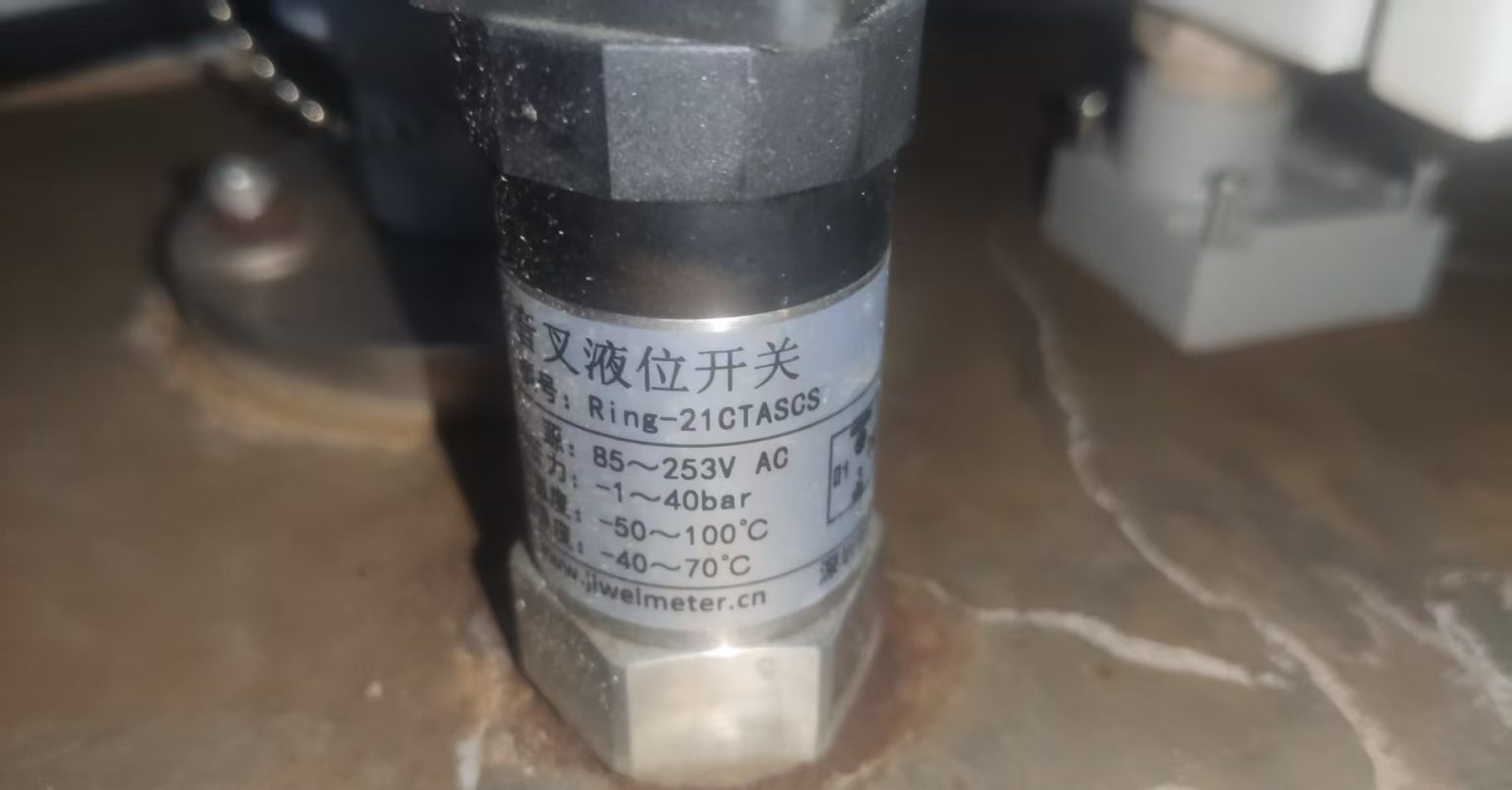
Depending on the configuration, the Ring-21 can provide relay or NPN/PNP transistor outputs.
Relay versions can be available with:
- 85–253 V AC;
- 10–35 V DC.
NPN/PNP versions use approximately:
- 10–35 V DC.
Before ordering, confirm the signal type required by the PLC, DCS, relay circuit, or control system.
6. Hazardous-Area Requirements
This is an important limitation.
The standard Ring-21 is mainly intended for non-hazardous applications.
If the installation area contains explosive gas, vapor, or combustible dust, the instrument should not be selected only because its process parameters are suitable.
A level switch with the required hazardous-area certification should be used instead.
Installation Considerations for the Ring-21
Align the Fork Properly with Liquid Flow
In pipelines or vessels with moving liquid, the fork orientation should be selected to reduce unnecessary flow impact.
Proper orientation helps improve detection stability and mechanical reliability.
Avoid High-Velocity Inlet or Outlet Zones
If liquid directly impacts the sensing fork, it may affect switching stability and increase mechanical stress.
Avoid mounting directly in front of:
- pump discharge jets;
- nozzles;
- high-velocity liquid streams;
- turbulent inlet zones.
Install at the Correct Control Level
The physical mounting position becomes the actual switching point.
Before installation, define clearly:
- At what level should filling stop?
- At what level should refill start?
- Where should an alarm be triggered?
- Where should the pump be protected?
The instrument should be installed according to the intended process control logic, not the other way around.
Allow Space for Maintenance
Although the Ring-21 is compact, maintenance clearance is still required.
Engineers should allow enough room for:
- wiring;
- removal;
- inspection;
- replacement.
Compact installation does not mean the instrument should be completely blocked by surrounding piping or structures.
When Is the Ring-21 Not the Best Choice?
Compact tuning fork level switches are versatile, but they are not suitable for every liquid application.
Additional evaluation is required in the following conditions.
Medium Density Below or Near 0.7 g/cm³
The actual liquid density must be checked to confirm that the instrument can detect the medium reliably.
Severe Buildup, Scaling, or Crystallization
If thick deposits continuously cover the tuning fork, the vibration characteristics may be affected.
Applications with severe coating or crystallization should be evaluated carefully.
Highly Corrosive Liquids
Material compatibility must be confirmed for both the wetted metal and sealing materials.
Hazardous Areas
The standard Ring-21 is intended mainly for non-hazardous locations.
Applications in explosive atmospheres require a suitable certified model.
Continuous Level Measurement
The Ring-21 provides only point level switching.
If the application requires:
- real-time liquid height;
- percentage level;
- volume calculation;
- continuous trend data;
a continuous technology such as radar, ultrasonic, hydrostatic, or another level transmitter should be selected.
This is an important principle in instrument selection:
Do not ask one type of instrument to perform a task it was not designed to do.
Frequently Asked Questions About Compact Tuning Fork Level Switches
Can the Ring-21 Detect Water?
Yes.
When temperature, pressure, and material compatibility are within the specified range, the Ring-21 can be used for high- and low-level detection in:
- industrial water tanks;
- coolant reservoirs;
- collection tanks;
- circulation systems.
Can the Ring-21 Detect Oil?
It depends on the specific oil.
The liquid density must first be confirmed to be above approximately 0.7 g/cm³.
Temperature and material compatibility should also be checked.
The fact that the medium is “oil” alone is not enough to determine suitability.
Can a Tuning Fork Level Switch Measure Continuous Level?
No.
The Ring-21 is a point level switch.
It only detects whether liquid has reached the installed position.
For continuous 0–100% level measurement, another technology should be used.
How Long Is the Ring-21 Tuning Fork?
The tuning fork is approximately 38 mm long.
The total product length is approximately 160.5 mm, and the maximum diameter is approximately 31.5 mm.
This compact structure is particularly suitable for small vessels, pipelines, and equipment with limited installation space.
Does a Tuning Fork Level Switch Require Frequent Calibration?
Normally, no.
A vibration-based point level switch detects changes in the vibration condition of the sensing fork.
It usually does not require the same type of frequent field range calibration associated with some continuous analog instruments.
However, routine inspection should still check for:
- heavy deposits;
- mechanical damage;
- wiring issues;
- abnormal process conditions.
Can the Ring-21 Be Used in Hazardous Areas?
The standard Ring-21 is mainly designed for non-hazardous locations.
If the application is located in a hazardous gas or dust area, a level switch with the appropriate hazardous-area certification should be selected.
Can a Tuning Fork Level Switch Be Installed in a Pipeline?
Yes, depending on:
- pipe diameter;
- liquid velocity;
- medium properties;
- installation position.
The Ring-21’s short-fork design makes it suitable for many compact pipe applications, but the sensing element should not be subjected to continuous direct impact from high-velocity liquid flow.
Conclusion: For Compact Level Detection, the Right Instrument Matters More Than More Functions
Industrial water tanks, coolant reservoirs, lubrication systems, compact vessels, laboratory equipment, and pipelines do not always require complicated continuous level instrumentation.
In many cases, the process only needs to answer a few simple questions:
Has the liquid reached the high level?
Is the tank nearly empty?
Does the equipment need more coolant?
Is there liquid inside the pipe?
For these applications, a compact tuning fork level switch can provide a direct point level signal using a relatively small installation footprint.
The Ring-21 compact tuning fork level switch features:
- an approximately 38 mm short fork;
- total length of approximately 160.5 mm;
- maximum diameter of approximately 31.5 mm;
- suitability for liquids above approximately 0.7 g/cm³;
- process temperature range of approximately -50°C to 150°C;
- process pressure range of approximately -1 to 40 bar.
For space-limited, cost-sensitive, non-hazardous industrial equipment that only requires high- or low-level alarms and equipment interlocks, the Ring-21 provides a compact point level detection solution.
Before final selection, however, users should still confirm:
liquid density, process temperature, process pressure, material compatibility, power supply, output type, installation space, and hazardous-area requirements.
Only when the level switch matches the real process conditions can users avoid later problems such as false switching, difficult installation, poor material compatibility, or incorrect model selection.
Learn more about the Ring-21 Compact Tuning Fork Level Switch, including technical specifications, dimensions, wiring, and installation requirements.