
Safety valves, relief valves, rupture discs, and breather valves are commonly found on pressure vessels, chemical process equipment, pump discharge lines, and storage tanks.
Because all four devices are related to pressure protection, they are often confused with one another. However, they do not solve exactly the same problem.
Some are designed to protect pressure vessels from abnormal overpressure. Others are used to limit pressure in liquid systems or provide bypass flow. Rupture discs create a rapid, non-reclosing relief path when pressure reaches a specified limit, while breather valves mainly control normal pressure and vacuum conditions in atmospheric or low-pressure storage tanks.
Selecting the correct device requires more than simply looking at the product name, connection size, or appearance.
Engineers should first ask:
- Is the protected equipment a pressure vessel, pipeline, pump system, or low-pressure storage tank?
- Is the process medium gas, vapor, liquid, or two-phase flow?
- What causes the pressure to increase?
- How much relief capacity is required?
- Is the medium corrosive, crystallizing, coking, or polymerizing?
- Must the device automatically reclose after operation?
- Is vacuum protection required in addition to positive-pressure protection?
Once these questions are answered, the differences between safety valves, relief valves, rupture discs, and breather valves become much easier to understand.
Safety Valve, Relief Valve, Rupture Disc, and Breather Valve at a Glance
| Device | Typical Application | Main Function | Automatic Reclosing | Key Characteristic |
|---|---|---|---|---|
| Safety valve | Boilers, pressure vessels, gas and steam systems | Emergency overpressure protection | Usually yes | Opens automatically when pressure reaches the set condition |
| Relief valve | Liquid piping, hydraulic systems, pump discharge lines | Pressure limitation, bypass, or recirculation | Usually yes | Commonly used for liquid pressure control |
| Rupture disc | Reactors, pressure vessels, corrosive or fouling services | Rapid overpressure relief | No | No moving parts; must be replaced after activation |
| Breather valve | Oil tanks, solvent tanks, chemical storage tanks | Normal pressure and vacuum control | Yes | Opens during tank filling, emptying, and thermal breathing |
Terminology may vary between standards, industries, and manufacturers. Terms such as “safety valve,” “relief valve,” and “pressure relief valve” are not always used in exactly the same way.
For this reason, engineering decisions should not be based on terminology alone. The device design, process medium, applicable standard, operating characteristics, and intended protection function should all be considered.
When Should a Safety Valve Be Used?
A safety valve is primarily used to protect equipment from abnormal overpressure.
Typical applications include:
- boilers;
- pressure vessels;
- steam systems;
- compressed gas equipment;
- reactors;
- pressurized piping systems.
Under normal operating conditions, the safety valve remains closed.
When the pressure inside the protected equipment reaches the specified opening condition, the valve automatically opens and discharges gas, vapor, or another process medium. This prevents the pressure from continuing to rise beyond the allowable limit.
Once pressure returns to an acceptable level, the valve normally recloses.
What Can Cause a Safety Valve to Open?
Common industrial overpressure scenarios include:
- a downstream valve being accidentally closed;
- compressor discharge blockage;
- external heating of a pressure vessel;
- fire exposure causing liquid vaporization;
- runaway chemical reactions generating gas;
- heat exchanger tube rupture allowing high-pressure fluid into the low-pressure side;
- thermal expansion of blocked-in liquid;
- failure of a control valve or pressure-reducing system.
The purpose of a safety valve is therefore not to regulate normal process pressure.
Its role is to provide a final layer of overpressure protection when normal process control systems fail or abnormal operating conditions occur.
Safety Valve Selection Is Not Just About Connection Size
A common maintenance mistake is assuming:
“The existing valve is DN50, so any DN50 valve can replace it.”
This is not correct.
Two valves with the same connection size may have very different relief capacities.
Proper safety valve selection also depends on:
- set pressure;
- allowable overpressure;
- process medium;
- operating temperature;
- required relieving capacity;
- discharge coefficient;
- inlet pressure loss;
- outlet backpressure.
A safety valve is part of the overall pressure protection system. Its size and configuration should therefore be based on actual overpressure scenarios and calculated relief requirements rather than connection size alone.
When Should a Relief Valve Be Used?
The term “relief valve” is used broadly in industry.
In many hydraulic, lubrication, and liquid transfer systems, a relief valve is used to limit maximum operating pressure or to create a bypass or recirculation path when pressure reaches a specified value.
A positive displacement pump is a typical example.
Gear pumps, screw pumps, and reciprocating pumps continue moving liquid while operating. If the discharge valve is accidentally closed while the pump continues running, the liquid has no normal flow path and discharge pressure can rise rapidly.
A relief device can be installed to protect the system.
When pressure reaches the set value, the valve opens and redirects part or all of the liquid back to:
- the storage tank;
- the pump suction;
- another suitable low-pressure location.
This prevents excessive pressure from damaging the pump or piping.
What Is the Difference Between a Safety Valve and a Relief Valve?
This is one of the most common questions in industrial pressure protection.
A practical way to understand the difference is:
A safety valve is generally associated with emergency overpressure protection of pressure equipment, while the term relief valve is often used for pressure limiting, bypass, or recirculation in liquid systems.
However, this distinction should not be treated as absolute.
In many international standards and English-language engineering references, “pressure relief valve” is a broader term that may include different types of reclosing pressure relief devices.
Therefore, when engineers encounter terms such as:
- Safety Valve;
- Relief Valve;
- Pressure Relief Valve;
they should not rely on translation alone.
Instead, they should review:
- applicable design standards;
- process medium;
- set pressure;
- valve construction;
- opening characteristics;
- intended protection function.
When Should a Rupture Disc Be Used?
A rupture disc is another widely used overpressure protection device.
One of the biggest differences between a rupture disc and a reclosing pressure relief valve is that:
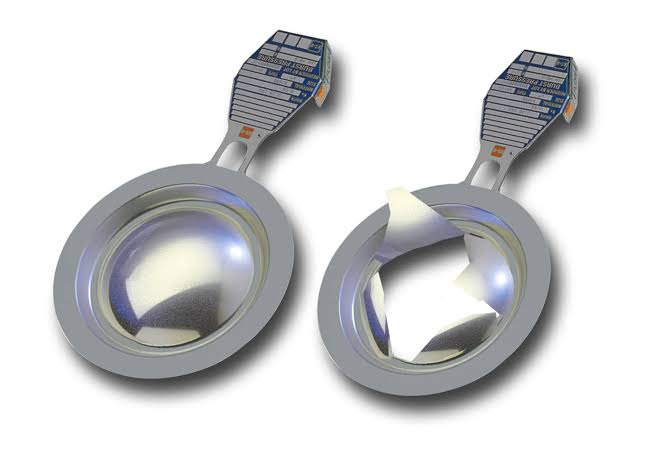
A rupture disc is a non-reclosing pressure relief device.
During normal operation, the disc remains intact.
When the pressure differential across the disc reaches its specified burst condition, the membrane ruptures and creates an open flow path, allowing the process pressure to be released rapidly.
After activation, the rupture disc cannot automatically reset.
It must be inspected and replaced before the system returns to normal service.
What Are the Advantages of a Rupture Disc?
Rupture discs have relatively simple construction and contain no conventional moving components such as springs, stems, or valve discs.
This makes them particularly useful in several challenging process conditions.
1. Crystallizing, Coking, or Polymerizing Media
Some chemical media can form deposits during operation.
If deposits accumulate inside the seat or moving components of a conventional pressure relief valve, they may affect opening reliability or sealing performance.
A rupture disc can provide a relatively complete process barrier during normal operation, which makes it useful in certain fouling services.
2. Highly Corrosive Media
Strongly corrosive process fluids may attack the seat, disc, stem, or other internal components of a conventional safety or relief valve.
In a properly engineered installation, a rupture disc can isolate the downstream relief valve from continuous exposure to the process medium.
3. Rapid Pressure Rise
Some reactors and process systems may experience extremely fast pressure increases.
Once its burst pressure is reached, a rupture disc can open rapidly and provide a large relief area.
This makes rupture discs suitable for certain fast overpressure scenarios.
However, “fast opening” does not mean that a rupture disc automatically solves every rapid-pressure-rise problem.
Relief capacity must still be calculated based on:
- the cause of overpressure;
- required flow rate;
- physical state of the medium;
- the complete discharge system.
4. Tight Isolation During Normal Operation
For toxic, corrosive, volatile, or leakage-sensitive media, a rupture disc can provide a complete physical barrier before activation.
For this reason, rupture discs are also frequently used in combination with pressure relief valves.
Why Install a Rupture Disc Upstream of a Safety Valve?
A common arrangement in chemical plants is:
Pressure Vessel → Rupture Disc → Safety Valve → Relief System
This does not mean that two identical protection devices are being installed unnecessarily.
In many applications, the upstream rupture disc isolates the process medium, while the downstream safety valve provides controlled pressure relief.
Typical reasons for using this combination include:
- corrosive process media;
- crystallizing materials;
- deposit-forming services;
- polymerizing media;
- strict leakage control requirements;
- reducing direct exposure of the safety valve to aggressive process fluids.
However, combining a rupture disc and a safety valve requires proper system design.
The space between the rupture disc and safety valve must be considered carefully.
If the rupture disc develops a small leak and pressure gradually builds in the intermediate space, the actual differential pressure across the disc may change, potentially affecting its burst behavior.
For this reason, a rupture disc and safety valve combination should be engineered as an integrated pressure relief system rather than simply treating the two devices as independent products.
When Should a Breather Valve Be Used?
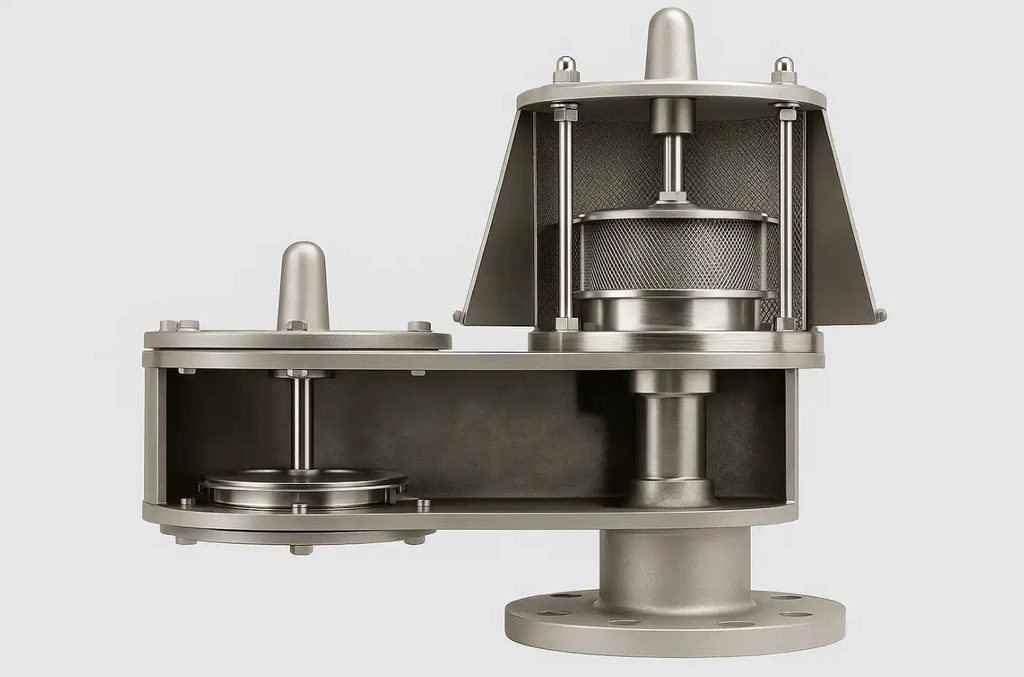
A breather valve is primarily used on atmospheric or low-pressure storage tanks.
Typical applications include:
- crude oil storage tanks;
- refined petroleum product tanks;
- solvent tanks;
- chemical raw material tanks;
- fixed-roof tanks containing volatile liquids.
These storage tanks normally operate at much lower pressures than pressure vessels.
However, the internal pressure of a storage tank is not constant.
Pressure changes occur naturally as the tank is filled, emptied, heated, and cooled.
During Tank Filling
As liquid enters the tank, the liquid level rises and the vapor space becomes smaller.
If vapor cannot escape quickly enough, pressure inside the tank increases.
During Tank Emptying
As liquid leaves the tank, the vapor space increases.
If sufficient gas cannot enter the tank, a vacuum may develop.
Severe vacuum can cause tank deformation or structural damage.
When Temperature Increases
The liquid may evaporate more rapidly and the gas phase expands.
This can increase internal tank pressure and require vapor to be vented.
When Temperature Decreases
Gas contracts and vapor may condense.
Tank pressure can fall, creating a need for air or inert gas to enter the tank.
A breather valve responds to these normal pressure changes.
When tank pressure becomes too high, it vents outward. When vacuum develops, it allows gas to enter.
For this reason, a breather valve is more accurately described as a pressure/vacuum protection device for low-pressure storage tanks.
Can a Breather Valve Replace Emergency Tank Venting?
Not necessarily.
A breather valve primarily handles normal breathing caused by:
- tank filling;
- tank emptying;
- daily temperature changes.
Emergency scenarios can generate much larger vapor volumes.
For example, external fire exposure may rapidly heat the tank contents and produce vapor at a rate far greater than normal breathing conditions.
Emergency venting capacity must therefore be evaluated separately.
In simple terms:
Normal venting and emergency venting are different design cases.
The presence of a breather valve on a storage tank does not automatically mean that all possible overpressure scenarios are adequately protected.
How to Select the Right Pressure Protection Device
A practical selection process starts with five questions.
1. What Type of Equipment Is Being Protected?
For boilers, pressure vessels, and pressurized piping, overpressure protection should be evaluated first.
For liquid pump discharge systems, maximum pump pressure and bypass or recirculation requirements should be considered.
For atmospheric or low-pressure storage tanks, both pressure and vacuum venting should be evaluated.
2. What Is the Process Medium?
Determine whether the medium is:
- gas;
- vapor;
- liquid;
- two-phase fluid.
Also consider whether it is:
- corrosive;
- toxic;
- crystallizing;
- polymerizing;
- particulate;
- deposit-forming.
These characteristics directly influence device type, construction materials, and maintenance requirements.
3. Why Is Pressure Increasing?
This is one of the most important questions.
It is not enough to ask, “What is the maximum pressure?”
The cause of the overpressure must also be identified.
Possible causes include:
- blocked outlet;
- pump deadheading;
- external fire;
- runaway reaction;
- heat exchanger tube rupture;
- thermal expansion of trapped liquid.
Each scenario can result in a completely different required relieving capacity.
4. Must the Device Reclose Automatically?
If the process should continue operating after pressure returns to normal, a reclosing pressure relief valve is generally preferred.
A rupture disc does not reclose after operation and must be replaced.
It is therefore better suited to specific applications or as part of a combined protection system.
5. Is Vacuum Protection Also Required?
This is especially important for storage tanks.
Engineers often focus on overpressure, but fixed-roof tanks may also be damaged by vacuum caused by:
- rapid liquid withdrawal;
- sudden cooling;
- vapor condensation.
Storage tank protection should therefore evaluate both positive and negative pressure conditions.
Common Installation and Maintenance Problems
1. Replacing a Device Based Only on Connection Size
Matching flange or thread size does not mean two pressure relief devices have the same capacity.
Before replacement, the design conditions and technical specifications should always be rechecked.
2. Incorrect Isolation Valve Position
If an upstream or downstream isolation valve blocks the relief path, even a fully functional safety valve cannot protect the equipment.
Isolation valves associated with pressure relief systems should therefore be managed under strict operating and maintenance procedures.
3. Incorrect Rupture Disc Installation Direction
Rupture discs are typically designed for a specific pressure direction.
Installing the disc backward can change its burst behavior.
Always follow the manufacturer’s orientation markings and installation instructions.
4. Blocked or Sticking Breather Valves
Breather valves are installed on tank roofs and may be exposed to:
- dust;
- vapor condensation;
- sticky hydrocarbons;
- polymer deposits;
- crystallized materials.
If the pallet, seat, or vent passage becomes blocked, both overpressure and vacuum risks can increase.
Inspection frequency should therefore reflect the actual process medium and environmental conditions.
5. Considering Only “How to Relieve,” Not “Where the Discharge Goes”
Pressure relief does not end when fluid leaves the protected equipment.
Engineers must also consider what happens downstream.
Depending on the medium, potential concerns include:
- high-temperature steam;
- flammable gas dispersion;
- toxic releases;
- flashing of hot liquids;
- discharge piping backpressure;
- routing to flare systems;
- routing to recovery systems;
- discharge to a safe location.
The true protection system is therefore not just a valve or rupture disc.
It is the complete pressure relief path.
Frequently Asked Questions
Are Safety Valves and Relief Valves the Same?
Not exactly, but the terminology is not always used consistently.
Different standards, industries, and manufacturers may use the terms differently.
In engineering practice, the process medium, valve construction, opening characteristics, applicable standard, and protection function are more important than the product name alone.
Can a Rupture Disc Replace a Safety Valve?
In some applications, yes.
A rupture disc can be used as a pressure relief device when permitted by the applicable design requirements and when its performance matches the process conditions.
However, rupture discs are non-reclosing devices and must be replaced after activation.
Can a Rupture Disc and Safety Valve Be Used Together?
Yes.
This arrangement is common in chemical processes involving:
- corrosive media;
- crystallization;
- polymerization;
- deposit formation;
- strict leakage control requirements.
The combination must be designed and evaluated as a complete system.
Is a Breather Valve the Same as a Safety Valve?
No.
A breather valve mainly controls normal positive and negative pressure in atmospheric or low-pressure storage tanks.
A safety valve primarily protects pressurized equipment against abnormal overpressure.
Their pressure ranges, application environments, and design purposes are different.
Does a Storage Tank Need Emergency Venting If It Already Has a Breather Valve?
Possibly.
Normal breathing caused by filling, emptying, and temperature changes is different from emergency venting caused by fire exposure or other abnormal conditions.
Emergency venting requirements should therefore be evaluated separately based on the tank design and applicable engineering standards.
Conclusion: Select Pressure Protection Devices Based on the Application, Not Just the Name
Safety valves, relief valves, rupture discs, and breather valves are all related to pressure protection, but they serve different purposes.
A simple way to remember the difference is:
Safety valve — protects pressurized equipment against abnormal overpressure.
Relief valve — commonly used for pressure limiting, bypass, or recirculation in liquid systems.
Rupture disc — provides non-reclosing rapid pressure relief and is useful for corrosive, fouling, crystallizing, or polymerizing services.
Breather valve — controls normal positive pressure and vacuum in atmospheric or low-pressure storage tanks.
The final selection should never be based only on the product name or connection size.
Engineers should consider:
- equipment design pressure;
- cause of overpressure;
- process medium;
- required relief capacity;
- operating temperature;
- backpressure;
- corrosion;
- leakage requirements;
- vacuum conditions;
- discharge destination.
For pressure vessels, flammable or explosive media, toxic chemicals, and other safety-critical services, pressure relief devices should always be sized, selected, installed, and inspected in accordance with the applicable project standards, equipment design requirements, and qualified engineering procedures.