
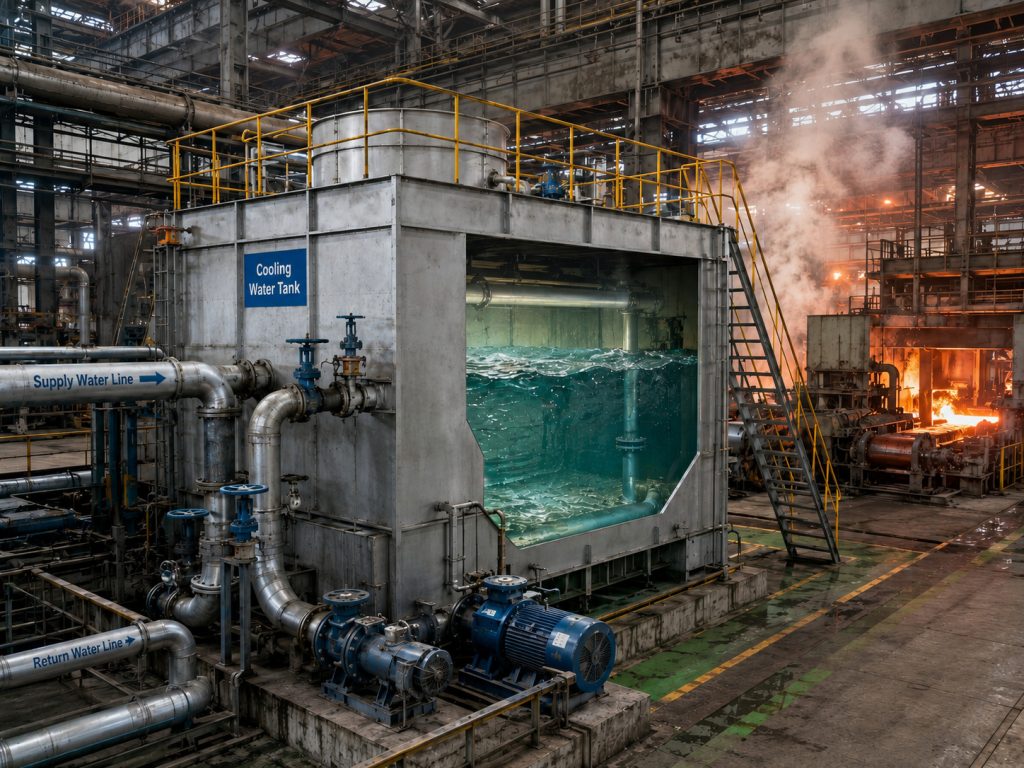
Steel production is characterized by continuous operation, heavy equipment loads, high temperatures, and demanding industrial environments. From ironmaking and steelmaking to continuous casting and rolling, many production processes rely on circulating cooling water systems to maintain equipment at safe operating temperatures.
Cooling water is widely used for continuous casting equipment, rolling mills, motors, hydraulic systems, heat exchangers, and other auxiliary equipment. If the cooling water supply becomes insufficient, equipment temperatures may rise rapidly. In less severe cases, production efficiency can be affected; in more serious situations, equipment protection systems may be activated and production may have to be stopped.
Although a cooling water tank may appear to be only a small part of a steel plant’s auxiliary system, maintaining a stable liquid level is essential for ensuring that circulation pumps receive a continuous water supply and that the entire cooling system operates reliably.
During an upgrade of a circulating cooling water system at a steel production facility, continuous monitoring of the cooling water tank level was required. The level signal also needed to be transmitted to the plant control system.
After evaluating the tank structure, process medium, measuring range, environmental conditions, signal requirements, and maintenance considerations, a float level transmitter was selected for continuous level measurement. Its 4–20 mA output was connected to the PLC to provide real-time level indication, low-level alarms, and automatic water replenishment control.
1. Why Is Cooling Water Tank Level Important in Steel Production?
Steelmaking is a typical continuous-process industry. Large quantities of mechanical equipment, hydraulic systems, electrical equipment, and high-temperature process machinery require reliable and continuous cooling.
For this reason, industrial instrumentation used in steel plants must not only provide accurate measurements but also maintain stable operation under demanding conditions. Depending on the installation location, instruments may be exposed to elevated ambient temperatures, thermal radiation, vibration, dust, moisture, and electromagnetic interference.
A typical circulating cooling water system may consist of:
Cooling water tank → circulation pump → production or heat-exchange equipment → return water line → cooling water tank.
During operation, the amount of water in the system changes continuously because of evaporation, blowdown, leakage, process consumption, and other factors.
If the liquid level in the cooling water tank cannot be monitored reliably, two major problems may occur.
Low Water Level
When the tank level falls close to the minimum suction level of the circulation pump, the pump may experience insufficient suction, cavitation, or even dry running.
A reduction in cooling water flow may then cause the temperature of the equipment being cooled to rise, creating additional operational risks.
High Water Level
If the make-up water valve remains open because the actual liquid level is not detected correctly, the tank may overflow.
Overflow not only wastes water but can also leave the surrounding equipment area wet for extended periods, increasing housekeeping and maintenance requirements.
Therefore, cooling water tank level measurement serves three important functions:
- Process monitoring
- Equipment protection
- Automatic water replenishment control
A reliable cooling water tank level transmitter is therefore an important component of the overall cooling water control system.
2. Cooling Water Tank Level Measurement Requirements
At this steel production facility, the circulating water system supplied cooling water to multiple pieces of production equipment. The tank contained mainly industrial circulating cooling water.
Previously, the liquid level was checked through manual inspections and basic local level indication.
Although this method could meet basic operational needs, several limitations became increasingly apparent as the plant moved toward a higher level of automation.
Manual Inspection Cannot Provide Continuous Monitoring
Operators cannot continuously observe the tank level.
If abnormal water consumption, pipeline leakage, or a failure in the make-up water system occurs, the liquid level may fall significantly between two inspection intervals.
The Tank Level Was Not Available in the Control Room
Without a continuous level signal, operators in the central control room could only estimate the condition of the cooling water system indirectly from pump operation and other process information.
The actual amount of water remaining in the tank could not be monitored in real time.
No Historical Level Trend Was Available
Without continuous liquid level data, operators had difficulty evaluating daily make-up water patterns or identifying abnormal water consumption in the circulating cooling system.
As part of the system upgrade, the plant therefore required a continuous level measuring instrument that could transmit real-time tank level data to the PLC or DCS.
The main requirements included:
- Continuous measurement of the cooling water tank level;
- Standard industrial signal output for easy PLC integration;
- Wetted materials suitable for water and industrial operating conditions;
- Reliable long-term operation in a steel plant environment;
- Simple structure and relatively low maintenance requirements;
- Measuring range configurable according to tank height;
- Reliable low-level alarm capability.
Based on these requirements, a float level transmitter was selected as a suitable solution for the cooling water tank.
3. Why Use a Float Level Transmitter for a Cooling Water Tank?
Several level measurement technologies can be used for industrial cooling water tanks, including hydrostatic level transmitters, ultrasonic level transmitters, radar level transmitters, magnetic level gauges, and float level transmitters.
Each technology has its own advantages and suitable applications.
In this project, the process medium was relatively stable industrial circulating water. It was not a highly viscous liquid and did not contain large quantities of solids.
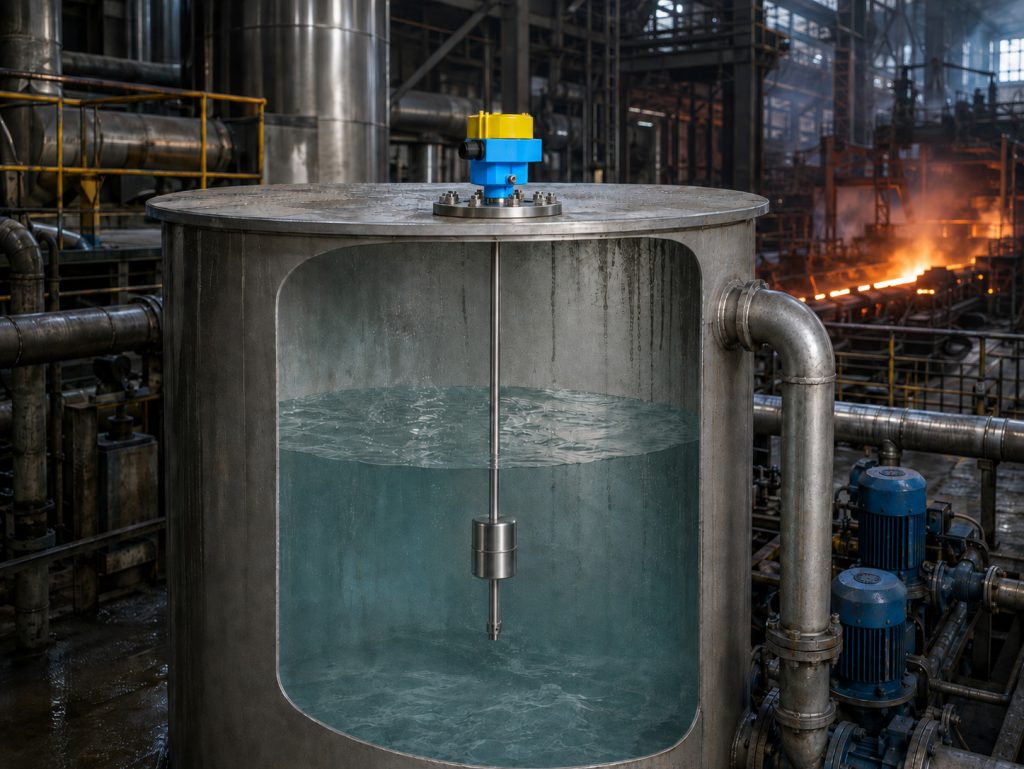
In addition, the tank structure allowed a guide rod to be installed vertically from the top of the tank.
These conditions made continuous float level measurement a practical choice.
Working Principle of a Float Level Transmitter
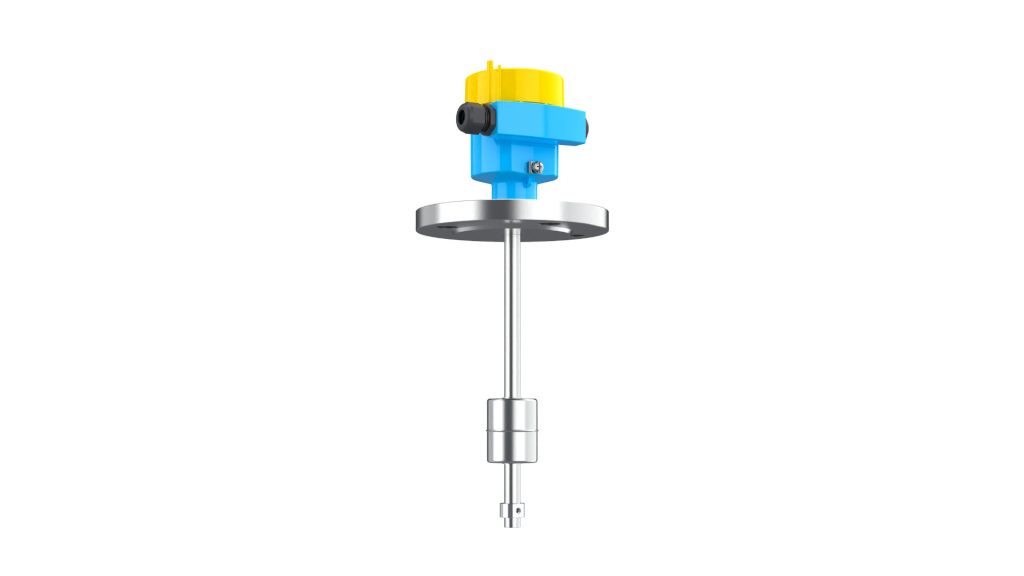
A float level transmitter operates according to the principle of buoyancy.
As the liquid level inside the tank rises or falls, the float moves vertically along the guide rod.
A magnetic component inside the float interacts with reed switches located inside the guide rod. As the float position changes, the resistance of the sensing circuit changes accordingly.
The transmitter electronics then convert this resistance variation into a standard 4–20 mA DC signal, providing continuous remote liquid level measurement.
For cooling water tank applications, this measuring principle offers several practical advantages.
3.1 Direct and Simple Measurement Principle
The float follows the actual liquid surface directly, without requiring complex echo processing or signal interpretation.
For water and other liquids with relatively stable density, the float can provide consistent level measurement when properly selected for the process medium.
3.2 Easy Integration with PLC and DCS Systems
A float level transmitter can provide a standard 4–20 mA current output.
The PLC can scale this signal according to the configured measuring range and convert it into an actual liquid level or percentage value.
For example:
- 4 mA = 0% level
- 12 mA ≈ 50% level
- 20 mA = 100% level
Operators can therefore monitor the cooling water tank level directly from the central control room without repeatedly visiting the field.
3.3 Suitable for Long-Term Industrial Water Tank Monitoring
For standard float level transmitter designs, wetted components such as the float, guide rod, and process connection can be manufactured from 304 or 316L stainless steel.
Typical specifications can cover measuring ranges from 300 to 6000 mm, process temperatures from -20 to 120°C, liquid densities of 0.5 g/cm³ or higher, 4–20 mA signal output, and enclosure protection up to IP66/IP67.
Provided that the actual process temperature, pressure, medium properties, and installation conditions fall within the instrument’s specifications, this type of transmitter can be suitable for many conventional industrial cooling water tank applications.
3.4 Relatively Simple Maintenance
Cooling water systems often operate continuously. For many steel plants, long-term stability and ease of maintenance are more important than unnecessary functional complexity.
The structure of a float level transmitter is relatively straightforward.
For cooling water with limited solids and scaling, routine maintenance mainly involves checking whether deposits, scale, or contaminants have accumulated on the float and guide rod.
4. How to Select a Float Level Transmitter for a Cooling Water Tank
The long-term performance of a level transmitter depends heavily on correct instrument selection.
Several parameters should be confirmed before selecting a float level transmitter for a cooling water tank.
4.1 Determine the Required Measuring Range
The first step is to determine the distance between the lowest effective operating level and the highest required measuring level.
The level transmitter should not be selected simply according to the total height of the tank.
Factors such as the top process connection, bottom clearance, actual operating range, float dimensions, and safety margin must also be considered.
A standard measuring range of approximately 300 to 6000 mm can accommodate many industrial tank applications.
For example, if the effective liquid level range is approximately 2000 mm, the overall probe length should still be determined according to the installation flange position, minimum operating level, float dimensions, and tank structure.
4.2 Confirm the Liquid Density
The ability of the float to remain on the liquid surface depends directly on the density of the medium.
The process medium and its density should therefore be specified during instrument selection.
For a standard float level transmitter requiring a liquid density of at least 0.5 g/cm³, ordinary industrial cooling water generally meets the basic buoyancy requirement.
However, if the cooling water contains a high concentration of special additives or treatment chemicals, the actual liquid density should be confirmed.
4.3 Evaluate Water Quality and Corrosiveness
For ordinary industrial cooling water, 304 or 316L stainless steel can be considered depending on the actual water chemistry.
However, if the circulating water contains high concentrations of acids, alkalis, salts, chlorides, or special water treatment chemicals, the instrument should not be selected simply on the assumption that the medium is “water.”
Material compatibility should be checked against the actual chemical composition.
For more corrosive media, alternative wetted materials or another corrosion-resistant level measurement technology may be required.
4.4 Confirm the Process and Ambient Temperatures
In a steel plant, the overall production environment may be hot, but the process liquid temperature and the ambient temperature around the transmitter housing are two different parameters.
A standard float level transmitter may support a process temperature range of approximately -20 to 120°C and an ambient temperature range of around -40 to 70°C, depending on the specific model.
Both the actual cooling water temperature and the temperature around the transmitter electronics should therefore be checked.
If the cooling water tank is installed close to high-temperature equipment, thermal radiation should also be considered.
Where necessary, the instrument can be installed farther from the heat source or additional heat shielding can be provided.
4.5 Confirm the Installation Method
The process connection can generally be selected according to the tank design, such as a threaded or flanged connection.
Before installation, sufficient space should be available above the tank so that the guide rod can be inserted vertically.
The transmitter should also be positioned away from the inlet, return water pipe, and other areas with strong turbulence.
This point is particularly important for cooling water tank applications.
If high-velocity return water directly impacts the float, the liquid surface may fluctuate significantly. This can cause unstable readings and repeated float movement.
Continuous mechanical impact may also affect long-term instrument reliability.
5. How Is the 4–20 mA Level Signal Connected to the PLC?
After mechanical installation was completed, the 4–20 mA output from the float level transmitter was connected to the analog input module of the PLC.
The PLC was configured to scale the signal according to the actual measuring range.
For example, for a 2000 mm measuring range:
- 4 mA = 0 mm
- 20 mA = 2000 mm
The control system could then display:
- Real-time liquid level
- Level percentage
- High-level status
- Low-level status
- Historical level trends
This transformed the cooling water tank from a manually monitored vessel into part of the plant’s automated level management system.
The control program was further configured with several level thresholds.
Low-Level Alarm
When the tank level falls to the predefined low-level setpoint, the PLC generates a low-level warning.
Operators can then inspect the make-up water system and determine why the water level is decreasing.
Low-Low-Level Protection
If the level continues to fall to a low-low setpoint, a higher-priority alarm can be activated.
Depending on the process safety requirements, this signal can also be incorporated into circulation pump protection or equipment interlock logic.
Automatic Water Replenishment
When the water level falls below the make-up starting setpoint, the PLC can open the make-up water valve.
When the level rises to the configured stopping point, the PLC closes the valve.
This allows the water tank to operate within a controlled liquid level range.
High-Level Alarm
If the liquid level rises abnormally above the high-level setpoint, an alarm can be triggered.
Operators can then check whether the make-up water valve has failed to close or whether another process abnormality has occurred.
In this way, a continuous float level transmitter does more than simply measure the amount of water in the tank.
It becomes an important process input for the entire cooling water control and protection system.
6. Improvements After Installing the Float Level Transmitter
After the float level transmitter was integrated with the PLC, cooling water tank management changed from periodic manual inspection to continuous automatic monitoring.
One of the most important improvements was that operators could view the tank level in real time from the control room.
Previously, an operator had to visit the tank physically to check the water level.
After the upgrade, both the current liquid level and historical trend could be monitored on the control screen.
If the liquid level began to decrease continuously, operators could recognize the abnormal trend before the tank reached the low-level alarm point.
This made it easier to identify possible leakage, abnormal water consumption, or problems with the make-up water system.
More Consistent Automatic Replenishment
The PLC can start and stop water replenishment according to predefined level setpoints.
This keeps the cooling water tank within a more consistent operating range and reduces fluctuations caused by manual control.
Improved Circulation Pump Protection
A low water level may eventually result in an unstable supply of water to the circulation pump suction.
By configuring low-level and low-low-level alarms, operators have more time to respond before the condition becomes critical.
Where required, the level signal can also be included in equipment interlock logic.
Better Process Visibility
Historical liquid level data can help plant personnel identify patterns in water consumption.
For example, an unusual rate of level decrease may indicate:
- Pipeline leakage
- Abnormal process consumption
- Make-up water system failure
- Valve malfunction
- Increased evaporation or discharge
For a continuously operating steel plant, the real value of liquid level measurement is therefore not simply knowing “how much water is left.”
The level measurement becomes much more valuable when it is integrated with production control, maintenance, and equipment protection.
7. Installation Considerations for Float Level Transmitters in Steel Plant Cooling Water Tanks
Several installation details should be considered when using a float level transmitter in a steel plant cooling water system.
Keep the Transmitter Away from Water Inlets and Return Lines
Strong water flow can cause the float to move repeatedly and create unstable measurements.
The transmitter should therefore be installed in an area where the liquid surface is relatively calm.
Install the Guide Rod Vertically
The guide rod should be installed as vertically as possible.
If the rod is tilted, the float may experience additional friction or mechanical resistance while moving, which can affect measurement performance.
Provide Enough Clearance for Float Movement
The float must be able to move freely throughout the entire measuring range.
Internal supports, pipes, heating coils, structural components, or other equipment should not obstruct the float.
Monitor Cooling Water Quality
Over time, circulating cooling water in steel plants may contain suspended solids, rust, scale, treatment chemicals, or other deposits.
If significant deposits accumulate on the float or guide rod, the movement of the float may eventually be affected.
Maintenance intervals should therefore be determined according to actual water quality and scaling conditions rather than relying only on a fixed schedule.
Pay Attention to Signal Cable Routing and Grounding
Steel plants contain large motors, variable-frequency drives, transformers, and other high-power electrical equipment.
Instrument signal cables should be installed according to appropriate industrial instrumentation practices.
Where possible, long parallel runs with high-power cables should be avoided, and proper shielding, grounding, and electrical connection practices should be followed.
Verify All Process Parameters Before Installation
Process temperature, ambient temperature, pressure, liquid density, corrosiveness, measuring range, tank dimensions, and process connection should all be confirmed during the selection stage.
A level transmitter should never be selected solely on the basis that the application is “water level measurement.”
8. Why Float Level Transmitters Are Suitable for Certain Steel Industry Water Systems
As automation continues to increase throughout the steel industry, many auxiliary systems that were previously managed manually are being integrated into PLC and DCS platforms.
Cooling water tanks, circulating water tanks, make-up water tanks, and equipment water reservoirs are typical examples.
For suitable applications, float level transmitters offer several practical advantages:
- Direct measurement principle
- Continuous level indication
- Standard 4–20 mA output
- Easy PLC/DCS integration
- Stainless-steel wetted parts available
- Configurable measuring range
- Straightforward maintenance
Float level transmitters are particularly suitable when:
- The process medium is water or another liquid with relatively stable physical properties;
- The tank provides sufficient internal space for vertical guide rod installation;
- The liquid does not contain large amounts of fibrous or entangling materials;
- Continuous level measurement is required instead of only point-level detection;
- A 4–20 mA signal is required for PLC or DCS integration;
- Simple maintenance and long-term stability are priorities.
However, every liquid level technology has its limitations.
If a cooling water tank contains large quantities of sediment, severe scaling, floating debris, or internal structures that restrict float movement, the suitability of a float level transmitter should be evaluated carefully.
For very large tanks where a long guide rod is impractical, or for applications requiring completely non-contact measurement, technologies such as radar or ultrasonic level measurement may be more appropriate.
The key to industrial level instrument selection is therefore not to choose the technology that appears to be the most advanced.
The right solution is the one whose measuring principle best matches the actual process conditions.
9. From Tank Level Measurement to Automated Cooling Water Management
Cooling water is an important utility in steel production.
Although cooling water tank level may appear to be a simple process parameter, it is directly connected to the make-up water system, circulation pumps, production equipment cooling, and equipment protection functions.
After continuous level measurement is implemented, the level signal can be used to establish a more complete automatic control strategy.
For example:
Level decreases → Start automatic water replenishment
Level returns to normal → Stop water replenishment
Low level → Generate warning alarm
Low-low level → Activate equipment protection according to process requirements
High level → Stop water replenishment and generate alarm
Abnormally rapid level decrease → Check the cooling water system for leakage
With these control functions, the cooling water tank is no longer simply a storage vessel.
It becomes an active data point in the steel plant’s automation and process management system.
This illustrates the practical value of industrial liquid level measurement: moving beyond basic measurement and becoming part of overall process control.
10. Conclusion
Steel production involves high equipment loads, long continuous operating periods, and demanding requirements for cooling system reliability.
As an important component of the circulating water system, the cooling water tank must maintain an appropriate liquid level.
An excessively low level may affect circulation pump operation and equipment cooling, while an excessively high level can result in overflow and unnecessary water consumption.
For cooling water tanks with stable liquid properties and suitable installation conditions, a float level transmitter provides a practical solution for continuous level monitoring.
Its direct measuring principle, simple mechanical structure, configurable measuring range, 4–20 mA output, and convenient PLC integration make it suitable for many industrial water tank applications.
By properly determining the measuring range, selecting suitable wetted materials, avoiding turbulent return-water areas during installation, and integrating the transmitter with PLC high- and low-level alarm logic, steel plants can improve the automation and reliability of their circulating cooling water systems.
For steel manufacturers upgrading production automation, cooling water tank level measurement may represent only a small part of the entire control system, but it can directly influence circulation pump protection, cooling continuity, equipment reliability, and operational safety.
Therefore, when selecting a level transmitter for a cooling water tank, the decision should not be based only on price or measuring range.
The process medium, liquid density, tank structure, installation conditions, signal output, operating temperature, environmental conditions, material compatibility, and maintenance requirements should all be considered.
Only when the level measurement technology is correctly matched to the actual application can reliable liquid level data continue to support safe and efficient steel production over the long term.