When people first encounter industrial level measurement, it is easy to assume that guided wave radar level transmitters and non-contact radar level transmitters are closely related technologies.
The reason is simple: they both have the word “radar” in their names.
This naturally creates an assumption: if both are radar level transmitters, perhaps the main difference is just their physical construction, while the actual installation and operating experience should be more or less the same.
However, anyone who has worked with real-world level measurement applications knows that this is not necessarily the case.
Although guided wave radar and non-contact radar both belong to the radar level measurement family, the practical experience of selecting, installing, operating, and maintaining them can be very different.
The differences go far beyond the measurement principle. They affect installation, process contact, buildup risk, mechanical forces, internal vessel obstructions, maintenance requirements, and long-term reliability.
So before asking, “Which is better, guided wave radar or non-contact radar?” it is more useful to ask another question:
Is your application better suited to a radar signal traveling along a probe or cable, or to a radar signal traveling freely through the space above the material?
That question gets much closer to the fundamental difference between these two technologies.
1. Both Are Radar, but the Radar Signal Takes a Very Different Path
At a basic level, guided wave radar and non-contact radar do have something important in common.
Both use electromagnetic waves for measurement. By analyzing the signal traveling from the instrument toward the material surface and returning from it, the transmitter can determine distance and calculate the corresponding level.
The major difference is how the radar signal reaches the material surface.
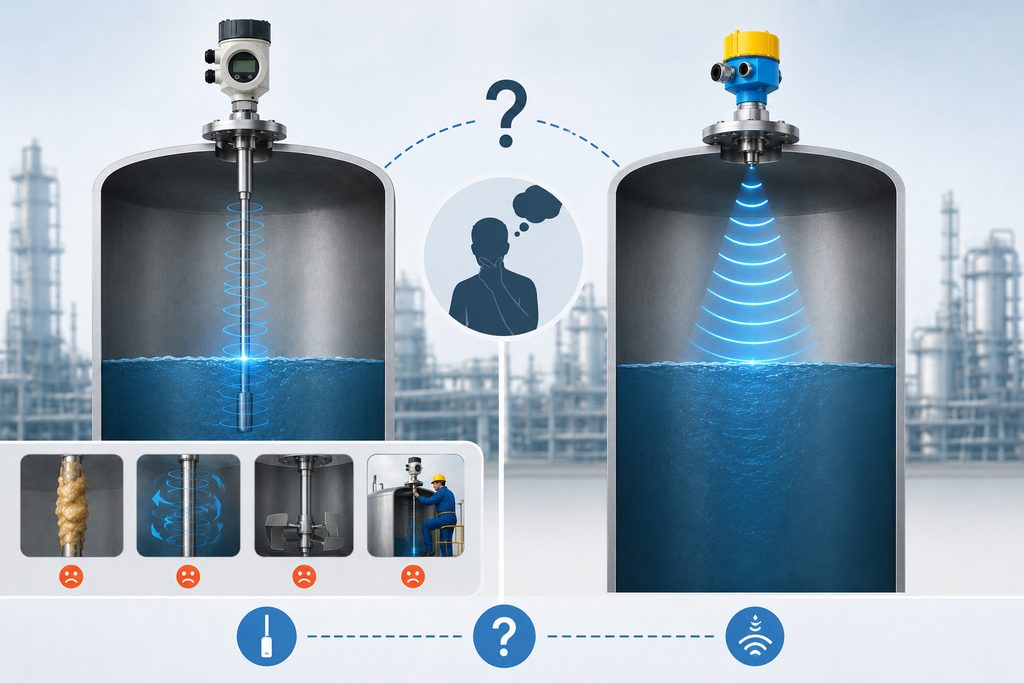
Guided Wave Radar: Giving the Radar Signal a “Track”
A guided wave radar level transmitter normally has a rod, cable, or another type of probe extending downward into the vessel.
Instead of allowing the radar pulse to propagate freely through the entire open space inside the vessel, the signal travels along this guiding element.
When the signal reaches the surface of the process medium, part of the energy is reflected and travels back along the probe toward the transmitter.
A simple way to visualize this is:
The radar signal does not have to find its own path through the vessel. It travels along a predefined route.
That is the basic idea behind the term “guided wave.”
Non-Contact Radar: Letting the Radar Signal Travel Through Free Space
A non-contact radar level transmitter works more like what most people imagine when they hear the word “radar.”
The instrument is generally installed at the top of a vessel. Its antenna sends electromagnetic waves toward the material surface. The radar signal travels through the vapor space, reaches the surface of the liquid or bulk solid, and is reflected back toward the antenna.
The transmitter analyzes the returning signal and determines the distance to the material.
In normal operation, there is no long probe or cable extending from the top of the vessel into the product.
From a mechanical perspective, this already creates a major distinction:
Guided wave radar requires a guiding element that enters the process, while non-contact radar primarily performs the measurement through free-space propagation.
Many of the differences in real-world user experience begin with this fundamental distinction.
2. The Biggest Practical Difference: One Goes Into the Process, the Other Does Not
If there is only one difference to remember between guided wave radar and non-contact radar, this is probably the most useful one.
Guided wave radar is generally considered a contact measurement technology.
Its rod or cable extends into the vessel and may remain in direct contact with the process medium.
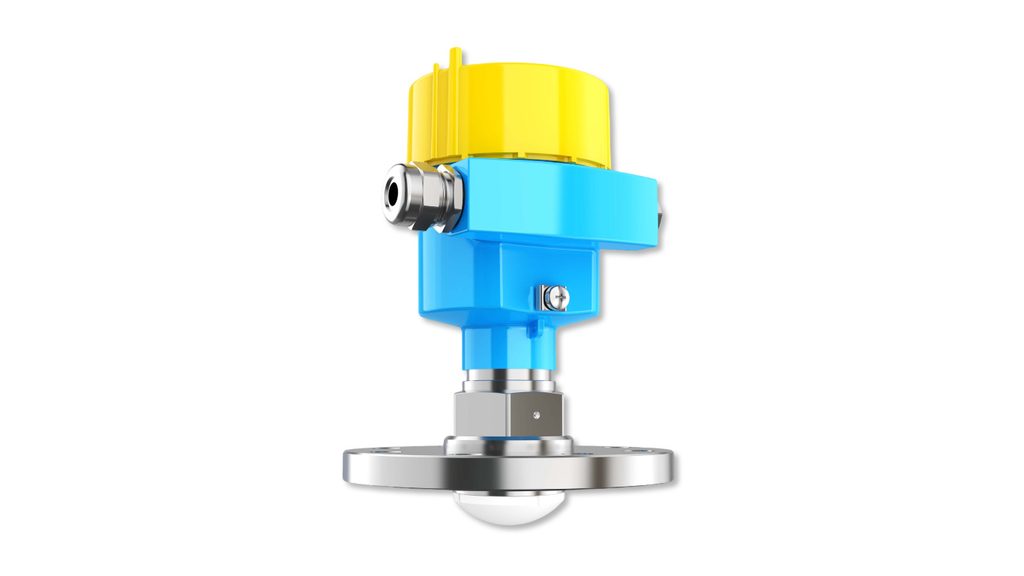
Non-contact radar, as the name suggests, normally performs non-contact level measurement. The antenna is installed at or near the top of the vessel, and radar waves are transmitted toward the material surface below.
This may sound like a simple structural difference, but it can affect the entire lifecycle of the instrument.
Consider a storage tank containing relatively clean water. A probe being in contact with the liquid may not create any significant problems.
Now replace that water with a highly viscous liquid, slurry, crystallizing chemical, or sticky material.
The situation changes.
As soon as a physical component remains inside the process, several additional questions become important:
- Will material accumulate on the probe?
- Can the process medium crystallize on it?
- Will deposits form over time?
- Can the probe be chemically attacked or corroded?
- Will material movement create mechanical forces on the probe?
- How difficult will it be to remove the entire probe during maintenance?
A non-contact radar does not have a long probe immersed in the material, so it can eliminate or reduce some of the issues associated with continuous physical contact.
The difference between the two technologies is therefore not simply that they “measure differently.”
A more useful way to describe it is:
Guided wave radar converts part of the measurement challenge into an interaction between the probe and the process medium, while non-contact radar places more emphasis on signal propagation, mounting position, beam path, and echo processing.
3. Why Can Guided Wave Radar Work So Well in Some Complicated Vessels?
At this point, it might seem that non-contact radar should always be the better option because it does not need a probe in the process.
That would be an oversimplification.
The guided signal path itself can provide important advantages.
Because the radar signal travels along a rod or cable, its propagation path is much more clearly defined.
Imagine a vessel containing heating coils, support structures, reinforcement components, inlet pipes, agitators, or other internal metal objects.
For a non-contact radar level transmitter, any object entering the radar beam can potentially generate an additional reflection.
The transmitter then needs to distinguish between the real level echo and false echoes produced by fixed internal structures.
With a poor mounting position, commissioning and signal configuration can become more complicated.
Guided wave radar approaches the problem differently.
Because most of the signal energy is guided along the probe, the measurement path is concentrated around a relatively well-defined area.
For this reason, guided wave radar can be an effective solution in narrow spaces, restricted mounting locations, or vessels containing complicated internal structures.
This is also why non-contact radar should not simply be viewed as a newer or upgraded version of guided wave radar.
They are better understood as two different approaches designed to solve different measurement problems.
4. Probe Buildup Is One of the Biggest Differences in Long-Term Use
If the process medium tends to stick to surfaces, probe buildup becomes an important consideration when selecting a guided wave radar level transmitter.
This is one of the most significant differences between guided wave radar and non-contact radar in long-term operation.
What Is Probe Buildup on Guided Wave Radar?
The rod or cable of a guided wave radar remains in direct contact with the process medium.
If the material is sticky, it can gradually accumulate on the probe surface.
A small and uniform coating may not immediately cause a measurement problem. However, as the buildup becomes thicker or changes in distribution, the conditions under which the signal propagates and reflects can also change.
The situation can become more challenging if the material crystallizes, forms scale, or hardens after drying.
For example, some slurries remain fluid during normal operation but form hard deposits on the probe when the process is shut down.
After several months of operation, the physical condition of the probe may be very different from when it was first installed.
At that point, maintenance personnel may no longer be dealing only with transmitter configuration.
They may also need to answer practical questions such as:
How do we clean the probe? How often does it need cleaning? Does the process need to be shut down before it can be cleaned?
Why Is the Experience Different with Non-Contact Radar?
A non-contact radar does not have a long probe immersed in the material, so the large contact surface associated with probe buildup is eliminated.
This does not mean non-contact radar can never be affected by contamination.
Heavy condensation, splashing, dust, or material accumulation around the antenna can still influence performance and should be considered during installation.
However, contamination around an antenna and buildup along a probe several meters long are clearly different maintenance situations.
For this reason, when measuring high-viscosity, sticky, crystallizing, scaling, or deposit-forming materials, non-contact radar is often worth evaluating early in the selection process.
5. Agitated Vessels Create Different Challenges for the Two Technologies
Agitated tanks are another common industrial level measurement application.
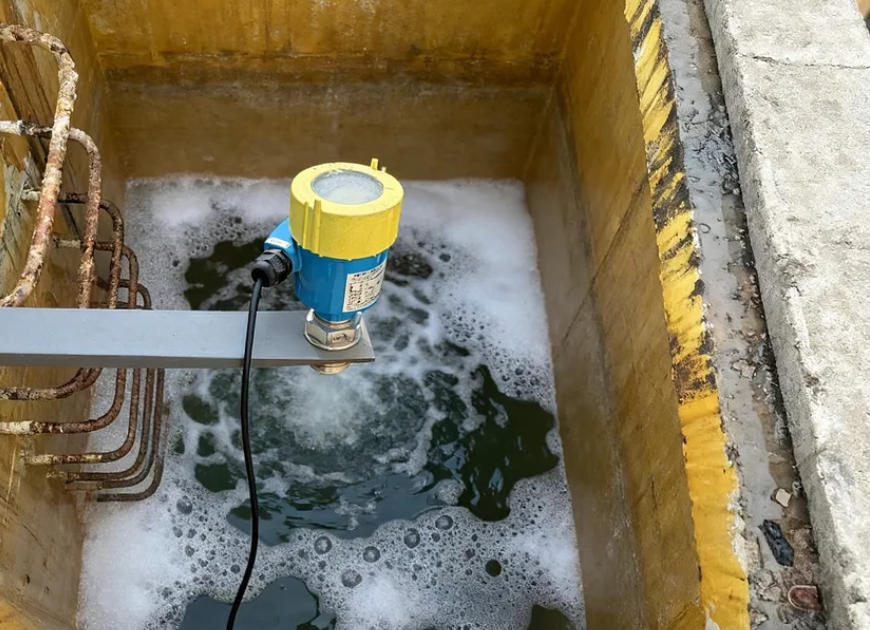
The first concern is usually the liquid surface itself: agitation causes waves and turbulence, so will the changing surface interfere with the radar echo?
That is an important question.
For guided wave radar, however, there is an additional mechanical question:
What forces will the moving process fluid apply to the probe or cable?
With a flexible cable probe, the possibility of movement or deflection needs to be considered.
If the cable is long, it is also important to determine whether it could contact the vessel wall, agitator, or other internal components.
For dense, viscous, or rapidly moving materials, mechanical loading becomes even more important.
A non-contact radar has no long probe extending into the agitated zone, so it does not experience the same type of mechanical loading on a probe.
However, it has its own challenges.
A heavily turbulent liquid surface can produce more complicated echoes, while agitator shafts and blades may create unwanted reflections if they enter the radar beam.
So even when both technologies are used on an agitated vessel, the engineering considerations are different:
Guided wave radar requires attention to both signal behavior and mechanical interaction, while non-contact radar places greater emphasis on mounting position, beam path, surface conditions, and echo quality.
This is a good example of why the two technologies can feel very different in actual operation.
6. In Small Vessels and Restricted Spaces, Guided Wave Radar Can Have a Real Advantage
Non-contact radar needs to transmit radar energy toward the material surface, which means the available beam path must be considered.
In a large storage tank, finding a suitable mounting location is often relatively straightforward.
In a very small or narrow vessel, however, internal components may occupy much of the available space.
There may simply be very little room for a clean radar beam path.
This is where guided wave radar can become particularly useful.
Because the signal follows the guiding element, it does not depend on the same amount of free propagation space as non-contact radar.
In certain bypass chambers, stilling arrangements, narrow vessels, or confined measurement locations, guided wave radar can therefore be a highly practical solution.
For small vessels, narrow process equipment, bypass chambers, and other restricted spaces, guided wave radar should not be dismissed simply because non-contact technology sounds more modern.
The correct choice depends on the application.
7. Installation Priorities Are Very Different
Installation is another area where the practical differences between guided wave radar and non-contact radar become obvious.
Guided Wave Radar Installation Considerations
When installing guided wave radar, attention needs to be given to the position of the rod or cable.
Typical questions include:
Will the probe touch the bottom of the vessel?
Are there metal structures close to the probe?
Can a flexible cable move or swing?
Will process flow create significant lateral forces?
Could the incoming material stream directly strike the probe?
Does the probe length match the required measurement range?
If the instrument needs to be removed, is there enough space above the vessel to pull the probe out?
That last question is especially easy to overlook during the design stage.
A level transmitter may look perfectly reasonable on an engineering drawing. But if it has a rigid probe several meters long, maintenance personnel may eventually need several meters of vertical clearance above the vessel to remove it.
If the vessel is installed inside a building with limited overhead space, the maintenance experience may be very different from what was expected during design.
Non-Contact Radar Installation Considerations
With non-contact radar, the focus shifts from the physical probe to what the radar antenna can “see.”
Typical installation considerations include:
- Are there obstructions below the antenna?
- Could the radar beam intersect the vessel wall?
- Is the instrument too close to the filling inlet?
- Is the material surface heavily sloped?
- Is the mounting nozzle suitable?
- Are support structures, heating coils, pipes, or agitators located inside the measurement path?
A useful way to summarize the difference is:
Installing guided wave radar is often about finding the right place for a measurement probe, while installing non-contact radar is more about giving the radar a clear and appropriate field of view.
8. Maintenance Experience May Matter More Than Initial Accuracy
When purchasing a radar level transmitter, it is easy to focus primarily on specifications such as accuracy, measuring range, process conditions, and output signal.
Those specifications are important.
But industrial instruments are not installed for one week.
In many applications, the real cost of a level measurement solution becomes clearer after several years of operation.
With guided wave radar, maintenance considerations may include probe corrosion, buildup, scaling, mechanical damage, and the physical space required to remove the probe.
If the process medium is clean and the operating conditions are stable, these issues may never become significant. In that case, guided wave radar can provide a very straightforward and low-maintenance measurement solution.
However, if the material tends to stick, crystallize, or form deposits, the probe itself may eventually become part of the maintenance routine.
Non-contact radar eliminates the need for a long probe immersed in the process. In applications involving corrosive, sticky, or difficult materials, this can reduce some of the maintenance associated with direct process contact.
But “non-contact” does not mean “maintenance-free.”
Condensation or contamination around the antenna, poor installation causing false echoes, and changes in process conditions can still require inspection or adjustment.
That is why professional radar level transmitter selection should not focus only on the question:
“Which technology has better accuracy?”
It should also ask:
“Which technology will be easier to maintain three years from now?”
In many industrial applications, that question is more valuable than a small difference in a specification sheet.
9. When Is Guided Wave Radar a Good Choice?
Based on these characteristics, guided wave radar level transmitters are often worth considering in applications such as:
Vessels with limited installation space.
When free space is restricted, the guided signal path can provide a more concentrated measurement route.
Vessels containing multiple fixed internal obstructions.
If it is difficult to provide a clean free-space propagation path for non-contact radar, guided wave radar may be worth evaluating.
Bypass chambers and similar measurement arrangements.
Guided wave radar can be particularly useful in certain narrow or confined measurement structures.
Certain interface measurement applications.
When two liquids form distinct layers and the process meets the necessary measurement conditions, guided wave radar can be one of the technologies considered for interface measurement.
Relatively clean media with low buildup tendency.
If long-term contact between the probe and the process does not create significant coating, corrosion, or mechanical problems, the contact nature of guided wave radar may not be a disadvantage at all.
10. When Is Non-Contact Radar a Good Choice?
Non-contact radar level transmitters are often worth evaluating first in applications involving:
Sticky or crystallizing materials.
Eliminating a long immersed probe can reduce some of the maintenance risks associated with buildup.
Strong agitation or material movement.
Because there is no long probe inside the process, there is no equivalent concern about probe movement or mechanical loading.
Corrosive process media.
Reducing the number and surface area of components directly exposed to the process can simplify some material compatibility challenges, although all actual wetted parts must still be selected correctly.
Large storage tanks.
When a suitable top-mounted location and a clear propagation path are available, non-contact radar can be an excellent technology for continuous level measurement.
Applications where reducing mechanical contact is a priority.
For storage and process applications focused on long-term operation with minimal physical interaction with the product, non-contact measurement can be especially attractive.
However, “suitable” never means “universally correct.”
Final selection should still consider dielectric properties, temperature, pressure, measuring range, vessel geometry, foam, vapor, dust, agitation, filling conditions, and available mounting locations.
11. How Should You Choose Between Guided Wave Radar and Non-Contact Radar?
A simple preliminary selection process can begin with three questions.
Question 1: Is It Acceptable for a Probe to Remain in the Process?
If the process medium is clean, relatively calm, does not produce significant buildup, and is not likely to cause serious corrosion, the contact nature of guided wave radar may be perfectly acceptable.
If the medium is sticky, crystallizing, deposit-forming, or subject to strong mechanical movement, non-contact measurement deserves closer consideration.
Question 2: Is There a Suitable Path for a Free-Space Radar Signal?
If the top of the vessel provides an open mounting position and the radar has a relatively clear view of the material surface, non-contact radar may be the natural choice.
If the vessel is narrow, contains many internal obstructions, or offers very limited mounting options, guided wave radar may provide a more predictable measurement path.
Question 3: Which Technology Will Be Easier to Maintain in the Future?
Do not consider only whether the instrument can be installed today.
Think about how it will eventually be removed.
How will a probe several meters long be taken out?
Can the antenna be inspected easily?
Is there enough maintenance clearance above the vessel?
How long would the process need to be shut down for cleaning?
Once these questions are considered, radar level transmitter selection often becomes much clearer.
12. Why Do They Have Similar Names but Such Different User Experiences?
From an instrumentation classification perspective, both technologies clearly belong to the radar level measurement family.
But from the perspective of plant operators and maintenance personnel, they solve the measurement problem in very different ways.
The essential guided wave radar experience can be summarized as:
The radar signal travels along a rod or cable, creating a clearly defined signal path, but the guiding element must enter and interact with the process.
The essential non-contact radar experience is:
There is no long probe immersed in the material, reducing mechanical contact with the process, but the radar requires an appropriate mounting position, beam path, and view of the material surface.
One approach effectively fixes the measurement path.
The other observes the material surface from above.
That is why treating the two technologies as interchangeable simply because both contain the word “radar” can lead to important application details being overlooked during instrument selection.
13. Frequently Asked Questions About Guided Wave Radar and Non-Contact Radar
1. Is Guided Wave Radar a Contact or Non-Contact Level Measurement Technology?
Guided wave radar is generally considered a contact measurement technology because its rod or cable extends into the vessel and comes into contact with the process medium.
Non-contact radar normally transmits radar waves from an antenna mounted at the top of the vessel and does not require a long probe to be immersed in the material.
2. Which Is More Accurate: Guided Wave Radar or Non-Contact Radar?
Actual measurement performance cannot be determined solely by whether the instrument uses guided wave or non-contact radar.
Performance also depends on measuring range, process medium, installation, vessel geometry, operating conditions, instrument configuration, and signal processing.
In real applications, correct selection and installation can be more important than comparing a single accuracy value on a specification sheet.
3. Can Guided Wave Radar Be Used for Viscous or Sticky Liquids?
It can, but the application should be evaluated carefully.
If the process medium tends to adhere to the probe, buildup may develop over time and could affect measurement or increase maintenance requirements.
For applications involving severe coating, crystallization, or deposit formation, non-contact radar is often worth evaluating as an alternative.
4. Can Guided Wave Radar Be Used in a Tank with an Agitator?
Yes, but probe position, fluid movement, mechanical loading, and clearance from the agitator should all be evaluated.
Particular attention should be given to flexible cable probes to ensure that they cannot move into the mechanical operating area of the agitator.
5. Which Radar Level Technology Is Better for a Vessel with Many Internal Obstructions?
If a non-contact radar cannot obtain a suitable propagation path because of internal structures, guided wave radar may be a good option.
However, if the non-contact radar can be positioned so that its beam avoids obstructions, it may also perform well.
The final decision should be based on the actual vessel geometry and installation conditions.
6. Is Non-Contact Radar Always More Advanced Than Guided Wave Radar?
No.
The two technologies should not be viewed simply as old versus new.
They use different measurement approaches and have different application strengths.
Guided wave radar can remain highly effective in narrow spaces, bypass chambers, and certain specialized level or interface measurement applications.
Non-contact radar has important advantages when reducing process contact, buildup risk, and mechanical interaction is a priority.
Conclusion: When Selecting a Radar Level Transmitter, Look Beyond the Word “Radar”
The easiest thing to misunderstand about guided wave radar and non-contact radar is how similar their names sound.
Technically, both use electromagnetic waves for level measurement, and both belong to the broader category of radar level measurement technology.
In real-world engineering, however, they represent two very different approaches.
Guided wave radar directs the signal along a probe toward the process surface. This provides a defined propagation path, but it also introduces direct interaction between the probe and the process medium.
Non-contact radar allows the signal to travel through free space. This reduces mechanical contact with the material, but places greater importance on mounting position, beam path, vessel geometry, and echo conditions.
The best selection therefore does not come from simply asking:
“Is guided wave radar or non-contact radar better?”
A more useful question is:
“What problems is this particular application most likely to create?”
If buildup, corrosion, crystallization, or mechanical loading are the main concerns, the advantages of non-contact measurement deserve serious consideration.
If restricted space, complicated vessel geometry, or a difficult free-space propagation path are the main challenges, the advantages of guided wave radar should not be overlooked.
There is rarely one level measurement technology that is ideal for every industrial application.
Understanding why guided wave radar and non-contact radar can have similar names but very different installation, operation, and maintenance experiences makes it much easier to select the right technology for the actual process rather than making a decision based on terminology or a single specification.