
As industrial monitoring becomes more connected, more level sensors are moving from traditional wired communication to wireless IoT connectivity. For remote tanks, water reservoirs, chemical storage vessels, fuel tanks, silos, and wastewater facilities, installing communication cables can be expensive or simply impractical.
This is where NB-IoT and LTE-M become useful.
Both technologies are cellular Low Power Wide Area, or LPWA, technologies designed for Internet of Things applications. They allow devices such as radar level sensors, ultrasonic level sensors, pressure transmitters, and other industrial instruments to send measurement data through a mobile network directly to a cloud platform.
But what is the difference between NB-IoT and LTE-M, and which technology is more suitable for a level sensor?
This guide explains the basics.
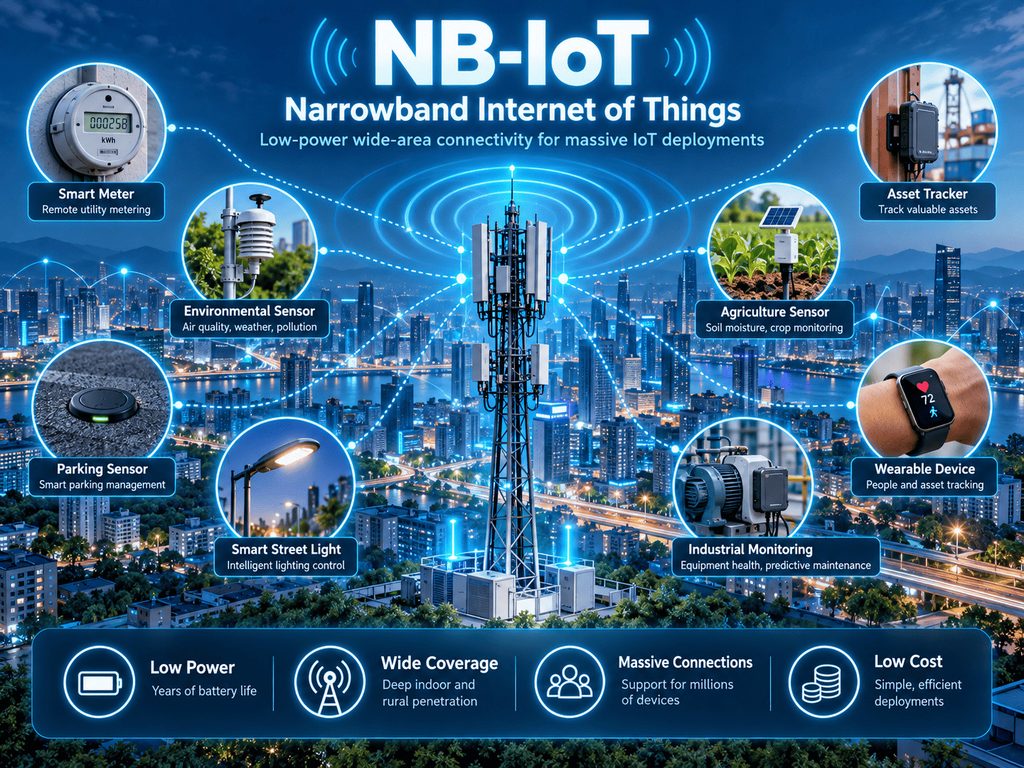
What Is NB-IoT?
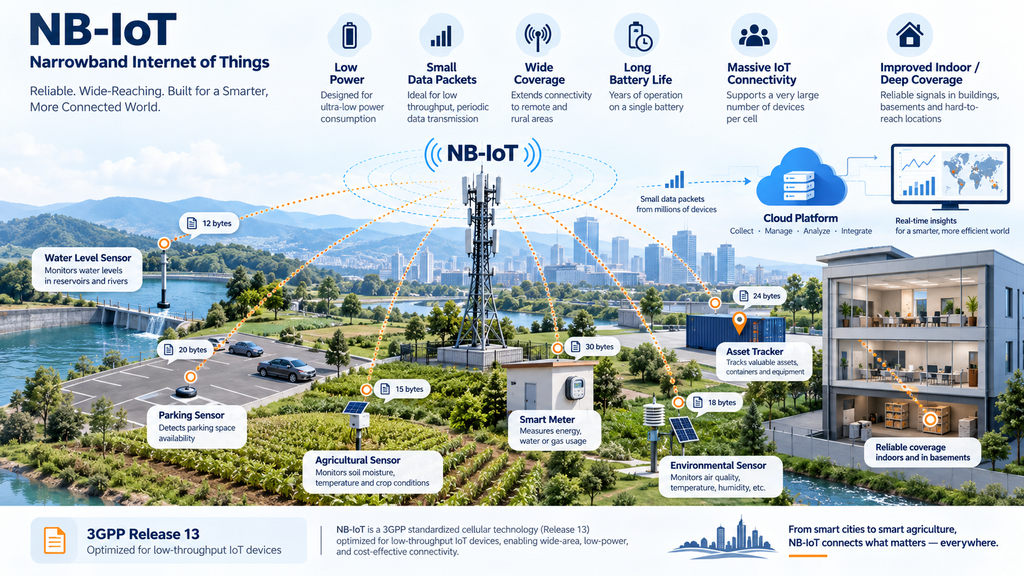
NB-IoT, or Narrowband Internet of Things, is a cellular LPWA technology designed primarily for devices that transmit relatively small amounts of data and need low power consumption, wide coverage, and long operating life.
NB-IoT was standardized by 3GPP as part of Release 13. It is optimized for applications involving large numbers of low-throughput IoT devices and is particularly useful where improved indoor or deep coverage is required.
Typical NB-IoT applications include:
- Smart water meters
- Gas meters
- Environmental monitoring stations
- Parking sensors
- Agricultural sensors
- Tank level monitoring
- Remote industrial instruments
For a wireless level sensor, the operating principle can be simplified as:
Tank → Level Sensor → NB-IoT Network → Cloud Platform → PC or Mobile App
The sensor measures the material level, while the NB-IoT communication module sends that measurement through a cellular network.
Because most level monitoring applications only need to transmit a few values—such as level, temperature, battery status, signal strength, and alarm information—NB-IoT can be an efficient solution.
What Is LTE-M?
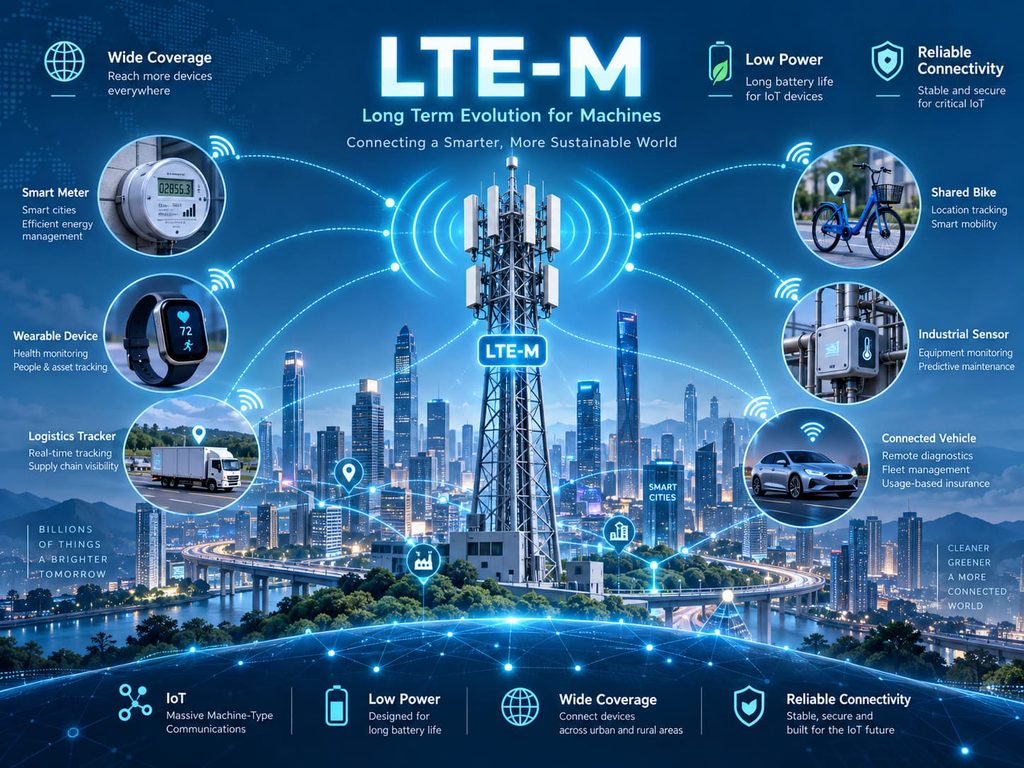
LTE-M, also known as LTE Cat-M or LTE-MTC, is another cellular LPWA technology standardized by 3GPP in Release 13.
Like NB-IoT, LTE-M was developed specifically for IoT devices requiring lower power consumption and lower hardware complexity than conventional cellular devices. However, LTE-M generally provides greater communication capability and better support for mobility than NB-IoT. GSMA also highlights LTE-M’s support for relatively faster data transfer, mobility, roaming, and potential voice services.
A typical LTE-M level monitoring architecture is similar:
Tank → Radar Level Sensor → LTE-M Network → IoT Cloud → Remote User
LTE-M can therefore be attractive for monitoring systems that require more frequent communication, larger data transfers, mobile operation, or more advanced remote device management.
NB-IoT vs LTE-M: What Is the Difference?
Although NB-IoT and LTE-M are both cellular LPWA technologies, they are optimized for somewhat different applications.
| Feature | NB-IoT | LTE-M |
|---|---|---|
| Main purpose | Small, infrequent IoT data | More flexible IoT communication |
| Power consumption | Very low | Low |
| Coverage | Excellent, including difficult locations | Excellent |
| Data capability | Lower | Higher |
| Mobility | Best suited to mainly stationary devices | Better suited to moving devices |
| Response speed | Usually less critical | Better for applications requiring faster communication |
| Typical devices | Meters and fixed sensors | Sensors, trackers and mobile equipment |
| Level monitoring | Excellent for fixed tanks | Excellent for more demanding applications |
These technologies should not necessarily be viewed as competitors. GSMA describes NB-IoT and LTE-M as complementary technologies, with different performance characteristics for different IoT requirements.
Why Are NB-IoT and LTE-M Useful for Level Sensors?
Traditional level transmitters often use interfaces such as 4–20 mA, RS485, Modbus, HART, or wired Ethernet.
These interfaces remain important in industrial plants, but wired communication becomes more difficult when tanks are located several kilometers away from a control room.
Consider a remote diesel tank on a construction site.
Running several kilometers of signal cable only to transmit one level measurement may not make economic sense. A cellular IoT level sensor can transmit the measurement through an existing operator network instead.
This creates several advantages.
1. Reduced Communication Cabling
There is no need to install a dedicated long-distance communication cable between every remote tank and the monitoring center.
2. Remote Tank Monitoring
Operators can view tank level information through a web platform or mobile application without physically visiting each tank.
3. Low-Power Operation
NB-IoT and LTE-M are designed for low-power IoT applications. Features such as Power Saving Mode and extended Discontinuous Reception can help reduce energy consumption when properly supported and configured.
This is especially valuable for battery-powered level sensors installed in remote locations.
4. Alarm Notifications
An IoT level monitoring system can send data when conditions such as high level, low level, abnormal measurement, or low battery are detected.
For example:
Radar Sensor → NB-IoT/LTE-M → Cloud → Low-Level Alarm → User
This allows users to respond before a tank becomes empty or overfilled.
Should a Level Sensor Use NB-IoT or LTE-M?
For many fixed tank level monitoring applications, NB-IoT is a logical choice.
Imagine a radar level sensor installed on a water tank. The tank does not move, and the device may only need to report:
- Current level
- Percentage full
- Battery voltage
- Device status
- Signal strength
If data is uploaded every 15 minutes, every hour, or several times per day, the amount of transmitted information is very small.
In this situation, NB-IoT can provide an efficient balance of coverage, power consumption, and communication cost.
LTE-M may be more appropriate when the application requires more communication capability.
Examples include:
- Frequently updated level measurements
- Mobile tanks or transport containers
- Larger data packets
- More frequent remote configuration
- Firmware updates
- Applications where mobility or roaming is important
In simple terms:
For stationary devices sending small amounts of data, consider NB-IoT.
For applications requiring greater mobility, faster communication, or more data, consider LTE-M.
What About Battery Life?
Long battery life is one of the major advantages of cellular LPWA technology.
GSMA states that both NB-IoT and LTE-M have been designed for IoT applications where devices may need to operate for many years with limited power. In suitable use cases, battery life of around ten years or more may be achievable.
However, a level sensor’s actual battery life depends on much more than the communication standard.
Important factors include:
- Measurement interval
- Data upload interval
- Cellular signal quality
- Network configuration
- Transmission retries
- Sensor power consumption
- Operating temperature
- Battery capacity
- Alarm frequency
For example, a radar level sensor measuring every minute and uploading every minute will normally consume much more energy than a sensor measuring every hour and transmitting once every six hours.
Therefore, battery life should always be evaluated at the complete device level, rather than based only on the NB-IoT or LTE-M modem specification.
Check Network Availability Before Choosing
One important point is often overlooked: NB-IoT and LTE-M availability varies by country and mobile operator.
A sensor that works perfectly on one network may require different frequency bands, SIM configurations, or network settings in another market.
GSMA’s current deployment guidance specifically emphasizes interoperability, network configuration, roaming, frequency bands, and power optimization when designing global NB-IoT and LTE-M products.
Before selecting a communication technology for an industrial level sensor, check:
- Local operator coverage
- Supported LTE frequency bands
- NB-IoT or LTE-M service availability
- SIM and IoT data plan requirements
- Roaming requirements
- Cloud communication protocol
- Installation environment
This is particularly important for level sensor manufacturers selling products internationally.
NB-IoT and LTE-M Are Changing Remote Level Monitoring
NB-IoT and LTE-M are not measurement technologies themselves. A radar sensor still uses radar to determine the material level, and an ultrasonic sensor still uses acoustic waves.
What NB-IoT and LTE-M change is how that measurement reaches the user.
Instead of:
Level Sensor → Cable → PLC → Control Room
a remote monitoring system can use:
Level Sensor → NB-IoT/LTE-M → Cellular Network → Cloud → PC or Smartphone
This makes cellular IoT particularly attractive for distributed tanks, agricultural water systems, environmental monitoring, chemical storage, fuel management, and other applications where installing traditional communication infrastructure is difficult.
Frequently Asked Questions
Is NB-IoT better than LTE-M for tank level monitoring?
For a stationary tank that sends small amounts of data at relatively long intervals, NB-IoT is often an excellent option. LTE-M may be preferable when faster communication, mobility, or larger data transfers are required.
Can radar level sensors use NB-IoT?
Yes. A radar level sensor can integrate an NB-IoT modem or connect to an external NB-IoT communication unit. Radar performs the measurement, while NB-IoT sends the measurement data to a remote platform.
Does an NB-IoT level sensor need Wi-Fi?
No. NB-IoT communicates through a supported cellular operator network, so a local Wi-Fi network is generally not required.
Can LTE-M be used for remote tank monitoring?
Yes. LTE-M is well suited to remote monitoring and can be particularly useful when the device requires more frequent communication or better mobility support.
Conclusion
Both NB-IoT and LTE-M provide practical cellular connectivity for IoT level sensors and remote tank monitoring systems.
NB-IoT is particularly attractive for fixed, low-data devices where coverage and low power consumption are priorities. LTE-M provides greater flexibility for applications that need more frequent communication, mobility, or higher data capability.
The right choice ultimately depends on the application, reporting frequency, power supply, local cellular network, and deployment region.
For level sensor manufacturers and system integrators, understanding these differences makes it easier to design reliable wireless level monitoring solutions that connect remote tanks directly to modern cloud-based monitoring platforms.