
Pharmaceutical alcohol is widely used in drug manufacturing, equipment disinfection, cleanroom sanitation, raw material preparation, and process pipeline cleaning. Because alcohol is volatile and flammable, its storage and transfer systems must ensure a continuous material supply while preventing tank overfilling, pump dry running, and safety risks caused by frequent manual access to storage areas.
Reliable, continuous, and explosion-proof level monitoring is therefore an important part of automation upgrades for pharmaceutical alcohol storage and handling systems.

This application case describes a typical pharmaceutical manufacturing project in which a Float-11A standard float level transmitter was installed on an alcohol storage tank. The solution enabled continuous level measurement, local indication, remote monitoring, high- and low-level alarms, and automatic pump interlocking.
1. Project Background: Manual Measurement Could Not Support Continuous Production
At the pharmaceutical plant, medical-grade alcohol was unloaded from road tankers into a vertical storage tank. It was then transferred by pump to the liquid preparation room and disinfectant production area.
The original level management method relied mainly on manual inspections and simple scale readings. Operators were unable to continuously monitor level changes during filling, storage, and discharge.
When production demand increased unexpectedly, personnel could miss the correct time to replenish the tank. During tanker unloading, delays in communication between operators could also result in an excessively high tank level or even alcohol overflow.
The original system did not provide a standard analog output. As a result, level information could not be transmitted to the plant PLC or DCS. Pump start and stop control, low-level protection, and high-level alarms depended heavily on manual observation and operator judgment.
Frequent entry into the storage tank area also increased personnel exposure to alcohol vapor. In addition, excessive manual intervention raised the risk of operational errors and potential contamination.
The company therefore established several objectives for the level monitoring upgrade:
- Continuous measurement of the pharmaceutical alcohol level
- Local level indication
- Remote monitoring from the control room
- High- and low-level alarms
- Pump and valve interlocking
- Explosion-proof electrical protection
- Suitable wetted materials
- Reliable environmental sealing
- Simple installation and maintenance
The company also wanted to complete the upgrade without making major structural modifications to the existing storage tank.
2. Process Analysis: Why a Float Level Transmitter Was Suitable
The storage tank contained pharmaceutical alcohol at approximately ambient temperature. The liquid had good fluidity and did not normally crystallize, form heavy deposits, or exhibit high viscosity.
The density of alcohol was approximately 0.79 g/cm³, which was higher than the minimum medium density requirement of 0.5 g/cm³ for the selected float level transmitter. The liquid could therefore provide sufficient buoyancy for stable float operation.
Alcohol is a flammable liquid, so any level instrument installed in the storage area must be selected with careful consideration of explosion protection, electrical connections, enclosure sealing, and environmental protection.
After evaluating the tank height, medium properties, installation conditions, and control requirements, the project team selected a top-mounted Float-11A standard float level transmitter.
The wetted components of the instrument were available in 304 or 316L stainless steel. For pharmaceutical applications, 316L stainless steel was preferred because it provides better corrosion resistance and is more compatible with strict cleanliness and long-term reliability requirements.

The transmitter offered a measuring range of 300 to 6,000 mm, an operating temperature range of −20 to 120°C, and a process pressure rating of up to 25 bar. These specifications covered the normal-temperature and low-pressure operating conditions of the pharmaceutical alcohol storage tank.
Measurement accuracy could be selected as ±5 mm or ±10 mm, depending on the application requirements. The instrument also provided a standard 4–20 mA output for integration with the plant control system.
Unlike a float level switch, which normally provides only one or several fixed alarm points, a continuous float level transmitter measures level changes throughout the entire operating range.
The continuous signal can be used for:
- Real-time level display
- Historical trend recording
- Inventory estimation
- High- and low-level alarm management
- Pump protection
- Automatic filling and discharge control
- Material consumption analysis
3. Operating Principle: Converting Float Movement into a 4–20 mA Signal
The float level transmitter operates according to Archimedes’ principle of buoyancy.
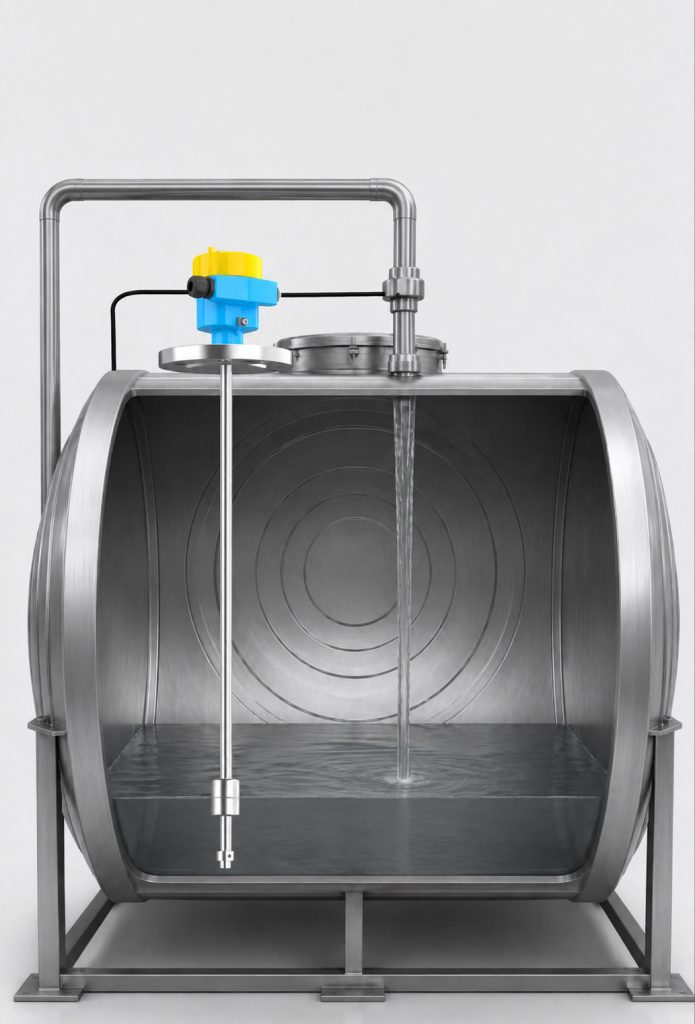
As the liquid level inside the storage tank rises or falls, the float moves vertically along the guide rod. A magnetic element inside the float activates a series of reed switches and a resistance network installed within the guide rod.
The resistance value changes in a controlled sequence according to the position of the float. The transmitter electronics then convert this resistance change into a standard 4–20 mA DC signal.
In this project, 4 mA represented the minimum calibrated measurement point, while 20 mA represented the maximum measurement point.
The PLC converted the current signal into a level value based on the effective tank height. The level could be displayed in millimeters, as a percentage, or as an estimated liquid volume.
Operators could therefore view the current level, remaining alcohol inventory, alarm status, and level trend directly from the central control room. They no longer needed to enter the storage area frequently to confirm the tank level manually.
Correct float selection was essential for reliable measurement. The float had to be matched to the actual density of the pharmaceutical alcohol.
When alcohol concentration or temperature varies significantly, the minimum possible liquid density should be used during instrument selection. Using only the density under normal operating conditions could result in insufficient buoyancy and inaccurate measurement under changing process conditions.
4. Monitoring Solution: Combining Explosion Protection, Sealing, and Automatic Interlocking
Because alcohol vapor is flammable, explosion-proof performance was treated as a primary instrument selection requirement.
Depending on the hazardous area classification, power supply method, and control system design, the float level transmitter could be configured with either of the following protection methods:
- Flameproof protection: Ex db IIC T6 Gb
- Intrinsic safety protection: Ex ia IIC T6 Ga
The enclosure protection rating could reach IP66/IP67, allowing the instrument to operate reliably in storage areas exposed to humidity, dust, rain, and equipment cleaning.
The transmitter was powered by an 18–36 V DC supply and sent a 4–20 mA signal to the plant PLC.
Four level control points were configured according to the production process.
High-High Level
When the alcohol reached the high-high level, the control system immediately activated an audible and visual alarm.
At the same time, the tanker unloading pump was stopped or the inlet valve was closed. This automatic action reduced the risk of alcohol overflow caused by delayed operator response or continued filling.
High Level
The high-level alarm provided an early warning before the high-high shutdown point was reached.
Operators could observe the unloading process, confirm the remaining tank capacity, and prepare for the automatic interlock action if filling continued.
Low Level
When the alcohol reached the low-level setting, the control system sent a replenishment notification to the warehouse and production departments.
This early warning allowed personnel to arrange alcohol delivery before the available inventory became insufficient for liquid preparation or disinfection operations.
Low-Low Level
At the low-low level, the control system automatically stopped the alcohol transfer pump.
This prevented the pump from running dry for an extended period and reduced the risk of seal damage, overheating, equipment failure, and unplanned production downtime.
For applications requiring a higher level of safety independence, a separate point-level switch can also be installed at the high-high level.
In this combined arrangement, the continuous float level transmitter performs process monitoring, trend analysis, and inventory measurement, while the independent level switch provides a separate overflow protection function.
This “continuous measurement plus independent limit protection” design can improve the overall reliability of the alcohol storage system.
5. Installation: Avoiding Inlet Turbulence and Internal Obstructions
The float level transmitter was installed vertically from the top of the storage tank.
Before installation, the engineering team verified the following parameters:
- Total tank height
- Effective measuring range
- Process connection and flange size
- Guide rod length
- Float diameter
- Upper and lower dead zones
- Tank nozzle position
- Internal tank structure
- Required explosion-proof configuration
The installation team also confirmed that no agitator shafts, heating coils, internal pipes, support structures, or other components would interfere with float movement.
The transmitter should not be installed directly beneath the alcohol inlet.
During tanker unloading, high-velocity liquid entering the tank can strike the float directly. This may cause temporary signal fluctuations, excessive mechanical movement, or long-term damage to the guide rod assembly.
Where the liquid surface is highly turbulent, an appropriate guide or stilling structure may be installed. However, the design must ensure that the float can move freely throughout the entire measuring range without friction, collision, or jamming.
Electrical wiring must comply with the requirements of the hazardous area.
The installation should use suitable cables, certified cable glands, proper sealing components, and reliable grounding.
An intrinsically safe installation requires an appropriate safety barrier between the field instrument and the control system. A flameproof installation requires the cable entry, terminal enclosure, cover, and flameproof joints to remain complete and correctly assembled.
The 4–20 mA signal cable should be routed separately from pump power cables and other high-voltage wiring. This helps reduce electromagnetic interference and improves signal stability.
During commissioning, the instrument was checked at several reference points:
- Empty-tank or minimum measurement point
- One or more known intermediate levels
- Near-full or maximum measurement point
The local display, PLC reading, and actual liquid level were compared to confirm that the measurement values were consistent.
The commissioning team also tested the high-high level pump shutdown, low-low level pump shutdown, alarm acknowledgment, alarm reset, and valve interlock logic.
These tests ensured that both the measurement loop and the automatic safety functions operated correctly.
6. Application Results: Moving from Manual Inspection to Data-Based Level Management
After the upgrade, operators could continuously view the pharmaceutical alcohol level, alarm status, and historical trends from the control room.
During tanker unloading, the system provided early warnings based on the rising liquid level. This reduced the safety risks associated with manual estimation, delayed communication, and incorrect judgments about the tank’s remaining capacity.
The low-level alarm allowed the warehouse, purchasing, and production departments to arrange alcohol replenishment in advance.
This reduced the possibility of production interruptions caused by inaccurate inventory information or late material delivery.
The low-low level interlock protected the transfer pump against dry running. It also helped reduce equipment wear, pump failures, and unexpected maintenance.
Once the 4–20 mA signal had been integrated into the control system, the company could establish a relationship between liquid level and tank volume based on the geometry of the storage tank.
This enabled the system to support:
- Shift-based alcohol consumption statistics
- Batch material reconciliation
- Inventory estimation
- Filling and discharge records
- Consumption trend analysis
- Abnormal usage identification
Continuous level records also preserved information about alcohol receiving, storage, and consumption.
These records could provide supporting data for production traceability, deviation investigations, maintenance analysis, and operating performance reviews.
Because pharmaceutical alcohol is relatively clean and has low viscosity, it normally does not produce serious deposits on the float or guide rod.
Routine maintenance mainly consisted of:
- Checking the external condition of the instrument
- Inspecting cable glands and enclosure seals
- Comparing displayed values with known reference values
- Verifying grounding
- Testing alarms and interlocks periodically
- Confirming that the float moves freely
Compared with manual level measurement, the maintenance and operating workload became more stable, predictable, and manageable.
7. Important Considerations for Pharmaceutical Alcohol Level Monitoring
Selecting a float level transmitter for pharmaceutical alcohol requires more than simply matching the measuring range to the tank height.
The following process and installation information should be confirmed during instrument selection:
- Alcohol concentration
- Minimum liquid density
- Operating temperature
- Tank pressure
- Wetted material requirements
- Tank connection size
- Measuring range
- Required accuracy
- Hazardous area classification
- Power supply
- Signal output
- Installation restrictions
- Cleaning procedures
Alcohol-water mixtures with different concentrations have different densities.
When concentration or temperature may change, the float should be selected according to the lowest expected liquid density. This helps prevent measurement errors caused by insufficient buoyancy.
The suitability of a contact-type float instrument should be reconsidered when the process involves severe agitation, heavy foam, crystallization, highly viscous deposits, or complex internal tank obstructions.
During tank cleaning, hard objects should not be allowed to strike the float or guide rod. Personnel should also avoid unauthorized disassembly of the explosion-proof enclosure or modification of the sealing structure.
The level transmitter is only one part of a complete alcohol storage safety system.
The overall solution should also include appropriate measures such as:
- Effective ventilation
- Static electricity grounding
- Alcohol vapor or leak detection
- Fire protection equipment
- Emergency shutdown valves
- Safe unloading procedures
- Periodic inspection
- Operator training
- Documented emergency response procedures
Combining reliable level measurement with these protective measures creates a more complete risk-control system for pharmaceutical alcohol storage and transfer.
8. Conclusion
In pharmaceutical alcohol storage and transfer systems, liquid level measurement directly affects material availability, inventory management, pump protection, and overflow prevention.
For alcohol tanks operating at normal temperature with low-viscosity liquid and relatively stable surface conditions, the Float-11A standard float level transmitter provides a practical continuous monitoring solution.
Its main features include:
- 304 or 316L stainless steel wetted components
- Measuring ranges from 300 to 6,000 mm
- Standard 4–20 mA output
- Optional ±5 mm or ±10 mm accuracy
- Explosion-proof configurations
- IP66/IP67 enclosure protection
- Simple integration with PLC and DCS systems
- Continuous level display and trend recording
- High- and low-level alarm capability
- Pump and valve interlocking
Through correct instrument selection, standardized installation, and properly designed control logic, pharmaceutical manufacturers can replace manual alcohol level inspection with an automated system that provides real-time display, alarms, historical records, and process control.
This type of float level transmitter application can improve the continuity of pharmaceutical production, strengthen alcohol inventory management, protect transfer equipment, and support safer operation of flammable liquid storage areas.