
In industrial level measurement, ultrasonic level transmitters and radar level transmitters are often compared with each other.
It is easy to understand why. Both technologies can be installed at the top of a tank, silo, basin, or vessel for non-contact measurement. Neither necessarily needs to touch the measured material. From a basic measurement perspective, both transmit a signal toward the material surface, receive the reflected echo, calculate the distance, and then convert that distance into a liquid level or solids level.
For this reason, ultrasonic and radar level measurement may appear very similar when viewed only from their installation method, appearance, or basic operating description.
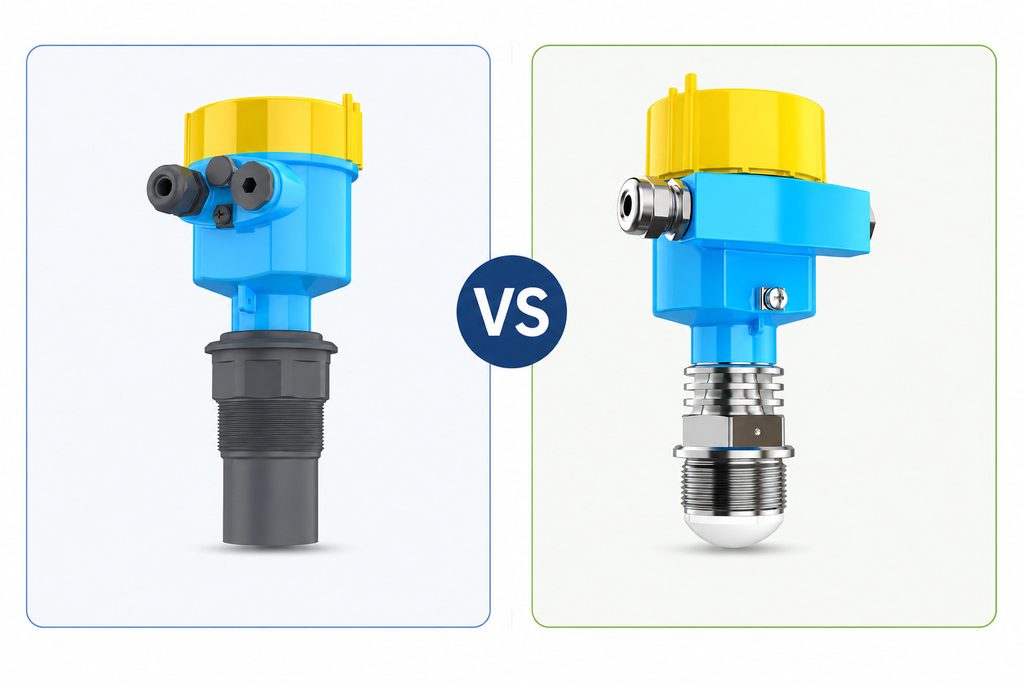
However, once we look at the underlying physics, one fundamental difference becomes clear:
Ultrasonic waves require a material medium for propagation, while the electromagnetic waves used by radar do not require a material medium in order to propagate.
This is not simply a matter of one technology being cheaper or another being more advanced. Nor is it accurate to classify them casually as “one for water and one for chemical applications.” The difference begins with the physical nature of the waves themselves.
Understanding the concept of the propagation medium helps explain many practical questions in level measurement: Why can temperature changes affect ultrasonic measurement? Why should changes in gas composition be considered? Why is radar generally more suitable for vacuum applications? And why do vapor, dust, foam, and volatile gases affect ultrasonic and radar level measurement differently?
To answer these questions, we need to start with the fundamentals of wave propagation.
1. Why Do Ultrasonic and Radar Level Transmitters Look So Similar?
First, consider what the two technologies have in common.
In a typical top-mounted, non-contact ultrasonic level measurement application, the sensor transmits an ultrasonic pulse toward the surface of a liquid or bulk solid. When the sound wave reaches the material surface, part of its energy is reflected back toward the sensor.
The instrument measures the travel time of the signal and calculates the distance between the sensor and the material surface.
In simplified form:
Distance = Wave Velocity × Round-Trip Time ÷ 2
Radar level measurement follows a remarkably similar process.
A radar level transmitter sends electromagnetic waves toward the material surface. The signal is reflected at the interface, and the instrument processes the returned signal to determine the distance.
Different radar technologies may use different signal-processing methods, such as pulse radar or frequency-modulated continuous wave techniques, but the fundamental objective is the same: determining the distance between the antenna and the material surface.
If the reference height of a tank is H and the measured distance from the instrument to the surface is D, the level L can be expressed as:
L = H − D
From an application perspective, therefore, ultrasonic and radar measurement do look very similar.
But a similar measurement sequence does not mean the propagation process is the same.
The critical question is:
What allows the signal to travel through the space between the sensor and the material surface?
This is where the concept of the propagation medium becomes important.
2. What Is a Propagation Medium?
A propagation medium can be understood as the physical environment through which a wave travels.
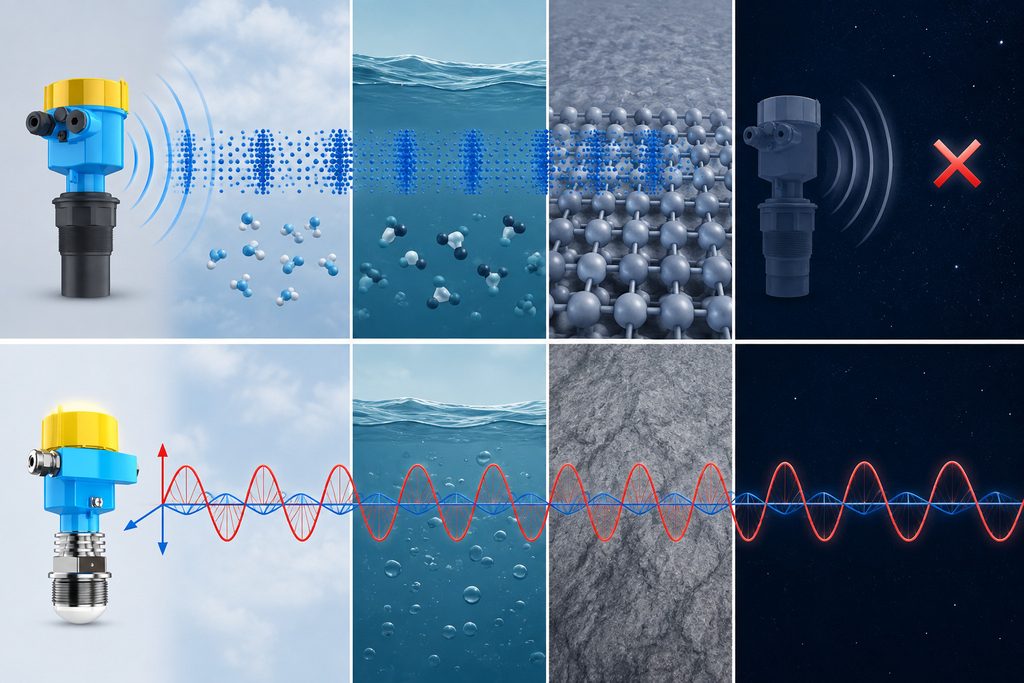
Sound is a mechanical wave. Mechanical waves depend on interactions between particles in matter to transfer energy. As a result, sound requires a material medium such as a gas, liquid, or solid in order to propagate. Without matter capable of transmitting mechanical vibration, sound cannot propagate in the same way it does through air.
Electromagnetic waves are fundamentally different.
They are not mechanical waves and do not require air, water, or another material substance as a propagation medium. Electromagnetic waves can travel through a vacuum.
This is one of the most fundamental physical differences between ultrasonic and radar level measurement.
Ultrasonic measurement: uses mechanical sound waves and requires a material propagation medium.
Radar measurement: uses electromagnetic waves and does not require a material medium in order to propagate.
However, this does not mean radar signals are completely unaffected by the materials through which they travel.
Electromagnetic waves can still experience reflection, absorption, refraction, attenuation, and other effects when interacting with matter. The dielectric properties of the measured material can also strongly influence radar echo strength.
The more accurate statement is therefore:
Radar electromagnetic waves do not require matter in order to exist and propagate, whereas ultrasonic waves must propagate through a material medium.
That distinction is essential.
3. Ultrasonic Level Measurement Is Essentially “Listening for an Echo”
One useful way to understand an ultrasonic level transmitter is to imagine shouting in a valley.
You produce a sound. The sound travels through the air, reaches a rock wall, reflects, and returns as an echo. By measuring how long the sound takes to travel to the wall and back, the distance to the wall can be estimated.
Ultrasonic level measurement works according to a similar principle, except that the instrument uses high-frequency sound waves above the normal range of human hearing.
In a typical non-contact application, the sensor transmits an ultrasonic pulse. The sound wave travels through the gas space between the sensor and the liquid surface, reflects from the surface, and then travels back through the gas toward the sensor.
This means that the gas space between the sensor and the material surface is not simply “empty space.”
It is part of the ultrasonic measurement path.
If conditions in this space change significantly, the velocity of sound, signal attenuation, and overall echo quality may also change.
This explains why selecting an ultrasonic level transmitter should involve more than asking:
“What liquid are you measuring?”
Another important question is:
“What exists above the liquid surface?”

4. Why Does Temperature Affect Ultrasonic Level Measurement?
Temperature is one of the clearest examples of how the propagation medium affects ultrasonic measurement.
The speed of sound is not a universal constant under all operating conditions.
It depends on the propagation medium and the physical state of that medium.
In air, for example, the speed of sound is approximately 331 m/s at 0°C and around 343 m/s at 20°C. Even though the propagation medium remains air, changing its temperature changes the speed of sound.
Distance calculation depends directly on propagation velocity:
D = v × t ÷ 2
Where:
D = measurement distance
v = speed of sound
t = round-trip travel time
If the actual speed of sound changes while the instrument continues calculating distance using an incorrect velocity, measurement error can occur.
For this reason, many ultrasonic level transmitters include temperature compensation.
However, an important point is sometimes overlooked:
Having temperature compensation does not mean that every complex temperature condition can be perfectly compensated.
For example, a large process vessel may contain significant temperature gradients. The gas temperature close to the sensor may differ from the temperature close to a hot liquid surface.
The ultrasonic pulse therefore travels through a path containing different temperature zones rather than through a perfectly uniform gas space.
Consequently, the statement “the instrument has temperature compensation” should not automatically be interpreted as “temperature can never affect the measurement.”
5. Why Does Gas Composition Matter?
Temperature is not the only factor that affects sound propagation.
The physical properties of the gas itself are also important.
The speed of sound can vary considerably between different gases. Under ideal-gas assumptions, the relationship can be expressed approximately as:
v = √(γRT/M)
where M is related to the molar mass of the gas.
This means that when the composition of the gas in the measurement path changes significantly, the speed of sound may also change.
This has practical importance in industrial level measurement.
Consider an open water basin. The space above the water surface mainly contains normal atmospheric air, so the propagation environment is relatively straightforward.
Now consider a sealed process vessel.
The space above the liquid may contain process vapor, volatile compounds, inert gas, purge gas, or another gas mixture. In this situation, the “air space” should no longer automatically be treated as ordinary atmospheric air.
If the gas composition remains stable, the application can often be evaluated accordingly.
A more difficult situation occurs when the gas composition changes continuously.
In that case, the acoustic propagation conditions may also change.
For ultrasonic level measurement, therefore, understanding the liquid being measured is only part of the application analysis. Understanding the gas space above the liquid can be equally important.
6. Why Does Vacuum Clearly Reveal the Fundamental Difference?
If we want one extreme operating condition that clearly demonstrates the difference between ultrasonic and radar level measurement, vacuum is an excellent example.
Sound is a mechanical wave and requires matter for propagation. In an ideal vacuum, there are not enough particles to transmit mechanical vibration in the normal acoustic sense.
For conventional non-contact ultrasonic level measurement, this creates a fundamental problem.
The ultrasonic signal needs to travel from the sensor to the material surface and back through the space inside the vessel. If that space is a vacuum, the acoustic propagation path no longer functions as required.
Radar is different.
Radar level measurement uses electromagnetic waves, which do not require air molecules or another material medium to propagate. Electromagnetic waves can travel through a vacuum.
As a result, in vacuum or near-vacuum vessel applications, the propagation principle itself becomes an important factor in technology selection.
This is also why the question “Which is better, ultrasonic or radar?” cannot be answered without understanding the process conditions.
Under some conditions, both technologies may work well.
Under other conditions, the underlying physics may place a significant limitation on one of them.
7. If Radar Does Not Require a Propagation Medium, Why Does Dielectric Constant Matter?
This is another area where misunderstanding can occur.
Someone may hear that “radar does not require a propagation medium” and conclude:
Radar is completely unaffected by the measured material.
That is incorrect.
Although radar does not depend on gas as a mechanical propagation medium, it still needs to receive a sufficiently strong and identifiable electromagnetic reflection from the target.
When a radar signal travels from the gas space toward the material surface, part of the signal is reflected because of the difference in electromagnetic properties across the interface.
The relative dielectric constant of the material and the properties of the interface are important factors affecting echo strength.
Radar level measurement may therefore require consideration of:
- Dielectric properties of the material
- Surface condition
- Foam
- Condensation and buildup near the antenna
- Internal tank obstructions
- Installation position
- Beam path
- False echoes
A more accurate comparison is therefore:
Ultrasonic measurement must consider whether sound can propagate reliably through the gas space, while radar measurement must consider whether the electromagnetic signal can obtain a sufficiently reliable reflection from the target surface.
The two technologies are dealing with different physical challenges.
8. Why Do Vapor, Volatile Gases, and Temperature Gradients Often Separate the Two Technologies?
In an open basin or storage tank operating at normal temperature and pressure with a stable gas space, ultrasonic level measurement can often perform reliably.
As process conditions become more complex, however, the importance of the propagation medium becomes increasingly obvious.
Consider a process vessel with substantial temperature variation. The liquid may also be continuously evaporating, creating a complex vapor layer above the surface.
An ultrasonic pulse must travel through this gas space and complete a round trip.
If gas temperature and composition vary at different heights inside the vessel, the propagation velocity may no longer be as predictable as it would be in uniform atmospheric air.
Steam, condensation, and strong air movement can also affect acoustic signal quality.
Radar electromagnetic waves do not depend on the mechanical vibration of these gas molecules for propagation. Therefore, radar is generally not affected by changes in the speed of sound in the same way as ultrasonic measurement.
This is one reason radar is often considered for vessels involving high temperatures, complex vapor spaces, volatile materials, or rapidly changing process conditions.
However, “more suitable” does not mean “completely unaffected.”
Heavy condensation, severe buildup, strongly absorbing materials, unusual foam conditions, and complicated vessel internals can still create challenges for radar level measurement.
9. What Happens in Dusty Solids Applications?
Bulk solids level measurement provides another useful comparison.
Applications involving powders, granules, minerals, grain, cement-type materials, and other bulk solids can generate large amounts of suspended dust during filling.
For ultrasonic measurement, the sound wave must travel through this dust-laden gas before reaching the material surface.
High concentrations of airborne particles can increase acoustic scattering and attenuation, potentially reducing the strength of the useful return echo.
Radar operates with electromagnetic waves rather than sound.
Because the propagation mechanism is different, radar can offer important advantages in many dusty applications, particularly in tall silos, long measurement ranges, or processes where heavy dust is continuously generated during filling.
Nevertheless, dust is only one part of the application.
Bulk solid surfaces are rarely perfectly flat. They may form peaks, valleys, angled surfaces, or irregular profiles. The installation must therefore also consider beam angle, sensor orientation, reflection direction, measurement range, and internal silo structures.
Dust should be treated as an important selection factor, but not as the only factor.
10. Why Does Foam Not Automatically Mean “Radar Will Work”?
Foam is one of the most representative examples of a difficult liquid-level interface.
Thick, soft, or highly sound-absorbing foam can significantly attenuate ultrasonic energy, weakening the return signal.
Radar behaves differently, but its performance in foam depends on the electromagnetic properties of the foam.
Some types of foam may have relatively little effect on a particular radar signal, allowing the instrument to detect the liquid surface beneath it. Other dense, wet, or highly structured foams may produce significant reflection or attenuation.
It is therefore inaccurate to use a simple rule such as:
“Foam means ultrasonic will fail, so radar will always work.”
A better approach is to first determine what the process actually needs to measure:
the top surface of the foam or the true liquid level below the foam.
Then evaluate foam thickness, density, liquid content, stability, and other process conditions before selecting the measurement technology.
This illustrates an important principle in level instrumentation:
Do not evaluate only the sensor. Evaluate the complete measurement system: sensor + propagation path + target interface + process conditions.
11. Ultrasonic vs. Radar Level Measurement: Key Differences
| Comparison | Ultrasonic Level Measurement | Radar Level Measurement |
|---|---|---|
| Signal type | Mechanical sound wave | Electromagnetic wave |
| Requires a material medium for propagation | Yes | No |
| Can propagate through vacuum | No | Yes |
| Typical non-contact propagation path | Gas space | Gas space or vacuum |
| Temperature changes | Can affect measurement through changes in sound velocity | Generally not affected through the same sound-velocity mechanism |
| Changes in gas composition | Can change sound velocity | Usually much less significant than for ultrasonic measurement |
| Volatile vapor space | Requires careful evaluation | Often more adaptable, depending on conditions |
| Heavy dust | Can attenuate acoustic signals | Often advantageous in dusty applications |
| Foam | May absorb or weaken sound | Depends on foam and dielectric properties |
| Material dielectric properties | Usually not a primary parameter | Important parameter |
| Typical simple applications | Water basins, open channels, atmospheric tanks | Also suitable for many such applications |
| Typical complex applications | Propagation conditions require careful evaluation | Often offers a wider operating envelope |
This comparison should not be interpreted as saying that radar is superior in every situation.
Instead, it demonstrates that the two technologies require different approaches to evaluating process conditions.

12. When Is an Ultrasonic Level Transmitter Still a Good Choice?
Understanding the propagation-medium difference should not lead to the opposite misconception that radar is always better than ultrasonic measurement.
Ultrasonic technology remains a mature and effective solution for many simple and stable applications.
Typical examples include:
- Open water basins
- Wastewater tanks
- Sumps
- Atmospheric storage tanks
- Certain open-channel applications
- Liquid level measurement with a stable gas space
Ultrasonic level measurement can be a practical solution when:
The gas space consists mainly of stable air.
Temperature variations remain within an appropriate range.
There is no severe vapor or rapidly changing gas composition.
Heavy foam is absent.
Continuous high-density dust is absent.
The measurement range and installation geometry are suitable.
The target surface provides a stable acoustic echo.
The goal of engineering selection is not to choose the technology that sounds the most advanced.
The goal is to select a technology that can perform the measurement reliably, consistently, and maintainably under the actual process conditions.
13. When Should Radar Level Measurement Be Evaluated First?
Radar deserves particular consideration when an application involves conditions such as:
- High temperature or large temperature variations
- Complex or changing gas composition
- Significant steam or volatile vapor
- Vacuum or unusual pressure conditions
- Heavy dust
- Long measurement ranges
- Tall vessels or silos
- Complex internal structures
- A need to reduce measurement sensitivity to changing gas-space conditions
The reason is not simply that radar is a more expensive or sophisticated technology.
The reason is that radar uses electromagnetic waves and does not depend on the gas space as a mechanical propagation medium.
This allows radar to avoid one of the fundamental variables involved in ultrasonic measurement:
changes in the speed of sound caused by changes in the propagation environment.
Radar selection, however, still requires consideration of dielectric properties, installation position, antenna configuration, measurement range, process temperature and pressure, internal obstructions, condensation, and buildup.
14. Five Questions to Ask Before Choosing a Level Measurement Technology
When choosing between an ultrasonic level transmitter and a radar level transmitter, start with these five questions.
1. What Exists Between the Sensor and the Material Surface?
Is it ordinary air, steam, volatile vapor, inert gas, heavy dust, or near-vacuum conditions?
2. Is the Propagation Environment Stable?
Do temperature, gas composition, humidity, and process conditions change frequently?
3. What Is the Condition of the Target Surface?
Is it a calm liquid surface, turbulent liquid, foam, powder, granules, or an angled bulk-solids surface?
4. What Is Located in the Signal Path?
Beams, agitators, filling pipes, ladders, heating coils, and other internal structures may produce unwanted echoes.
5. Which Interface Does the Process Actually Need to Measure?
This question is especially important for foam, layered liquids, and irregular solids surfaces.
The interface detected most strongly by an instrument may not always be the interface that matters most to the process.
Answering these five questions before comparing measurement range, accuracy, and price usually leads to a more reliable technology selection.
15. Frequently Asked Questions
What is the main difference between ultrasonic and radar level measurement?
One of the most fundamental differences is the type of wave used. Ultrasonic level measurement uses mechanical sound waves that require a material medium for propagation. Radar level measurement uses electromagnetic waves, which do not require a material medium to propagate.
This difference affects how the two technologies respond to temperature, gas composition, vacuum, vapor, dust, and other process conditions.
Why is ultrasonic level measurement affected by temperature?
The speed of sound depends on the temperature and properties of the propagation medium. Because ultrasonic distance measurement uses sound velocity in its calculation, temperature changes can introduce measurement error if they are not properly compensated.
Does a radar level transmitter need air to work?
No.
Radar uses electromagnetic waves, which do not require air as a propagation medium. This is one reason radar technology can be used in vacuum applications when other process conditions are suitable.
Is radar completely unaffected by the process medium?
No.
Although radar does not depend on the gas space as a mechanical propagation medium, the dielectric properties of the measured material, surface condition, foam, condensation, buildup, vessel geometry, and internal obstructions can still influence echo quality and measurement performance.
Should I use ultrasonic or radar for a normal water tank?
For a water tank operating at normal temperature and pressure with a stable air space and no severe foam or vapor, either technology may be suitable.
The final choice should consider measurement range, installation geometry, required accuracy, environmental conditions, maintenance requirements, and overall application needs.
Why does steam make ultrasonic measurement more challenging?
Ultrasonic waves must travel through the gas space above the liquid.
If steam, temperature gradients, or changing gas composition significantly alter that space, the acoustic propagation conditions and echo quality may change.
Can an ultrasonic level transmitter work in a vacuum vessel?
Conventional non-contact ultrasonic measurement depends on sound propagation through the space between the sensor and the target.
Because mechanical sound waves cannot propagate through a true vacuum, vacuum applications create a fundamental limitation for this measurement principle. A technology that does not depend on an acoustic propagation medium should normally be evaluated instead.
Conclusion: The Real Comparison Is More Than “Ultrasonic vs. Radar”
Ultrasonic and radar level transmitters are often considered similar because both can provide non-contact measurement and both can determine level by transmitting a signal and analyzing the returned echo.
At the level of fundamental physics, however, there is a clear distinction:
Ultrasonic measurement uses mechanical waves and requires a propagation medium. Radar measurement uses electromagnetic waves and does not require a material medium for propagation.
This fundamental difference helps explain why the two technologies behave differently in applications involving temperature changes, varying gas composition, steam, vacuum, dust, foam, and complex process environments.
For this reason, selecting a level transmitter should involve more than asking:
“What material am I measuring?”
There is another question that is just as important:
“What does the signal have to travel through before it reaches the material surface?”
For ultrasonic measurement, that space is an important part of the measurement system itself.
For radar measurement, although the signal does not depend on air or another gas as a mechanical propagation medium, the signal path, target dielectric properties, surface characteristics, and echo conditions still need to be evaluated.
Once this principle is understood, many differences between ultrasonic and radar level measurement no longer need to be memorized as isolated rules. They can be understood directly from the underlying physics.
That is one of the most useful approaches to level measurement technology selection:
First understand how the signal propagates. Then determine whether the process environment supports that propagation method. Finally, compare measurement range, accuracy, installation requirements, reliability, and cost.