1. What Is Water Glass?
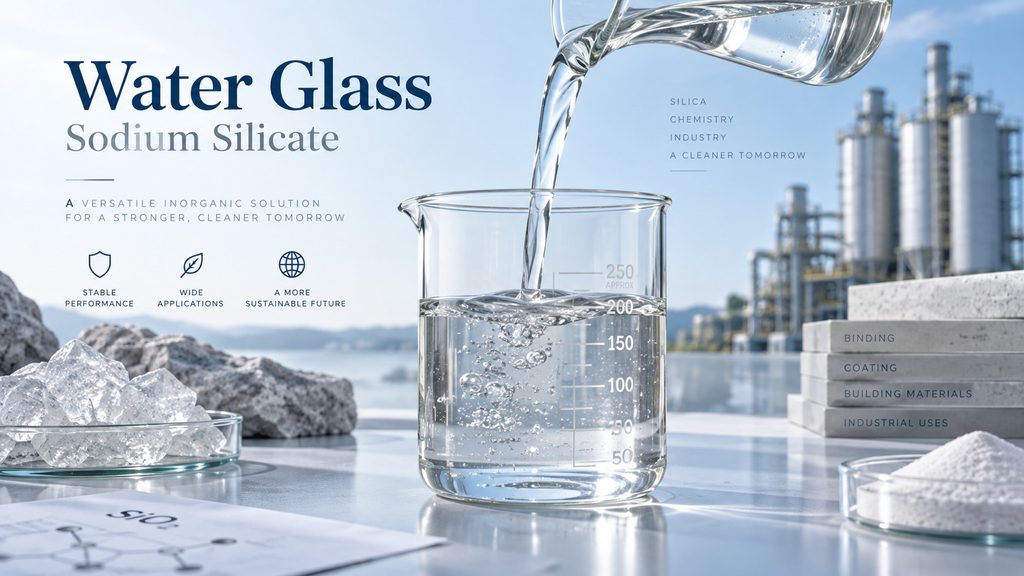
Water glass generally refers to an aqueous solution of soluble silicates, with sodium silicate being the most common type. For this reason, the terms “water glass” and “sodium silicate” are often used interchangeably in industrial applications.
The chemical composition of sodium silicate is commonly expressed as:
Na₂O·nSiO₂
In this formula, Na₂O represents sodium oxide, SiO₂ represents silicon dioxide, and “n” indicates the molar ratio between silicon dioxide and sodium oxide.
This ratio is usually referred to as the silicate modulus or water glass modulus.
Depending on the raw materials and intended applications, other types of soluble silicates are also available, including potassium silicate and lithium silicate.
Among them:
- Sodium silicate is the most widely used type of water glass.
- Potassium silicate is often valued for its weather resistance and water resistance.
- Lithium silicate is commonly used in high-performance coatings and concrete densifiers.
Therefore, in a broad sense, water glass can be classified as an inorganic silicate binder material.
2. Why Is It Called “Water Glass”?
Many people assume that water glass is simply a kind of liquid glass because of its name.
In reality, the term comes from its appearance and physical behavior.
Liquid water glass is usually a clear, translucent, or slightly colored viscous liquid. Its appearance can resemble molten glass. In addition, after drying, dehydration, or chemical reaction, the silicate components can form hard silica-based structures.
For this reason, these water-soluble silicate materials became commonly known as “water glass.”
In English, the material is often referred to as:
Water Glass
while sodium silicate is commonly written as:
Sodium Silicate
Both terms are frequently used in product descriptions, technical documents, and industrial searches.
3. What Is Water Glass Made Of?
The main components of sodium silicate water glass are:
Sodium oxide (Na₂O) and silicon dioxide (SiO₂).
The ratio between silicon dioxide and sodium oxide has a significant effect on the properties of the material.
This ratio is expressed as the silicate modulus:
Modulus = Molar ratio of SiO₂ to Na₂O
Water glass products with different modulus values can vary significantly in solubility, viscosity, bonding strength, alkalinity, and chemical resistance.
In general:
Low-modulus water glass tends to have higher alkalinity, better solubility, and relatively higher fluidity.
High-modulus water glass usually contains a higher proportion of silica and may offer better bonding performance and acid resistance, although it can require more demanding processing conditions.
Therefore, there is no single grade of water glass that is suitable for every application. The correct modulus, concentration, density, and viscosity should be selected according to the specific industrial use.
4. What Are the Main Properties of Water Glass?
The broad industrial use of water glass is closely related to its distinctive physical and chemical properties.
4.1 Good Bonding Performance
Water glass can function as an inorganic binder.
After the water evaporates, or after the sodium silicate reacts with a curing agent, it can form a hardened silicate structure with a certain level of mechanical strength.
This makes it useful for bonding sand, mineral powders, refractory particles, and other inorganic materials.
As a result, water glass has long been used in foundry sand systems, refractory materials, and construction-related products.
4.2 Heat Resistance
Compared with many organic adhesives, water glass is an inorganic material that is non-flammable and relatively stable under elevated temperatures.
For this reason, it is commonly used in refractory materials, fire-resistant coatings, and high-temperature bonding systems.
4.3 Strong Alkalinity
Sodium silicate water glass is generally alkaline.
Because of this, care should be taken during storage, transportation, and use, particularly when it comes into contact with materials that are sensitive to alkalis.
Appropriate protection for the skin and eyes is also recommended during industrial handling.
4.4 Gelation and Hardening
Water glass can form silica gels under certain conditions.
For example, when sodium silicate reacts with acidic substances, carbon dioxide, or specific curing agents, its internal structure changes and gradually forms a gel or hardened solid network.
This behavior is one of the main reasons why water glass can be used as a binder and curing material.
5. How Is Water Glass Produced?
Industrial sodium silicate is mainly produced by two common methods:
Dry Process
In the dry process, quartz sand and sodium-containing raw materials are reacted at high temperatures to produce solid sodium silicate.
The solid sodium silicate is then dissolved, often under pressure, to produce liquid water glass.
This is a traditional and well-established production route widely used in industrial manufacturing.
Wet Process
In the wet process, silica-containing raw materials react directly with alkaline substances under controlled temperature and pressure conditions to produce sodium silicate solution.
The exact production method depends on the raw materials, production equipment, desired modulus, and final application requirements.
Regardless of the method used, manufacturers typically control important product specifications such as modulus, concentration, density, viscosity, and impurity content.
6. What Is Water Glass Used For?
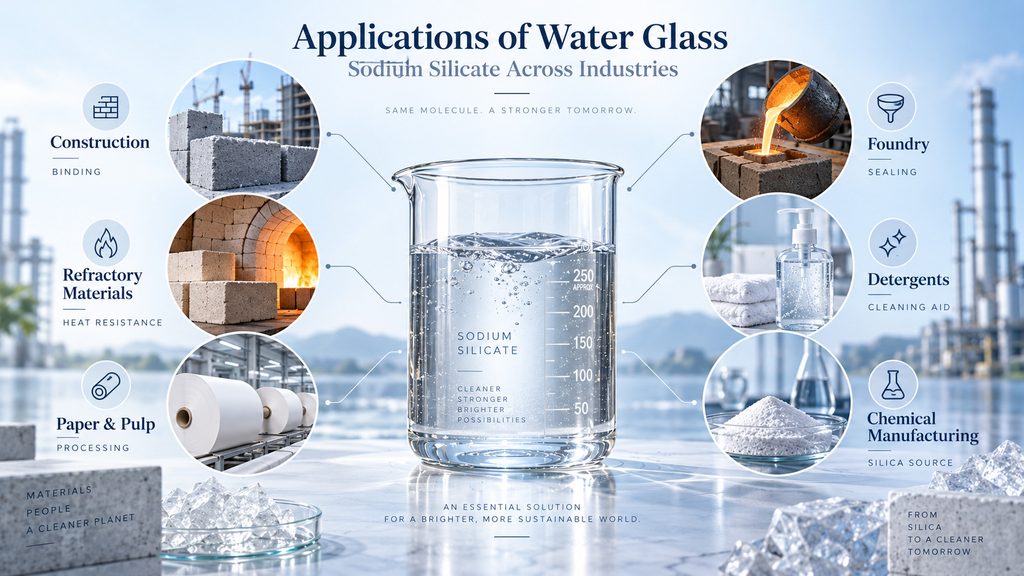
Water glass has a wide range of applications across many industrial sectors, including construction, foundry, refractory materials, detergents, papermaking, and chemical production.
6.1 Construction Materials
In the construction industry, water glass may be used in certain waterproofing materials, acid-resistant materials, grouting compounds, and concrete-related products.
It can also be combined with other inorganic materials to improve density, hardness, strength, or surface performance.
However, sodium silicate should not be considered a universal waterproofing material. Its actual effectiveness depends on the formulation and application conditions.
6.2 Foundry Industry
The foundry industry is one of the major application areas for water glass.
Sodium silicate can be used as an inorganic binder for molding sand and core sand, helping sand particles form molds and cores with sufficient strength.
As manufacturers seek to reduce the use of organic binders and lower certain volatile organic emissions, inorganic binder systems based on sodium silicate have become increasingly important.
6.3 Refractory Materials
Because water glass is non-flammable and has relatively good heat resistance, it can be used as a binder in some refractory systems.
Applications may include refractory mortars, castables, repair compounds, and other heat-resistant products.
6.4 Detergent Industry
Sodium silicate can also be used as an additive in detergent formulations.
It may help regulate alkalinity and contribute to the overall performance of industrial cleaners and some conventional detergent systems.
6.5 Papermaking and Paper Products
In papermaking and paper processing, sodium silicate can be used as an auxiliary chemical.
Its exact function depends on the production process and the requirements of the final product.
6.6 Chemical Manufacturing
Water glass is also an important raw material in the production of many silicon-based chemical products.
For example, sodium silicate may be used as a silica source in the manufacture of:
- Precipitated silica
- Silica gel
- Molecular sieves
- Other silicate-based materials
Therefore, water glass is not only a finished industrial product but also an important basic chemical raw material.
7. What Are the Advantages of Water Glass?
Water glass is widely used because of several practical advantages.
First, it is an inorganic material and is generally non-flammable.
Second, the raw materials are relatively abundant, and the industrial production technology is mature.
In addition, sodium silicate offers good inorganic bonding performance and can be combined with many minerals, fillers, and inorganic powders.
By adjusting the modulus and formulation, water glass can also be designed to provide different levels of fire resistance, acid resistance, hardening performance, and surface strengthening.
However, water glass also has some limitations.
For example, some sodium silicate systems have limited water resistance. Hardened materials may experience performance changes under long-term exposure to moisture.
In addition, because water glass is alkaline, it can impose certain requirements on handling, compatibility, and processing.
For this reason, curing agents, fillers, and modification additives are often used to improve the final properties of water-glass-based materials.
8. Is Water Glass Toxic?
Standard industrial water glass is not generally considered a highly toxic chemical, but this does not mean it should be handled without precautions.
Sodium silicate solutions are typically alkaline and may irritate the skin and eyes.
When handling water glass in industrial settings, appropriate personal protective equipment should be used according to the product’s safety instructions. This may include protective gloves and safety goggles.
If significant skin or eye contact occurs, the affected area should be rinsed according to the recommendations in the product Safety Data Sheet.
Because water glass products from different manufacturers may vary in concentration, additives, and impurities, specific safety information should always be based on the relevant Safety Data Sheet (SDS).
9. What Is the Difference Between Water Glass and Ordinary Glass?
Water glass and ordinary glass have similar names, but they are very different materials.
Ordinary glass typically uses silicon dioxide as a major network-forming component and also contains sodium, calcium, and other oxides. It is melted at high temperatures and cooled to form a hard, transparent solid.
Water glass, by contrast, refers mainly to soluble silicates, most commonly sodium silicate. It may be supplied as a liquid, solid block, powder, or soluble granular product and is used for bonding, chemical reactions, surface treatment, and material modification.
In simple terms:
Ordinary glass is mainly a structural material, while water glass is primarily an inorganic chemical material and binder.
10. How to Choose the Right Water Glass
When purchasing or using water glass, it is important to look beyond the product name “sodium silicate.”
Several technical parameters should be considered.
The first is the silicate modulus.
Different applications require different modulus values because the modulus affects alkalinity, bonding performance, and chemical reactivity.
The second is concentration and density.
Liquid sodium silicate products with different solid contents will have different viscosities and processing behavior.
Other important specifications may include:
- Na₂O content
- SiO₂ content
- Iron content
- Water-insoluble matter
- Viscosity
- Appearance
- Purity
If water glass is used in foundry applications, refractory materials, coatings, or high-purity chemical manufacturing, the required specifications can vary significantly.
Therefore, the correct product grade should be selected according to the actual process requirements rather than price alone.
11. Frequently Asked Questions About Water Glass
Is Water Glass the Same as Sodium Silicate?
In most industrial contexts, water glass refers to sodium silicate solution.
However, in a broader sense, other soluble silicates such as potassium silicate and lithium silicate may also be classified as types of water glass.
Is Water Glass a Liquid or a Solid?
It can be both.
Liquid sodium silicate is very common, but solid sodium silicate, instant soluble sodium silicate, and powdered silicate products are also commercially available.
Can Water Glass Be Used for Waterproofing?
Water glass can be used in certain waterproofing, sealing, leakage-control, and surface-treatment formulations.
However, this does not mean that sodium silicate alone is suitable for every waterproofing application.
The final waterproofing performance depends on the modulus, concentration, curing method, substrate, and overall formulation.
Is Water Glass Heat Resistant?
Water glass is an inorganic silicate material and generally offers better heat resistance and non-flammability than many organic adhesives.
For this reason, it is widely used in refractory materials and high-temperature bonding systems.
However, the actual temperature resistance of a finished product depends on the complete formulation rather than water glass alone.
Conclusion
Water glass is an important inorganic chemical material based on soluble silicates, with sodium silicate being the most widely used form.
Because of its good inorganic bonding ability, heat resistance, chemical reactivity, and mature manufacturing process, water glass is widely used in construction, foundry, refractory materials, detergents, papermaking, and silicon-based chemical production.
In practical applications, the performance of water glass depends not only on whether the product is sodium silicate, but also on technical parameters such as silicate modulus, concentration, density, viscosity, and purity.
Therefore, whether you are purchasing water glass or developing an industrial formulation, it is important to select the appropriate product grade based on the specific application.
As industries continue to develop greener inorganic binders, advanced refractory systems