Reliable liquid level control is essential in modern chocolate production. From raw material preparation and melting to mixing, storage and product transfer, chocolate slurry must remain within a controlled operating range. An unexpected high level may cause overflow, contamination and production losses, while an excessively low level can expose pumps, heating equipment and downstream machinery to unsuitable operating conditions.
However, chocolate slurry is not an easy medium to measure. It is highly viscous, sticky and temperature-sensitive. It can coat the surface of instruments and may contain bubbles or foam during mixing and transfer. At the same time, every instrument installed in the production line must meet strict hygiene requirements.

A Russian chocolate manufacturer needed a dependable point level detection solution for chocolate slurry in its processing system. After evaluating liquid level switches from several suppliers, the company selected the Jiwei Ring-11 food-grade tuning fork level switch.
The Ring-11 was installed to detect the presence or absence of chocolate slurry at a defined level. Its compact vibrating fork, hygienic process connection, smooth product-contact surface and resistance to process interference made it suitable for this demanding food-processing application.
The successful installation demonstrates how a properly selected tuning fork level switch can improve chocolate slurry level control, reduce overflow risk, protect production equipment and support automated operation.
Customer Background
The customer is a chocolate producer serving the Russian market. Its production line includes chocolate melting, mixing, storage and transfer processes. During production, chocolate slurry is heated and maintained in a flowable condition before being delivered to the next processing stage.
The company required a level switch for a chocolate slurry vessel operating at approximately 40°C. The instrument needed to provide a stable switching signal while remaining compatible with a viscous food product.
The customer also had several additional requirements:
- Hygienic construction suitable for direct food contact
- Reliable operation in thick and sticky chocolate slurry
- A compact sensing element for limited installation space
- Resistance to bubbles, foam and product coating
- Suitable electrical output for the plant control system
- Appropriate explosion-protection options
- Easy installation, inspection and cleaning
- Stable long-term operation with limited maintenance
Because the level switch would be integrated into the production control system, false alarms or unstable switching could interrupt the chocolate manufacturing process. Reliability was therefore one of the most important factors in the final product selection.
The Challenge of Measuring Chocolate Slurry
Chocolate slurry behaves very differently from water or other low-viscosity liquids. Its physical properties create several challenges for conventional level measurement technologies.
High Viscosity
Chocolate slurry has a thick consistency and may flow slowly around a sensor. A level switch must respond reliably when the product reaches the sensing element and when the level falls away.
Highly viscous media can restrict the movement of mechanical devices such as float switches. Product may also remain attached to a sensor after the actual liquid level has dropped.
Sticky Product Coating
Chocolate can form a coating on the product-contact surface. Depending on temperature and composition, the coating may remain soft or gradually harden.
A suitable level switch must distinguish between normal residue and the actual presence of chocolate slurry. It should also have a simple sensing structure that can be cleaned efficiently.
Temperature Sensitivity
Chocolate viscosity changes significantly with temperature. When the temperature decreases, the product becomes thicker and may eventually solidify. When heated, it becomes more fluid.
This means the level switch must remain stable even when the physical characteristics of the chocolate change within the normal operating range.
Bubbles and Foam
Mixing, pumping and filling operations can introduce air into chocolate slurry. Bubbles or foam near the liquid surface may affect certain level detection methods.
For point level control, the customer needed a technology that would not be easily disturbed by changing surface conditions.
Hygienic Requirements
Any sensor in direct contact with chocolate must use appropriate materials and hygienic process connections. Rough surfaces, gaps or complex moving parts can trap product and make cleaning more difficult.
The instrument therefore needed smooth product-contact surfaces and a structure suitable for food-industry sanitation procedures.
Why Point Level Detection Was Required
The customer did not need to continuously display the exact amount of chocolate in the vessel. Instead, the production system required a dependable switching signal at a specific position.
This type of measurement is called point level detection.
A point level switch detects whether the product is present or absent at its installation point. It can be used for several important control functions.
High-Level Alarm
A level switch mounted near the upper section of a vessel can detect when the chocolate reaches the maximum permitted level.
The output signal can then:
- Stop the inlet pump
- Close the filling valve
- Activate an alarm
- Prevent product overflow
- Protect nearby equipment from contamination
Low-Level Protection
A switch installed near the lower section of a vessel can detect when the chocolate level falls below a safe operating point.
The signal may be used to:
- Stop the discharge pump
- Prevent dry running
- Protect heating or mixing equipment
- Request refilling
- Interrupt downstream transfer
Automatic Level Control
Two switches can be installed at different heights to establish a working range. The lower switch starts the filling process, while the upper switch stops it.
This simple control strategy helps maintain chocolate slurry between predefined minimum and maximum levels.
For the Russian chocolate plant, reliable point level detection was more important than continuous measurement accuracy. The Ring-11 therefore provided a practical and cost-effective solution.
Why the Ring-11 Tuning Fork Level Switch Was Selected
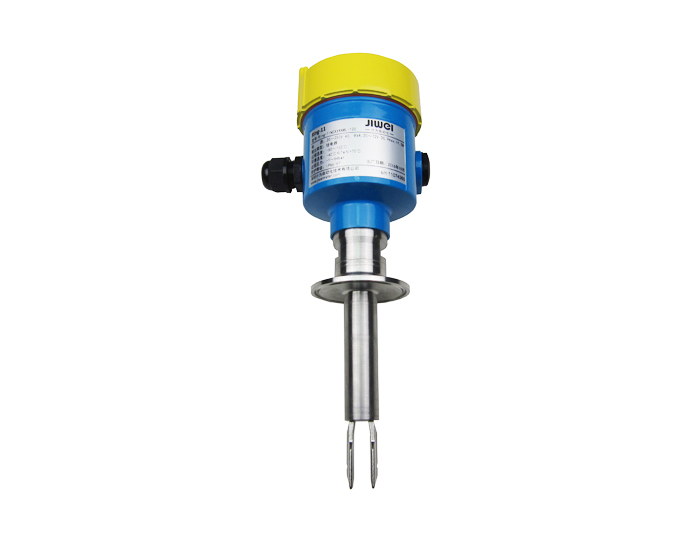
The Ring-11 is a vibration-based point level switch designed for liquid applications. Its sensing element consists of a compact tuning fork driven at its natural resonant frequency by piezoelectric components.
When the fork is not covered by liquid, it vibrates at its normal frequency. When chocolate slurry reaches the fork, the surrounding medium changes the vibration characteristics. The electronic system detects this change and converts it into an electrical switching signal.
The customer selected the Ring-11 because the vibrating fork principle offered several advantages in the chocolate slurry application.
No Moving Mechanical Parts
Unlike a float level switch, the Ring-11 does not depend on the movement of a mechanical component.
This is particularly useful in viscous chocolate because sticky material cannot easily block the movement of the sensing element. The absence of moving parts also reduces mechanical wear and maintenance requirements.
Independent of Liquid Conductivity
Conductivity level switches require the process medium to have sufficient electrical conductivity. Chocolate slurry may not provide stable conductivity under all process conditions.
The Ring-11 detects changes in vibration rather than electrical conductivity, making it suitable for a wider range of food products.
Resistance to Process Disturbances
The vibrating fork principle is less affected by foam, bubbles, turbulence and normal changes in product properties than many alternative technologies.
This stability is important in chocolate vessels where mixing, filling and transfer operations may create changing surface conditions.
Clear On/Off Signal
The instrument provides a defined point level signal that can be connected directly to a programmable logic controller, distributed control system, pump control circuit or alarm system.
The output allows the plant to automate filling, emptying and equipment-protection functions.
Food-Grade Design for Chocolate Production
Hygienic design was one of the customer’s main selection requirements.
The food-grade Ring-11 configuration uses product-contact materials suitable for food and beverage applications. A hygienic clamp process connection allows the instrument to be installed securely while supporting routine removal and inspection.
The food-grade version is available with a smooth product-contact surface with roughness below Ra 0.5 μm. A fine surface finish helps reduce product retention and makes the sensing element easier to clean.
Benefits of the Hygienic Clamp Connection
Clamp-style process connections are widely used in food-processing systems because they offer several practical benefits:
- Fast installation and removal
- Reduced risk of product accumulation
- Convenient inspection of the sensing fork
- Compatibility with hygienic piping and tanks
- Easier cleaning and maintenance
- Limited use of complex threaded structures in the product area
When correctly installed with a suitable gasket, the clamp connection creates a hygienic interface between the level switch and the process vessel.
Stainless Steel Product-Contact Parts
For common food-processing applications, 316L stainless steel offers good corrosion resistance, mechanical strength and cleanability.
The final material selection should always consider the chocolate formulation, process temperature and cleaning chemicals. In this application, the selected material was suitable for direct contact with the chocolate slurry.
Performance in Viscous Chocolate Slurry
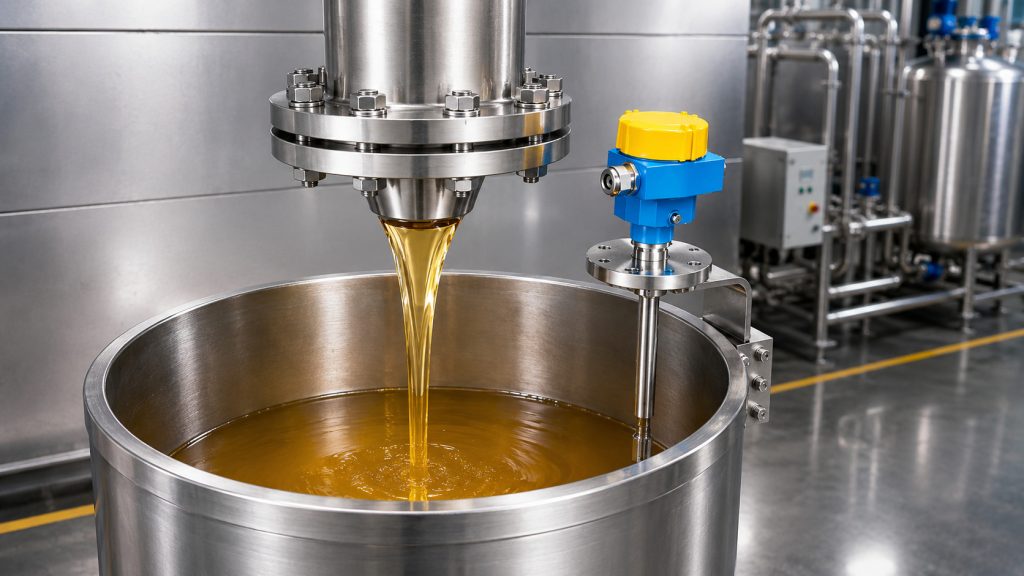
The Ring-11 product range is designed for liquids with viscosities up to approximately 10,000 mPa·s under defined operating conditions. This makes it suitable for many viscous food products, including syrups, sauces, edible oils, dairy products and chocolate slurry.
Chocolate may leave a film on the sensing fork when the vessel level falls. However, the vibration-based detection principle can remain reliable when normal product buildup is considered during configuration and installation.
The compact sensing structure also reduces the surface area available for product accumulation compared with larger mechanical devices.
For particularly sticky products, the application engineer should review several factors:
- Maximum and minimum product viscosity
- Possibility of chocolate solidification
- Cleaning frequency
- Vessel temperature
- Sensor orientation
- Product flow direction
- Required switching sensitivity
- Expected residue on the fork
In the Russian installation, the operating temperature helped keep the chocolate in a flowable condition, allowing the sensor to detect level changes consistently.
Operation at Approximately 40°C
The chocolate slurry vessel operated at a temperature of around 40°C. This temperature was within the operating capability of the selected standard Ring-11 configuration.
Matching the instrument version to the actual process temperature is important. A level switch should be capable of handling the maximum process and ambient temperatures without exposing the electronics, seal or process connection to unsuitable conditions.
The Ring-11 product family includes configurations for standard-temperature, high-temperature and ultra-high-temperature applications. Since this chocolate process operated at a moderate temperature, the customer could use a standard model rather than purchasing an unnecessarily complex high-temperature version.
Selecting the correct temperature class helped balance performance, reliability and project cost.
Compact Fork for Flexible Installation
The Ring-11 uses a compact tuning fork with a length of approximately 40 mm. This short sensing element was an important advantage because installation space on food-processing vessels can be limited.
A compact fork provides several benefits:
- Minimal intrusion into the vessel
- Reduced interference with mixers or internal equipment
- Installation in small nozzles and compact tanks
- Faster contact with the product
- Easier cleaning
- Reduced mechanical loading from product flow
The short fork also makes the instrument suitable for mounting in pipelines where a longer probe could obstruct flow.
In this application, the compact design allowed the switch to be installed at the required level without affecting the normal movement of the chocolate slurry.
Electrical Output and Control-System Integration
The Ring-11 is available with several electrical output options, including relay, two-wire, NAMUR and transistor outputs.
This flexibility allows the level switch to be matched with different plant control systems.
Relay Output
A relay output can be connected to alarms, pumps, valves or controller inputs. It is a practical choice for many standard industrial control applications.
Transistor Output
NPN or PNP transistor outputs can be used with compatible PLC digital inputs, providing fast and direct signal transmission.
Two-Wire Output
A two-wire version can reduce wiring requirements in suitable control loops.
NAMUR Output
NAMUR output is commonly selected for intrinsically safe installations and can be connected through an appropriate safety barrier or isolator.
The correct output option depends on the supply voltage, controller input type, hazardous-area requirements and desired fail-safe behavior.
For the chocolate plant, the selected output was integrated into the existing automation system. When the chocolate slurry reached or left the defined switching point, the Ring-11 transmitted a clear signal to the controller.
Explosion-Protection and Safety Considerations
Although chocolate is a food product, chocolate manufacturing facilities may still contain combustible dust or designated hazardous areas. Cocoa powder, sugar and other dry ingredients can create dust-related risks under certain conditions.
The customer therefore required the level switch to meet appropriate explosion-protection requirements.
The Ring-11 family is available in intrinsically safe and flameproof configurations for applicable gas or dust hazardous areas. Relevant versions may also be supplied with certifications such as CE, EAC and functional safety approvals.
The exact certificate and protection method must be confirmed for each project. Engineers should evaluate:
- Hazardous-area zone classification
- Gas or dust group
- Temperature class
- Ambient temperature
- Cable entry requirements
- Power supply and barrier selection
- Enclosure protection
- Plant electrical standards
Instrument certification alone is not sufficient. Installation, wiring and associated equipment must also comply with the applicable hazardous-area regulations.
The availability of certified Ring-11 configurations helped the instrument meet the Russian customer’s safety expectations.
Installation Recommendations
Correct installation has a major influence on the performance of a tuning fork level switch.
Avoid Direct Filling Impact
The fork should not be positioned directly below an inlet pipe or filling nozzle. Continuous impact from incoming chocolate can cause unstable switching and unnecessary mechanical stress.
When direct impact cannot be avoided, a protective plate or alternative mounting point should be considered.
Align the Fork with Product Flow
For side mounting, the broad surfaces of the fork should generally be aligned parallel to the expected flow direction. This helps the viscous chocolate move smoothly around the sensing element.
Encourage Product Drainage
The sensor position should allow chocolate to drain from the fork when the liquid level falls. A location where product collects around the sensing element may delay the return signal.
Consider the Actual Switching Point
The physical location of the fork determines the high- or low-level switching position. Engineers should consider vessel geometry, switching tolerance, product movement and the response time of pumps or valves.
Keep the Sensor Accessible
The hygienic clamp should remain accessible for inspection and cleaning. Maintenance personnel should be able to remove the instrument without dismantling major sections of the process equipment.
Protect the Fork from Mechanical Damage
The fork should not be used as a step, handle or support. It should also be positioned away from agitator blades and other moving equipment.
Commissioning and Functional Testing
Before normal operation, the level switch and control loop should be tested.
A typical commissioning procedure includes:
- Confirming the model, process connection and output type
- Inspecting the fork for transport damage
- Verifying correct gasket installation
- Checking the electrical supply and wiring
- Confirming fail-safe operating mode
- Testing the switch in uncovered and covered conditions
- Verifying controller input status
- Testing pump, valve or alarm response
- Checking for leakage at the process connection
- Recording the final switching position
The plant should also test how the sensor responds after cleaning and after the chocolate has been held at different operating temperatures.
Periodic functional testing helps confirm that the complete safety and control loop remains effective.
Application Results
After installation and commissioning, the Ring-11 food-grade tuning fork level switch provided stable point level detection in the chocolate slurry vessel.
The instrument met the customer’s main application requirements:
- Reliable operation in viscous chocolate
- Compatibility with an operating temperature of approximately 40°C
- Hygienic food-contact construction
- Compact installation
- Stable switching despite bubbles and product movement
- Integration with the production control system
- Suitable explosion-protection options
- Low maintenance requirements
The switch generated a dependable signal when the chocolate reached or left the defined level. This allowed the control system to manage filling and transfer operations more effectively.
The customer reported positively on the reliability of the instrument. The successful application also confirmed that the vibration principle was suitable for point level detection in chocolate slurry.
Benefits for the Chocolate Manufacturer
The Ring-11 installation created several operational benefits.
Reduced Overflow Risk
Reliable high-level detection helps prevent chocolate from overflowing the vessel. This reduces product loss, floor contamination and unnecessary cleaning.
Improved Equipment Protection
Low-level detection can prevent pumps and related equipment from operating without sufficient product.
More Consistent Automation
A stable switching signal allows valves and pumps to be controlled automatically. This reduces dependence on manual observation.
Lower Maintenance
The tuning fork has no moving mechanical parts. Its compact structure and hygienic connection simplify inspection and cleaning.
Improved Production Continuity
Reliable level control reduces unplanned interruptions caused by false alarms, overflow or insufficient product supply.
Better Process Hygiene
Smooth stainless steel product-contact surfaces and a hygienic clamp connection help support food-industry cleaning procedures.
Other Food and Beverage Applications
Although this project focused on chocolate slurry, the Ring-11 food-grade tuning fork level switch can also be considered for other liquid and viscous food products, including:
- Sugar syrup
- Glucose solution
- Cooking oil
- Milk and cream
- Yogurt
- Fruit juice
- Tomato sauce
- Condiments
- Liquid ingredients
- Brewing liquids
- Fermentation products
- Pharmaceutical liquids
- Cleaning solutions
Every application should be evaluated individually. Density, viscosity, process pressure, temperature, coating behavior, cleaning method and material compatibility must be confirmed before selection.
How to Select a Level Switch for Chocolate Slurry
To select the correct tuning fork level switch, users should provide complete process information to the instrument supplier.
Important data includes:
- Type and formulation of chocolate
- Normal and maximum viscosity
- Minimum and maximum temperature
- Process pressure
- Product density
- Possibility of solidification
- Tank or pipeline dimensions
- Required switching position
- Mounting direction
- Process connection type
- Product-contact material
- Cleaning method and cleaning chemicals
- Power supply
- Required output signal
- Hazardous-area classification
- Required certification
- Enclosure and cable-entry requirements
- Fail-safe control philosophy
Providing accurate information helps avoid incorrect model selection and ensures that the instrument is configured for the real operating conditions.
Conclusion
The Russian chocolate slurry application demonstrates the value of the Jiwei Ring-11 food-grade tuning fork level switch in a demanding food-processing environment.
Chocolate slurry is viscous, sticky and sensitive to temperature. It may contain bubbles, coat instrument surfaces and create difficulties for mechanical or conductivity-based level switches. At the same time, the sensor must meet strict hygiene, installation and safety requirements.
The Ring-11 addressed these challenges through its vibration-based measuring principle, compact fork, food-grade stainless steel construction, hygienic clamp connection and flexible electrical outputs.
Installed in a chocolate process operating at approximately 40°C, the level switch provided reliable point level detection and supported automated high- or low-level control. Its stable performance helped reduce overflow risk, protect equipment, improve production continuity and simplify maintenance.
For chocolate manufacturers seeking dependable level control in melting vessels, storage tanks, transfer systems or processing lines, a properly configured food-grade tuning fork level switch offers a simple and effective solution.
The success of this project also shows that reliable chocolate slurry level control depends on more than choosing a measurement technology. Process temperature, viscosity, hygiene, installation position, electrical integration and safety certification must all be considered.
When these factors are evaluated carefully, the Ring-11 tuning fork level switch can provide long-term and reliable point level detection for chocolate slurry and many other viscous food products.