Managing tank levels sounds simple when there is only one tank located a few meters from the control room.
The situation changes quickly when a company needs to monitor dozens of storage tanks across a factory, several water reservoirs in different locations, chemical tanks at unmanned stations, or silos spread across multiple sites.
In these applications, knowing the level is only the first step.
Operators also need to know what is happening without constantly visiting the site.
This is why remote tank level monitoring is becoming an important part of industrial digitalization.
A modern remote monitoring system combines level measurement, wireless communication, cloud software, alarms, historical data, and mobile access into one connected solution.
Instead of relying only on local displays or manual inspections, operators can view level data from a PC or mobile device, monitor several sites at once, and respond more quickly when abnormal conditions occur.
What Is Remote Tank Level Monitoring?
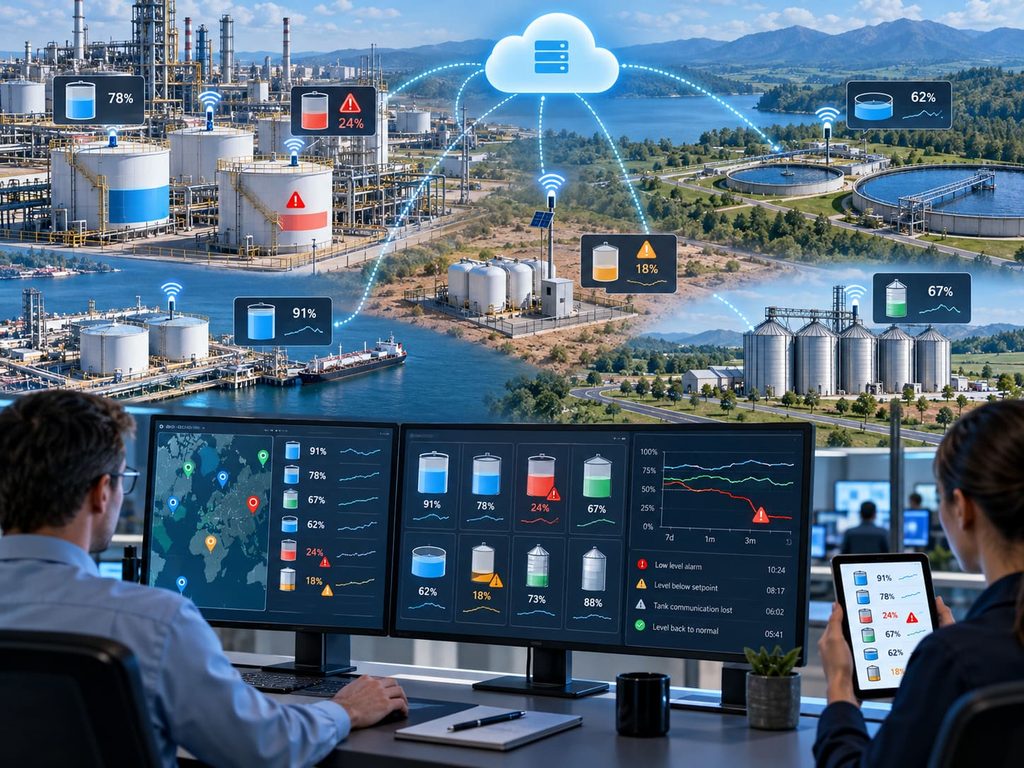
Remote tank level monitoring is a system that measures the amount of liquid or bulk material inside a tank or vessel and transfers the measurement data to a remote monitoring platform.
A typical system contains four main layers:
Level sensor → Communication network → Cloud or server → PC/mobile monitoring
The level sensor performs the actual measurement.
A radar level transmitter, for example, measures the distance between the sensor and the material surface without contacting the product.
The communication system then transfers the measurement through a suitable network such as 4G, NB-IoT, LTE-M, Ethernet, Wi-Fi, or another industrial communication method.
The data is received by a monitoring platform where operators can view real-time level, device status, historical trends, and alarms.
This architecture turns a traditional level instrument into part of a connected Industrial Internet of Things system.
Why Are Industrial Companies Moving Toward Remote Monitoring?
Traditional level measurement often focuses on a single question:
What is the level inside this tank right now?
Remote monitoring expands that question.
Operators may also want to know:
- Is the level rising unusually fast?
- Is the tank approaching a high-level limit?
- Is the sensor online?
- Has consumption changed during the last week?
- Which tanks at another site need replenishment?
- Did a remote device stop communicating?
- Can several facilities be monitored from one dashboard?
These questions become especially important when measurement points are geographically distributed.
Consider a company operating tanks at ten different locations.
Without remote monitoring, employees may need to visit each location simply to confirm inventory.
With a connected level monitoring system, those measurements can be collected automatically and displayed through a centralized platform.
The result is not simply convenience. It changes how tank information is used.
Why Radar Is Well Suited to Remote Tank Monitoring
Several technologies can be used for level measurement, but non-contact radar is particularly attractive for remote and unattended applications.
A radar level sensor sends electromagnetic waves toward the liquid or material surface and analyzes the returned signal.
Because the sensor normally does not need to touch the measured product, there are no floats that must move with the liquid and no submerged probe that depends on hydrostatic pressure.
This can be useful in applications involving:
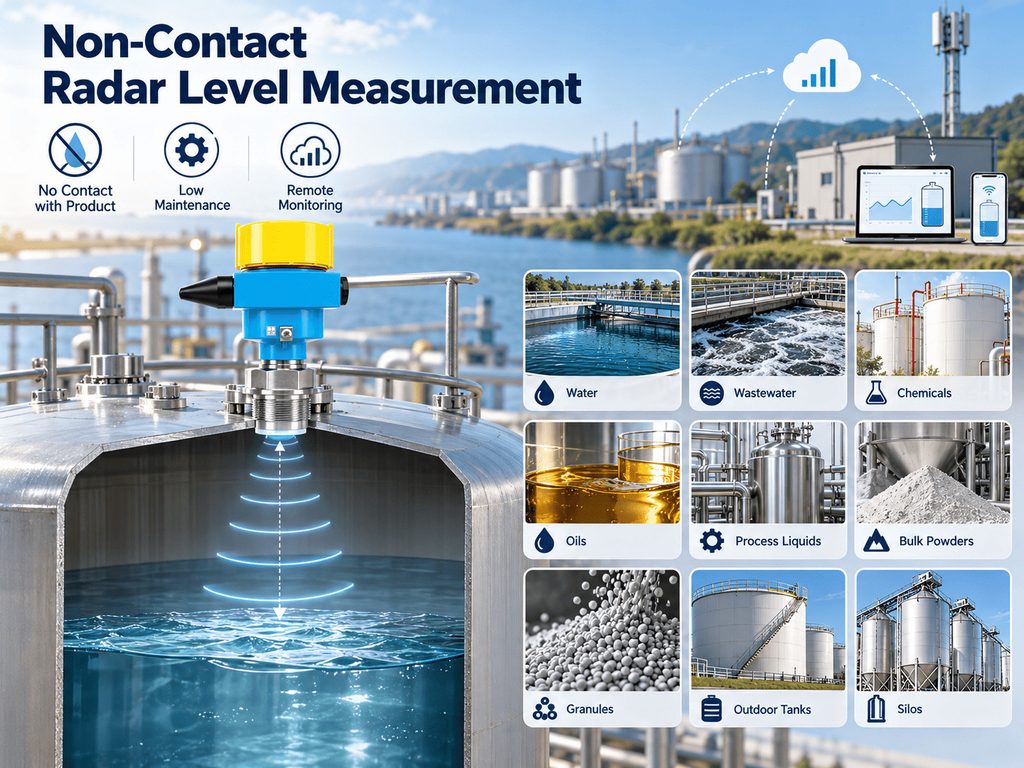
- Water
- Wastewater
- Chemicals
- Oils
- Process liquids
- Bulk powders
- Granules
- Outdoor tanks
- Silos
The key advantage for remote monitoring is reduced dependence on manual interaction with the measuring element.
When an instrument is installed at a distant site, every maintenance visit adds cost and time.
A measurement technology designed for stable, non-contact operation can therefore be a strong foundation for an unattended monitoring system.
How Does Wireless Tank Level Monitoring Work?
The communication path depends on the site.
Inside a factory, a radar sensor may connect to an industrial gateway using RS485, Modbus, 4–20 mA, or another interface.
The gateway collects data from one or more instruments and uploads it to a server.
At isolated outdoor locations, cellular communication can be more practical because there may be no Ethernet infrastructure.
A wireless level monitoring architecture can look like this:
Radar Level Sensor → 4G / NB-IoT / LTE-M → Cloud Platform → Web Dashboard / Mobile App
The JIWEI Air solution follows this type of architecture.
Air rada-32 provides continuous non-contact level measurement, while JIWEI Air Cloud provides a SaaS remote monitoring platform that can be accessed through a PC web platform or mobile application.
Depending on the project, Air Link can be used as a wireless data gateway for multi-device access and data aggregation, while Air Control can extend the system toward remote I/O and control applications.
This creates a broader architecture:
Measure → Connect → Monitor → Control
What Can a Cloud Monitoring Platform Show?
A useful tank monitoring platform should provide more than a single level number.
Real-time level is important, but context makes the information much more useful.
Typical functions may include:
Real-Time Level
Operators can view the latest measurement without physically checking the tank.
Device Status
A dashboard can indicate whether the monitoring device is online and communicating normally.
This helps distinguish between a genuine level condition and a communication problem.
Alarm Status
High-level, low-level, or device alarms can help operators focus attention on tanks that need action.
Historical Trends
Historical data can reveal how a tank fills and empties over time.
This is useful for inventory planning, abnormal consumption analysis, maintenance, and process understanding.
Multi-Site Management
A single platform can organize tanks by plant, customer, region, process, or other categories.
This becomes increasingly valuable as the number of connected devices grows.
Mobile Access
Remote access through a smartphone allows authorized personnel to check conditions when they are away from the control room.
Remote Monitoring vs Traditional Manual Tank Inspection
Manual tank inspection can still be suitable for simple, low-value applications.
However, it has obvious limitations when the number of tanks increases.
Employees must travel to each measurement point.
Readings may be recorded at different times.
Information is usually not continuous.
Abnormal conditions may occur between inspection intervals.
Historical data may also be difficult to organize.
Remote tank level monitoring changes the process from periodic inspection to continuous visibility.
Instead of asking an employee to check every tank, the system automatically brings the measurement to the operator.
Manual inspection can then be reserved for situations that genuinely require physical attention.
Where Is Remote Tank Level Monitoring Used?
Water and Wastewater
Remote water tanks, reservoirs, pumping stations, dosing tanks, and wastewater facilities are common candidates for wireless monitoring.
These sites may be distributed across large geographic areas, making cellular communication attractive.
Chemical Storage
Chemical plants may use remote monitoring to track storage tank inventory while reducing unnecessary personnel access around process areas.
Sensor material, hazardous-area classification, process temperature, pressure, and chemical compatibility must still be evaluated carefully.
Agriculture
Irrigation tanks, fertilizer storage, remote water reservoirs, and livestock water systems can benefit from centralized monitoring.
Oil and Industrial Fluids
Fuel, lubricant, and process-fluid inventory can be monitored across distributed storage locations.
Silos and Bulk Solids
Radar technology can also be used to monitor powders and granules in suitable silo applications.
In this case, the monitoring platform may display material level rather than liquid level.
What Should You Consider Before Building a Remote Level Monitoring System?
A successful project starts with the process conditions rather than the cloud platform.
First, determine what must be measured.
Important questions include:
- What is the medium?
- What is the tank height?
- Is the product liquid or solid?
- Is there foam, vapor, dust, agitation, or buildup?
- Is the site indoors or outdoors?
- Is the area hazardous?
- Is mains power available?
- Which communication networks are available?
- How frequently must data be updated?
- How many measurement points will eventually be connected?
These questions determine the sensor, network, power system, and software architecture.
Choosing the Communication Network
There is no universal communication technology for every remote tank.
4G is useful where established cellular data service is available and the device requires flexible IP connectivity.
NB-IoT is designed for low-power IoT applications that send relatively small amounts of data.
LTE-M is also designed for IoT and can offer a useful balance between power consumption, mobility, and data capability.
Network availability varies by country and mobile operator, so coverage should always be verified at the actual installation site.
For a factory with its own network infrastructure, Ethernet or a local gateway may be preferable.
The correct choice is determined by the application rather than by selecting the newest communication standard.
Why Gateways Still Matter
Not every sensor needs its own cellular connection.
A facility may already have twenty level transmitters using Modbus.
Instead of replacing all of them, an industrial gateway can collect their data and send the combined information to the cloud.
This makes gateways particularly useful for retrofit projects.
A wireless gateway can provide:
- Multi-device access
- Data aggregation
- Protocol integration
- Centralized communication
- Connection between field instruments and cloud software
This is the role of Air Link within the wider JIWEI Air architecture.
From Monitoring to Action
Remote visibility becomes more valuable when it supports operational decisions.
A rising level may trigger an alert.
A low inventory level may initiate a replenishment process.
A device offline condition may generate a maintenance task.
In more advanced systems, level information may also participate in remote control or automatic logic.
However, monitoring and control should be treated differently.
A cloud value used for management information does not automatically mean it should be used as a safety-critical control signal.
Critical shutdowns, overfill protection, and process interlocks should be engineered according to the required safety architecture.
Remote platforms are valuable tools, but they should complement appropriate field-level protection.
Building a Scalable System
Companies often design the first remote monitoring project around one or two tanks.
A better approach is to think about what happens when the project expands.
Ask whether the platform can support:
- More tanks
- More users
- Multiple customer accounts
- Multiple sites
- Device grouping
- Alarm management
- Historical data
- Different communication technologies
- Gateways and remote I/O
A scalable architecture reduces the need to redesign the complete system every time another tank is added.
The Future of Level Measurement Is Connected
Industrial level measurement is moving beyond the traditional model of a sensor connected only to a local display or PLC.
The sensor remains the foundation because accurate data still begins with accurate measurement.
But the value of that measurement increases when it can be accessed, analyzed, shared, and acted on remotely.
Wireless radar, cellular communication, cloud monitoring, gateways, and remote control can work together to create a connected level-management system.
For operators, the key benefit is visibility.
For maintenance teams, it is faster access to device information.
For managers, it is centralized data.
And for distributed industrial operations, it creates a practical path from isolated measurement points to connected infrastructure.
JIWEI Air brings these functions together through Air rada continuous measurement, Air Cloud remote monitoring, Air Link wireless data connectivity, and Air Control remote I/O.
The objective is simple:
Measure what matters, connect the data, monitor it from anywhere, and use it to operate more intelligently.
FAQ
Can remote tank level monitoring work without a PLC?
Yes. Depending on the system architecture, a wireless sensor or gateway can send measurement data directly to a remote platform without requiring a local PLC.
Can one platform monitor many tanks?
Yes. Multi-device and multi-site management is one of the main advantages of cloud-based monitoring.
Is radar suitable for outdoor tanks?
Radar is widely used in outdoor level applications, but enclosure protection, mounting, power supply, lightning protection, ambient temperature, and site conditions must all be considered.
Can a traditional level sensor be connected to the cloud?
Often yes. An industrial IoT gateway can collect data from existing instruments and forward it to a cloud platform.
Does every remote tank need 4G?
No. 4G, NB-IoT, LTE-M, Ethernet, Wi-Fi, or gateway-based networks may be used depending on the project.