
Acetic acid is widely used in chemical processing, pharmaceuticals, fine chemicals, organic chemical production, and many other industrial applications. Whether it is stored in raw material tanks, intermediate vessels, buffer tanks, or process vessels, reliable level measurement is essential.
Because a magnetic level gauge provides clear local indication, requires no external power for mechanical level display, and can also be equipped with magnetic switches or a 4–20 mA transmitter, it is often considered for acetic acid tank applications.
This raises an important question:
Can a magnetic level gauge be used for acetic acid?
The answer is yes, but the wetted material and float must be selected according to the actual acetic acid concentration, temperature, pressure, chemical composition, and liquid density.
For acetic acid with relatively moderate corrosiveness and normal process conditions, a 316L stainless steel magnetic level gauge may be suitable. For higher concentrations, elevated temperatures, or mixed chemical media with stronger corrosiveness, a PTFE- or FEP-lined corrosion-resistant design should be considered.
At the same time, the float material, weight, and displacement volume must match the actual operating density of the acetic acid. Otherwise, even if the wetted material offers sufficient corrosion resistance, the float may fail to rise properly or the indicated level may become inaccurate.

1. Why Is Material Selection Important for Acetic Acid Level Measurement?
Acetic acid, also known as ethanoic acid, is an organic acid. Compared with strong inorganic acids such as hydrochloric acid and sulfuric acid, acetic acid is generally considered less aggressive under many conditions.
However, this does not mean that every metal can safely withstand long-term exposure to acetic acid.
In industrial applications, corrosion is not determined solely by the name of the chemical. It depends on several factors, including:
- Acetic acid concentration
- Actual operating temperature
- Tank or process pressure
- Water content
- Chloride content
- Presence of other organic or inorganic acids
- Oxidizing contaminants
- Welds and crevices
- Continuous or intermittent exposure
- Cleaning and shutdown conditions
Therefore, selecting a magnetic level gauge for acetic acid should never be based on assumptions such as “316L is always suitable for acetic acid” or “PTFE is always required.”
316L stainless steel generally provides better corrosion resistance than standard 304 stainless steel and is widely used in chemical, pharmaceutical, and food-processing equipment.
However, the corrosion resistance of any metal changes with temperature, chemical concentration, contamination, and process conditions. For this reason, magnetic level gauge selection should always be based on the actual operating parameters.
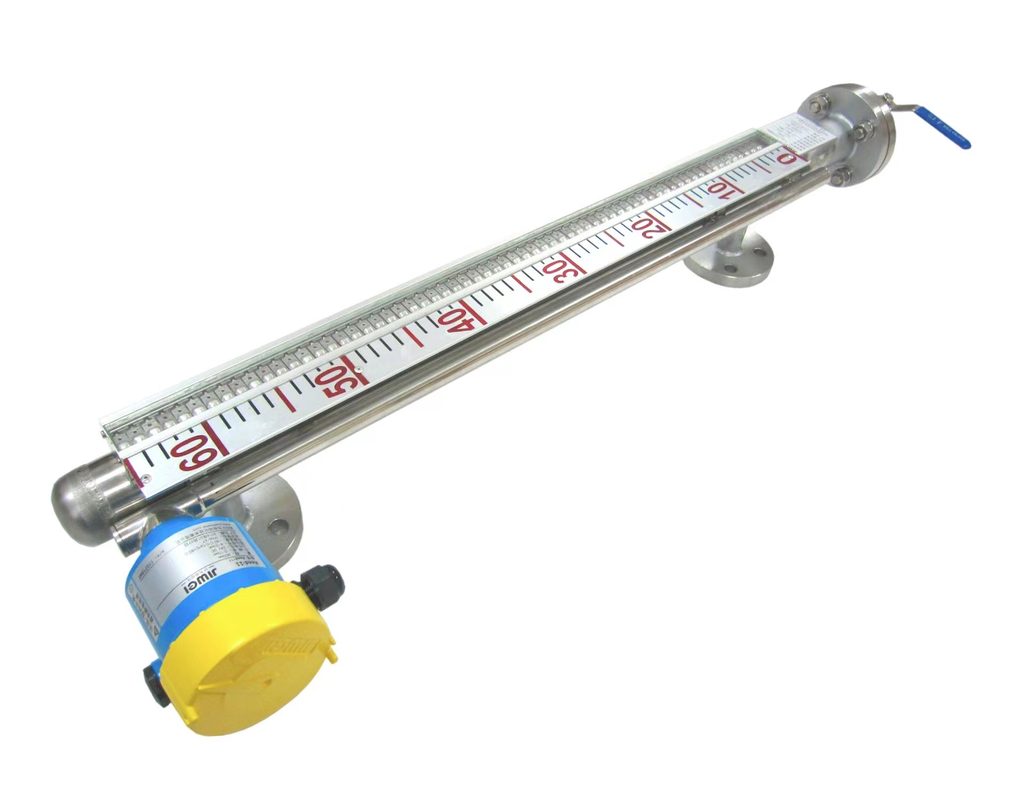
2. Can a 316L Magnetic Level Gauge Be Used for Acetic Acid?
For many conventional acetic acid storage and process applications, 316L stainless steel can be considered as the first material option to evaluate.
A standard 316L magnetic level gauge is typically suitable for mildly corrosive liquids and a broad range of process conditions.
Typical specifications for this type of magnetic level gauge may include:
- Wetted chamber material: 316 or 316L stainless steel
- Liquid density range: approximately 0.45–2.0 g/cm³
- Liquid viscosity: typically up to 200 cP
- Process temperature: approximately -40 to 350°C
- Pressure capability: from vacuum conditions to elevated process pressures, depending on design
However, these temperature and pressure limits represent the mechanical capability of the instrument design. They do not mean that 316L stainless steel offers identical corrosion resistance in every acetic acid concentration and at every temperature.
Before confirming a 316L magnetic level gauge for acetic acid, the following information should be provided:
Medium: Acetic acid
Acetic acid concentration: For example 10%, 30%, 50%, 80%, or glacial acetic acid
Normal temperature: For example 25°C
Maximum temperature: For example 80°C
Operating pressure: For example atmospheric pressure
Design pressure: For example 0.6 MPa
Liquid density: Actual density at operating temperature
Other chemical components: Especially chlorides, inorganic acids, or oxidizing substances
Only after these parameters have been confirmed can the suitability of 316L stainless steel be properly evaluated.
3. Can a Magnetic Level Gauge Be Used for Glacial Acetic Acid?
Yes. A magnetic level gauge can also be used for glacial acetic acid, but material and float selection normally require greater attention.
Glacial acetic acid generally refers to highly concentrated or nearly pure acetic acid.
For this application, the first step is to verify whether the selected wetted material provides sufficient corrosion resistance under the actual temperature conditions.
The second important factor is liquid density.
A magnetic level gauge works according to the buoyancy of a magnetic float. According to Archimedes’ principle, the buoyant force depends on the density of the liquid and the volume of liquid displaced by the float.
If the liquid density decreases, the same float receives less buoyant force.
When the float density is too close to the process liquid density, several problems may occur:
- The float may sit too deeply in the liquid
- Float movement may become sluggish
- Indication may vary between low- and high-temperature conditions
- In extreme cases, the float may fail to rise properly
Therefore, when measuring glacial acetic acid, both corrosion resistance and the minimum operating density must be considered.
It is not sufficient to provide only the room-temperature density.
4. Why Is 316L Often Preferred Over 304 for Acetic Acid?
304 and 316L stainless steel are both commonly used industrial materials, but their corrosion resistance is different.
304 stainless steel provides good general-purpose corrosion resistance and is widely used for water, oils, food products, and mildly corrosive media.
316L stainless steel contains molybdenum and has a lower carbon content. These characteristics generally improve its corrosion resistance in many chemical environments.
For this reason, 316L is widely used for wetted parts in:
- Chemical equipment
- Pharmaceutical processing
- Food and beverage applications
- Fine chemical plants
- Corrosive liquid storage systems
For acetic acid level measurement, 316L is therefore usually a more conservative starting point than 304.
This becomes especially important in applications involving:
- Higher acetic acid concentrations
- Elevated temperatures
- Continuous long-term operation
- Long maintenance intervals
- Variations in chemical composition
- Possible contamination by other corrosive chemicals
For low-concentration acetic acid at low temperature, 304 may still be evaluated if reliable corrosion compatibility data are available.
However, material selection should always be based on actual operating conditions.
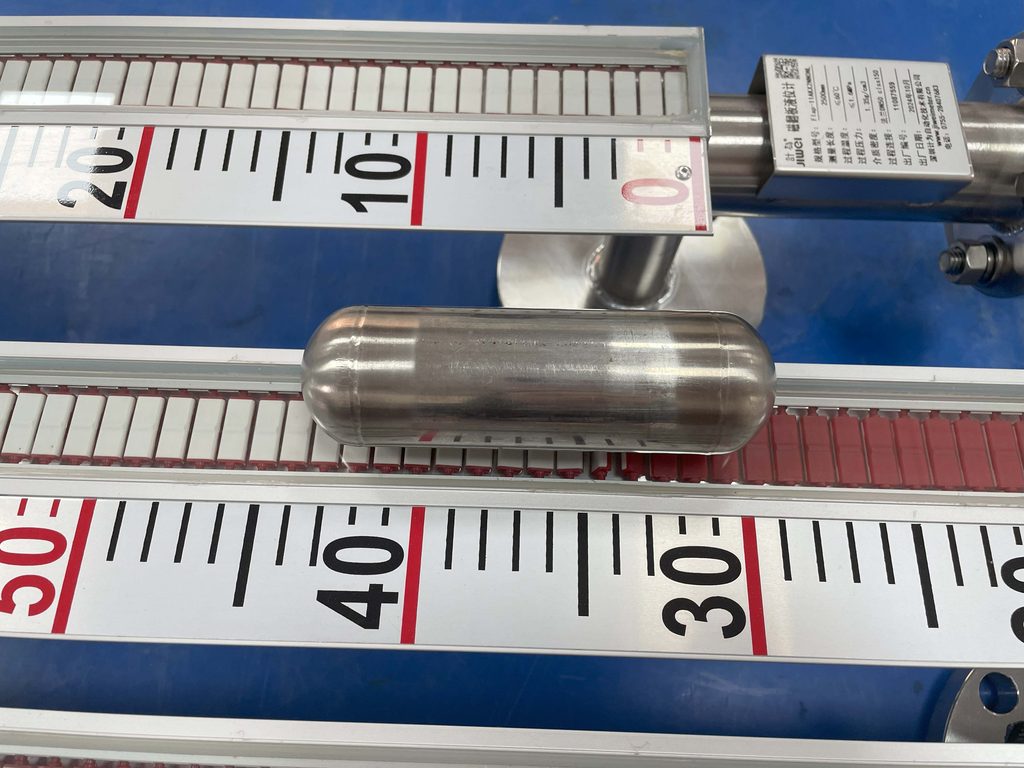
5. When Should a PTFE- or FEP-Lined Magnetic Level Gauge Be Used?
When the corrosion level becomes more severe, or when direct contact between the process liquid and metal surfaces should be minimized, a lined corrosion-resistant magnetic level gauge can be considered.
A common design uses a 304 or 316L stainless steel pressure chamber as the mechanical structure, while the internal wetted surface is lined with PTFE or FEP.
This allows the corrosive liquid to contact the fluoropolymer lining instead of directly contacting the metal body.
PTFE
PTFE stands for polytetrafluoroethylene.
It is widely used in chemical applications because of its excellent resistance to many acids, alkalis, solvents, and corrosive chemicals.
PTFE generally offers very good compatibility with acetic acid.
FEP
FEP stands for fluorinated ethylene propylene.
Like PTFE, FEP provides broad chemical resistance and is frequently used for linings, coatings, tubing, and corrosion-resistant process components.
For highly corrosive or permeating chemicals, PTFE or FEP can be selected according to the operating conditions and instrument construction.
Typical specifications for a lined magnetic level gauge may include:
- Metal body: 304 or 316L stainless steel
- Internal lining: PTFE or FEP
- Float: FEP-coated magnetic float
- Liquid density range: approximately 0.8–2.0 g/cm³
- Process pressure: approximately 0–1.6 MPa
- Maximum process temperature: typically around 120°C
This illustrates an important selection principle:
Higher corrosion resistance does not automatically mean higher temperature and pressure capability.
Fluoropolymer-lined magnetic level gauges must also meet the mechanical limitations of the lining material and manufacturing process.
Therefore, chemical compatibility, temperature, pressure, and mechanical design must all be checked together.
6. What Float Material Should Be Used for Acetic Acid?
The float is the internal moving element of a magnetic level gauge and remains in direct contact with the process liquid.
Its material is therefore just as important as the chamber material.
Common float options for acetic acid applications include:
316L Stainless Steel Float
A 316L magnetic float is commonly used with a 316L stainless steel chamber.
This configuration is suitable for many mildly to moderately corrosive acetic acid applications.
FEP-Coated Float
For more corrosive applications or for lined magnetic level gauges, an FEP-coated float can be used.
The coating reduces direct contact between the acetic acid and the metallic float body.
However, float selection is not based on material alone.
The float must also be designed according to the liquid density.
This is one of the most important aspects of magnetic level gauge selection.
7. Why Does Acetic Acid Density Matter?
A magnetic level gauge does not detect the liquid surface electronically.
Instead, the float rises and falls with the liquid level inside the chamber. The magnetic field inside the float then actuates the external indicator.
As a result, liquid density directly determines the buoyancy acting on the float.
The density of acetic acid solutions changes with concentration and temperature.
Therefore, simply stating that the medium is “acetic acid” does not provide enough information to select a float.
The following density information should ideally be supplied:
- Normal operating density
- Maximum operating density
- Minimum operating density
- Temperature corresponding to each density value
The minimum liquid density is particularly important because lower density produces less buoyancy.
A standard 316L magnetic level gauge may support liquid densities down to approximately 0.45 g/cm³.
A PTFE- or FEP-lined corrosion-resistant model may have a minimum liquid density closer to approximately 0.8 g/cm³ because of differences in float structure and material.
Most common acetic acid solutions fall within a workable density range, but the float must still be selected according to the actual process conditions.
8. How to Select a Magnetic Level Gauge for an Acetic Acid Tank
The following process can be used when selecting a magnetic level gauge for an acetic acid storage or process tank.
Step 1: Determine the Acetic Acid Concentration
Do not simply specify “acetic acid.”
Clearly identify whether the liquid is:
- Dilute acetic acid
- Medium-concentration acetic acid
- High-concentration acetic acid
- Glacial acetic acid
- Acetic acid mixed with other chemicals
Concentration is one of the main factors affecting material compatibility.
Step 2: Confirm Normal and Maximum Temperature
The corrosion rate of the same material may change significantly as temperature increases.
Therefore, material selection should consider more than the normal storage temperature.
Important temperatures may include:
- Normal operating temperature
- Maximum process temperature
- Startup temperature
- Cleaning temperature
- Steam cleaning temperature
- Abnormal or upset temperature
Step 3: Select the Chamber Material
A practical initial selection approach is:
Moderately corrosive acetic acid under normal conditions:
Evaluate 316L stainless steel first.
More corrosive conditions or uncertain compatibility:
Consider a PTFE- or FEP-lined magnetic level gauge.
Acetic acid mixed with strongly corrosive chemicals:
Evaluate the complete chemical mixture rather than selecting the material based only on acetic acid.
Step 4: Select Float Material and Density Rating
The float material must be chemically compatible with the liquid.
For a conventional 316L unit, a 316L magnetic float can be used.
For a lined corrosion-resistant design, an FEP-coated float may be more appropriate.
The float must also be selected according to the minimum operating density of the liquid.
Step 5: Confirm Operating Pressure
Atmospheric storage tanks and pressurized vessels require different mechanical designs.
A standard metallic magnetic level gauge can be designed for a wide pressure range by adjusting:
- Chamber wall thickness
- Flange rating
- Connection design
- Structural strength
Lined magnetic level gauges usually have a more limited pressure capability because of the lining construction.
For high-pressure acetic acid vessels, both corrosion resistance and mechanical pressure resistance must be evaluated.
Step 6: Determine Measurement Range and Connection Center Distance
Side-mounted magnetic level gauges normally connect to the vessel through upper and lower process flanges.
Important dimensions include:
- Center-to-center distance
- Actual liquid measurement range
- Upper dead zone
- Lower dead zone
- Drain clearance
- Installation location
A single-section standard magnetic level gauge may typically cover measurement ranges of approximately 200–5600 mm.
For larger tanks, multi-section arrangements can be used.
Step 7: Decide Whether Remote Transmission Is Required
If operators only need local visual indication, a mechanical magnetic level indicator may be sufficient.
If the level signal must be transmitted to a PLC or DCS, a reed-chain level transmitter can be added to provide a 4–20 mA output.
If high- or low-level alarms are required, magnetic switches can also be installed.
This means one magnetic level gauge can provide:
- Local visual level indication
- Remote continuous level transmission
- High-level alarm
- Low-level alarm
9. Installation Considerations for Acetic Acid Magnetic Level Gauges
Correct instrument selection is only part of achieving reliable measurement.
Installation conditions are also important.
First, avoid installing the magnetic level gauge directly beside a strong liquid inlet.
High flow velocity and severe turbulence can cause the float to move rapidly up and down, which may reduce indication stability.
If the tank inlet is close to the level gauge connection, consider using process arrangements that reduce turbulence.
Second, keep the chamber clean.
If the acetic acid contains:
- Crystals
- Suspended solids
- Sediment
- Polymerized substances
- Process contamination
deposits may accumulate inside the chamber.
A bottom drain connection and periodic maintenance plan may therefore be required.
Third, avoid placing ferromagnetic materials or strong external magnetic fields close to the float and indicator area.
A magnetic level gauge relies on magnetic coupling between the internal float and external indicator.
Strong magnetic interference can affect indication.
For hazardous areas, any added transmitter or magnetic switch should also be selected according to the required explosion-protection classification.
10. Advantages of Magnetic Level Gauges for Acetic Acid Tanks
Magnetic level gauges offer several advantages in acetic acid storage and process applications.
Clear Local Indication
The external indicator uses contrasting colored flaps or rollers, allowing operators to read the liquid level directly at the tank.
Magnetic Coupling
The float remains inside the chamber while the indicator remains outside.
The indication mechanism does not need to be directly exposed to the acetic acid.
Local and Remote Measurement
A magnetic level gauge can provide local indication while also transmitting a 4–20 mA level signal to a control system.
Magnetic switches can also provide high- and low-level alarms.
Suitable for Closed Vessels
The chamber connects to the tank through sealed flanges or process connections.
This makes the technology suitable for closed tanks where reducing leakage and vapor release is important.
Multiple Material Options
Depending on the chemical environment, the instrument can be manufactured using:
- 316L stainless steel
- PTFE lining
- FEP lining
- Corrosion-resistant coated floats
This allows magnetic level gauges to be adapted to a wide range of chemical applications.
11. Common Mistakes When Selecting a Magnetic Level Gauge for Acetic Acid
Mistake 1: Acetic Acid Is a Weak Acid, So 304 Stainless Steel Is Always Suitable
The term “weak acid” refers to the degree of ionization in solution.
It does not mean that the acid cannot corrode industrial materials.
Material selection must consider concentration, temperature, contaminants, and exposure duration.
Mistake 2: 316L Can Handle Acetic Acid, So It Works in Every Acetic Acid Application
This is also incorrect.
Material compatibility depends on process conditions.
Higher temperature, complex chemical mixtures, and corrosive impurities can significantly change the corrosion environment.
Mistake 3: A PTFE-Lined Instrument Does Not Require Temperature or Pressure Evaluation
PTFE and FEP provide excellent chemical resistance, but lined magnetic level gauges still have structural limitations.
For example, lined designs may have typical process temperature limits of approximately 120°C, while their pressure ratings may also be lower than those of fully metallic versions.
Chemical resistance and mechanical ratings must always be evaluated together.
Mistake 4: Selecting the Float Material Without Providing Liquid Density
This is one of the most common magnetic level gauge selection errors.
A float can be chemically resistant but still fail to operate if its density and displacement are not matched to the process liquid.
The float must be designed according to the actual operating density range.
12. Conclusion: Which Magnetic Level Gauge Is Suitable for Acetic Acid?
In general, acetic acid can be measured with a magnetic level gauge, provided that the chamber material, float material, liquid density, temperature, pressure, and process conditions are properly evaluated.
For acetic acid with moderate corrosiveness, stable composition, and normal operating temperatures, a 316L stainless steel magnetic level gauge can often be considered first.
The magnetic float should then be selected according to the actual liquid density.
For more corrosive acetic acid applications, chemically complex mixtures, or processes requiring reduced metal exposure, a PTFE- or FEP-lined magnetic level gauge with an FEP-coated float may provide a more suitable solution.
Before finalizing the selection, at least the following eight parameters should be confirmed:
- Acetic acid concentration
- Normal operating temperature
- Maximum operating temperature
- Operating pressure
- Design pressure
- Minimum liquid density
- Measurement range
- Tank connection and flange specifications
If remote monitoring is required, additional specifications should include:
- 4–20 mA output
- High-level alarm
- Low-level alarm
- Explosion-proof classification
- Ingress protection rating
For chemical level measurement, reliable selection is not simply a matter of choosing the most corrosion-resistant material.
The correct approach is to ensure that the chamber material, float material, liquid density, operating temperature, process pressure, and installation configuration are all compatible with the real process conditions.
Only when these factors are properly matched can a magnetic level gauge provide stable, accurate, and reliable long-term level indication for acetic acid tanks.