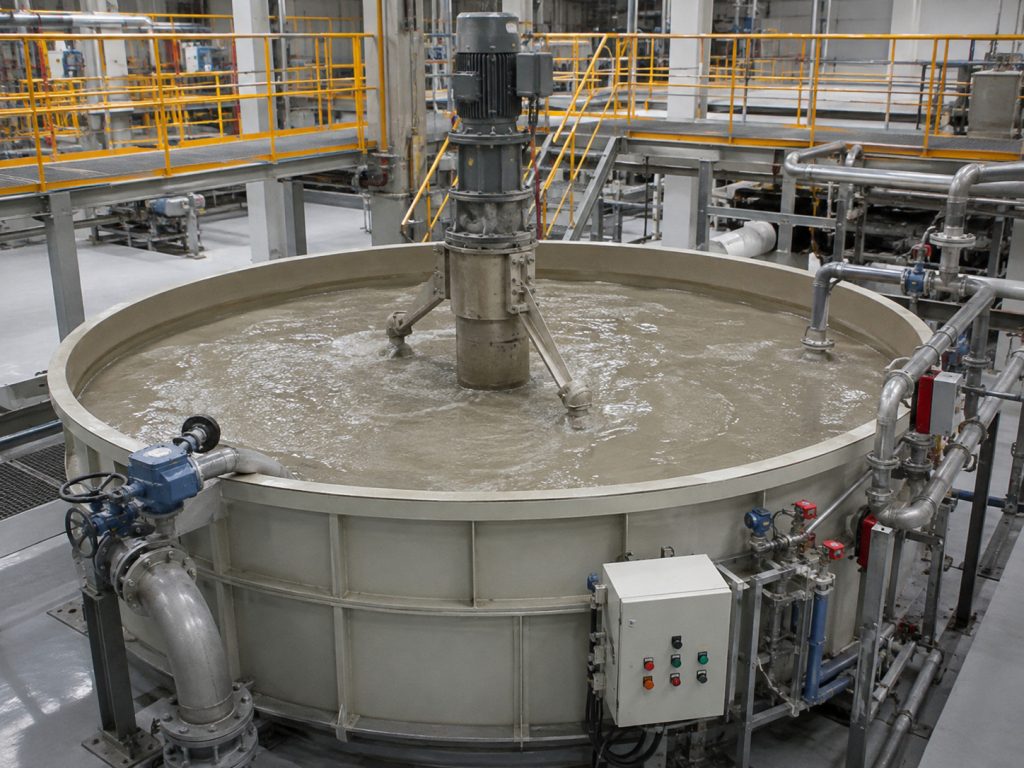
In a paper production line, the stock preparation chest plays an important role in pulp mixing, consistency adjustment, and stable stock supply. Pulp, recycled fiber, water, and various process additives are fed into the chest and thoroughly mixed before being transferred to the next production stage.
As a result, stable level measurement in the stock preparation chest is essential. It not only affects pump operation, but also influences stock consistency, pulp supply continuity, process stability, and overall production efficiency.
However, from a level measurement perspective, a stock preparation chest is far more complicated than an ordinary water tank.
Paper pulp contains a large amount of fibers and suspended solids. Mechanical agitation causes continuous surface fluctuations and may also generate foam. Depending on the process, the stock may have relatively high viscosity, while the chest itself can contain agitator shafts, inlet pipes, support structures, and other internal obstructions.
These conditions can cause conventional level instruments to suffer from unstable readings, material buildup, false echoes, or even intermittent loss of measurement.
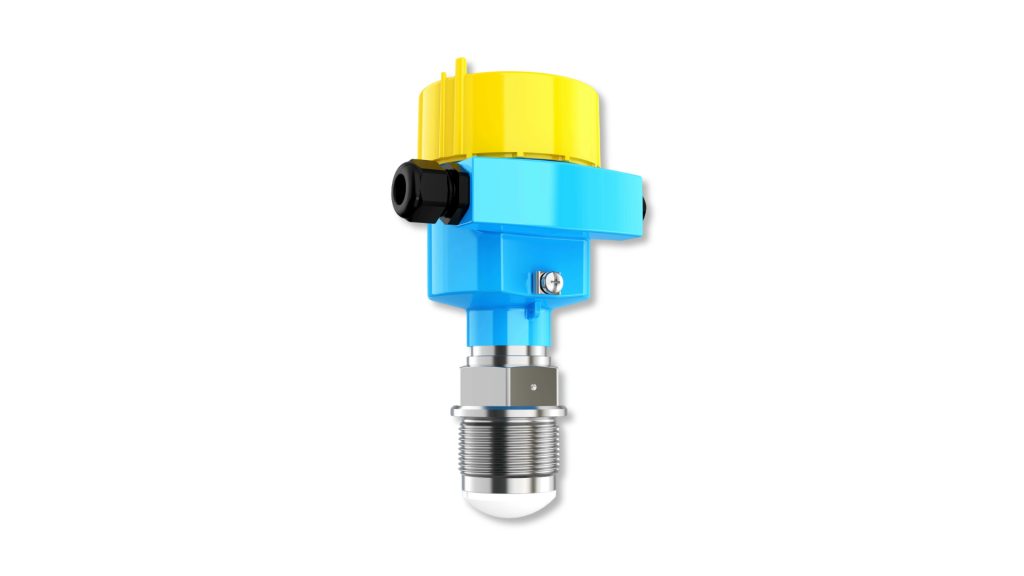
For applications involving pulp fibers, foam, agitation, and complex internal structures, the JWrada-32 radar level meter provides a non-contact continuous level measurement solution. Based on 80GHz FMCW radar technology, a narrow beam angle, and intelligent echo processing, the instrument is designed to reduce interference from internal structures and unstable surfaces while providing a reliable level signal for process control.
1. Why Is Reliable Level Measurement Important in a Paper Mill Stock Preparation Chest?
The stock preparation chest is commonly located in a critical section of the stock preparation or paper machine approach system.
Pulp, dilution water, and process additives are mixed according to production requirements before being delivered downstream at a controlled consistency and flow rate.
If the level in the chest becomes too low, the discharge pump may run dry or the downstream pulp supply may become unstable.
If the level becomes too high, there is a risk of stock overflow.
At the same time, if the level signal fluctuates excessively, the PLC or DCS may be unable to accurately determine the actual amount of stock in the chest. This can lead to frequent adjustments of inlet valves, pumps, and upstream or downstream equipment.
Therefore, a suitable paper pulp level measurement system should provide more than a simple high- or low-level alarm.
It should offer:
- Continuous level measurement
- Reliable operation under agitation
- Resistance to pulp fiber buildup
- Reduced sensitivity to foam and surface turbulence
- Stable signal output for PLC or DCS integration
- Low maintenance requirements
These requirements are among the main reasons why non-contact radar technology is increasingly considered for pulp chests, stock preparation tanks, broke chests, white-water tanks, and similar vessels in the pulp and paper industry.
2. What Makes Pulp Chest Level Measurement Difficult?
Pulp Fibers Can Cause Buildup on Contact-Type Sensors
One of the main differences between paper pulp and clean water is the high concentration of suspended fibers.
When a measuring element remains in direct contact with the stock, fibers may gradually wrap around or accumulate on the sensor.
Over time, this buildup can affect the instrument’s mechanical movement, sensing surface, or measurement response. Maintenance personnel may then have to remove and clean the sensor regularly.
For a continuously operating paper production line, frequent instrument cleaning increases maintenance workload and may create unnecessary downtime.
A radar level meter uses electromagnetic waves transmitted from the top of the vessel toward the pulp surface. Since the measuring antenna normally does not need to remain immersed in the stock, the risk of fiber wrapping around the sensing element can be significantly reduced.
Agitation Creates a Constantly Moving Surface
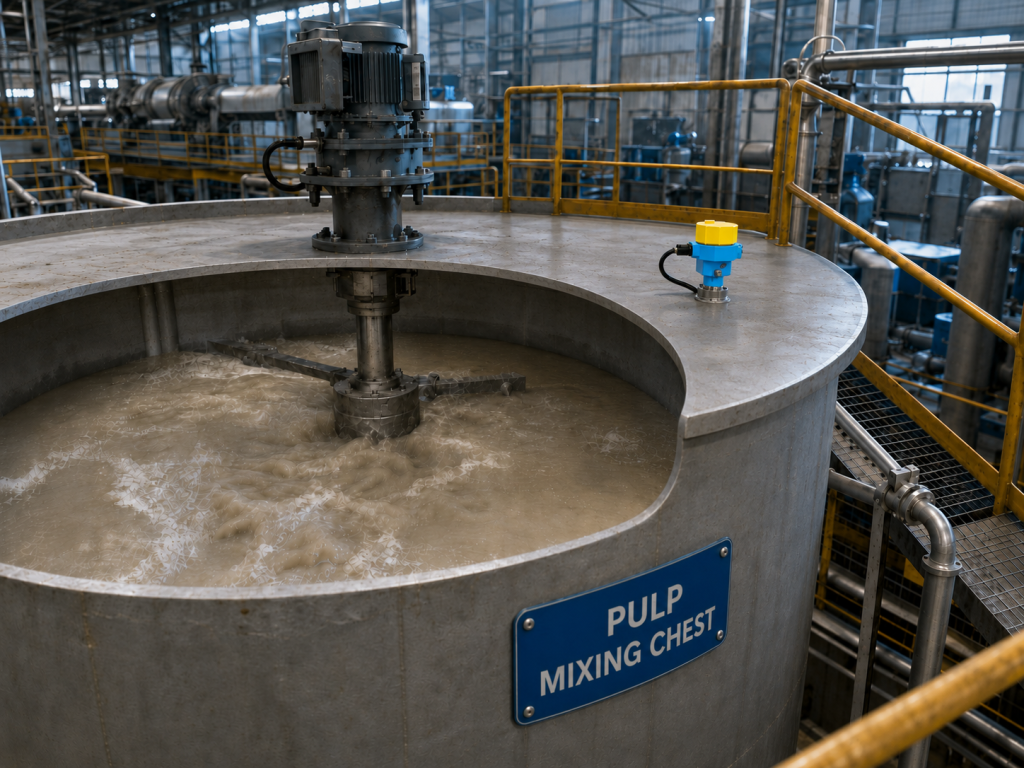
Mechanical agitation is essential in stock preparation because it keeps pulp fibers, water, and additives properly mixed.
However, an agitated surface is rarely flat.
The pulp surface may continuously form waves, peaks, depressions, or even local vortices. If the level instrument cannot distinguish these fluctuations from the actual average product level, the output may become unstable.
The situation becomes more complicated because agitator shafts, blades, pipes, and other internal structures can also produce radar reflections.
This means successful radar level measurement depends not only on the instrument itself, but also on correct installation and effective echo processing.
Foam Can Create an Additional Reflection Layer
Foam is another common challenge in pulp processing.
Air entrainment during agitation, combined with certain chemicals and process additives, may create a foam layer above the stock.
The effect of foam on radar measurement depends on its density, thickness, moisture content, and stability.
Under moderate foam conditions, proper radar frequency selection, focused beam characteristics, and intelligent echo processing can help the instrument identify the actual pulp surface.
However, extremely thick or unstable foam may produce a separate reflective interface or weaken the signal returning from the true liquid surface.
For this reason, professional radar level applications should not simply claim that foam has “no effect” on measurement.
Instead, foam thickness, pulp consistency, agitation conditions, and actual echo characteristics should be evaluated during engineering and commissioning.
Internal Structures May Produce False Echoes
Many existing paper mills were not originally designed around radar level measurement.
The top of a stock chest may already contain motors, gearboxes, inlet pipes, maintenance openings, and ventilation connections.
Inside the chest, the radar signal may encounter agitator shafts, support beams, reinforcing structures, or other fixed objects.
If the radar beam is directed toward one of these objects, a strong false echo may be generated.
Therefore, selecting the correct installation position is critical to reliable operation.
3. Why Use the JWrada-32 Radar Level Meter?
For stock preparation chests containing fibers, foam, agitation, and internal structures, the JWrada-32 offers several useful characteristics, including high-frequency radar, narrow beam focusing, non-contact measurement, and intelligent echo processing.
80GHz FMCW Radar for High Target Resolution
The JWrada-32 uses 80GHz FMCW, or Frequency-Modulated Continuous Wave, radar technology.
During operation, the instrument continuously transmits frequency-modulated millimeter-wave signals toward the material surface and receives the reflected signal.
By analyzing the frequency difference between the transmitted and returned signals, the instrument calculates the distance between the antenna and the pulp surface. This distance is then converted into a level value.
Compared with lower-frequency or wider-beam measuring technologies, high-frequency millimeter-wave radar concentrates more energy within a smaller measurement area.
This is particularly useful in a stock preparation chest containing agitators, pipes, and structural components.
The JWrada-32 offers a maximum measuring range of up to 60 meters and a stated measurement accuracy of ±1 mm, depending on application conditions and configuration.
For a pulp chest only several meters high, the 60-meter maximum range does not mean that such a large range is required. Instead, the instrument should always be selected according to the actual chest height, process level range, mounting distance, and application conditions.
Narrow Beam Helps Reduce Interference
One of the main challenges in stock chest radar level measurement is preventing the signal from simultaneously detecting the agitator shaft, tank wall, inlet pipe, and process surface.
The focused beam characteristics of an 80GHz radar level meter make it easier to direct the measuring signal toward a relatively clear area of the pulp surface.
This helps minimize reflections from unrelated objects.
For existing pulp chests with limited installation space and multiple internal structures, a narrow radar beam can provide a significant engineering advantage.
However, a narrow beam does not eliminate the need for proper installation.
The area directly below the antenna should still be checked for agitator shafts, support beams, pipelines, and other fixed objects.
Whenever possible, interference should first be minimized mechanically by choosing a better mounting position rather than relying entirely on software suppression.
Non-Contact Measurement Helps Reduce Fiber Buildup
The JWrada-32 uses non-contact radar measurement, so the antenna normally does not need to extend into the pulp.
This is particularly valuable in high-fiber applications.
Long pulp fibers and fiber bundles can easily accumulate on contact-based measuring elements. By measuring from above the stock surface, a radar level meter helps reduce the risk of fiber wrapping, material buildup, sticking, and frequent sensor cleaning.
This makes radar technology attractive for stock chests, pulp storage tanks, blending chests, and selected white-water applications.
Intelligent Echo Processing for Dynamic Surfaces
Real industrial process surfaces are rarely ideal.
The JWrada-32 is designed with echo-processing functions capable of distinguishing useful process reflections from unwanted echoes created by fixed structures and changing process conditions.
For a stock preparation chest, the practical objective is not simply to obtain an extremely precise reading at one instant.
Instead, the more important requirement is to provide a stable and continuous level trend so that the control system can correctly determine whether the pulp level is rising, falling, or remaining stable.
This is particularly important for automated inlet and discharge control.
4. How Should the JWrada-32 Be Selected for a Stock Preparation Chest?
Before selecting a radar level meter for a typical stock preparation application, the following process information should be confirmed:
- Total chest height
- Normal operating level range
- Distance between the radar mounting position and maximum level
- Type of pulp stock
- Approximate pulp consistency
- Foam thickness and stability
- Whether the agitator operates continuously
- Location of the agitator shaft
- Position of inlet pipes
- Internal support structures or other obstructions
- Operating temperature
- Operating pressure
- Required process connection
- Required communication signal
- Hazardous-area requirements, if applicable
The JWrada-32 can be configured for common industrial signal outputs such as 4–20mA/HART and RS485/Modbus, depending on the selected version.
Threaded or flanged process connections can also be selected according to installation requirements.
For most paper mill stock preparation chests, the key selection factors are not simply maximum measuring range or nominal accuracy.
Mounting space, foam conditions, internal obstacles, antenna material, process connection, and control-system interface are often more important.
Therefore, obtaining complete application information before instrument selection is essential.
5. How Should the JWrada-32 Be Installed on a Pulp Chest?
Avoid the Stock Inlet
The radar level meter should not normally be installed directly above the pulp inlet.
Incoming stock can create a highly disturbed local surface and may cause splashing around the mounting location.
More importantly, if the radar beam directly detects the falling pulp stream, the transmitter may interpret it as part of the measurement target.
The antenna should therefore be directed toward a relatively stable area that represents the overall stock level.
Avoid the Agitator Shaft and Internal Structures
Before installation, the internal structure of the stock chest should be reviewed.
The positions of the agitator shaft, blades, inlet piping, support structures, and other components should be identified.
For an existing plant, this information can be confirmed using vessel drawings or by visual inspection during scheduled maintenance.
The fewer obstacles inside the effective radar beam, the easier it is for the transmitter to distinguish the true pulp surface.
For an agitated vessel, the geometric center of the chest is not automatically the best location.
In many cases, the agitator shaft is located exactly in the center.
The mounting position should therefore be selected according to the actual internal geometry rather than simply according to the shape of the vessel.
Ensure Correct Antenna Orientation
The radar antenna should be directed toward the target measurement surface.
The mounting nozzle or standpipe should not unnecessarily obstruct the effective radar beam.
If a mounting nozzle is very long or its diameter is too small, it may produce strong near-field reflections or affect signal transmission.
Nozzle dimensions should therefore be checked during the design stage.
Perform False-Echo Mapping During Commissioning
After installation, the instrument should be commissioned using known level conditions whenever possible.
Permanent reflections from tank walls, pipes, structural components, or other fixed objects can be analyzed using the echo curve.
False-echo suppression or mapping functions can then be configured to help the instrument distinguish permanent obstructions from the changing pulp surface.
Proper commissioning is particularly important in vessels with complex internal geometry.
6. Bluetooth Commissioning Simplifies Maintenance
Stock preparation chests are often located in areas with limited access.
The radar instrument may also be installed at an elevated position near agitator motors, pipelines, or maintenance platforms.
With conventional instruments, technicians may need to stand directly next to the transmitter and use local keys to configure the device.
For elevated or difficult-to-access installations, this can be inconvenient.
The JWrada-32 supports Bluetooth-based configuration, allowing parameters and instrument status to be accessed from a compatible mobile device.
For pulp applications where engineers may need to observe the echo curve while evaluating foam or agitation effects, wireless commissioning can make setup considerably more convenient.
Technicians can review operating conditions and optimize parameters without repeatedly opening the instrument housing or remaining directly beside the transmitter for every adjustment.
7. How Can the Radar Level Signal Be Used in PLC or DCS Control?
The final purpose of level measurement is not simply to display a number on an instrument screen.
The signal should support process automation.
The JWrada-32 can transmit continuous level data through industrial interfaces such as 4–20mA/HART or RS485/Modbus, depending on the selected configuration.
In a typical stock preparation control strategy, the PLC or DCS can define:
- Normal operating level
- High-level alarm
- Low-level alarm
- High-high level protection
- Low-low level protection
- Pump start/stop conditions
- Feed valve control logic
When the chest level falls, the control system may increase pulp feed or adjust related equipment according to the process strategy.
When the level approaches the upper operating limit, the system can reduce inlet flow or activate a high-level alarm.
If the stock level falls toward the minimum pump operating level, the control system can take protective action to reduce the risk of dry running.
It is also important to distinguish between continuous level control and independent safety protection.
Where overflow prevention, pump protection, or process safety requires a defined safety integrity level, an independent point-level switch may be installed in addition to the radar level transmitter.
A combination of continuous level measurement and independent high-high or low-low protection can provide a more robust instrumentation architecture.
8. What Problems Can the JWrada-32 Help Solve in Pulp Level Measurement?
For a paper mill stock preparation chest, the JWrada-32 can provide several practical advantages.
Reduced sensitivity to fiber buildup
Because the instrument operates without continuously immersing a measuring probe in the pulp, the risk of fibers wrapping around the sensor can be reduced.
More stable measurement under agitation
80GHz FMCW radar combined with intelligent echo analysis can help identify and track the process surface under dynamic conditions.
Reduced interference from internal structures
A focused radar beam makes it easier to avoid agitator shafts, pipes, vessel walls, and other internal components during installation design.
Convenient integration with automation systems
Industrial signal outputs such as 4–20mA/HART and RS485/Modbus can support integration with PLC, DCS, and plant monitoring systems.
Simplified commissioning and maintenance
Bluetooth configuration enables technicians to review parameters, status, and measurement behavior more conveniently, particularly in elevated or difficult-to-access installations.
9. Why ±1 mm Accuracy Is Not the Only Factor That Matters
When selecting a radar level meter, users often focus first on measurement accuracy.
The JWrada-32 has a stated measurement accuracy of up to ±1 mm under applicable conditions.
However, in a stock preparation chest, practical measurement performance should not be evaluated based on nominal accuracy alone.
The pulp surface itself may be moving continuously.
Mechanical agitation can create surface variations of several centimeters or more. In such conditions, the process does not necessarily benefit from observing every single millimeter of surface movement.
What matters more is whether the instrument can produce a stable, continuous, and representative process signal.
A successful pulp chest radar level measurement system therefore depends on several factors working together:
Instrument performance + mounting position + echo quality + parameter configuration + process control strategy
Only when these elements are properly coordinated can the advantages of an 80GHz radar level meter be fully utilized.
10. Radar Level Meter Selection Recommendations for Paper Mill Stock Chests
When selecting a level transmitter for a stock preparation chest, machine chest, broke chest, or other pulp storage vessel, the following application information should be collected.
Medium information: pulp type, consistency, chemical additives, and foam conditions.
Vessel information: chest height, diameter or dimensions, top structure, and nozzle size.
Internal structures: agitator shaft position, inlet pipe location, reinforcement structures, and other obstacles.
Process conditions: temperature, pressure, maximum level, and minimum level.
Electrical requirements: power supply, 4–20mA/HART, or Modbus communication.
Control requirements: local level indication only, or integration with pumps, valves, PLC, or DCS.
The more complete the application information, the easier it becomes to identify possible interference before installation and determine the correct mounting position, process connection, and parameter configuration.
11. Conclusion
Paper mill stock preparation chests are challenging level measurement applications because they combine pulp fibers, foam, agitation, and continuously changing process surfaces.
Contact-type instruments may require additional maintenance when pulp fibers accumulate on the sensing element.
At the same time, non-contact instruments with insufficient beam focusing or echo-processing capability may be affected by agitator shafts, vessel walls, internal pipes, or foam.
The JWrada-32 radar level meter, based on 80GHz FMCW millimeter-wave radar technology, combines a focused radar beam, non-contact measurement, intelligent echo processing, Bluetooth configuration, and multiple industrial communication options.
These characteristics make it a suitable solution for continuous level measurement in many paper mill stock preparation applications.
However, reliable pulp level measurement depends on more than the transmitter model alone.
For stock chests with heavy foam, strong agitation, or complex internal structures, actual process conditions should be evaluated before installation. The correct mounting position, process connection, measurement parameters, and echo settings should then be determined accordingly.
From a long-term operational perspective, proper instrument selection, correct installation, and application-specific echo optimization are the key factors in achieving stable and reliable stock preparation chest level measurement.
Frequently Asked Questions
Can the JWrada-32 Radar Level Meter Measure Paper Pulp?
Yes. The JWrada-32 can be used for continuous pulp level measurement when the application conditions are suitable.
Its non-contact measuring principle helps reduce problems associated with pulp fibers wrapping around or accumulating on submerged sensing elements.
However, pulp consistency, foam, agitation intensity, vessel geometry, and installation conditions should all be evaluated before selection.
Does Foam Affect Radar Level Measurement in a Stock Preparation Chest?
It depends on the thickness, density, moisture content, and stability of the foam.
Moderate foam conditions can often be managed through appropriate radar frequency, echo processing, installation, and parameter optimization.
However, extremely thick or highly unstable foam can weaken the reflection from the true pulp surface or create an additional reflective layer.
For severe foam applications, actual echo conditions should be evaluated during engineering and commissioning.
Should a Radar Level Meter Be Installed in the Center of a Pulp Chest?
Not necessarily.
The installation position should primarily avoid the pulp inlet, agitator shaft, internal piping, support structures, and other strong reflecting objects.
If an agitator shaft is located in the center of the chest, installing the radar transmitter at the geometric center may actually increase interference.
The mounting point should therefore be selected according to the internal vessel structure.
Can the JWrada-32 Be Connected to a PLC or DCS?
Yes.
Depending on the selected configuration, the JWrada-32 supports industrial communication options including 4–20mA/HART and RS485/Modbus, allowing the level signal to be integrated into PLC, DCS, or other automation systems.
Why Is an 80GHz Radar Level Meter Suitable for a Stock Preparation Chest?
An 80GHz radar level meter uses a relatively focused beam, allowing the transmitted energy to be directed more precisely toward the target surface.
This makes it easier to avoid vessel walls, agitator shafts, piping, and other internal structures.
Combined with intelligent echo processing, this characteristic can improve the instrument’s ability to continuously track the actual pulp surface under challenging operating conditions.