Fuel tank level is one of the most fundamental and important measurement parameters in a vessel automation system.
Accurate information about the fuel remaining onboard helps operators monitor fuel consumption, arrange bunkering operations, manage voyages, and identify abnormal changes in fuel inventory.
However, one question frequently appears during instrument selection:
Which type of level transmitter should be used for a marine fuel tank?
Some engineers prefer radar level transmitters. Others recommend guided wave radar. Hydrostatic and pressure-based systems are also widely used in marine tank applications.
In reality, there is no single technology that is always the best choice.
The correct approach is to select the measurement principle according to fuel properties, tank geometry, mounting conditions, and system requirements.
1. How Is Marine Fuel Tank Level Measurement Different from Standard Storage Tanks?
Land-based industrial storage tanks are normally fixed in position, and their liquid surfaces remain relatively stable.
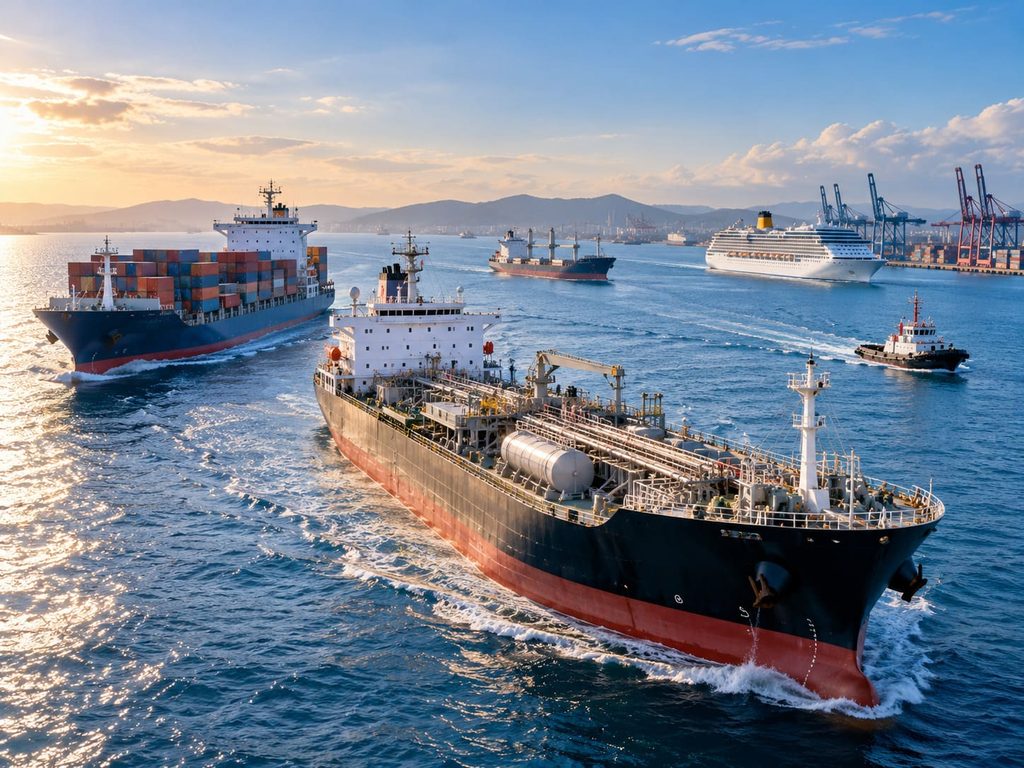
Marine fuel tanks operate under very different conditions.
During navigation, the vessel may roll, pitch, turn, accelerate, and experience continuous wave motion.
As a result, the liquid surface is constantly moving.
Marine fuel tanks also commonly have several characteristics:
- Limited installation space
- Internal stiffeners and heating coils
- High-viscosity fuel
- Heated fuel systems
- Restricted maintenance access
- High reliability requirements
For these reasons, marine fuel tank level transmitter selection should not simply copy the practices used for conventional industrial storage tanks.
2. Option One: Radar Level Transmitter
Radar level transmitters are widely used for continuous industrial liquid level measurement.
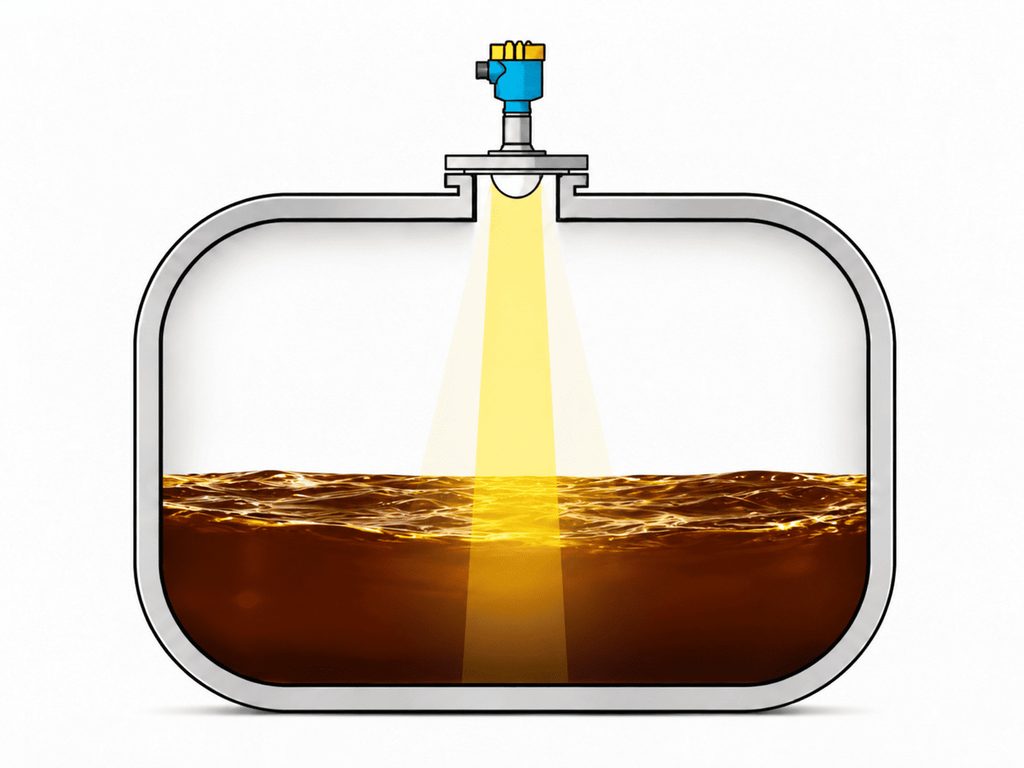
They are usually installed on the top of the tank and transmit electromagnetic waves toward the liquid surface.
The reflected signal is received by the instrument, and the distance between the transmitter and the fuel surface is calculated.
This distance is then converted into a level value.
Advantages of Radar Level Transmitters
The most obvious advantage is non-contact measurement.
The sensing element does not need to remain submerged in the fuel, helping reduce problems associated with mechanical wear and product coating.
Radar level measurement is also based mainly on distance rather than hydrostatic pressure.
As a result, it is generally less sensitive to changes in fuel density than hydrostatic measurement.
Other typical advantages include:
- Continuous level measurement
- Relatively low maintenance
- No moving mechanical parts
- Suitability for various fuel products
- Easy integration into vessel monitoring systems
What Should Be Considered When Using Radar?
Marine fuel tanks often contain structural beams, heating coils, supports, and other internal components.
These structures can create unwanted radar reflections.
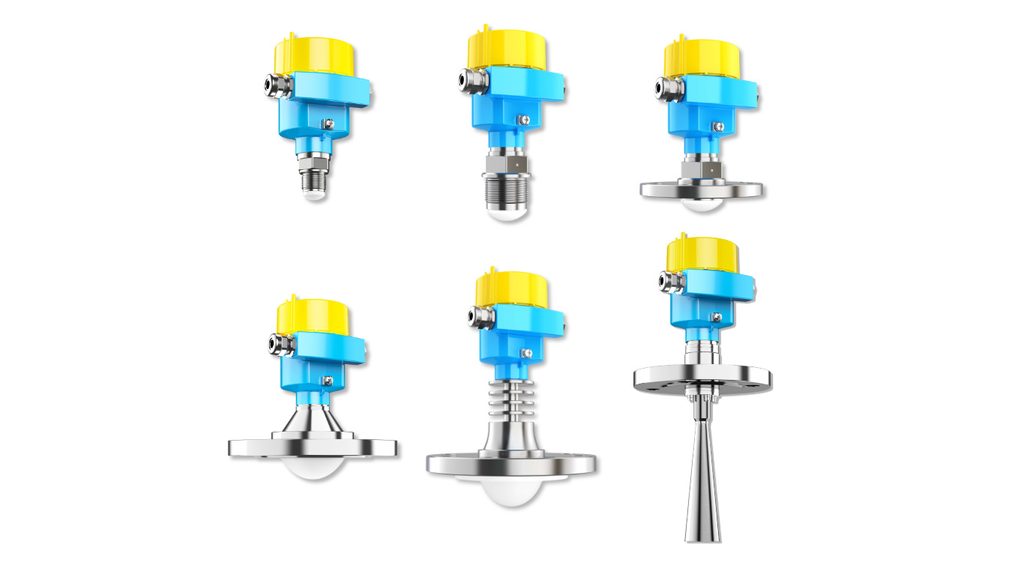
For this reason, beam angle is an important factor when selecting a radar level transmitter.
In narrow tanks or tanks with many internal obstacles, a narrower radar beam can help reduce interference from tank walls and internal structures.
Mounting position is equally important.
The transmitter should not be installed directly above large beams, inlet pipes, or other structures that could interfere with the radar signal.
Where Is Radar Level Measurement Suitable?
Radar may be a strong option for:
- Fuel tanks requiring non-contact measurement
- High-viscosity fuel applications
- Applications with changing fuel density
- Projects focused on reducing maintenance
- Tanks with suitable top mounting positions
3. Option Two: Guided Wave Radar Level Transmitter
Guided wave radar works differently from non-contact radar.
It uses a rod or cable probe to guide the microwave signal into the tank.
When the signal reaches the fuel surface, part of the signal is reflected back to the instrument.
The level is calculated based on the signal travel time.
Advantages of Guided Wave Radar
The main characteristic of guided wave radar is that the signal travels along a defined probe.
Compared with free-space radar, the signal path is more controlled.
This can make guided wave radar useful in certain applications, including:
- Narrow fuel tanks
- Small service tanks
- Settling tanks
- Tanks with limited installation space
- Applications where free-space radar propagation is difficult
What Should Be Considered with Guided Wave Radar?
The probe is in direct contact with the fuel.
If the fuel is highly viscous or tends to form deposits, buildup can develop on the rod or cable over time.
A certain amount of coating may not immediately prevent measurement, but heavy buildup should be considered when planning maintenance.
In addition, long cable probes should be properly installed and secured in applications where vessel movement could cause the probe to swing or contact internal tank structures.
Where Is Guided Wave Radar Suitable?
Guided wave radar may be considered for:
- Narrow fuel tanks
- Service tanks
- Settling tanks
- Tanks where free-space radar has limited installation options
- Top-mounted continuous level measurement
4. Option Three: Hydrostatic Level Transmitter
Hydrostatic level measurement is another common technology used in marine tank applications.
It determines liquid level by measuring the pressure created by the liquid column.
As the liquid height increases, the hydrostatic pressure increases.
This pressure can then be converted into a level value.
Advantages of Hydrostatic Level Measurement
Typical advantages include:
- Relatively simple measuring principle
- Flexible installation
- Cost-effective system design
- Suitability for many liquid tank applications
When liquid density remains stable and extremely high measurement accuracy is not required, hydrostatic measurement can be a practical solution.
Limitations of Hydrostatic Measurement
Its main limitation is that level calculation depends on liquid density.
For the same liquid height, a change in density produces a different hydrostatic pressure.
Therefore, if the vessel changes fuel types or fuel temperature changes significantly, density compensation or parameter adjustment may be required.
Pressure sensors installed at the bottom or side of the tank are also in direct contact with the fuel.
Material compatibility, contamination, and long-term maintenance should therefore be considered.
5. How Do the Three Technologies Compare?
A simplified selection approach is:
Radar Level Transmitter
Often suitable when non-contact measurement, low maintenance, and reduced sensitivity to fuel density changes are priorities.
Guided Wave Radar
Often suitable for narrow tanks, tanks with complex internal structures, or applications where a defined measurement path is preferred.
Hydrostatic Level Transmitter
Often suitable for stable applications with relatively simple tank conditions and strong cost considerations.
However, actual engineering selection should never be based on only one factor.
The complete tank and operating conditions should be reviewed.
6. What Information Is Required for Marine Fuel Tank Level Transmitter Selection?
Before contacting a level instrument supplier, it is useful to prepare the following information.
1. Fuel Type
Specify whether the medium is:
- Marine diesel oil
- Marine gas oil
- Heavy fuel oil
- Another marine fuel
Different fuels can have different viscosities, densities, temperatures, and dielectric properties.
2. Tank Height and Measurement Range
Provide:
- Total tank height
- Normal operating range
- Minimum operating level
- Maximum operating level
This information helps determine the correct measuring range.
3. Process Temperature
If the fuel is heated, provide both the normal operating temperature and maximum possible temperature.
4. Internal Tank Structure
A tank drawing is highly recommended.
Important internal features include:
- Stiffeners
- Heating coils
- Pipes
- Baffles
- Manholes
- Fuel inlet pipes
- Instrument nozzles
This information is particularly important for radar level measurement.
5. Mounting Connection
Confirm the flange size, thread size, nozzle dimensions, and available installation space.
Maintenance access above the tank should also be considered.
6. Output Signal
Many continuous level systems use signals such as 4–20 mA for integration with the vessel monitoring system.
The required output should be confirmed according to the existing automation architecture.
For new-build vessel projects, communication and control system requirements should be defined during the design phase.
7. Marine Certification Requirements
Marine instruments may need to comply with project-specific approval requirements.
These can include classification society approval, marine-type certification, and hazardous-area certification.
Certification requirements should therefore be confirmed before the final instrument is selected.
7. Is One Continuous Level Transmitter Enough?
That depends on the safety philosophy of the application.
For some important fuel tanks, the design may use:
Continuous level measurement + independent point-level alarm
The continuous transmitter provides real-time level monitoring.
A separate level switch provides an independent high-level or low-level alarm.
This creates a more robust monitoring system.
For example, even if the continuous level transmitter develops a fault, the independent high-level switch can still provide protection against overfilling.
8. Is Radar Always the Best Choice for Marine Fuel Tanks?
Radar level transmitters offer many advantages, but it is not correct to assume that every marine fuel tank must use radar.
For a small tank with stable fuel properties and simple geometry, hydrostatic measurement may already satisfy the application requirements.
For a narrow tank where free-space signal propagation is difficult, guided wave radar may be more suitable.
The objective of engineering selection is not to choose the most expensive or highest-specification instrument.
The objective is to select the instrument that best matches the actual operating conditions.
Conclusion: How Should a Marine Fuel Tank Level Transmitter Be Selected?
When selecting a marine fuel tank level transmitter, consider the following questions:
Does the fuel tend to create coating or deposits?
Does the fuel temperature vary significantly?
Will different fuel types be used?
Are there many internal tank structures?
Is there enough installation space above the tank?
Is minimizing maintenance important?
Are marine or hazardous-area certifications required?
If reducing product contact and maintenance is important, and fuel density may vary, non-contact radar level measurement is often worth considering.
If the tank is narrow or structurally complicated, guided wave radar may be evaluated.
If the medium is stable, the tank is relatively simple, and project cost is a major factor, hydrostatic level measurement can also be an effective option.
The final selection should be based on fuel properties, temperature, measuring range, tank geometry, installation conditions, output requirements, and certification requirements.
FAQ: Marine Fuel Tank Level Measurement
Can an 80 GHz radar level transmitter be used in marine fuel tanks?
Yes, depending on the application. A narrow radar beam can be advantageous in narrow tanks or tanks containing internal structures. However, the final selection should still be based on mounting position, measurement range, fuel properties, and tank geometry.
Does fuel temperature affect level measurement?
Yes, but the degree of influence depends on the measurement principle. Hydrostatic measurement depends on liquid density, so significant density changes should be considered. Radar distance measurement is generally less sensitive to density variation.
Why do marine fuel tank level transmitters need marine certification?
Marine instruments may be exposed to vibration, humidity, temperature changes, and specific electrical operating conditions. Therefore, the required marine approval or classification society certification should be confirmed according to the project specification.
What information is needed to select a marine fuel tank level transmitter?
Typically, the supplier should receive the fuel type, process temperature, tank dimensions, measuring range, internal tank drawing, mounting connection, required output signal, and certification requirements. The more complete the operating data, the more accurate the instrument selection will be.