A cloud platform cannot measure the liquid inside a tank.
That job still belongs to the field instrument.
But once a reliable measurement exists, the cloud can completely change how that information is used.
Instead of being visible only on a local display or PLC screen, level data can be available across sites, departments, and devices.
This is the idea behind cloud-based level monitoring.
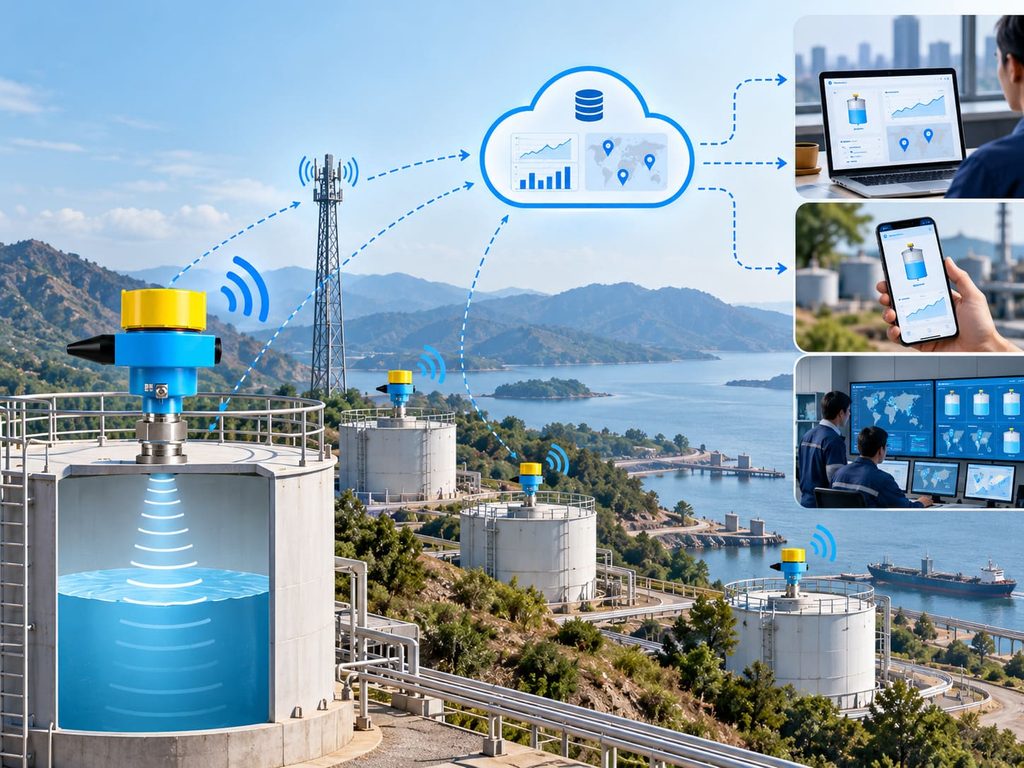
The technology connects level sensors, industrial gateways, communication networks, and remote software to create centralized visibility of tanks and silos.
What Is Cloud-Based Level Monitoring?
Cloud-based level monitoring means transferring field measurement data to remotely hosted software where authorized users can view and manage the information.
The basic architecture is:
Level Sensor → Communication → Cloud Platform → User
The communication path may involve:
- 4G
- NB-IoT
- LTE-M
- Ethernet
- Wi-Fi
- Industrial gateway
The user may access the platform through a browser or mobile application.
The Cloud Does Not Replace the Level Sensor
This distinction is important.
Measurement accuracy still depends on the instrument installed at the tank.
If the radar sensor is installed incorrectly or unsuitable for the process, sending its data to the cloud does not make the measurement more accurate.
The cloud layer manages information.
The sensor creates the information.
A good remote monitoring project therefore begins with correct field measurement.
What Does a Cloud Platform Add?
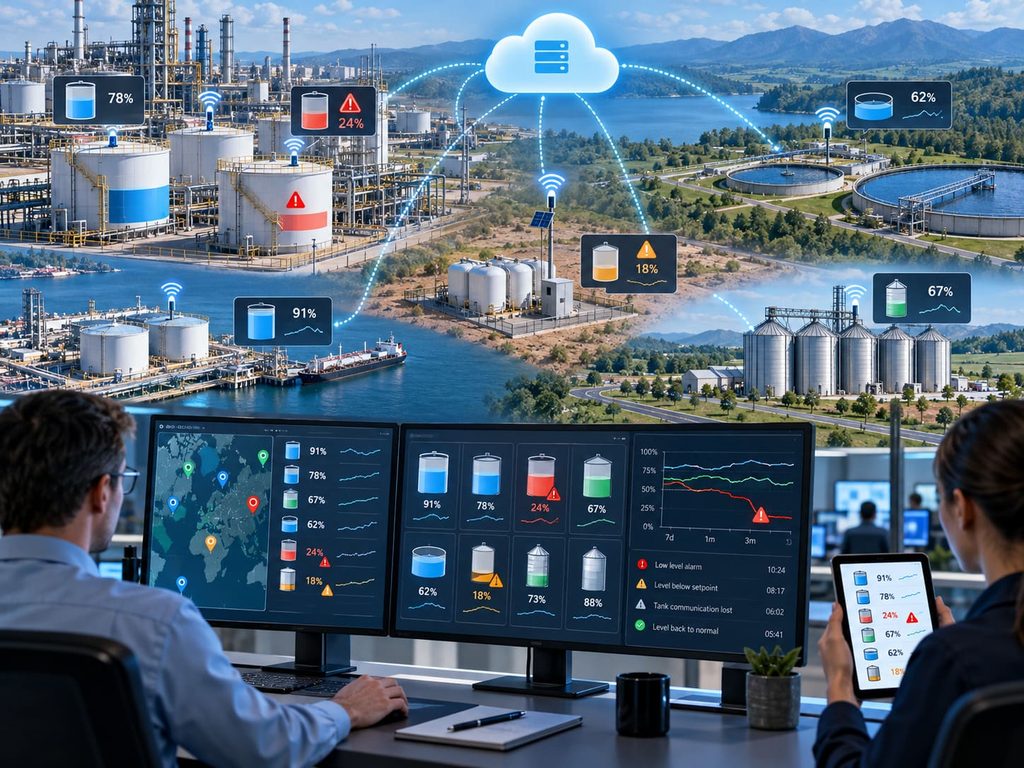
One Dashboard for Many Devices
Instead of checking multiple local displays, users can see several devices from one interface.
This is useful for organizations with tanks spread across different areas or facilities.
Real-Time Status
Operators can view the current level and determine whether the device is online.
The combination of process value and device status helps users understand whether the displayed information is current.
Historical Trends
A single measurement tells you what is happening now.
Historical data tells you what has been happening over time.
A level trend can reveal:
- Filling cycles
- Consumption patterns
- Unusual losses
- Process changes
- Replenishment frequency
- Unexpected level movement
Alarm Management
High level, low level, or communication alarms can help users focus on abnormal conditions.
Instead of constantly watching every tank, the system can highlight conditions that require attention.
Multi-Site Management
Devices can be grouped by plant, region, process, customer, or asset type.
This is particularly useful for companies that manage distributed assets.
Remote Access
A web platform allows operators to access the system from a PC.
A mobile application extends that visibility to personnel who are away from the office.
A Practical Example
Consider a company with storage tanks at five facilities.
Each site has several radar level sensors.
Without a centralized platform, each facility may operate independently.
Management has no simple way to see the overall inventory situation.
A cloud architecture changes the flow.
Sensors send measurements through a gateway or cellular network.
The cloud platform stores and organizes the data.
Authorized users can then select:
- Site A
- Site B
- Site C
- Site D
- Site E
and view all relevant tanks from one system.
This makes the level measurement useful beyond the individual tank.
JIWEI Air Cloud
Within the JIWEI Air architecture, Air Cloud is designed as a SaaS remote monitoring platform.
It connects the measurement layer with PC and mobile monitoring.
The platform can provide visibility of information such as:
- Real-time level
- Level percentage
- Device status
- Operating status
- Multi-site information
This allows the Air solution to move from local measurement toward centralized monitoring.
Air rada performs the measurement.
Wireless communication connects the instrument.
Air Cloud makes the information accessible.
Air Link can aggregate additional devices.
Air Control can extend the architecture into remote I/O and selected control functions.
Why SaaS Can Be Attractive
Traditional monitoring software may require users to deploy and maintain their own server infrastructure.
A SaaS model moves much of that application infrastructure to a hosted platform.
This can simplify access for organizations that mainly need monitoring rather than a highly customized on-premise software environment.
However, industrial users should still evaluate:
- Data ownership
- User access
- Security
- Availability
- Data retention
- Export requirements
- Integration requirements
- Regional connectivity
Cloud software should fit the organization’s IT and operational requirements.
Cloud Monitoring and SCADA Are Not the Same Thing
Cloud platforms and SCADA systems can overlap in some functions, but they often serve different purposes.
SCADA is commonly used for local or plant-wide process supervision and control.
Cloud monitoring is especially useful for distributed visibility and remote asset management.
A company may use both.
For example:
Radar sensor → PLC/SCADA for plant operation
and
Gateway → Cloud for management and remote visibility
This hybrid architecture can preserve local control while making selected information accessible outside the plant.
What Makes a Good Level Monitoring Dashboard?
A useful dashboard should reduce complexity.
It should quickly answer:
- Which tanks are normal?
- Which tanks need attention?
- Which devices are offline?
- What is the current level?
- How has the value changed?
- Where is the asset located?
A dashboard filled with data but lacking hierarchy can make monitoring more difficult.
The best interface presents the most important operational information first.
Data Quality Matters
Cloud software can store thousands of measurements, but quantity is not the same as quality.
The system should consider:
- Measurement validity
- Timestamp
- Communication status
- Alarm state
- Device identity
- Units
- Tank configuration
If a device has not communicated for several hours, the platform should make that condition clear.
Otherwise, an old measurement may be mistaken for a current value.
How Often Should a Tank Send Data?
The answer depends on the process.
A slowly changing storage tank may not need continuous second-by-second uploads.
A process tank with rapid filling and emptying may require more frequent updates.
The reporting interval affects:
- Data volume
- Network usage
- Battery consumption
- Dashboard responsiveness
- Historical resolution
The correct interval should reflect the operational purpose of the measurement.
Using Historical Data
Historical level information can provide value beyond simple visualization.
For example, a tank repeatedly dropping at a similar rate may allow an operator to estimate when replenishment will be required.
An abnormal change may indicate a leak, unexpected consumption, or process issue.
A frequently triggered high-level condition may reveal an operational pattern that deserves investigation.
Cloud monitoring turns individual measurements into a time series that can support better decisions.
Multi-Site Operations
One of the strongest use cases for cloud monitoring is a distributed organization.
Examples include:
- Water utilities
- Chemical distributors
- Agricultural operations
- Environmental monitoring networks
- Industrial service providers
- Companies with several production facilities
These organizations often need a common view across many geographically separate assets.
A cloud platform provides a natural place to consolidate that information.
From Visibility to Collaboration
Once data is accessible remotely, different teams can work from the same information.
Operations can see the current level.
Maintenance can see device status.
Management can review site performance.
Suppliers may use inventory information for replenishment planning where appropriate.
Service teams can assist with diagnostics.
This reduces the number of separate spreadsheets, phone calls, and manual records required to understand tank conditions.
Security Should Be Designed from the Beginning
Industrial cloud systems should use controlled authentication and appropriate user permissions.
The organization should determine:
- Who can see which sites?
- Who can change settings?
- Who can acknowledge alarms?
- Who can perform remote control?
- How are accounts managed?
Remote monitoring should not mean uncontrolled access.
The greater the system capability, the more important clear permission management becomes.
Cloud Monitoring Is Part of a Larger Architecture
It is useful to think of the system as several layers.
Measurement layer: radar or other level sensor.
Connection layer: cellular, Ethernet, or gateway.
Monitoring layer: cloud platform and mobile application.
Action layer: alarms, maintenance workflow, or remote control.
Each layer serves a different function.
A strong project designs them together.
Conclusion
Cloud-based level monitoring changes level measurement from a local instrument function into an information service.
The sensor tells the system what is happening inside the tank.
The communication network moves the data.
The cloud platform organizes it.
The web and mobile interfaces make it available to people who need it.
For organizations managing remote or distributed tanks, this can significantly improve visibility and reduce dependence on manual checking.
The goal is not to put every instrument on the internet simply because it is possible.
The goal is to make reliable field data available where it creates operational value.
That is the role of Air Cloud within the wider JIWEI Air solution: connecting continuous level measurement with remote monitoring, multi-site visibility, and a more scalable approach to industrial asset management.