Explore float level transmitter applications in boiler water treatment dosing tanks, including low-level alarms, dosing pump protection, automated refilling, and PLC integration.
This article presents an illustrative engineering application, not a documented customer installation.
1. Why Boiler Water Treatment Systems Need Reliable Tank Level Monitoring
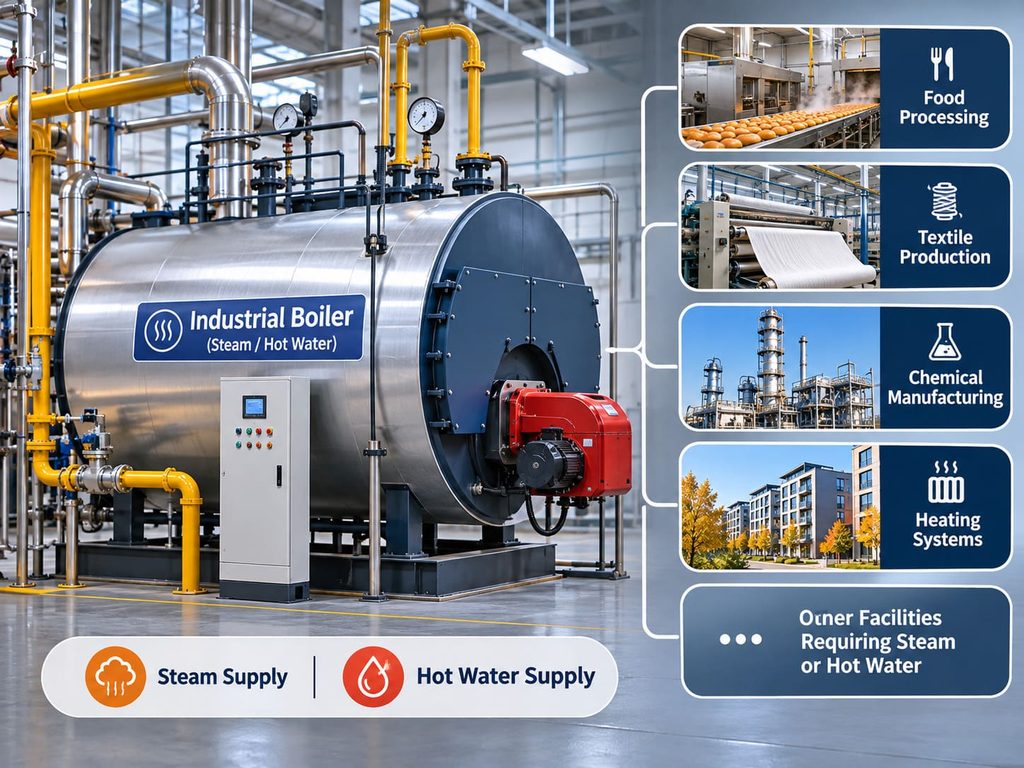
Industrial boilers are widely used in food processing, textile production, chemical manufacturing, heating systems, and other facilities requiring steam or hot water.
Many boiler water treatment systems use chemical additives to help control scaling, corrosion, and other water quality problems.
These chemicals are typically stored in dedicated dosing tanks and delivered through metering pumps.
Reliable chemical supply is important for maintaining the intended treatment process.
If the tank level becomes too low, the dosing pump may draw air, resulting in insufficient chemical delivery.
If the tank is overfilled, chemical liquid may overflow and create operational or handling hazards.
Continuous level monitoring provides real-time information that supports chemical replenishment and equipment protection.
2. Typical Application Scenario
Consider an industrial boiler water treatment skid equipped with a chemical storage tank, dosing pump, agitator, piping, and control cabinet.
For this illustrative application, assume an effective measuring height of 1000 mm and atmospheric operating pressure.
The tank contains a free-flowing water-based treatment chemical at approximately ambient temperature.
Previously, operators inspected the tank periodically to determine when replenishment was necessary.
The proposed system adds a continuous float level transmitter connected to the PLC.
The objective is to provide refill reminders, low-level alarms, and appropriate dosing pump protection.
3. Measurement Challenges
3.1 Chemical Compatibility
Boiler treatment chemicals vary in composition and concentration.
Some are compatible with stainless steel, while others may require corrosion-resistant materials.
The correct transmitter configuration must be selected according to the specific chemical and operating conditions.
3.2 Crystallization
Certain chemical solutions may crystallize under particular temperature or concentration conditions.
Deposits on the float or guide tube can restrict movement.
Crystallization risk should therefore be evaluated before choosing a mechanical float-based instrument.
3.3 Limited Installation Space
Compact dosing systems may have small tanks with multiple top-mounted components.
Agitators, filling connections, and piping can limit available space.
The float must have sufficient clearance throughout its measuring range.
4. Float-11 Transmitter Selection
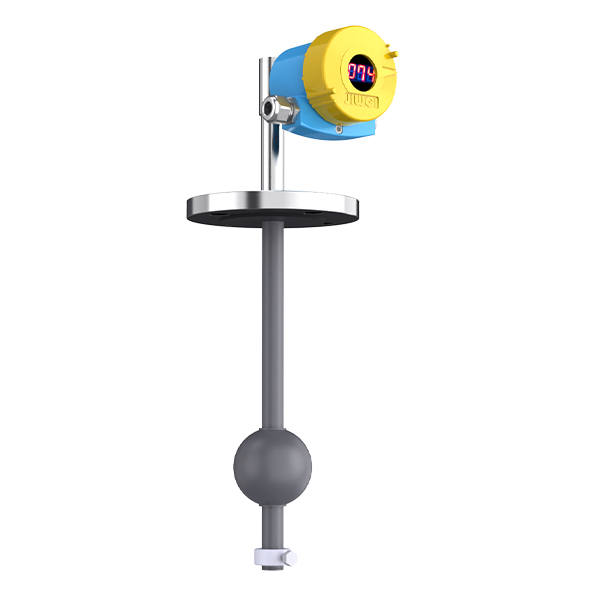
For compatible, free-flowing treatment chemicals, the Float-11A may be considered.
For more corrosive chemicals, the Float-11P may be evaluated according to the actual chemical conditions.
The Float-11 series uses a magnetic float and reed-switch resistance network to produce a continuous level measurement.
The transmitter converts this measurement into a 4–20 mA output suitable for compatible control systems.
Selection should include chemical identity, concentration, density, temperature, measuring range, and tank dimensions.
5. Installation Recommendations
The guide tube should be installed vertically.
The float must remain clear of tank walls, agitator blades, and other internal structures.
Installation near direct filling impact should be avoided.
For chemicals that may crystallize, sufficient maintenance clearance should be provided.
After installation, the transmitter should be tested during controlled filling and draining.
6. Low-Level Alarms and Dosing Pump Protection
The PLC can use the continuous level signal to establish several alarm thresholds.
For example, a tank with a 1000 mm effective measuring range might use:
| Function | Example Level |
|---|---|
| Refill reminder | 350 mm |
| Low-level alarm | 250 mm |
| Pump protection | Determined by suction requirements |
These values are illustrative and must not be used without engineering verification.
When the tank level reaches the reminder point, the system alerts the operator.
If the level continues to decrease, a low-level alarm is generated.
Protective action may be initiated when the level approaches the minimum acceptable pump suction condition.
The appropriate response depends on the process and the consequences of interrupting chemical dosing.
7. Automatic Chemical Replenishment
If the dosing system includes automated replenishment equipment, the PLC can use the transmitter signal to control filling.
When the level reaches the lower setpoint, the system initiates replenishment.
When the upper setpoint is reached, filling stops.
A suitable control deadband prevents unnecessary switching.
The PLC may also detect abnormal refill behavior.
If filling begins but the level does not rise, the supply system should be checked.
If the level continues rising after the inlet valve closes, valve leakage or another filling path may be present.
Independent overflow protection may be necessary for higher-risk chemicals.
8. Relationship Between Level Monitoring and Water Treatment Performance
Tank level monitoring helps maintain chemical availability, but it does not directly measure treatment effectiveness.
Even with sufficient chemical in the tank, a dosing pump may fail because of blocked piping, valve problems, or mechanical faults.
Therefore, actual chemical delivery and water quality must be monitored using appropriate equipment.
Level measurement should be treated as one part of the overall dosing system.
Combining tank level, dosing pump status, flow information, and water quality data provides a more complete understanding of system operation.
9. Maintenance and Troubleshooting
Maintenance should focus on corrosion, crystallization, and float movement.
If the signal remains unchanged, the float should be checked for sticking.
If the output is abnormal, inspect the power supply, wiring, and PLC analog input.
Measurement discrepancies may require verification of the configured range and installation reference.
For corrosion-resistant instruments, coatings and seals should also be inspected.
10. Frequently Asked Questions
Should a chemical dosing tank use a level switch or continuous transmitter?
A level switch may be sufficient for a simple low-level alarm. Continuous measurement is more useful for remote monitoring, replenishment control, and trend recording.
Can float level transmitters measure corrosive treatment chemicals?
Potentially. A float level transmitter is suitable only when all wetted materials are compatible with the chemical.
Does level monitoring guarantee accurate dosing?
No. Accurate dosing requires suitable metering and control equipment.
What should be checked when the level signal is abnormal?
Inspect float movement, chemical deposits, electrical connections, and PLC configuration.
11. Conclusion
Reliable chemical tank level monitoring supports continuous boiler water treatment operations.
A properly selected Float-11 float level transmitter can provide level data for refill reminders, automatic replenishment, and low-level protection.
The final design must account for chemical properties, dosing pump requirements, and the operating risks of the treatment system.