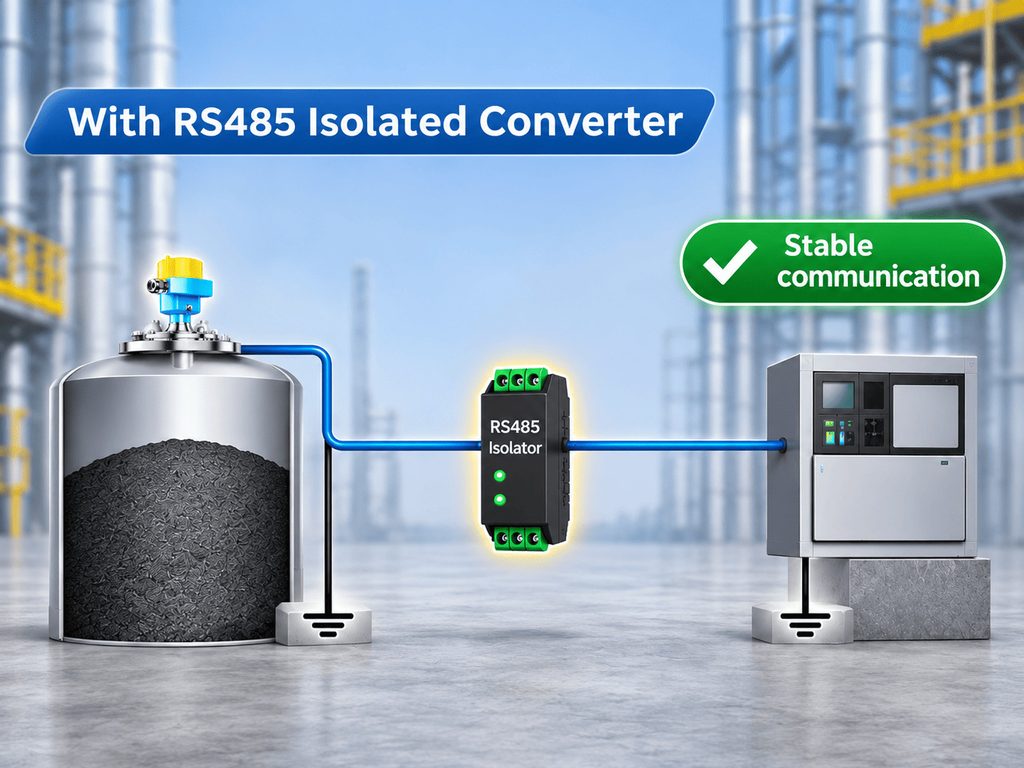
An industrial RS485 isolated converter can reduce communication faults caused by ground potential differences in level measurement systems.
RS485 is widely used in industrial automation and instrumentation systems, including radar level transmitters, ultrasonic level sensors, flow meters, pressure transmitters, and PLC control systems.
Although RS485 provides reliable differential communication, industrial environments may expose communication interfaces to ground potential differences, electromagnetic interference, and transient voltage disturbances.
To improve communication reliability, many industrial systems use RS485 isolated converters.
However, different products vary significantly in isolation performance, communication speed, power architecture, and protection features.
How should engineers select the right industrial RS485 isolated converter?
This guide explains eight important technical parameters that should be considered before purchasing or integrating an isolation device.
1. Define the Application Requirements First
Before selecting a product, identify the actual application.
Common industrial applications include:
- Radar level transmitter communication with PLCs.
- Ultrasonic level sensor data acquisition.
- Industrial instrumentation communication.
- RS485 communication between different grounding systems.
- Communication protection near variable frequency drives.
- Remote monitoring and control systems.
Different applications may require different isolation ratings, communication speeds, temperature ranges, and protection capabilities.
A product should be selected according to the actual system requirements rather than price or appearance alone.
2. Eight Key Parameters for Selecting an Industrial RS485 Isolated Converter
Parameter 1: Isolation Voltage
Isolation voltage is one of the most important specifications of an RS485 isolated converter.
It indicates the voltage that the isolation barrier can withstand under specified test conditions.
Some industrial products specify isolation withstand voltages of 2500 Vrms, 3000 Vrms, or higher.
However, these values do not necessarily represent the voltage at which the device can operate continuously.
When comparing products, check:
- Rated isolation withstand voltage.
- Test duration.
- Isolation technology.
- Working voltage.
- Creepage and clearance distances.
- Relevant safety certifications.
For industrial applications, select an appropriate isolation level based on the system’s electrical requirements.
A higher isolation voltage does not automatically mean that a product is better for every application.
Parameter 2: Signal Isolation Technology
RS485 isolated converters commonly use digital isolators or optocouplers.
Digital isolators use technologies such as capacitive or magnetic coupling to transfer digital signals across an isolation barrier.
Optocouplers use optical transmission to electrically separate input and output circuits.
Different technologies may have different characteristics in terms of:
- Maximum data rate.
- Propagation delay.
- Power consumption.
- Timing performance.
- Long-term operating characteristics.
Engineers should review the product datasheet to ensure that the selected isolation technology supports the required communication speed and operating conditions.
Parameter 3: Isolated Power Supply
Power isolation is an important consideration that is sometimes overlooked.
A complete galvanic isolation design should consider both the signal path and the power supply path.
If the signal is isolated but another conductive connection remains through the power supply, the overall isolation may not meet the intended system requirements.
For applications requiring galvanic isolation, consider products using isolated DC-DC power supplies.
Check the following specifications:
- Input voltage.
- Isolated output voltage.
- Output power.
- Load capacity.
- Isolation rating.
- Power efficiency.
Parameter 4: Communication Speed
The RS485 isolated converter must support the communication speed required by the connected instruments.
Common industrial baud rates include 4800 bps, 9600 bps, 19200 bps, and 115200 bps.
Actual requirements depend on the instruments and control system.
Check:
- Maximum supported baud rate.
- Stability at lower communication speeds.
- Signal propagation delay.
- Automatic transmit/receive switching.
- Timing compatibility with the communication protocol.
For Modbus RTU applications, transmit direction control and frame timing are also important.
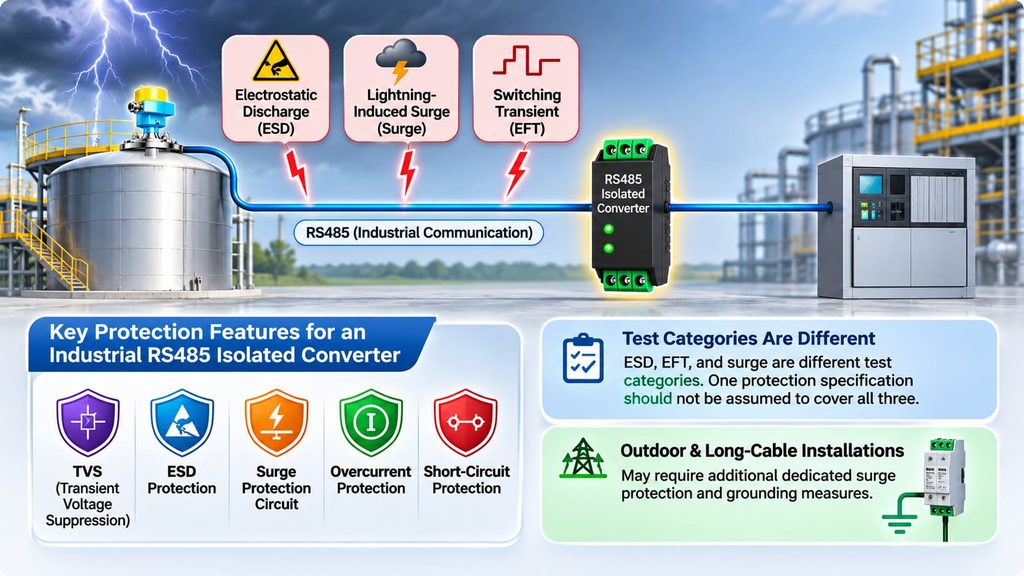
Parameter 5: Surge and ESD Protection
Industrial communication cables may be exposed to electrostatic discharge, lightning-induced surges, and switching transients.
Therefore, protection features should be considered when selecting an industrial RS485 isolated converter.
Common protection technologies include:
- TVS transient voltage suppression.
- ESD protection.
- Surge protection circuits.
- Overcurrent protection.
- Short-circuit protection.
ESD, EFT, and surge immunity are different test categories. One protection specification should not be assumed to cover all three.
Outdoor tank installations and long communication cables may require additional dedicated surge protection and grounding measures.
Parameter 6: Operating Temperature Range
Industrial equipment often operates under a wider temperature range than standard commercial electronics.
If the RS485 isolated converter is installed in an outdoor cabinet, near hot machinery, or in an environment with significant temperature changes, operating temperature becomes an important selection factor.
Some industrial products support operating temperatures from -40°C to +85°C, but the actual range must be verified in the product datasheet.
Also consider cabinet ventilation, heat accumulation, and enclosure thermal performance.
Parameter 7: Communication Interface and Installation Method
Different projects require different installation formats.
Common RS485 isolation products include:
- DIN-rail-mounted converters.
- PCB-mounted isolation modules.
- Enclosed industrial converters.
- USB-to-RS485 isolated converters.
- RS232-to-RS485 isolated converters.
For level transmitter manufacturers integrating isolation modules into their products, size, power requirements, interface compatibility, and PCB mounting are particularly important.
For system integrators, DIN-rail or enclosed modules may be more convenient for installation and maintenance.
Parameter 8: Network Nodes and Bus Loading Capacity
RS485 supports multi-device communication, but the number of connected devices is limited by the electrical characteristics of the bus.
Traditional RS485 transceivers commonly use a 32-unit-load reference design.
Modern low-unit-load transceivers may support more devices. For example, some 1/8-unit-load transceivers can support a greater number of receivers under suitable electrical conditions.
However, the actual network capacity also depends on termination resistors, biasing networks, receiver input impedance, and cable characteristics.
For large radar level measurement systems, engineers should evaluate the loading capacity of the complete network rather than relying only on the maximum node count stated for an individual converter.
3. How to Select an RS485 Isolated Converter for Different Industrial Applications
Radar Level Measurement Systems
Radar level transmitters are often installed on storage tanks and industrial silos.
Communication cables may extend over long distances and pass through electrically challenging environments.
Important selection factors include signal and power isolation, communication speed, surge protection, and operating temperature.
Outdoor installations also require appropriate lightning protection and grounding design.
Ultrasonic Level Measurement Systems
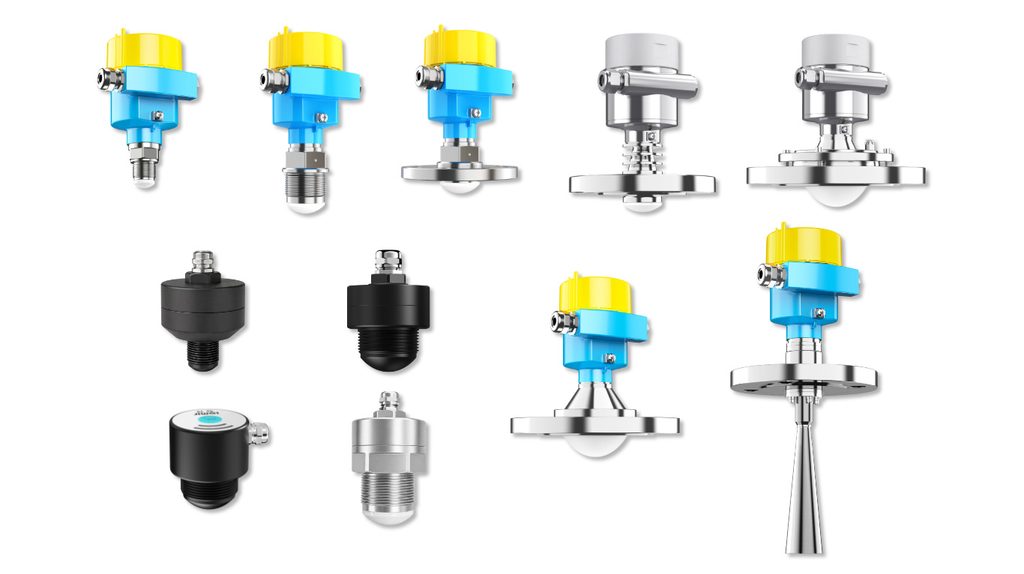
Ultrasonic level sensors are commonly used in water tanks, wastewater treatment facilities, and liquid storage systems.
For remote monitoring applications, select an isolated converter that supports the required baud rate, provides suitable electrical isolation, and offers convenient installation.
Chemical and Petroleum Storage Facilities
Chemical and petroleum facilities often have complex electrical environments and widely distributed instruments.
Engineers should evaluate isolation performance, surge protection, temperature range, and enclosure requirements.
For equipment installed in hazardous areas, the complete system must meet the applicable explosion-protection and intrinsic safety requirements.
A standard RS485 isolated converter does not automatically replace an intrinsically safe barrier or an explosion-protection device.
PLC and Industrial Data Acquisition Systems
For PLCs, industrial computers, and data acquisition equipment, interface compatibility is essential.
Also consider communication speed, automatic direction control, installation convenience, and compatibility with the existing network.
If the system requires USB, RS232, or RS485 interface conversion, choose a product designed for the required interfaces.
4. Common Mistakes When Selecting an RS485 Isolated Converter
Mistake 1: Assuming a higher isolation voltage always means better performance.
Isolation voltage is only one parameter. Working voltage, isolation structure, test standards, and application requirements must also be considered.
Mistake 2: Assuming isolation eliminates the need for surge protection.
Galvanic isolation is not a complete lightning protection system. Outdoor communication cables may still require dedicated surge protection and grounding.
Mistake 3: Assuming every RS485 isolator extends communication distance.
An isolator primarily provides electrical isolation. A standard isolator does not necessarily provide signal regeneration.
If distance extension is required, consider an RS485 repeater or isolated repeater.
Mistake 4: Assuming every RS485 converter supports Modbus RTU.
RS485 is a physical-layer standard, while Modbus RTU is a communication protocol.
Protocol timing, baud rate, and data format compatibility should be verified before installation.
5. RS485 Isolated Converter Selection Checklist
Before purchasing or integrating an industrial RS485 isolated converter, check the following:
- Does it support standard RS485 communication?
- Does it support two-wire, half-duplex operation?
- Does it provide signal isolation?
- Does it include an isolated power supply?
- Is the isolation rating suitable for the application?
- Does it support the required communication speed?
- Does it provide appropriate ESD and surge protection?
- Is the operating temperature range suitable?
- Is the installation method compatible with the control cabinet?
- Does it meet the network node and bus loading requirements?
- Are technical datasheets and test reports available?
This checklist makes it easier to compare different manufacturers and product models.
6. Conclusion
An industrial RS485 isolated converter may be a relatively small component, but it plays an important role in industrial communication systems.
For level measurement manufacturers, system integrators, and industrial equipment purchasers, selecting the right converter requires more than checking the isolation voltage.
Signal isolation technology, isolated power supply design, communication speed, surge protection, operating temperature, installation method, and network loading capacity should all be considered.
For radar level transmitters, ultrasonic level sensors, and large-scale tank monitoring systems, a properly selected RS485 isolated converter can help reduce the risks associated with ground potential differences and electrical interference.
If you are developing industrial level measurement equipment or upgrading an existing RS485 communication network, evaluate the interface requirements, communication parameters, and installation environment before choosing an isolation solution.
The right RS485 isolated converter does more than connect devices. It adds an important layer of electrical protection to industrial communication systems.