1. Why Are Winter Freezing Conditions Challenging for Level Measurement?
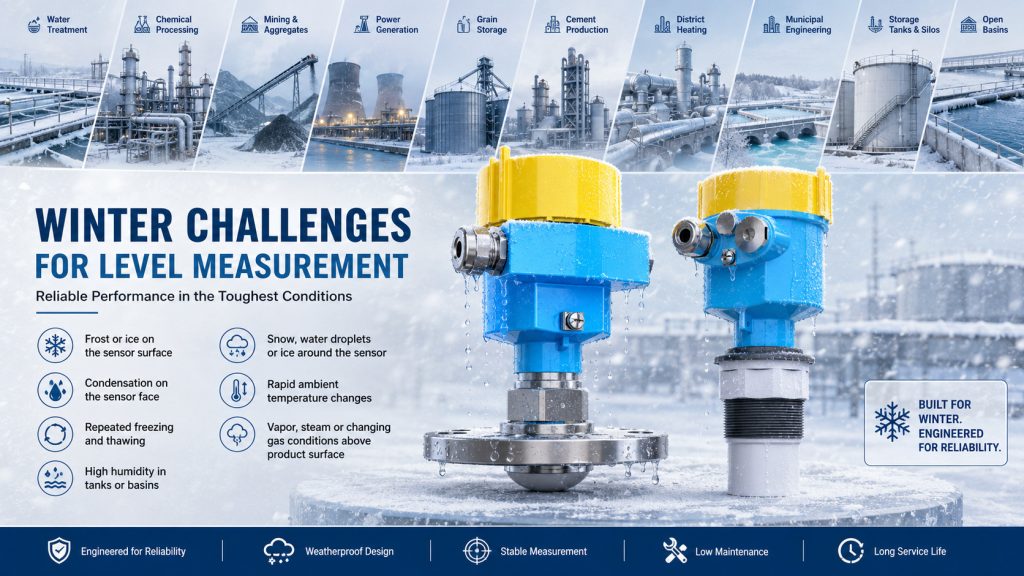
Level meters are widely used in water treatment, chemical processing, mining, power generation, grain storage, cement production, district heating, municipal engineering, storage tanks, silos, open basins, and many other industrial applications.
Under normal ambient conditions, several technologies can be used for continuous level measurement, including radar level meters, ultrasonic level meters, hydrostatic level transmitters, and other types of sensors.
However, winter operation can significantly increase the difficulty of reliable level measurement, especially in northern regions, high-altitude areas, and outdoor installations exposed to severe weather.
Typical winter-related problems include:
- Frost or ice forming on the sensor surface
- Condensation on the sensor face
- Repeated freezing and thawing caused by temperature changes
- High humidity inside tanks, wastewater wells, or open basins
- Snow, water droplets, or ice accumulating around the sensor
- Rapid changes in ambient temperature
- Vapor, steam, or changing gas conditions above the product surface
These factors do not affect every measurement principle in the same way.
In cold and freezing environments, ultrasonic level meters are generally more sensitive to environmental conditions than radar level meters.
For applications requiring continuous and reliable operation throughout winter, radar level measurement is therefore often the preferred solution.
2. How Does an Ultrasonic Level Meter Work?
An ultrasonic level meter is a non-contact level measurement instrument.
During operation, the ultrasonic sensor is installed above the product surface and sends sound waves toward the liquid or solid material.
When the sound waves reach the product surface, they are reflected back toward the sensor.
The instrument measures the time required for the ultrasonic pulse to travel to the surface and return. Based on this travel time, it calculates the distance between the sensor and the product.
The actual liquid level or solids level is then calculated according to the known height of the tank, vessel, basin, or silo.
Ultrasonic level measurement offers several advantages:
- Non-contact measurement
- Simple installation
- Relatively low cost
- No direct contact with the process medium
- Good performance in many standard water and wastewater applications
However, ultrasonic measurement depends on sound waves traveling through air or another gas.
That means any significant change in the gas path, temperature profile, vapor conditions, or sensor surface can influence measurement performance.
This is one of the main reasons ultrasonic level meters can become less reliable during winter.
3. Why Can Ultrasonic Level Meters Fail in Winter?
3.1 Ice Formation on the Ultrasonic Sensor Face
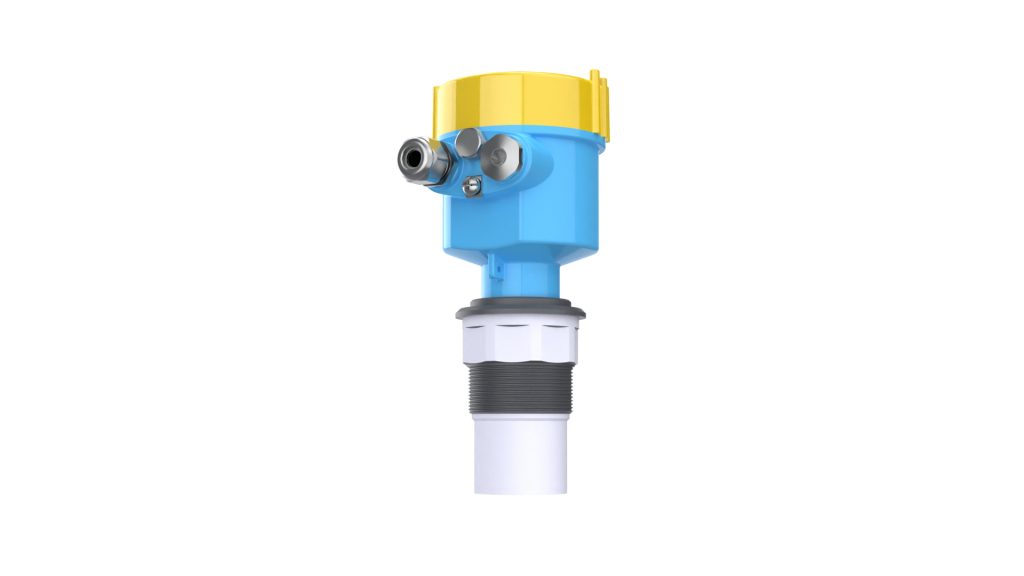
One of the most common winter problems is ice forming directly on the ultrasonic transducer.
The sensor must both transmit and receive sound waves through its front surface.
If moisture in the air condenses on the sensor and later freezes, frost or ice can gradually cover the transducer.
Once the sensor face is covered by ice, the normal transmission characteristics of the ultrasonic signal may change.
Possible symptoms include:
- Reduced transmitted signal strength
- Weak return echoes
- Unstable readings
- Measurement fluctuations
- False echoes
- Frozen or fixed readings
- Loss-of-echo alarms
- Complete measurement failure in severe cases
The thicker the ice layer, the more serious the measurement problem may become.
4. Temperature Changes Can Also Affect Ultrasonic Measurement
Ice formation is not the only problem.
Rapid changes in temperature can also influence ultrasonic level measurement.
The speed of sound in air changes with temperature.
For this reason, most industrial ultrasonic level meters include temperature compensation.
The instrument measures the temperature near the sensor and uses that value to correct the calculated distance.
In real industrial environments, however, the temperature may not be uniform throughout the entire measurement path.
For example, consider a 10-meter-high outdoor tank.
The air near the top of the tank may be at -15°C, while the air near the liquid surface may remain close to 0°C or even warmer because of the temperature of the process medium.
In such a situation, the temperature measured at the sensor does not necessarily represent the average temperature across the full acoustic path.
The greater the temperature difference and the longer the measuring distance, the more important this issue can become.
As a result, ultrasonic level meters may become less stable in applications with:
- Large day-night temperature differences
- Strong temperature gradients
- Heated liquids
- Cold outdoor tank roofs
- Vapor layers
- Rapid weather changes
5. Condensation, Steam, and Humidity Can Also Affect Ultrasonic Sensors
Many winter applications are not simply cold.
They often involve a combination of:
Low temperature + high humidity + vapor + condensation + icing
This is common in wastewater treatment plants, heated water tanks, cooling basins, outdoor process tanks, and open water applications.
If the liquid temperature is higher than the ambient temperature, moisture may continuously rise from the product surface.
When that vapor reaches the colder sensor area, condensation can form.
Water droplets may collect on the ultrasonic transducer.
If the temperature later falls below freezing, these droplets may turn into frost or ice.
This repeated cycle of condensation, freezing, thawing, and refreezing can increase maintenance requirements.
For outdoor systems that must operate continuously through winter, it is therefore not enough to ask:
“Can the instrument operate electrically at -20°C or -40°C?”
A more important question is:
Can the sensor continue to obtain a stable and reliable measurement signal under real winter conditions?
6. Why Are Radar Level Meters Better Suited to Cold Environments?
The main difference between radar and ultrasonic level measurement is the type of signal used.
Ultrasonic instruments use sound waves.
Radar level meters use electromagnetic waves.
A non-contact radar level meter installed above the vessel sends a radar signal toward the material surface.
The signal reflects from the liquid or solid product and returns to the instrument.
The level meter analyzes the returned signal and calculates the distance to the product surface.
Because radar does not rely on the speed of sound in air, it is generally less affected by changes in ambient temperature and gas conditions.
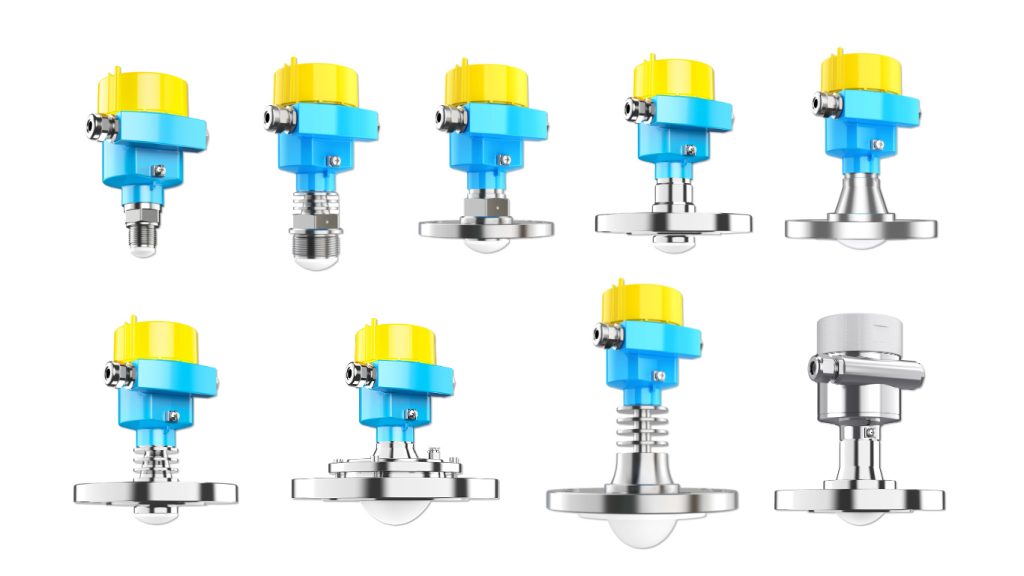
This is one of the reasons radar level meters are widely used in:
- Outdoor storage tanks
- Wastewater basins
- Deep wells
- Chemical tanks
- Silos
- Mining applications
- Cold-climate installations
- Vapor-heavy processes
- Applications with significant temperature variation
7. What Are the Advantages of Radar Level Meters in Winter?
7.1 Less Sensitive to Temperature Changes
Radar level measurement uses electromagnetic waves rather than acoustic waves.
It does not depend on the temperature-dependent speed of sound in air.
Therefore, when the outdoor temperature changes from 10°C to -20°C, radar measurement is generally less affected than ultrasonic measurement.
This is particularly useful in regions with:
- Large seasonal temperature changes
- Strong day-night temperature variation
- Extremely cold winters
- Outdoor tanks and silos
- Unheated installations
7.2 Better Performance in Vapor and Changing Gas Conditions
Industrial tanks and basins often contain steam, vapor, humidity, or changing gas compositions above the material surface.
These conditions can influence ultrasonic propagation.
Radar level meters are generally more tolerant of many such gas-phase variations.
For this reason, radar is often a better choice for:
- Wastewater tanks
- Hot water tanks
- Chemical storage tanks
- Process vessels with vapor
- Open basins with heavy condensation
7.3 High-Frequency Radar Can Provide a Narrow Beam Angle
Modern high-frequency radar level meters can produce relatively narrow measuring beams.
A narrow beam helps the sensor avoid unwanted reflections from internal structures such as:
- Pipes
- Ladders
- Support beams
- Agitators
- Heating coils
- Silo walls
- Tank internals
- Structural obstacles
This is especially valuable in vessels where installation space is limited or the internal geometry is complex.
7.4 Better Suitability for Long Measuring Ranges
Large storage tanks, tall silos, and deep wells may require measuring distances of tens of meters.
As ultrasonic measurement distance increases, several factors can become more important, including:
- Acoustic signal attenuation
- Temperature gradients
- Air movement
- Vapor conditions
- Echo weakening
Radar level measurement is often better suited to long-range measurement applications.
8. Is a Radar Level Meter Completely Immune to Ice?
No.
This is an important point in level meter selection.
Radar is generally better suited to freezing conditions, but this does not mean that a radar antenna can be completely covered by thick ice without any impact.
If large amounts of ice accumulate directly on the radar antenna, or if a thick ice layer forms around the sensor, the radar signal may still be affected.
Possible consequences include:
- Signal attenuation
- Abnormal reflections
- Reduced echo quality
- False echoes
- Measurement instability
Therefore, replacing an ultrasonic level meter with a radar level meter is not always enough by itself.
A reliable winter installation should also consider anti-icing design.
Possible measures include:
- Installing a weather shield
- Preventing snow accumulation above the sensor
- Selecting a suitable mounting nozzle
- Preventing condensation from flowing directly onto the antenna
- Adding insulation where appropriate
- Using heating or heat tracing in extremely cold climates
- Inspecting the antenna periodically for abnormal buildup
The best winter performance usually comes from combining:
Correct instrument selection + proper installation + anti-icing design
9. Ultrasonic vs. Radar Level Meter for Winter Applications
| Comparison Item | Ultrasonic Level Meter | Radar Level Meter |
|---|---|---|
| Measurement principle | Sound waves | Electromagnetic waves |
| Requires gas medium for wave propagation | Yes | Does not rely on acoustic propagation |
| Sensitivity to temperature changes | Relatively high | Relatively low |
| Temperature compensation | Usually required | No acoustic temperature compensation required |
| Effect of sensor icing | Often significant | Depends on ice thickness and antenna design |
| Performance in vapor | Can be affected | Usually more tolerant |
| Long-range measurement | More limited | Often better suited |
| Complex internal structures | More prone to interference | Narrow-beam radar can offer advantages |
| Initial equipment cost | Usually lower | Usually higher |
| Outdoor winter applications | Requires careful anti-icing consideration | Often preferred |
| Maintenance in freezing conditions | May increase | Often lower with proper installation |
If the application is indoors, relatively dry, thermally stable, and budget-sensitive, ultrasonic technology may still be a practical solution.
However, if the installation is exposed to low temperatures, frost, ice, condensation, steam, or continuous outdoor operation, radar level measurement is usually the safer choice.
10. Which Winter Applications Should Prioritize Radar Level Measurement?
Outdoor Wastewater Treatment Basins
Wastewater basins often have high humidity and significant vapor.
During winter, condensation and frost can easily form around exposed sensors.
For year-round continuous operation, non-contact radar level meters are often a strong option.
Outdoor Water Storage Tanks in Cold Regions
Firewater tanks, process water tanks, and circulation water systems can experience major temperature fluctuations.
These applications should consider:
- Minimum ambient temperature
- Condensation
- Ice formation
- Sensor protection
- Winter maintenance access
Radar level meters are often better suited to these conditions.
Mining and Aggregate Silos
Mining and bulk-solids applications may combine:
- Low temperatures
- Dust
- Uneven material surfaces
- Long measuring distances
High-frequency radar with a narrow beam can reduce interference from some silo structures and is widely used for solid material level measurement.
Grain and Feed Silos
Large grain silos can have tall measuring distances and uneven product surfaces.
Radar level measurement can be suitable when selected according to:
- Material dielectric properties
- Silo height
- Dust conditions
- Filling pattern
- Mounting location
Chemical Storage Tanks
Chemical tanks may involve much more than cold weather.
Additional factors can include:
- Corrosive media
- Volatile liquids
- Pressure
- High process temperature
- Hazardous areas
- Explosion protection requirements
For these applications, the radar frequency, antenna material, process connection, sealing material, and hazardous-area certification should all be selected according to the full process conditions.
11. How Should You Select a Radar Level Meter for Winter Use?
It is not recommended to select a radar level meter based only on maximum measuring range.
The supplier should receive complete process information.
Medium Type
Specify whether the application involves:
- Clean water
- Wastewater
- Chemicals
- Oil
- Slurry
- Granules
- Powder
- Grain
- Cement
- Aggregate
Minimum and Maximum Temperature
Both process temperature and ambient temperature should be specified.
For example, an outdoor installation at -20°C is very different from an installation that must operate continuously at -40°C.
Measuring Distance
Provide:
- Total vessel height
- Maximum measuring distance
- Normal operating level
- Minimum level
- Empty distance
Tank or Silo Geometry
Important information includes:
- Diameter
- Height
- Roof shape
- Mounting nozzle size
- Internal structures
- Agitators
- Pipes
- Beams
- Filling points
Vapor, Dust, or Foam
These process conditions may affect the selection of:
- Radar frequency
- Antenna type
- Signal processing method
- Installation position
Risk of Frost or Ice
If the site is located in an area with severe winter icing, this should be communicated during the equipment selection stage.
It is much better to design for icing in advance than to solve the problem after installation.
Explosion Protection and Environmental Protection
For chemical, petrochemical, mining, and other hazardous industrial sites, the required explosion protection certification must also be considered.
Ingress protection and enclosure rating should be suitable for the outdoor environment.
12. Winter Installation Tips for Radar Level Meters
Even the correct radar level meter can perform poorly if it is installed incorrectly.
Several installation points are especially important.
First, avoid installing the radar directly above the filling inlet whenever possible.
Falling material or turbulent inflow can produce unwanted reflections.
Second, aim the antenna toward the actual product surface and avoid direct alignment with large obstacles such as:
- Tank walls
- Ladders
- Pipes
- Beams
- Agitators
Third, outdoor installations should account for rain, snow, and condensation.
Fourth, if a mounting nozzle is used, its diameter and length should be selected according to the antenna design and the manufacturer’s installation guidelines.
Fifth, in extremely cold regions, insulation, heating, or heat tracing may be required.
These installation details can be just as important as the instrument specification itself.
13. Should Ultrasonic Level Meters Be Completely Avoided in Winter?
No.
Ultrasonic level meters remain a mature and cost-effective technology.
They can still be a good option when:
- Ambient temperature is relatively stable
- Ice formation is unlikely
- Humidity is low
- Vapor is limited
- Measuring distance is short
- Vessel geometry is simple
- Moderate measurement stability is acceptable
- Project budget is limited
The main mistake is not the use of ultrasonic technology itself.
The mistake is selecting ultrasonic measurement for a severe freezing environment simply because the initial purchase price is lower.
The correct question is not:
“Which technology is best?”
The correct question is:
Which measurement principle is best suited to the actual process conditions?
14. Frequently Asked Questions
Why Does an Ultrasonic Level Meter Lose Signal in Winter?
The first things to inspect are frost, ice, water droplets, or contamination on the sensor face.
You should also check:
- Ambient temperature
- Power supply
- Sensor alignment
- Mounting position
- Echo curve
- Vapor conditions
In cold climates, icing on the ultrasonic transducer should be one of the first possible causes to investigate.
Can a Radar Level Meter Freeze in Winter?
Yes.
A radar level meter cannot prevent ice from forming around it.
If the surrounding humidity is high and the temperature falls below freezing, frost or ice may still form on the antenna.
For severe winter environments, proper anti-icing design is still important.
Which Is Better Below 0°C: Radar or Ultrasonic?
If the main concerns are low temperature, large temperature changes, steam, condensation, and icing risk, radar level measurement generally has an advantage.
However, final selection should still consider:
- Medium type
- Measuring range
- Tank geometry
- Minimum ambient temperature
- Mounting conditions
Is an 80 GHz Radar Level Meter Suitable for Winter Applications?
80 GHz radar level meters typically offer a narrow beam angle and compact antenna design, which can be beneficial in tanks, basins, and silos.
However, suitability for a specific winter application should still be confirmed based on:
- Minimum ambient temperature
- Process temperature
- Antenna design
- Ingress protection
- Icing risk
- Mounting arrangement
Can a Radar Level Meter Still Measure Through Ice?
A light layer of frost may not immediately cause measurement failure.
However, thick ice, heavy buildup, or abnormal accumulation around the antenna can still reduce signal quality.
For this reason, “radar is resistant to environmental changes” should not be interpreted as “radar never requires anti-icing protection.”
15. Conclusion: In Freezing Winter Conditions, Reliability Should Come Before Purchase Price
Level meter selection should not be based only on initial equipment cost.
For outdoor applications exposed to low temperatures, condensation, high humidity, steam, frost, and ice, long-term reliability and maintenance costs are often more important.
Ultrasonic level meters use sound waves and can provide an economical, non-contact solution in stable environments.
However, in winter conditions, sensor icing, changes in sound velocity, temperature gradients, vapor, and condensation can increase measurement uncertainty.
Radar level meters use electromagnetic waves and are generally less sensitive to air temperature changes and many gas-phase variations.
For this reason, radar technology is often preferred in:
- Outdoor storage tanks
- Wastewater treatment systems
- Open basins
- Mining silos
- Grain storage
- Chemical processing
- Cold-climate industrial facilities
- Unattended winter installations
A practical selection principle is:
For normal and stable conditions, ultrasonic technology can be selected based on cost and application requirements. For low-temperature, freezing, condensation-heavy, vapor-rich, or unattended environments, radar level measurement should usually be evaluated first.
At the same time, no measurement technology should be selected without considering the actual process conditions.
The most reliable system is achieved by combining:
measurement principle, minimum temperature, product characteristics, measuring range, vessel geometry, installation design, anti-icing measures, and maintenance requirements.