In chemical processing, specialty chemicals, electroplating, pharmaceutical production, acid and alkali storage, and other demanding industrial applications, level detection equipment often faces more than just high temperature and pressure. Corrosive chemicals such as hydrochloric acid, sulfuric acid, nitric acid, caustic solutions, and various organic solvents can also attack the wetted parts of a level instrument.
For many standard liquid applications, 316L stainless steel provides adequate corrosion resistance. However, when a tuning fork level switch is exposed to aggressive chemicals, stainless steel alone may not offer sufficient long-term protection.
This is where fluoropolymer coatings such as PTFE and PFA become important.
Both PTFE and PFA are well known for their excellent chemical resistance, wide operating temperature range, low surface energy, and non-stick properties. However, their processing characteristics are different. These differences become especially important when a fluoropolymer needs to form a uniform and reliable protective layer over a relatively complex component such as a tuning fork sensor.
This article explains the key differences between PTFE and PFA coatings, why corrosion-resistant coatings are used on vibrating fork level switches, and how PFA coating can be applied in practical applications using the Jiwei Ring-11 tuning fork level switch as an example.
Why Do Tuning Fork Level Switches Need Corrosion-Resistant Coatings?
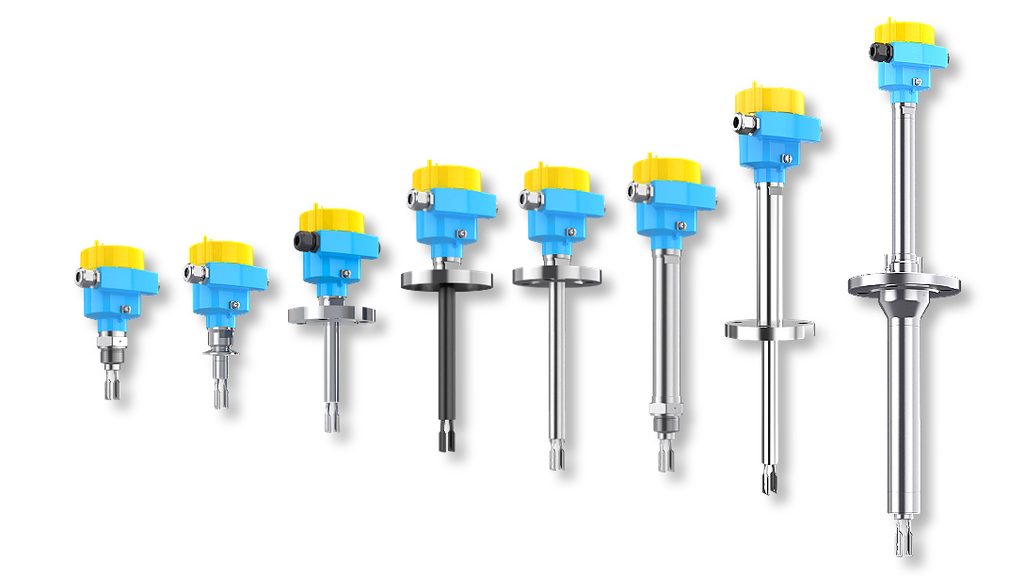
A tuning fork level switch, also known as a vibrating fork level switch, is a point-level detection instrument used to detect the presence or absence of liquid at a specific position in a tank, vessel, or pipeline.
Inside the instrument, piezoelectric elements excite the fork so that it vibrates at a defined resonant frequency.
When the fork is in air, it vibrates at its normal frequency. When liquid covers the fork, the additional mass and damping caused by the medium change the vibration characteristics. The electronics detect this change and convert it into a switching signal.
This signal can then be used for applications such as:
- High-level alarms
- Low-level alarms
- Pump protection
- Overfill prevention
- Dry-run protection
- Process interlocks
Because the vibrating fork must come into direct contact with the process medium, the wetted parts are continuously exposed to the liquid.
In corrosive applications, this creates a potential problem.
If the fork surface or process connection is gradually attacked by the chemical medium, the instrument may experience pitting, material loss, surface damage, or changes in its vibration characteristics. Over time, these effects can reduce measurement reliability and shorten service life.
A common solution is therefore to use a metal structure, such as stainless steel, for mechanical strength and apply a chemically resistant coating to the wetted surfaces.
The design concept can be summarized as follows:
Metal provides mechanical strength, while the fluoropolymer coating isolates the metal from the corrosive process medium.
What Is PTFE?
PTFE stands for polytetrafluoroethylene.
It is one of the most widely recognized fluoropolymers used in industrial corrosion protection.
PTFE is known for several important properties:
- Excellent resistance to many acids and alkalis
- Resistance to a wide range of organic chemicals
- High temperature capability
- Very low coefficient of friction
- Low surface energy
- Good non-stick characteristics
- Excellent electrical insulation
Because of these properties, PTFE is widely used in chemical equipment linings, gaskets, seals, pipes, valves, pumps, and other corrosion-resistant components.
Its chemical stability makes it particularly useful when equipment is exposed to aggressive process fluids.
However, one characteristic of PTFE is especially important when discussing sensor coatings.
PTFE has an extremely high melt viscosity.
Unlike many conventional thermoplastics, it does not flow easily in the molten state. As a result, PTFE generally requires specialized processing techniques rather than standard melt-processing methods.
This is not necessarily a disadvantage for PTFE as a material, but it does affect how easily the material can be applied to complex geometries.
For a component such as a tuning fork probe, where the coating must cover narrow fork tines, curved transitions, and process connection surfaces, coating processability becomes an important consideration.
What Is PFA?
PFA stands for perfluoroalkoxy polymer.
Like PTFE, PFA belongs to the fluoropolymer family and provides excellent resistance to many aggressive chemicals.
PFA also offers:
- Excellent chemical resistance
- High-temperature performance
- Low surface energy
- Good weather resistance
- Excellent electrical properties
- Good non-stick behavior
From a chemical resistance perspective, PFA and PTFE are often considered closely related materials.
The major difference is processing behavior.
Unlike PTFE, PFA is melt-processable.
Its molten material has significantly better flow characteristics, allowing it to be processed through methods that are difficult or impractical with conventional PTFE.
This property can be especially valuable for corrosion-resistant sensor coatings.
When PFA is applied correctly to a metal component, its melt flow can help produce a relatively smooth, continuous protective layer over complex surfaces. This can reduce the risk of coating defects such as pinholes or incomplete coverage.
For tuning fork level switches, coating integrity is extremely important because even a very small defect may expose the underlying metal to the corrosive medium.
PTFE vs. PFA for Tuning Fork Level Switches
PTFE and PFA are both high-performance fluoropolymers, so the question is not simply which material is “better.”
The more useful question is:
Which material is more suitable for the specific sensor design, manufacturing process, and process conditions?
Chemical Resistance
Both PTFE and PFA provide excellent resistance to a wide variety of corrosive chemicals.
They are commonly considered for applications involving strong acids, alkaline solutions, and many solvents.
However, material compatibility should never be determined by polymer name alone.
The actual resistance of the coating also depends on:
- Chemical composition
- Concentration
- Process temperature
- Pressure
- Exposure time
- Presence of mixed chemicals
For critical applications, a chemical compatibility review should always be carried out before final material selection.
Temperature Resistance
Both PTFE and PFA can tolerate relatively high temperatures compared with many other polymer materials.
However, the maximum temperature rating of the fluoropolymer itself should not be confused with the maximum allowable process temperature of the complete level switch.
A tuning fork level switch contains more than just the coating.
Its total temperature rating can also depend on:
- Sealing materials
- Piezoelectric elements
- Electronics
- Process connections
- Housing design
- Thermal isolation
- Coating thickness and manufacturing process
For this reason, the final selection should always be based on the manufacturer’s complete instrument specifications.
Processing Characteristics
This is one of the most important differences between PTFE and PFA.
PTFE has very high melt viscosity and is relatively difficult to process through conventional melt-flow methods.
PFA, on the other hand, is melt-processable and offers better flow during manufacturing.
For components that require a continuous fluoropolymer layer over a complex shape, this can give PFA an important practical advantage.
Surface Properties
Both PTFE and PFA have low surface energy.
This gives them good non-stick characteristics and can help reduce product adhesion compared with bare metal surfaces.
This can be beneficial in applications involving liquids that tend to crystallize, coat surfaces, or leave deposits.
However, a non-stick coating does not eliminate all buildup problems.
For highly viscous, sticky, or crystallizing liquids, installation position, fork orientation, cleaning requirements, and process conditions must still be considered.
Why Is Coating Uniformity Especially Important on a Tuning Fork Sensor?
A tuning fork level switch is not simply a metal probe.
The fork is a precisely tuned vibrating component.
Its geometry, mass, stiffness, and surface condition influence its resonant behavior.
Applying a corrosion-resistant coating therefore requires more care than simply covering the metal with a thick protective layer.
If the coating is excessively thick, uneven, or significantly different between the two fork tines, it may alter the mass distribution and vibration characteristics of the sensor.
A professionally designed coated tuning fork level switch must therefore consider several factors together:
- Coating thickness
- Coating uniformity
- Adhesion to the base metal
- Pinholes and surface defects
- Geometry between the fork tines
- Chemical compatibility
- Process temperature
- Final vibration calibration
This is why corrosion-resistant tuning fork level switches should ideally be designed as coated instruments from the beginning rather than created by applying an arbitrary coating to a standard sensor after manufacturing.
Jiwei Ring-11 Tuning Fork Level Switch as an Example
The Jiwei Ring-11 tuning fork level switch provides a useful example of how corrosion-resistant coatings can be incorporated into a vibrating fork level sensor.
The Ring-11 uses the same fundamental vibrating fork principle found in many point-level switches.
A piezoelectric system excites the fork, and the electronics monitor changes in vibration when the sensor is covered by liquid.
The compact fork design makes the instrument suitable for level detection in tanks, vessels, and certain pipeline applications.
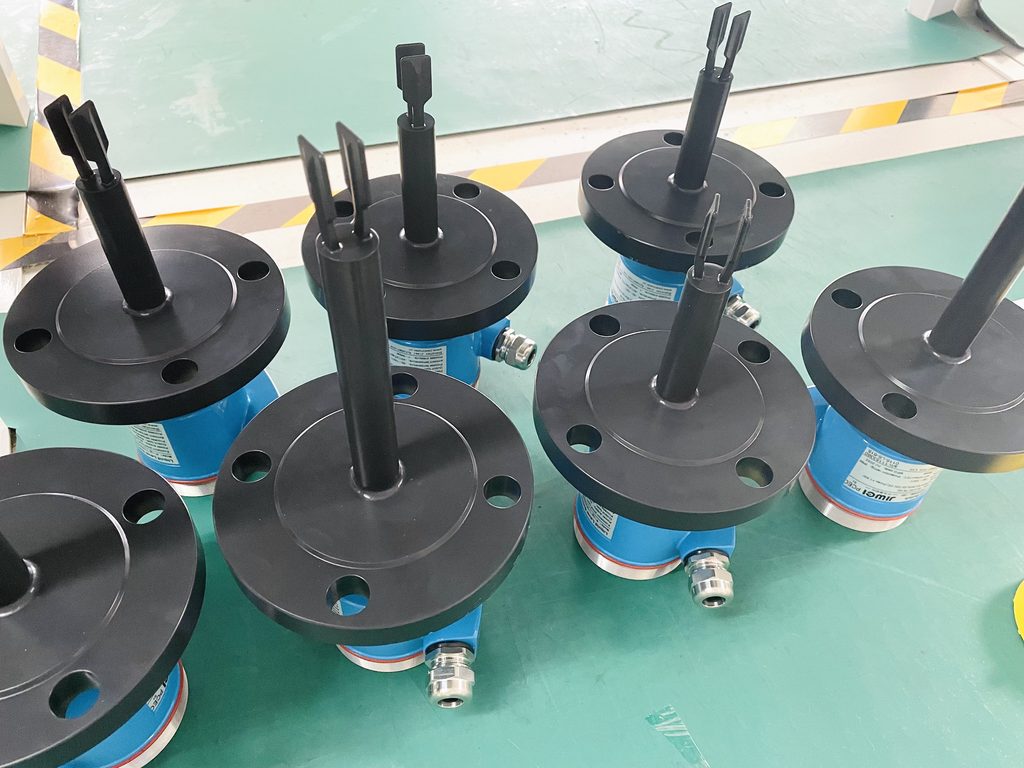
For corrosive applications, Jiwei offers corrosion-resistant versions of the Ring-11 using protective materials on the wetted parts.
Based on the currently published Ring-11 product information, the corrosion-resistant configurations include materials such as:
PFA, ECTFE, and enamel coatings.
These protective layers can be used on wetted components such as the vibrating fork and process connection.
It is important to distinguish this from PTFE.
Although PTFE is widely used as a reference material when discussing fluoropolymer corrosion protection, it should not automatically be described as a standard Ring-11 coating unless the specific product configuration confirms it.
For the Ring-11, PFA is a particularly relevant example because it combines fluoropolymer chemical resistance with useful processing characteristics for coating complex sensor structures.
The basic design philosophy is straightforward:
The metal sensor structure provides the required mechanical and vibration characteristics, while the PFA coating helps isolate the metal from corrosive process liquids.
This type of design can be considered for applications involving aggressive acids, alkaline liquids, and other corrosive chemicals, provided the complete chemical and process conditions have been reviewed.
What Information Is Needed When Selecting a PFA or PTFE-Based Level Switch?
When selecting a corrosion-resistant tuning fork level switch, it is not enough to tell the instrument supplier that the medium is simply “acid” or “alkaline.”
A reliable selection should include several key process parameters.
1. Exact Chemical Name
Hydrochloric acid, sulfuric acid, nitric acid, hydrofluoric acid, sodium hydroxide, and other chemicals behave differently.
Their compatibility with coatings, seals, metals, and other wetted materials can vary significantly.
2. Chemical Concentration
The same chemical can behave differently at different concentrations.
Material compatibility should therefore be checked using the actual process concentration.
3. Normal and Maximum Process Temperature
Corrosion rates and chemical permeability can change as temperature increases.
The maximum operating temperature is often more important than the normal temperature when selecting wetted materials.
4. Process Pressure
Pressure affects the mechanical design of the instrument and may also influence the choice of coating, lining, seal, and process connection.
5. Abrasive Solids
PFA and PTFE are primarily selected for chemical resistance.
If the liquid contains a large quantity of abrasive particles, mechanical wear can become another important design factor.
A coating that performs well against chemical corrosion may still be damaged by severe abrasion.
6. Product Buildup or Crystallization
If the medium is highly viscous, sticky, or prone to crystallization, the installation position and orientation of the tuning fork should be evaluated carefully.
Low-surface-energy coatings can help reduce adhesion, but they do not replace proper sensor installation.
7. Hazardous Area and Functional Safety Requirements
In chemical and petrochemical plants, corrosion resistance is only one part of instrument selection.
Depending on the installation, the level switch may also require appropriate hazardous area approvals, explosion protection, or functional safety capabilities.
Is PFA Always Better Than PTFE?
No.
PTFE remains one of the most important corrosion-resistant materials used in the chemical industry.
Its chemical stability, temperature resistance, and low-friction properties make it suitable for a wide range of demanding applications.
The advantage of PFA is not that it universally outperforms PTFE.
Its major advantage is that it combines excellent fluoropolymer performance with melt processability.
This can make PFA particularly suitable for applications requiring a continuous fluoropolymer layer over complex metal parts.
For a tuning fork level switch, where coating integrity and uniformity are important, this processing characteristic can be highly valuable.
A more accurate conclusion is therefore:
PFA may offer manufacturing advantages over PTFE when a complex sensor geometry requires a continuous, uniform fluoropolymer coating.
Conclusion
PTFE and PFA are both high-performance fluoropolymers widely recognized for their excellent chemical resistance, temperature capability, and low surface energy.
PTFE has a long history in industrial corrosion protection and remains an important material for chemical equipment, linings, seals, and components.
PFA provides many similar chemical and thermal properties while also offering better melt-processability. This can make it especially suitable for coating complex wetted components such as the fork and process connection of a corrosion-resistant tuning fork level switch.
The Jiwei Ring-11 tuning fork level switch illustrates this approach. In corrosion-resistant configurations, materials such as PFA, ECTFE, and enamel can be used to protect wetted parts while retaining the mechanical structure required for reliable vibration-based level detection.
However, choosing a corrosion-resistant level switch should never be based only on the words “PTFE” or “PFA.”
A proper selection should also consider the exact chemical, concentration, temperature, pressure, abrasion, buildup tendency, installation method, sealing materials, and required certifications.
Only when the coating material, sensor structure, manufacturing process, and actual operating conditions are evaluated together can a tuning fork level switch provide reliable long-term point-level detection in corrosive applications.
Frequently Asked Questions
Which is more corrosion resistant, PTFE or PFA?
Both PTFE and PFA offer excellent resistance to a wide range of corrosive chemicals. The best choice depends on the specific chemical, concentration, temperature, pressure, and application conditions. PFA has the additional advantage of being melt-processable, which can make it suitable for complex coated components.
Does PFA coating affect the accuracy of a tuning fork level switch?
A coating adds mass to the vibrating fork, so a properly designed coated tuning fork level switch must account for this during engineering, manufacturing, and calibration. A professional corrosion-resistant level switch is designed and tuned with the coating already considered.
Can a PFA-coated tuning fork level switch be used for strong acids and alkalis?
Potentially, yes, but material selection should not be based only on a general description such as “strong acid” or “strong alkali.” The exact chemical, concentration, maximum temperature, pressure, and presence of abrasive solids should be reviewed before selecting the coating.
Why is PFA often used on corrosion-resistant level switches?
PFA combines excellent chemical resistance with melt-processability. Its flow characteristics can help create a continuous and relatively uniform protective layer over complex sensor surfaces, making it suitable for certain corrosion-resistant instrument designs.
What is the difference between a tuning fork level switch and a continuous level sensor?
A tuning fork level switch normally provides point-level detection, such as high-level or low-level alarms. It does not continuously measure the full liquid level in the same way as radar, ultrasonic, or hydrostatic level transmitters.
Is a fluoropolymer coating enough for every corrosive application?
No. Fluoropolymer coatings are highly effective in many chemical applications, but the complete operating environment must be considered. High temperature, high pressure, abrasion, permeation, mechanical damage, and chemical compatibility can all affect service life.