Marine fuel tanks are an essential part of a vessel’s propulsion and power system. Reliable fuel supply to the main engine, auxiliary engines, and onboard generators depends heavily on accurate fuel inventory monitoring.
For this reason, marine fuel tank level monitoring is not only important for fuel inventory management, but also for voyage planning, bunkering operations, fuel consumption analysis, and safe vessel operation.
Compared with standard storage tanks installed on land, marine fuel tanks operate under much more demanding conditions. The vessel is constantly moving, installation space is limited, tank structures can be complex, and certain fuel oils may be highly viscous or require heating.
As a result, a level measurement technology that performs well in a stationary industrial tank may not always be suitable for marine applications.
So, what are the main challenges of fuel tank level measurement on ships, and how should a suitable level instrument be selected?
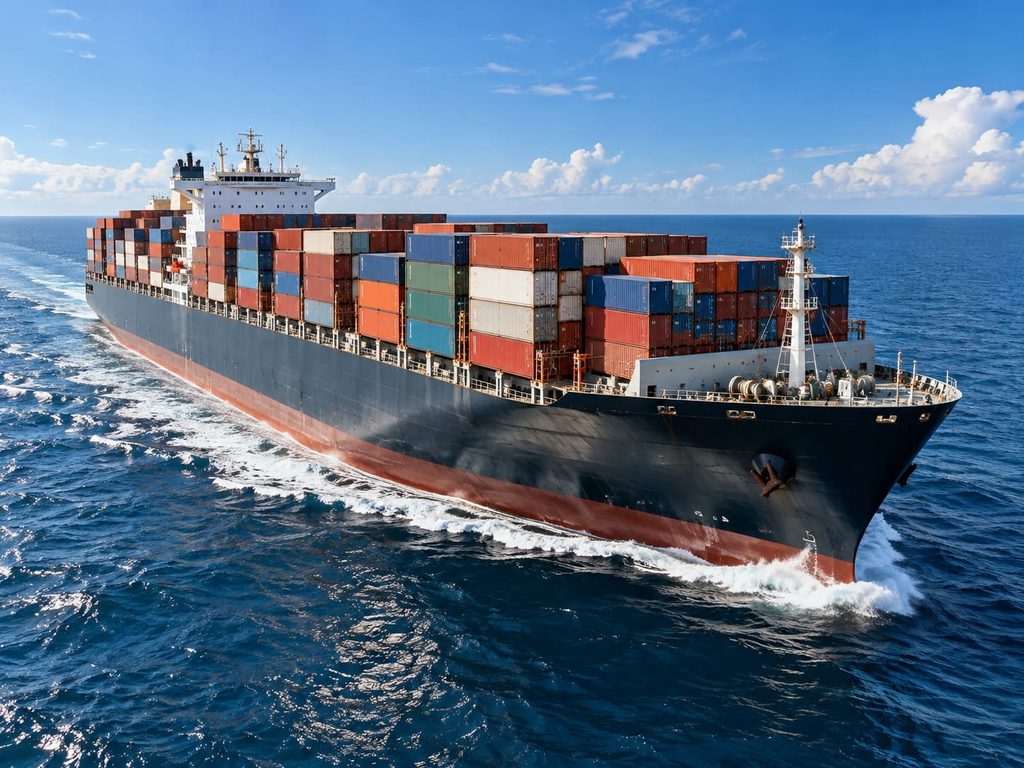
1. Vessel Movement Causes Continuous Liquid Surface Fluctuation
During navigation, a vessel is affected by waves, turning, acceleration, pitching, and rolling.
As a result, the fuel surface inside the tank may continuously move, tilt, or fluctuate instead of remaining stable and horizontal.
For a level transmitter, this can lead to rapidly changing instantaneous readings.
If the control or monitoring system directly uses raw level data without suitable filtering, several problems may occur:
- Unstable level indication
- False high-level or low-level alarms
- Inaccurate fuel inventory calculations
- Difficulty determining the actual fuel volume onboard
For this reason, when selecting a marine fuel tank level transmitter, measurement accuracy alone is not enough.
It is also important to evaluate whether the instrument provides reliable signal processing, echo tracking, damping, and filtering functions.
In many marine applications, stable measurement is more valuable than extremely high instantaneous accuracy.
2. Fuel Viscosity and Temperature Can Change
Marine fuel is not always a uniform or stable medium.
Different types of fuel may have different densities, viscosities, and dielectric properties. Some heavy fuel oils also need to be heated before pumping or combustion.
Changes in temperature can further affect the physical properties of the fuel.
This is particularly important for level measurement technologies that depend on liquid density.
For example, hydrostatic level measurement determines liquid level based on the pressure generated by the liquid column.
If fuel density changes significantly but the system continues using a fixed density value, the calculated level may become inaccurate.
Radar level measurement, on the other hand, primarily determines the distance between the sensor and the liquid surface. Therefore, it is generally less affected by density changes than hydrostatic measurement.
If fuel type or operating temperature varies significantly, the measurement principle should be carefully considered during instrument selection.
3. Fuel Can Cause Coating and Buildup
High-viscosity fuel oils can create another common problem: coating and buildup.
Over time, fuel may adhere to:
- Probe rods
- Cable probes
- Sensor surfaces
- Mounting nozzles
- Tank walls
When a contact-type level measurement technology is used, it is important to evaluate whether product buildup could affect the measuring signal.
This is one reason why non-contact radar level transmitters are often considered for marine fuel tank applications.
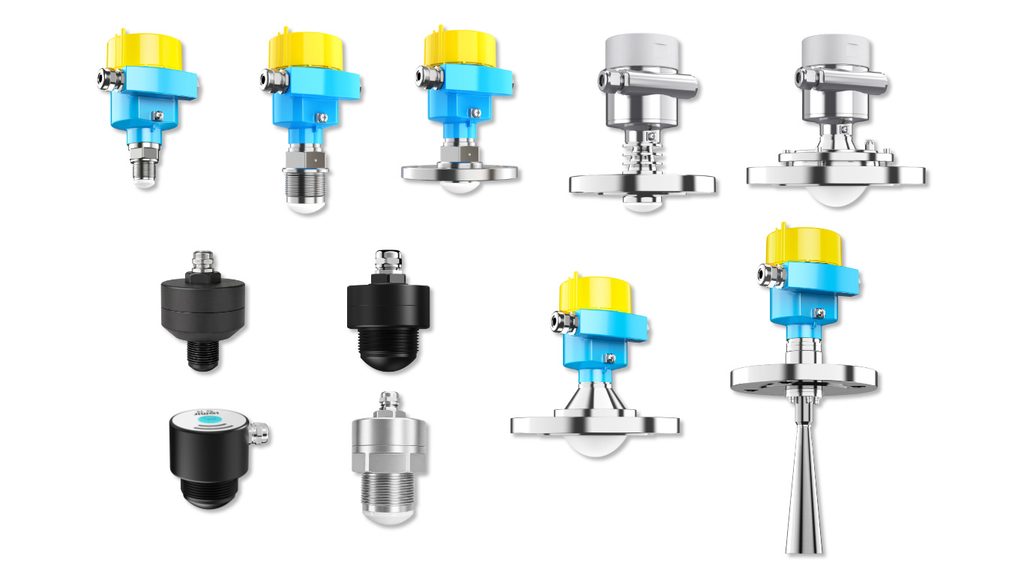
A radar level transmitter is typically installed on the top of the tank and measures the fuel surface using electromagnetic waves.
Since the main sensing element does not need to be immersed in the fuel, maintenance caused by product buildup may be reduced.
However, this does not mean that every marine fuel tank should automatically use non-contact radar.
In tanks with limited installation space or complicated internal structures, guided wave radar may also be a suitable option.
4. Marine Fuel Tanks Often Have Complex Internal Structures
A marine fuel tank is not always an open and geometrically simple vessel.
To maintain structural strength and support ship construction requirements, tanks may contain:
- Stiffeners
- Cross beams
- Baffles
- Heating coils
- Pipes
- Structural supports
These components can become sources of interference for level measurement.
For example, in radar applications, the radar signal may reflect from internal structures as well as from the fuel surface.
If the transmitter cannot distinguish between the actual liquid surface echo and false echoes from fixed objects, measurement stability may be affected.
Therefore, marine radar level transmitter selection should not be based on measuring range alone.
Several questions should be considered:
How high is the tank?
Where is the mounting nozzle located?
Are there beams or heating coils near the measurement path?
Are there any obstacles inside the radar beam?
These factors can significantly affect measurement performance.
For fuel tanks with complex internal structures, a radar transmitter with a narrow beam angle and advanced echo processing is often preferred. The mounting position should also be carefully selected.
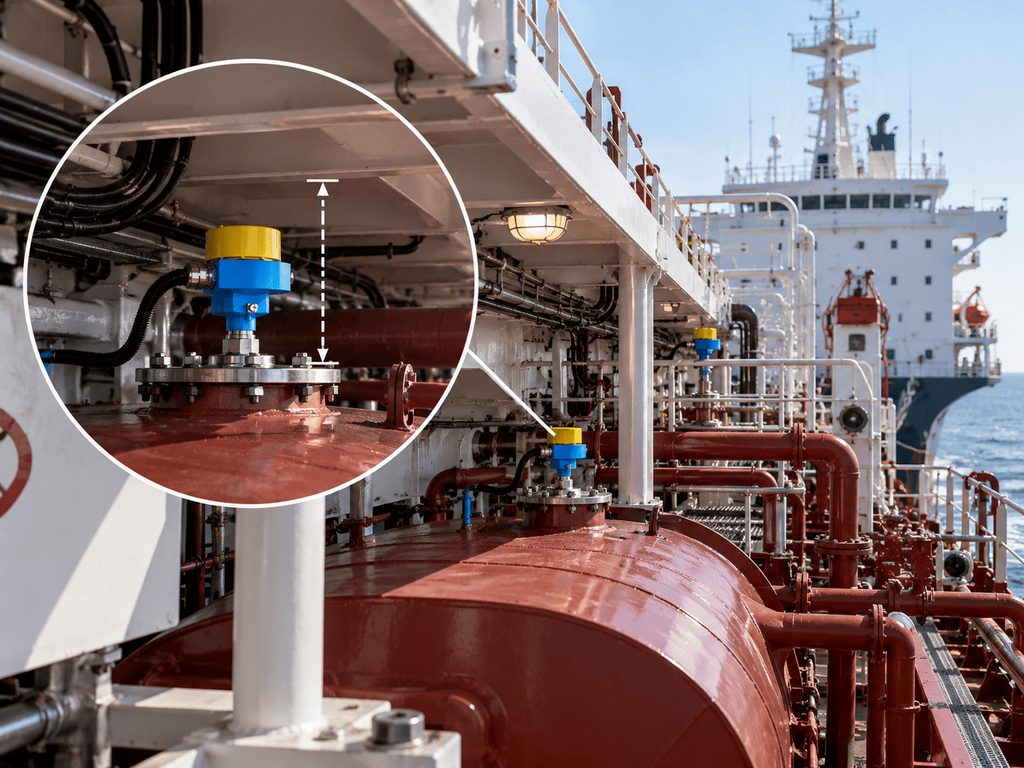
5. Installation Space on Ships Is Often Limited
Space utilization is extremely important in ship design.
As a result, the area above a fuel tank available for installing a level transmitter may be very limited.
Installation methods that are easy to implement on land-based storage tanks, such as large flanges, large antennas, or external bypass chambers, may be difficult to use onboard a vessel.
This is one of the main differences between selecting a marine level transmitter and selecting a general industrial level transmitter.
In addition to measurement performance, engineers should consider:
- Installation height
- Process connection size
- Maintenance access
- Cable routing
- Nearby onboard equipment
For new vessel projects, it is usually better to define the level instrument installation location during the design stage rather than trying to find available space after the tank structure has already been finalized.
6. Continuous Level Measurement May Not Be Enough
Continuous level measurement tells operators how much fuel is currently in the tank.
However, for some critical fuel tanks, one continuous level signal may not be sufficient.
Independent high-level or low-level detection may also be required.
For example:
A continuous level transmitter provides real-time fuel level monitoring.
A separate level switch provides high-level alarm protection.
Additional overflow protection may also be used where required.
This type of design provides an additional layer of safety.
Even if the continuous level measurement system fails, an independent level switch can still provide a warning.
Therefore, a complete marine fuel tank monitoring system may include continuous level measurement, independent level alarms, and integration with the vessel monitoring system.
What Level Instruments Are Commonly Used for Marine Fuel Tanks?
Several technologies are commonly used for marine fuel level measurement.
1. Radar Level Transmitter
Radar level transmitters provide non-contact liquid level measurement.
Typical advantages include:
- No direct contact with the fuel
- Low sensitivity to density changes
- Relatively low maintenance
- Suitable for continuous level measurement
- No moving mechanical parts
For narrow tanks or tanks with complex internal structures, beam angle and mounting position are especially important.
2. Guided Wave Radar Level Transmitter
Guided wave radar uses a rod or cable probe to guide the microwave signal.
Because the signal travels along a defined path, guided wave radar can be useful in narrow tanks or applications with complicated internal structures.
However, when measuring highly viscous or strongly coating products, buildup on the probe should be considered.
3. Hydrostatic Level Transmitter
Hydrostatic level measurement is widely used in many liquid tank applications, including marine systems.
Its main advantages include simple installation and relatively straightforward system design.
However, because the measurement depends on liquid density, changes in fuel density can influence the calculated level.
How to Select a Level Transmitter for a Marine Fuel Tank
Before selecting a level instrument, the following information should normally be confirmed:
Fuel type: Diesel, heavy fuel oil, marine gas oil, or another fuel?
Measurement range: What is the total tank height and normal operating level?
Temperature: Is the fuel heated?
Tank structure: Are there beams, baffles, heating coils, or pipes inside the tank?
Installation conditions: What process connection and installation space are available?
Measurement requirement: Is continuous level measurement enough, or are independent level alarms also required?
Certification: Does the project require marine approval, classification society certification, or hazardous-area approval?
Only by considering the actual operating conditions can the most suitable marine fuel tank level measurement solution be selected.
Conclusion
The challenge of marine fuel tank level monitoring is not simply measuring the liquid height.
Vessel movement, fuel viscosity, temperature variation, internal tank structures, limited installation space, and safety requirements can all affect measurement performance.
Therefore, when selecting a marine fuel tank level transmitter, engineers should not focus only on accuracy or instrument price.
The complete operating environment should be evaluated.
For applications where reduced maintenance and non-contact measurement are important, radar level transmitters are often worth considering.
For narrow tanks or specific internal configurations, guided wave radar may be suitable.
For relatively stable applications where cost is a major consideration, hydrostatic level measurement can also be practical.
The final selection should always be based on fuel properties, tank geometry, installation conditions, system requirements, and marine certification requirements.
FAQ
Can radar level transmitters be used in marine fuel tanks?
Yes. Non-contact radar level transmitters can be used for continuous fuel level measurement in many marine applications. Proper mounting location and beam angle should be selected according to the internal tank structure.
Does vessel movement affect level measurement?
Yes. Pitching and rolling can cause the liquid surface to fluctuate. A marine level transmitter should therefore provide stable signal processing, and suitable damping or alarm delay settings may be required.
Is guided wave radar better than non-contact radar for fuel tanks?
There is no universal answer. Non-contact radar offers low maintenance, while guided wave radar may perform well in narrow or structurally complicated tanks. Selection should be based on fuel properties, tank geometry, installation location, and measurement range.