1. Introduction: The Importance of Tank Level Monitoring in Textile Dyeing
Dye Preparation Tank level measurement helps textile plants manage chemical preparation and dosing.
Textile dyeing is a complex manufacturing process involving the preparation, storage, mixing, and transfer of different chemical solutions.
Dye preparation tanks are used to dissolve colorants and combine them with water, auxiliaries, and other chemical additives before the prepared solutions are supplied to dyeing machines.
Accurate liquid level information is important for maintaining consistent preparation batches, coordinating chemical transfer, and preventing interruptions during production.
However, textile dye preparation tanks may contain different types of liquids with varying physical and chemical properties.
Some solutions contain dissolved dyes, dispersing agents, surfactants, salts, and other additives.
Depending on the formulation, the liquid may produce foam during mixing or exhibit changing properties with temperature and concentration.
Traditional contact-type measurement instruments may require additional maintenance when exposed to chemical residues or material buildup.
The JWrada-32 radar level meter offers a non-contact measurement option for suitable dye preparation tank applications.
Using 80 GHz FMCW radar technology, it measures the distance to the liquid surface without requiring an immersed sensing element.
This article discusses the application of JWrada-32 in textile dye preparation systems and explains the important selection and installation considerations.
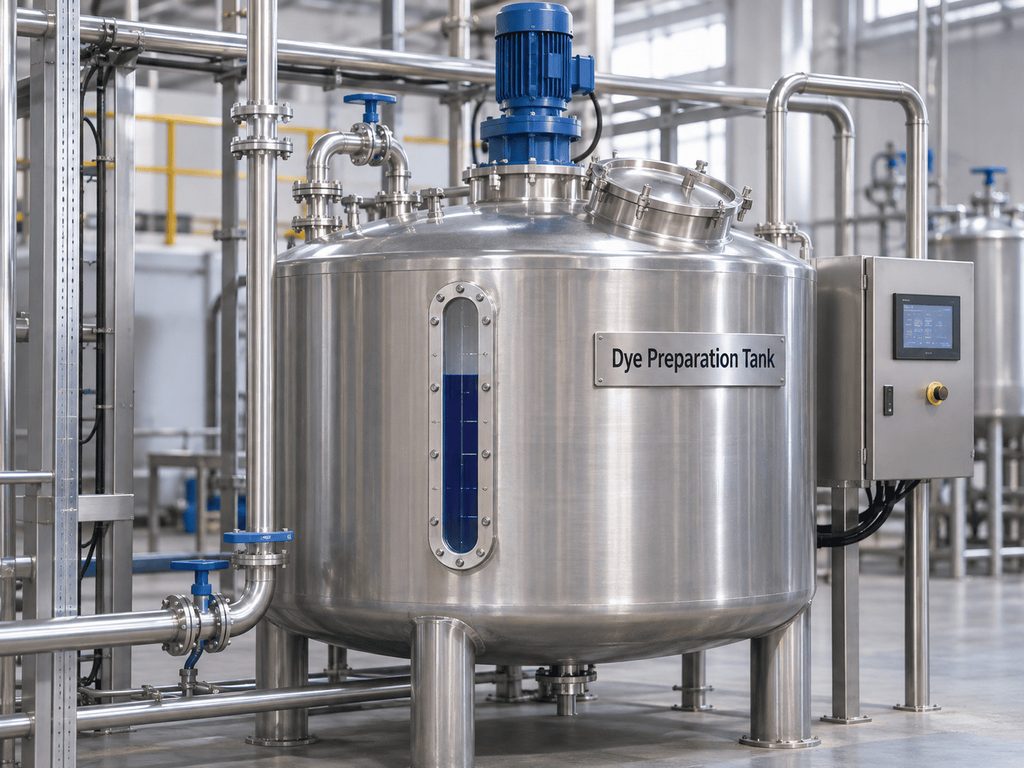
2. Measurement Challenges in Textile Dye Preparation Tanks
2.1 Different Chemical Formulations
Textile dyeing facilities use a wide range of chemical solutions.
The dielectric properties of these liquids may differ according to dye concentration, solvent content, water content, and additives.
These differences can influence the strength of the radar reflection.
Therefore, the actual formulation should be considered when evaluating the instrument.
A successful application with one dye solution does not automatically guarantee identical performance with every chemical mixture.
2.2 Foam During Mixing
Dye preparation tanks often include mechanical mixers or circulation systems.
Surfactants and other additives may contribute to foam formation during agitation.
Foam can alter the radar reflection depending on its thickness and physical structure.
The mounting position should be selected away from areas where persistent foam accumulates.
2.3 Chemical Corrosion and Material Compatibility
Some textile chemicals may be corrosive or incompatible with certain metals and sealing materials.
Although non-contact radar measurement avoids immersing the sensing element, the process connection and antenna assembly may still be exposed to vapor, splashing, or condensation.
Material compatibility must therefore be checked against the actual chemical composition.
2.4 Temperature Variations
Dye preparation may involve heated water or temperature-controlled chemical solutions.
Temperature changes can affect the process medium and the surrounding vapor environment.
The selected instrument configuration must be suitable for the actual operating temperature and pressure.
2.5 Tank Internal Structures
Mixing shafts, pipes, support brackets, and other components can create unwanted radar reflections.
The installation point should provide a clear measurement path toward the liquid surface.
3. Why Consider JWrada-32 for Textile Dye Preparation Tanks?
The JWrada-32 is an industrial 80 GHz FMCW radar level meter designed for non-contact level measurement.
Its published technical characteristics include:
- Operating frequency: 80 GHz.
- Maximum measuring range: 60 m.
- Measurement accuracy up to ±1 mm under specified conditions.
- 38 mm lens antenna.
- Intelligent echo processing.
- False-echo learning.
- Multi-echo separation.
- Dynamic target tracking.
- 4–20 mA/HART and RS485/Modbus communication options, depending on configuration.
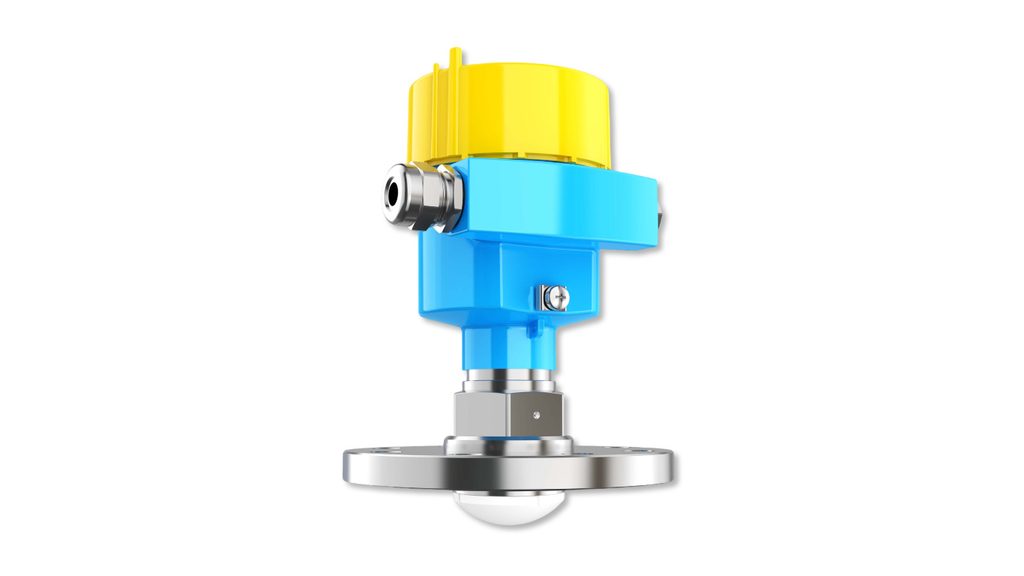
3.1 Non-Contact Measurement
The radar instrument measures from above the liquid surface.
It does not require an immersed probe or mechanical float.
This can reduce maintenance associated with direct contact between sensing components and dye solutions.
3.2 Focused Radar Beam
The 80 GHz frequency supports a concentrated radar beam.
This helps engineers select a measurement path that minimizes reflections from nearby pipes and mixing equipment.
3.3 Intelligent Echo Processing
The instrument includes functions for identifying the actual liquid surface among multiple reflections.
These functions are useful when the tank contains internal structures.
However, the actual echo should be verified during commissioning, especially when the mixer is operating.
3.4 Industrial Communication
Compatible JWrada-32 configurations can provide 4–20 mA/HART or RS485/Modbus communication.
This allows liquid level data to be transmitted to a PLC or DCS.
The information can support batch preparation, chemical transfer, and replenishment management.
4. Typical Application Scenario
Consider a textile dyeing facility that prepares different color solutions in dedicated mixing tanks.
The solutions are transferred to dyeing machines according to production schedules.
The plant wants to introduce continuous level monitoring to improve chemical inventory management and reduce manual inspections.
A representative engineering scenario is shown below.
| Parameter | Example Condition |
|---|---|
| Medium | Aqueous textile dye solution |
| Vessel | Vertical preparation tank |
| Tank height | Approximately 6 m |
| Operating temperature | Ambient to moderately heated |
| Pressure | Near atmospheric pressure |
| Internal equipment | Mixing and circulation system |
| Measurement method | Top-mounted radar |
| Control system | PLC |
| Output | 4–20 mA/HART |
| Instrument | JWrada-32 |
These are illustrative engineering conditions rather than verified customer project data.
The final selection should consider the chemical composition, temperature range, foam characteristics, and vessel configuration.
5. Recommended Installation Arrangement
5.1 Avoid the Mixer Shaft
The radar should not be positioned where the beam directly intersects the mixer shaft or other internal metal components.
The tank drawing should be reviewed before determining the mounting position.
5.2 Avoid the Chemical Inlet
Incoming dye solution may cause local turbulence and splashing.
A mounting location away from the inlet stream can help improve measurement stability.
5.3 Consider Chemical Compatibility
The antenna, sealing materials, and process connection should be suitable for the actual chemical environment.
Where chemical vapors or splashing are present, additional protection may be necessary.
5.4 Check the Mounting Nozzle
The nozzle dimensions should be checked against the instrument’s installation requirements.
Excessively long or narrow mounting connections may produce unwanted reflections.
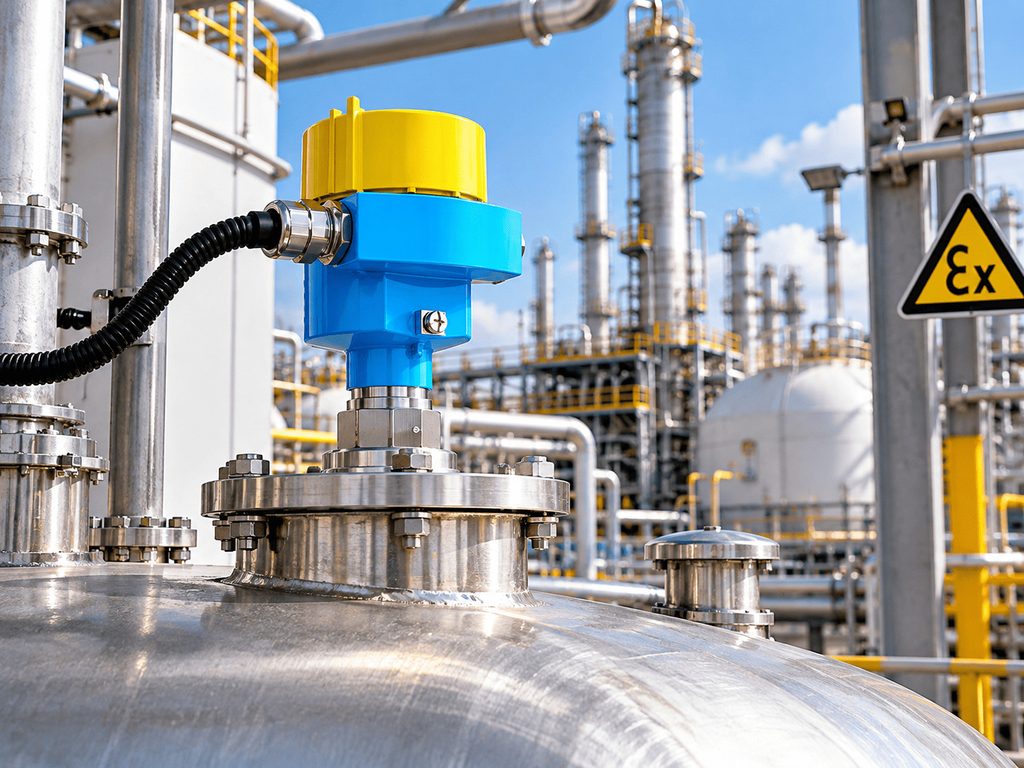
6. Commissioning and Configuration
The commissioning process should begin with the tank dimensions and measurement reference point.
The technician should configure the empty distance, operating range, and output scaling.
The echo profile should then be checked under different operating conditions.
Important conditions include:
- Tank filling.
- Normal mixing.
- Chemical transfer.
- Low liquid level.
- High liquid level.
- Changes in solution formulation.
If unwanted echoes are detected, their sources should be identified before applying false-echo learning.
The damping setting should be selected according to the required response time and the degree of surface movement.
The output signal should also be checked against the PLC to ensure correct level conversion.
7. PLC Integration and Automated Dye Preparation
The JWrada-32 can provide continuous level information for dye preparation systems.
Batch Preparation Monitoring
Operators can monitor the liquid level in each preparation tank and coordinate solution preparation with production requirements.
Chemical Transfer Control
The level signal can support transfer pump management and material availability checks.
Replenishment Management
Low-level warnings can notify operators when additional dye solution or preparation chemicals are required.
High-Level Monitoring
The control system can generate high-level alarms to help reduce the possibility of tank overfilling.
Independent protection should be considered where required by the process risk assessment.
Production Data Recording
Historical level trends can help the plant review batch preparation and chemical consumption patterns.
8. Expected Operational Benefits
A suitable JWrada-32 installation may provide:
- Continuous monitoring of dye preparation tanks.
- Reduced dependence on manual level inspection.
- Non-contact measurement for suitable chemical solutions.
- Improved visibility of chemical inventory.
- Support for automated transfer operations.
- Integration with existing textile production control systems.
The actual performance should be established through field testing and commissioning records.
9. Frequently Asked Questions
Q1: Can JWrada-32 measure textile dye solutions?
It can be evaluated for suitable aqueous dye solutions. Final suitability depends on the solution’s dielectric properties, foam, temperature, and tank geometry.
Q2: Do dye colors affect radar measurement?
Visible color alone is not the determining factor. Radar performance depends more directly on the electromagnetic properties of the medium and the process conditions.
Q3: Does foam interfere with radar measurement?
Thick or persistent foam may alter the reflected signal. The actual foam conditions should be evaluated.
Q4: Is the instrument suitable for corrosive dyeing chemicals?
The non-contact principle avoids immersing the sensing element, but process connection and antenna materials must still be checked for chemical compatibility.
Q5: Can JWrada-32 connect to a textile factory PLC?
Yes. Compatible configurations support 4–20 mA/HART and RS485/Modbus communication.
10. Conclusion
Textile dye preparation tanks require dependable level monitoring to support chemical preparation, transfer, and production scheduling.
Different liquid formulations, foam, temperature changes, and internal mixing equipment can complicate conventional measurement.
The JWrada-32 80 GHz radar level meter provides a non-contact alternative for suitable dye preparation applications.
With proper material compatibility checks, installation planning, and echo verification, the instrument can support continuous tank level monitoring and improve the visibility of chemical inventory in textile dyeing facilities.