In industrial automation sites, radar level meters have become important instruments for measuring liquids, powders, granules, corrosive media, and complex tanks. Many users face the same question during product selection: What is the difference between a 26G radar level meter and an 80G radar level meter? Which one is better?
Simply put, 80G radar does not “outperform 26G in every possible application.” However, in most modern level measurement scenarios, an 80G radar level meter offers a narrower beam angle, smaller antenna size, stronger focusing capability, and higher measurement resolution. In comparison, a 26G radar level meter is more mature, relatively lower in cost, and widely applicable. It still has value in some applications involving steam, foam, dust, or simple tank structures.
1. The Essential Difference Between 26G and 80G: Different Frequency, Different Wavelength
26G usually refers to a radar level meter operating at approximately 26GHz, while 80G usually refers to a millimeter-wave radar level meter operating in the 76–81GHz frequency band. According to the electromagnetic wave formula λ = c / f, the higher the frequency, the shorter the wavelength. The wavelength of a 26GHz radar is approximately 11.5mm, while the wavelength of an 80GHz radar is approximately 3.75mm. This difference directly affects antenna size, beam angle, echo resolution, and installation adaptability.
From an engineering perspective, with the same antenna aperture, the higher the frequency, the narrower the beam angle. In other words, an 80G radar level meter can achieve a more concentrated beam with a smaller antenna. VEGA’s public information mentions that 80GHz radar can achieve a beam angle of about 3° with an 80mm antenna. A narrow beam helps reduce false echoes caused by internal tank structures such as tank walls, heating coils, agitators, and other obstacles.
2. Beam Angle: 80G Is Narrower and More Suitable for Complex Tanks
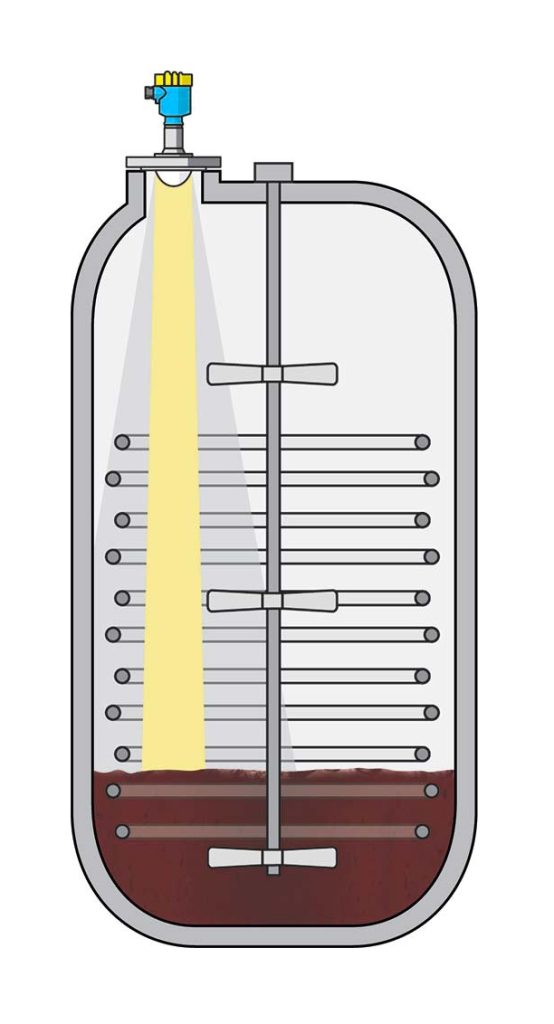
Beam angle is one of the most visible differences between 26G and 80G radar level meters. A 26G radar has a relatively wider beam. When there are agitators, reinforcing ribs, inclined tank walls, feeding inlets, coils, or other internal structures inside the tank, it is more likely to receive reflected signals from surfaces other than the real material level.
For simple vertical tanks, large installation openings, and vessels with few internal structures, 26G radar can usually operate stably. However, if the tank is narrow, the mounting nozzle is small, or there are many surrounding obstacles, the advantages of 80G radar become much more obvious.
The narrow beam of 80G radar works like a focused flashlight. It can more accurately illuminate the material surface and reduce clutter entering the receiving system. Endress+Hauser also emphasizes that the 3° narrow beam of 80GHz radar helps avoid pipes, baffles, and other internal tank obstacles, while reducing engineering installation difficulty.
3. Accuracy and Resolution: 80G Usually Has an Advantage, But Frequency Is Not the Only Factor
Many people believe that 80G radar must be more accurate than 26G radar. This is generally true in direction, but the statement is not complete. The measurement accuracy of a radar level meter depends not only on frequency, but also on FMCW sweep bandwidth, signal-to-noise ratio, dynamic range, antenna structure, echo algorithm, temperature drift compensation, and factory calibration.
A higher frequency usually makes it easier to design a narrow beam and achieve higher resolution. For FMCW radar, distance resolution is closely related to sweep bandwidth. Theoretically, it can be understood through the formula ΔR ≈ c / (2B), where a larger bandwidth means higher resolution.
In practical applications, 80G products can usually achieve a smaller blind zone, finer echo recognition, and better short-range measurement performance. For example, Endress+Hauser’s public information mentions that its 80GHz tank radar can achieve an accuracy level of ±0.5mm under specific product and range conditions. However, users should not simply assume that “all 80G radar level meters are ±0.5mm,” because actual performance varies depending on brand, model, antenna, medium, and installation conditions.
4. Anti-Interference Capability: 80G Relies on Focusing and Algorithms, While 26G Benefits from Wavelength Advantages
In terms of anti-interference performance, 80G and 26G radar level meters follow different technical logic. The advantage of 80G radar lies in its narrow beam, strong focusing capability, and reduced clutter. It is suitable for complex geometric structures such as tanks with agitators, coils, brackets, narrow vessels, and cone-bottom silos. When combined with intelligent echo algorithms, 80G radar can better distinguish real level echoes from interference echoes.
The advantage of 26G radar is its longer wavelength. In some conditions involving steam, condensation, foam, dust absorption, or scattering, it may be more tolerant. Endress+Hauser also mentions in its selection recommendations that 80GHz radar focuses on precision measurement, while 26GHz or 6GHz radar may be more suitable in environments with heavy steam or simple geometry. When foam or certain vapors cause signal absorption, lower-frequency radar may sometimes provide better penetration performance.
Therefore, it is not accurate to say that 80G radar always has stronger anti-interference capability than 26G radar. A more accurate conclusion is: when the tank has complex internal structures, limited installation space, or the measurement beam needs to avoid obstacles, 80G radar is stronger; in open vessels, heavy steam, thick foam, or budget-sensitive applications, 26G radar still remains competitive.
5. Installation and Maintenance: 80G Is More Suitable for Small Nozzles and Retrofit Projects
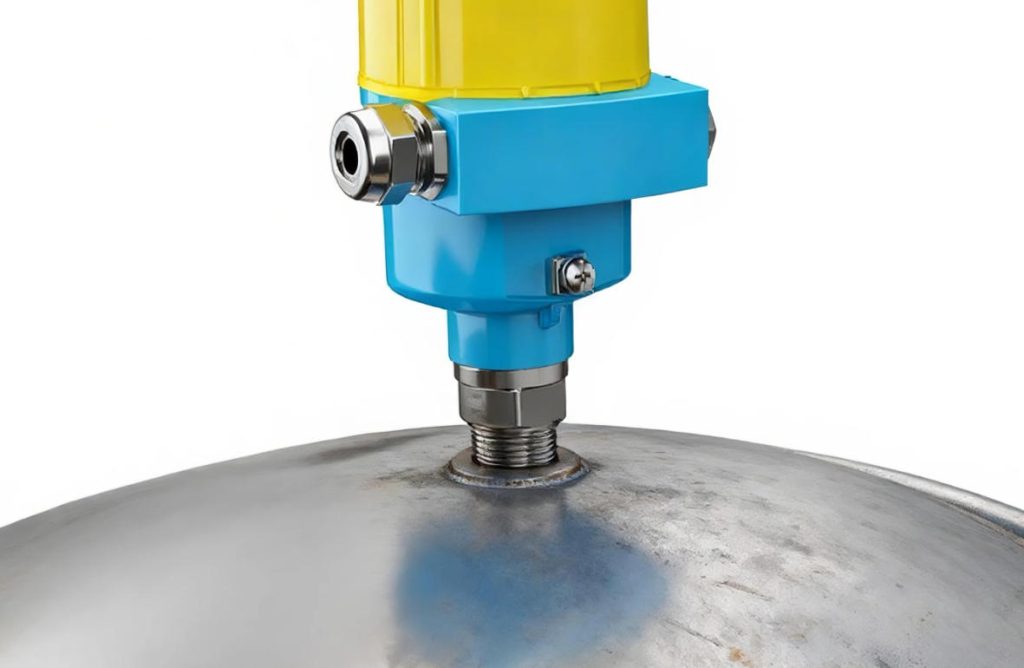
Many existing projects have small reserved process connections, long mounting nozzles, or limited tank-top installation space. To achieve better beam focusing, a 26G radar level meter often requires a larger horn antenna or flange connection. Because 80G radar has a shorter wavelength, it can achieve a narrower beam with a smaller antenna and smaller process connection. This makes it suitable for small tanks, reactors, sanitary vessels, and retrofit projects.
VEGA’s information also points out that 80GHz technology allows antenna systems and process connections to be made smaller, making the technology usable in small vessels and small installation openings.
In terms of maintenance, both 26G and 80G radar level meters are non-contact measurement instruments with no mechanical moving parts, so the overall maintenance workload is low. However, if the medium is prone to crystallization, material buildup, condensation, or adhesion, then antenna structure, purge design, anti-sticking materials, and software filtering capability become very important.
80G radar may be more sensitive to contamination on the antenna surface, but high-quality products can improve performance through lens antennas, PTFE/PEEK encapsulation, false echo suppression, and dynamic echo compensation.
6. Price and Cost Performance: 26G Is Cheaper, But the Overall Cost of 80G May Not Be Higher
In terms of purchase price, 26G radar level meters are usually cheaper. The domestic supply chain is mature, making 26G radar suitable for applications with limited budgets, simple working conditions, and non-extreme accuracy requirements.
80G radar level meters often have a higher unit price. However, in applications involving complex tank structures, difficult installation, high commissioning cost, or expensive downtime, 80G radar may actually offer better overall cost performance.
For example, if a reactor contains an agitator and heating coils, a 26G radar may require repeated angle adjustment, false echo mapping, and still suffer from signal jumps. If an 80G radar can achieve stable level recognition after one installation, the time saved in commissioning, maintenance, and reduced downtime risk may far exceed the price difference of the instrument itself.
7. How to Choose Between 26G and 80G Radar Level Meters
For clean liquids, narrow tanks, small process openings, strong agitation, many internal tank obstacles, and applications requiring high accuracy and high stability, an 80G radar level meter should be preferred.
For ordinary water tanks, open storage tanks, simple silos, budget-sensitive applications, and general accuracy requirements, a 26G radar level meter is still sufficient.
If the site involves thick foam, strong condensation, heavy steam, very low dielectric constant media, or large amounts of dust, selection should be based on medium characteristics, installation height, process temperature and pressure, antenna type, and the manufacturer’s application experience. On-site testing is recommended when necessary.
Endress+Hauser also describes 26GHz radar as having good focusing capability, being suitable for many applications, and maintaining accuracy under turbulent conditions. The advantages of 80GHz radar are mainly concentrated in best-in-class focusing, longer range, and high accuracy.
8. JWrada® Radar Level Meter: A Domestic Solution Competing with VEGA
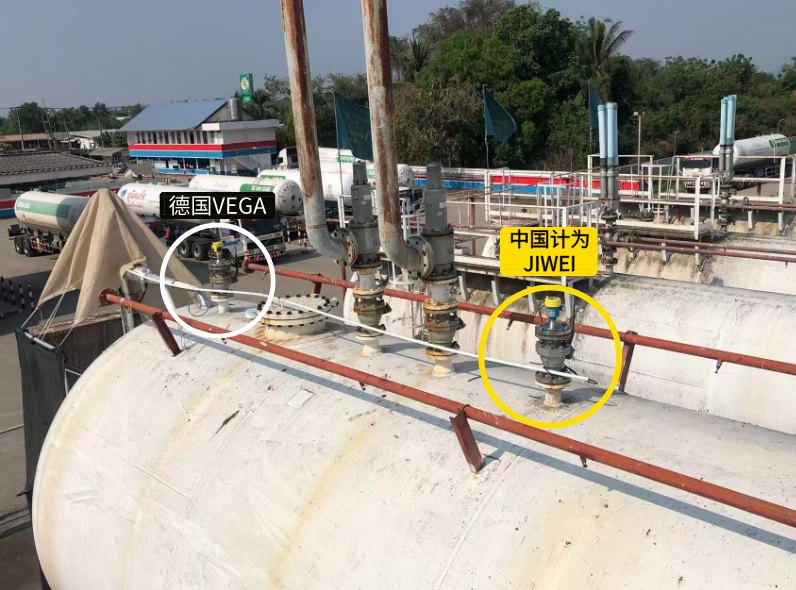
The Jiwei JWrada® radar level meter is designed with high accuracy, easy installation, and high reliability in mind:
Integrated stable Bluetooth connection
Intuitive APP operation, supporting remote commissioning and one-click parameter copying across multiple devices
LCD display and physical buttons for full manual control
Range can be preset before delivery, and quick on-site adjustment can be completed within 2–5 minutes
Non-contact measurement, supporting complex media and small process openings
JWrada® has successfully replaced VEGA in multiple applications. It provides maximum flexibility, efficiency, and reliability for the global market, and is the only radar level meter in the Chinese market capable of competing with VEGA.
Conclusion: Which One Is Better?
If we only look at technical advancement, the 80G radar level meter is better. It represents the current development direction of radar level measurement and is especially suitable for high-accuracy measurement, complex tanks, small process openings, strong interference, and intelligent commissioning scenarios.
However, from the perspective of real-world selection, there is no absolute “best” option — only the most suitable one. The 26G radar level meter is mature, stable, and cost-effective, and it remains an economical and reliable choice in many conventional applications.
The final recommendation is: choose 26G radar for conventional and simple working conditions, and choose 80G radar for complex and demanding applications. If a project emphasizes long-term stability, low maintenance, easy installation, and future expansion, 80G radar is usually the better priority.
26G radar level meter, 80G radar level meter, radar level transmitter, radar level sensor, radar liquid level meter, radar material level meter, level measurement selection, FMCW radar, non-contact level measurement, industrial radar level measurement.