Reliable level measurement in a cement raw meal silo can be challenging. High dust concentrations, uneven material surfaces, tall silo structures, internal obstructions, and powder buildup on the radar antenna can all affect measurement stability.
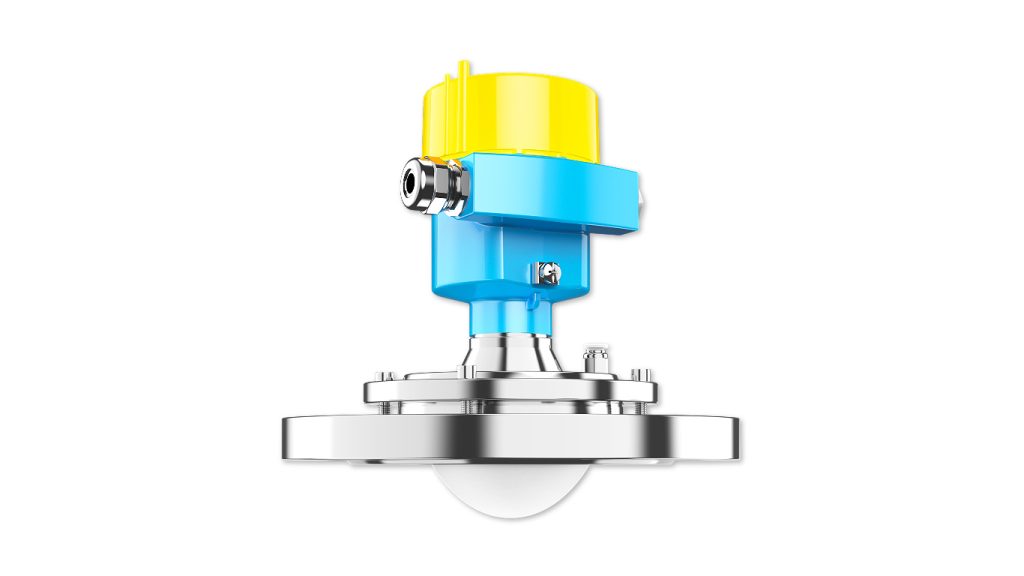
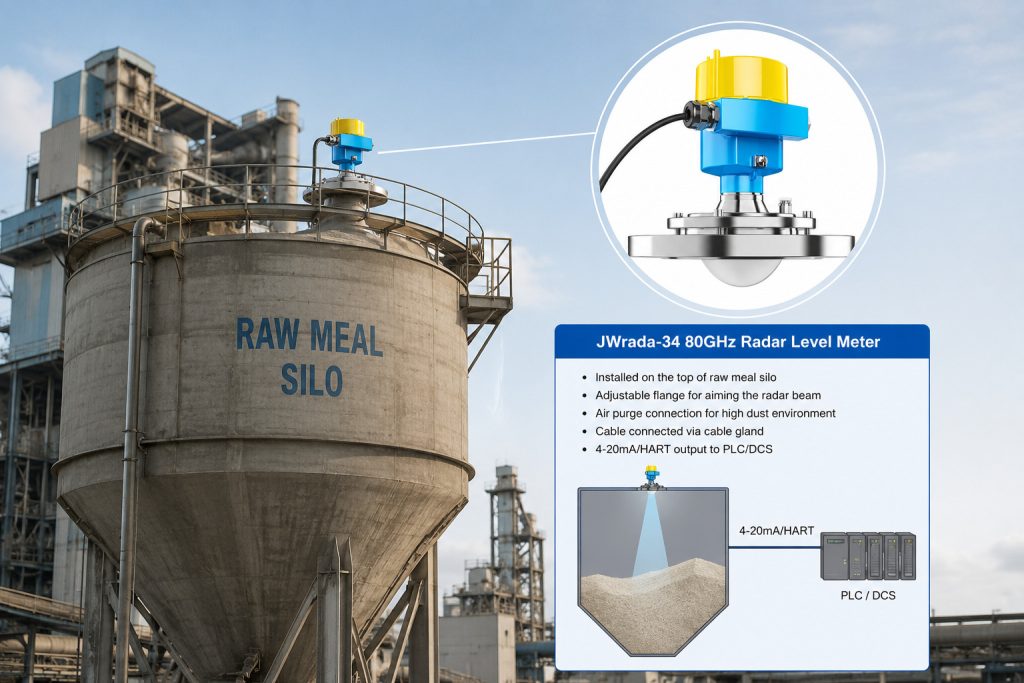
For these demanding conditions, the JWrada-34 80GHz radar level meter with an air purge system and adjustable universal flange provides an effective solution for continuous raw meal silo level measurement.
By combining narrow-beam 80GHz FMCW radar technology, intelligent echo processing, antenna air purging, and flexible antenna alignment, the instrument can maintain reliable measurement even under dusty and complex operating conditions.
This application case explains the measurement challenges found in cement raw meal silos, why the JWrada-34 was selected, how the air purge and adjustable flange improve performance, and what should be considered during installation and commissioning.
1. Why Is Raw Meal Silo Level Measurement Difficult?
Raw meal silos play an important role in cement production. After raw materials are crushed, proportioned, and ground into fine powder, the resulting raw meal is transferred to storage and homogenization silos before entering the kiln system.
Accurate silo level measurement helps operators maintain stable material flow between the raw grinding and clinker production processes.
However, a raw meal silo is one of the more demanding applications for industrial level instrumentation.
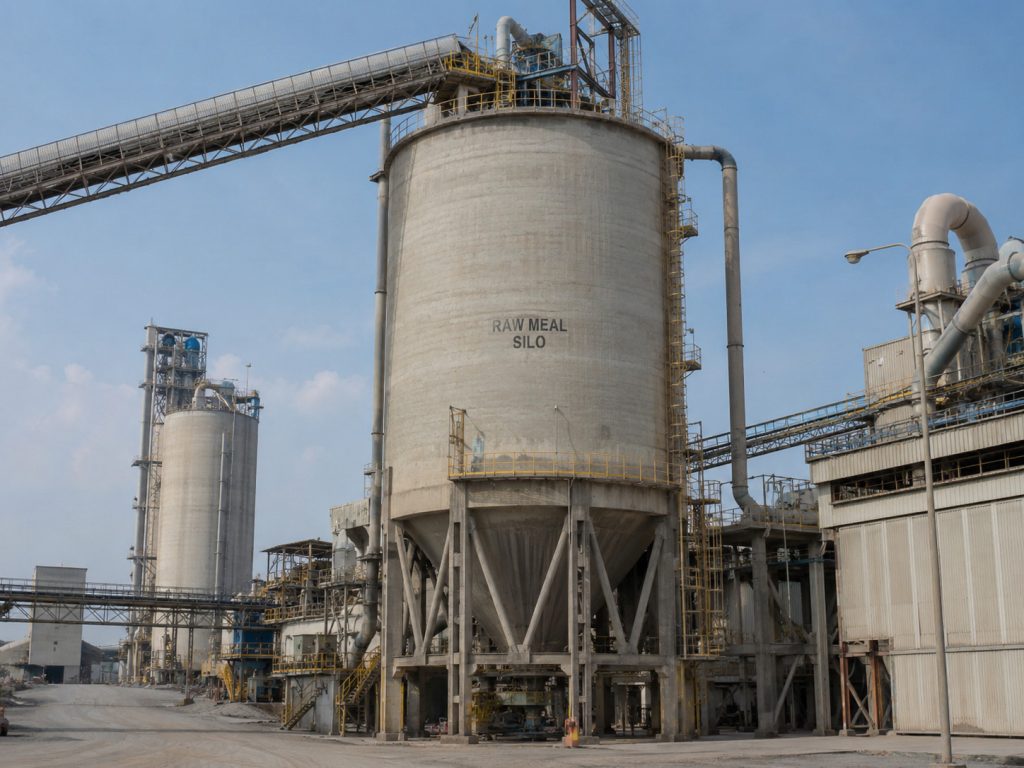
High Dust Concentration
Raw meal is an extremely fine powder.
During pneumatic conveying, silo filling, and material discharge, a large amount of airborne dust can be generated inside the silo. During continuous filling operations, the atmosphere above the material surface may remain heavily contaminated with suspended powder for extended periods.
This dusty environment can create difficulties for some conventional level measurement technologies.
Dust can also accumulate around the measuring instrument. If powder continuously deposits on the antenna surface, the transmitted and received radar signals may gradually become weaker.
Uneven Material Surface
Unlike liquids, powdered solids do not produce a flat horizontal surface.
When raw meal enters the silo, it forms an angle of repose. Depending on the filling point, discharge arrangement, material flow characteristics, and silo geometry, the surface may contain peaks, valleys, slopes, or irregular areas.
A radar level meter therefore needs to measure a representative area of the material surface rather than simply pointing vertically downward from any available process connection.
Internal Obstructions
A cement silo may contain or be affected by:
- Filling pipes
- Internal supports
- Silo wall reflections
- Structural beams
- Nozzles
- Material streams
- Other internal components
These structures can generate unwanted radar echoes.
If the radar beam is too wide or incorrectly aimed, the instrument may receive reflections from both the actual raw meal surface and surrounding structures.
Tall and Narrow Silo Geometry
Large cement plants often use tall silos with relatively limited internal space.
The longer the measuring distance, the more important radar beam focusing becomes. A wide radar beam can eventually reach the silo wall or internal structures, increasing the possibility of false echoes.
For these reasons, reliable cement raw meal silo level measurement requires more than a standard distance sensor. It requires a radar system designed for dusty bulk solids and complex silo geometry.
2. Application Background
In this application, a cement production facility required continuous level measurement in a raw meal storage silo.
The level signal needed to be transmitted to the plant PLC or DCS so operators in the central control room could monitor:
- Current raw meal inventory
- Silo filling conditions
- Material consumption
- Feeding and discharge trends
- High and low material levels
- Production balance
The existing measurement arrangement experienced several challenges.
First, significant dust was generated during raw meal filling. Dust continuously circulated near the top of the silo and gradually accumulated around the measuring area.
Second, the raw meal surface was not flat. Material entered from the upper part of the silo and formed a sloping surface.
Third, the existing process connection on the silo roof was not positioned directly above the ideal measuring point.
A radar mounted on a conventional fixed flange would therefore point vertically downward, potentially measuring an unrepresentative part of the material pile.
Finally, because the instrument was installed at the top of a tall silo, frequent manual cleaning and parameter adjustment would increase maintenance requirements and the amount of work performed at height.
To address these conditions, a JWrada-34 80GHz radar level meter equipped with an air purge system and adjustable flange was selected.
3. Why Was the JWrada-34 80GHz Radar Level Meter Selected?
The JWrada-34 uses 80GHz FMCW radar technology for non-contact continuous level measurement.
The radar antenna transmits high-frequency electromagnetic waves toward the material surface. These waves are reflected by the raw meal surface and received by the antenna.
Through frequency processing and echo analysis, the instrument calculates the distance between the antenna and the material surface. This distance is then converted into the actual material level inside the silo.
For cement raw meal applications, several characteristics of the JWrada-34 are particularly important.
80GHz High-Frequency Radar
Compared with lower-frequency radar instruments, 80GHz radar technology can produce a much narrower and more focused measuring beam.
This is especially useful for tall silos.
The concentrated radar beam allows the instrument to focus more effectively on the selected measurement area while reducing the possibility that surrounding structures enter the main measuring path.
Large Measuring Range
The JWrada-34 is designed for long-distance solid level measurement, with a maximum measuring range of up to approximately 150 meters depending on the application and configuration.
This makes it suitable not only for raw meal silos but also for many large industrial storage vessels.
Intelligent Echo Processing
Bulk solids generate more complicated radar reflections than flat liquid surfaces.
The JWrada-34 uses intelligent echo processing to help identify the actual material surface, suppress false echoes, separate multiple reflections, and track changing material levels.
Air Purge Option
An air purge connection can be used to reduce powder accumulation around the antenna.
This feature is particularly valuable in cement plants, where fine material can continuously deposit on exposed equipment.
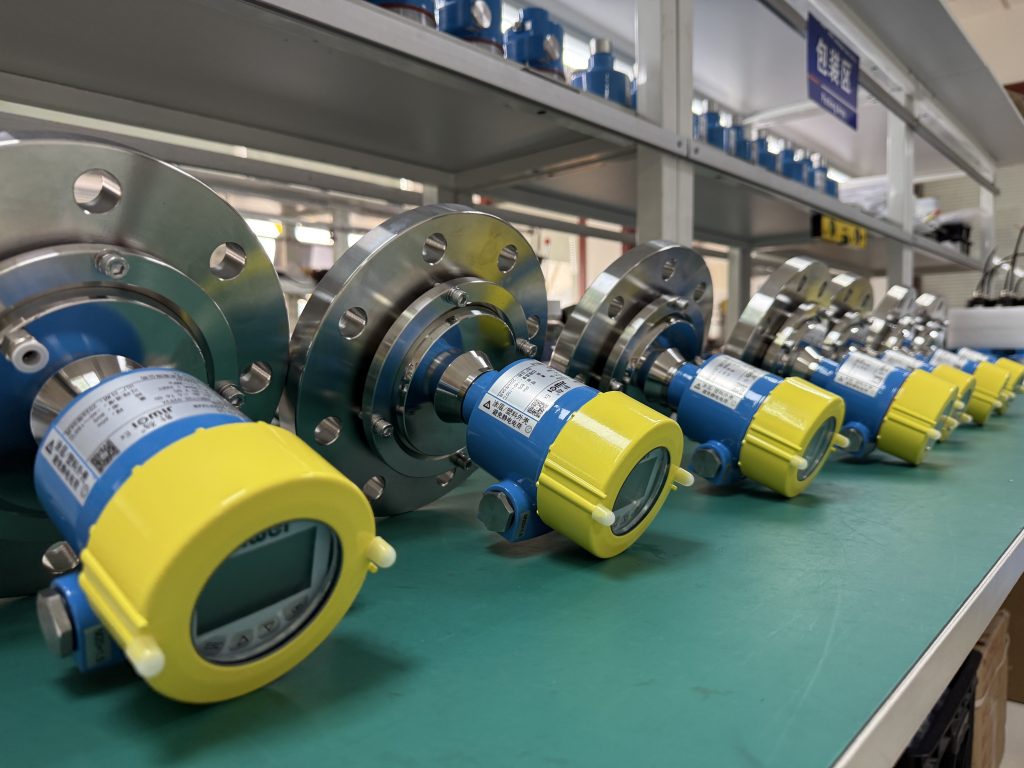
Adjustable Universal Flange
The adjustable flange allows the direction of the radar antenna to be changed after installation.
This means the radar beam can be aimed toward a more representative material surface and away from filling streams or internal obstructions.
Together, these characteristics make the JWrada-34 well suited to demanding powder silo level measurement applications.
4. How the 80GHz Narrow Beam Reduces False Echoes
One of the most important factors in radar level measurement is the beam angle.
A radar sensor does not transmit an infinitely narrow line. It emits a beam with a certain angle, and the diameter of the beam increases as the measurement distance becomes longer.
In a tall cement silo, this becomes extremely important.
If a radar level transmitter has a relatively wide beam, the beam may eventually reach:
- The silo wall
- Filling equipment
- Internal structural components
- Support beams
- Other reflective surfaces
These objects can create strong unwanted echoes.
The instrument then has to distinguish between the true raw meal surface and these fixed reflections.
The 80GHz radar technology used by the JWrada-34 produces a narrow, highly focused beam.
This allows more radar energy to be directed toward the intended measurement area.
For raw meal silos, the benefit is significant.
A narrow beam helps reduce wall reflections and allows the sensor to monitor a specific area of the material surface without receiving excessive signals from surrounding structures.
This focused measurement is especially useful when the raw meal surface contains peaks and slopes.
Instead of receiving reflections from a large irregular area, the radar can track a smaller and more representative target area.
As a result, the combination of narrow-beam transmission and intelligent echo processing improves the ability of the instrument to identify the actual material level.
5. Air Purge Function Helps Prevent Antenna Buildup
High dust is only one part of the challenge in a cement silo.
Another important issue is material buildup on the radar antenna.
During pneumatic conveying and silo filling, extremely fine raw meal particles are carried upward by air movement.
Some of these particles can eventually settle on the radar antenna.
If the buildup becomes severe, it may reduce the efficiency of radar signal transmission and reception.
For this reason, the JWrada-34 used in this application was equipped with an air purge system.
Clean, dry instrument air can be introduced through the purge connection to help keep the antenna area free from excessive powder deposits.
The purge arrangement provides several practical benefits.
Reduced Antenna Contamination
Regular air purging helps prevent fine raw meal powder from forming a thick layer over the antenna surface.
Improved Long-Term Measurement Stability
Keeping the antenna relatively clean helps maintain consistent radar signal transmission and reception during long-term operation.
Reduced Manual Cleaning
Without an air purge system, plant personnel may need to periodically access the silo roof and clean the antenna manually.
In a large cement plant, reducing unnecessary silo-top maintenance is an important operational advantage.
Lower Maintenance Requirements
Less manual cleaning means fewer maintenance interventions and less disruption to continuous production.
The purge function is particularly valuable for:
- Raw meal silos
- Cement silos
- Fly ash silos
- Mineral powder silos
- Fine powder storage vessels
- Other high-dust bulk solid applications
The purpose of the air purge system is therefore not simply to remove dust. It helps maintain the radar antenna in a suitable operating condition over a longer period.
6. Why the Adjustable Flange Is Important for Solid Level Measurement
The adjustable universal flange is another important feature in this raw meal silo application.
In many existing cement plants, instrument mounting openings have already been installed on the silo roof.
However, the available mounting position may not be directly above the ideal measurement area.
With a conventional fixed flange, the radar antenna normally points vertically downward.
This may be acceptable for a flat liquid surface, but bulk solids behave differently.
Raw meal forms a sloping surface as it enters the silo.
If the radar is positioned near the silo wall and points straight down, it may measure a local high or low point rather than a representative section of the material surface.
An adjustable flange allows the radar antenna to be tilted toward a more suitable measuring point.
The beam can therefore be directed:
- Away from the filling stream
- Away from internal structures
- Away from the silo wall
- Toward a representative material surface
The JWrada-34 adjustable mounting structure allows an inclination of approximately up to 10°, depending on the exact installation configuration.
Even a relatively small adjustment angle can make a significant difference over a long measuring distance.
For example, when the measuring distance is approximately 10 meters, changing the radar direction by several degrees can move the measurement point noticeably across the material surface.
This provides an important advantage during retrofit projects.
Instead of creating a new opening in the silo roof, the existing process connection may be used while the adjustable flange redirects the radar beam toward the preferred measurement area.
7. Installation Considerations for a Cement Raw Meal Silo
Even the best radar level meter cannot achieve optimum performance if it is installed incorrectly.
For a raw meal silo application, several installation details should be considered carefully.
Avoid the Filling Stream
The radar should generally not be installed directly above the falling material stream.
If the radar beam intersects the incoming raw meal, the instrument may receive reflections from the falling material instead of the stable surface below.
This can lead to unstable or incorrect level readings during filling.
The mounting position should therefore be selected according to the filling direction and material distribution pattern.
If necessary, the adjustable flange can then be used to aim the radar beam toward a more stable measurement area.
Maintain Suitable Distance from the Silo Wall
The instrument should not be positioned too close to the silo wall.
A reasonable clearance helps reduce strong reflections from the wall.
For many solid applications, a minimum distance of approximately 200 mm from the vessel wall is recommended, although the final position should always be determined according to silo dimensions, radar beam angle, internal structures, and the actual process conditions.
For large cylindrical silos, the optimum installation position is not always the exact center.
If the filling point is located in the center, installing the radar directly above it may create unnecessary interference.
The best mounting position should therefore be determined by considering:
- Silo diameter
- Silo height
- Filling point
- Discharge point
- Material angle of repose
- Internal structures
- Radar beam angle
Aim the Radar at a Representative Material Surface
Once the instrument is mounted, the universal adjustable flange can be used to optimize the radar direction.
The objective is not simply to point the sensor toward the highest material peak.
Instead, the radar should measure an area that accurately represents the operating level of the silo.
Perform False Echo Mapping
After mechanical installation, the echo curve should be checked during commissioning.
Fixed reflections generated by the mounting nozzle, silo wall, roof structure, or other permanent objects can be identified during setup.
False echo suppression and intelligent echo processing can then help the radar distinguish these fixed reflections from the actual moving material surface.
This commissioning step is particularly valuable in complex cement silo installations.
8. Bluetooth Commissioning Simplifies Maintenance
In traditional level measurement systems, technicians often need to stand next to the instrument to configure parameters using local buttons or a handheld device.
For a radar installed on top of a tall cement silo, this is not always convenient.
The JWrada-34 supports Bluetooth wireless communication, allowing technicians to configure and monitor the instrument more conveniently using a compatible mobile device.
Depending on the configuration, functions can include:
- Parameter configuration
- Measuring range setup
- Echo curve monitoring
- Instrument status checking
- Diagnostic information
- Commissioning adjustment
The instrument can also support industrial signal interfaces such as:
- 4–20mA
- HART
- RS485
- Modbus
This allows the radar level signal to be integrated into the plant PLC or DCS.
Operators in the control room can then continuously monitor raw meal inventory without relying on manual level checks.
If measurement fluctuations occur, maintenance personnel can first analyze instrument status and echo behavior before deciding whether a physical inspection is required.
This can improve troubleshooting efficiency and reduce unnecessary access to the silo roof.
9. Results and Benefits of the Application
Using the JWrada-34 with an air purge system and adjustable flange provides several benefits for continuous raw meal level measurement.
More Stable Continuous Level Measurement
The 80GHz narrow radar beam helps reduce reflections from silo walls and internal structures.
Combined with intelligent echo processing, the instrument can more effectively track the actual raw meal surface.
Reduced Impact of Dust Buildup
The air purge system helps prevent excessive powder accumulation on the radar antenna.
This supports more stable long-term operation in dusty cement environments.
Greater Installation Flexibility
The adjustable flange allows the radar beam direction to be optimized after installation.
This is especially useful where the existing mounting connection is not located directly above the best measuring point.
Reduced Manual Maintenance
Continuous remote level monitoring and an air purge arrangement can reduce the need for frequent manual inspection and antenna cleaning.
Better Material Inventory Visibility
The continuous level signal can be transmitted to the plant control system, allowing operators to monitor the filling and discharge status of the raw meal silo in real time.
Improved Production Management
Raw meal storage is closely connected with upstream grinding and downstream kiln operations.
Reliable silo level data provides useful information for maintaining stable material flow and planning production.
10. JWrada-34 Technical Features for Cement Silo Applications
The JWrada-34 is designed for demanding industrial bulk solid level measurement.
Key characteristics relevant to cement applications include:
- Radar technology: 80GHz FMCW
- Measurement type: Non-contact continuous level measurement
- Maximum measuring range: Up to approximately 150 m, depending on application conditions
- Application: Powders and bulk solids
- Antenna design: Lens antenna
- Air purge: Available for high-dust applications
- Adjustable flange: Available for beam alignment
- Maximum adjustment angle: Approximately 10°, depending on configuration
- Power supply: 12–30V DC
- Output options: 4–20mA/HART and RS485/Modbus depending on configuration
- Wireless communication: Bluetooth
- Protection: IP66/IP68 configurations available
- Hazardous area options: Configurations available for applicable gas and dust hazardous environments
For a cement plant project, the final instrument configuration should always be selected according to the actual process conditions.
Important parameters include silo height, temperature, pressure, dust concentration, process connection, required output signal, hazardous area classification, and installation geometry.
11. How to Select a Radar Level Meter for a Cement Raw Meal Silo
Selecting the correct radar level transmitter for a cement silo requires more than checking the maximum measurement range.
Several application details should be confirmed before purchasing the instrument.
Confirm Silo Dimensions
Record the total silo height, diameter, cone dimensions, maximum filling level, and minimum material level.
This information determines the actual measuring range.
Identify the Filling Point
The location and type of filling system strongly influence the material surface.
Central filling, side filling, and multiple filling points can create very different material profiles.
The radar installation position should be selected accordingly.
Check the Existing Process Connection
If the existing silo roof opening is not directly above the ideal measurement area, an adjustable flange can significantly improve installation flexibility.
This should be considered during instrument selection rather than after installation.
Evaluate Dust Conditions
Raw meal, cement, fly ash, and mineral powders can generate severe dust.
For these applications, an air purge arrangement should be considered where antenna buildup is expected.
The availability and quality of plant instrument air should also be confirmed.
Confirm PLC or DCS Communication Requirements
The required instrument output should match the plant control system.
Typical options include 4–20mA, HART, RS485, and Modbus.
Confirm Temperature and Hazardous Area Requirements
Cement plants may have specific environmental and dust explosion protection requirements.
Instrument temperature ratings, enclosure protection, and hazardous area certification should therefore be checked against the actual installation conditions.
12. Why Air Purge and Beam Adjustment Matter in Cement Silos
The most difficult part of cement raw meal silo level measurement is not simply the silo height.
The real challenge is the combination of:
- Heavy airborne dust
- Uneven powder surfaces
- Material buildup
- Long measuring distances
- Internal obstructions
- Continuous filling and discharge
- Limited mounting locations
The JWrada-34 addresses these challenges through a combination of technologies.
The 80GHz FMCW radar provides a narrow and focused measuring beam.
The intelligent echo processing system helps distinguish the actual material surface from false reflections.
The air purge function helps minimize powder buildup on the antenna.
The adjustable universal flange allows the radar beam to be directed toward the preferred measurement area instead of being restricted to a fixed vertical direction.
Together, these features create a practical continuous level measurement solution for demanding cement industry applications.
For raw meal silos, cement silos, fly ash silos, mineral powder storage, and other large powder vessels, radar selection should therefore not be based only on frequency or maximum range.
The instrument should also be evaluated according to its ability to handle dust, antenna buildup, irregular material surfaces, false echoes, and installation limitations.
For these reasons, the JWrada-34 80GHz radar level meter with air purge and an adjustable flange is particularly suitable for continuous level measurement in large, dusty cement silos with complex material surfaces.
FAQ: Radar Level Measurement for Cement Raw Meal Silos
Can an 80GHz radar level meter work in a heavily dusty cement silo?
Yes. An 80GHz radar level meter uses electromagnetic waves for non-contact level measurement. Its narrow beam and intelligent echo processing are suitable for many dusty bulk solid applications. In environments where powder buildup may occur on the antenna, an air purge system can further improve long-term operating reliability.
Why is an adjustable flange useful for raw meal silo level measurement?
Powdered materials normally form sloping or irregular surfaces, and the silo roof connection may not be located above the ideal measurement point. An adjustable flange allows the radar beam to be aimed toward a representative part of the material surface while avoiding filling streams, silo walls, and internal obstructions.
Should a radar level meter be installed directly above the raw meal inlet?
Generally, this should be avoided. Falling material can create additional radar reflections and may temporarily prevent the instrument from measuring the stable material surface. The radar should normally be positioned away from the main filling stream.
Does the air purge need to operate continuously?
Not necessarily. The purge strategy should be determined according to dust concentration, buildup rate, plant air supply, and actual operating conditions. Clean and dry instrument air should be used where required.
Can the JWrada-34 be connected to a cement plant PLC or DCS?
Yes. Depending on the selected configuration, the JWrada-34 can provide industrial communication and output options such as 4–20mA/HART and RS485/Modbus, allowing continuous raw meal silo level data to be integrated into the plant control system.
Is 80GHz radar suitable for other cement industry silos?
Yes. In addition to raw meal silos, 80GHz radar level measurement can be applied to cement silos, fly ash silos, clinker-related storage applications, mineral powder silos, and other bulk solid storage vessels, provided the instrument configuration and installation are matched to the actual process conditions.