Accurate Freon level measurement is essential for the safe and efficient operation of industrial refrigeration systems, chemical processing equipment, and refrigerant storage tanks. However, measuring the liquid level of Freon and other refrigerants is often more complicated than measuring water or conventional industrial liquids.
Refrigerants have unique physical properties, including low dielectric constants, high volatility, and strong sensitivity to temperature and pressure changes. These characteristics can create significant challenges for conventional level measurement instruments.
For engineers and plant operators, selecting the right Freon level sensor is therefore critical to maintaining reliable inventory monitoring, preventing equipment failures, and improving operational efficiency.
This article explores the major challenges of Freon level measurement, explains why traditional technologies may struggle, and discusses how modern radar level transmitters can provide reliable measurement solutions.
1. Why Is Freon Level Measurement Challenging?
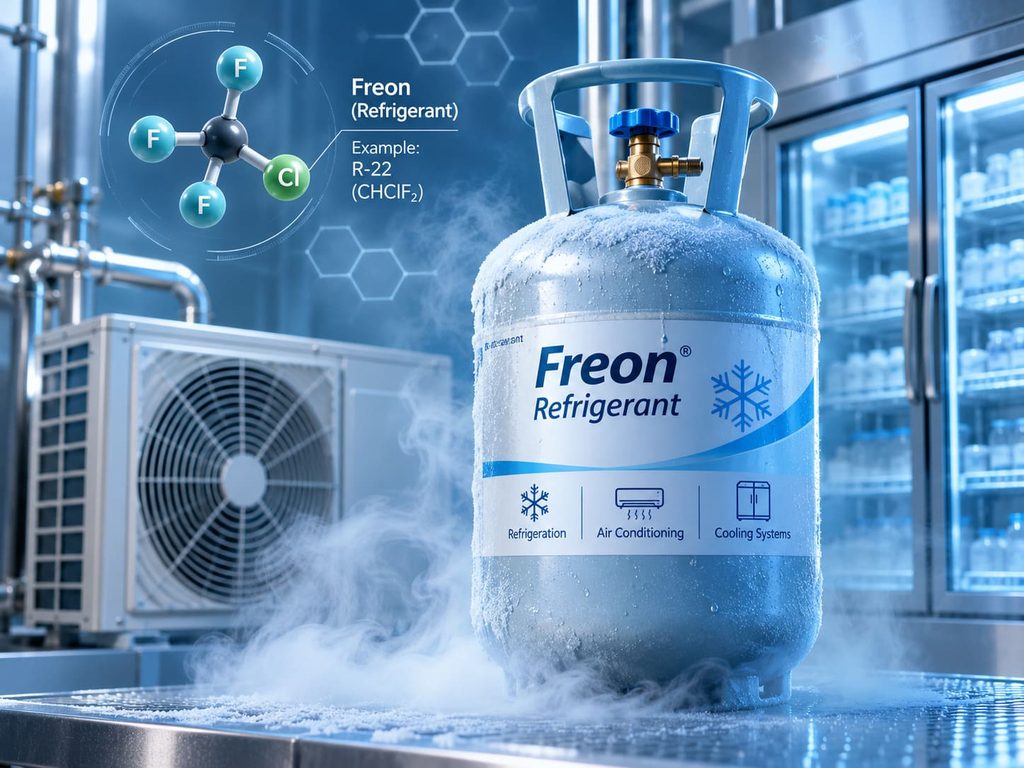
Freon is commonly used as a trade name associated with certain refrigerants. In industrial applications, the term may refer to different refrigerant formulations, such as R22, R134a, and other fluorinated refrigerants.
These refrigerants have different operating pressures, boiling points, dielectric properties, and chemical compatibility requirements.
Unlike water, many liquid refrigerants exhibit relatively low dielectric constants. Some also operate in closed, pressurized systems where evaporation and condensation occur continuously.
These conditions can make accurate level detection difficult, particularly when using instruments that depend on electrical properties, liquid density, or stable process conditions.
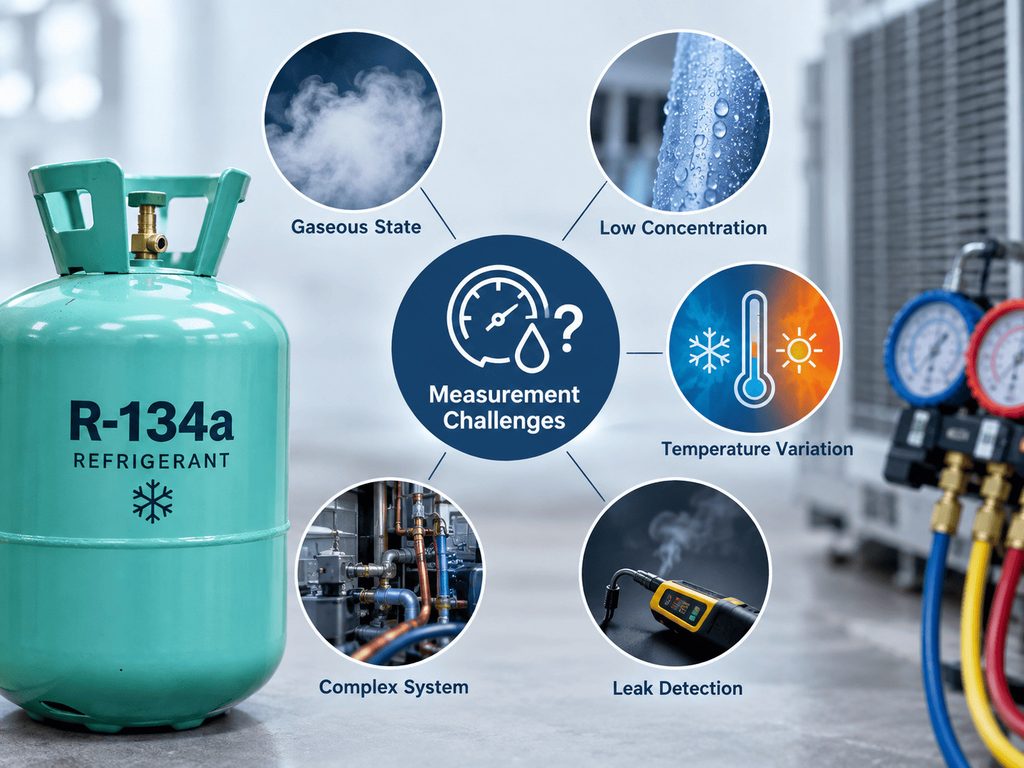
The most common challenges include:
- Low dielectric constant and weak radar signal reflection
- Fluctuating temperature and pressure
- Vapor formation and two-phase flow
- High requirements for pressure sealing and leak prevention
- Limited installation space and complex tank structures
- Measurement instability during filling and discharge
Understanding these challenges is the first step toward selecting a suitable refrigerant level measurement solution.
2. Challenge One: Low Dielectric Constant and Weak Radar Reflection
One of the most important technical difficulties in Freon level measurement is the relatively low dielectric constant of many refrigerants.
Radar level transmitters operate by emitting electromagnetic signals toward the liquid surface and analyzing the reflected signals to determine the distance between the sensor and the liquid.
The strength of the reflected signal depends partly on the dielectric properties of the measured medium.
Liquids with higher dielectric constants generally produce stronger radar reflections. In contrast, low-dielectric liquids may generate weaker reflected signals.
This can lead to several measurement problems:
- Reduced signal strength
- Difficulty identifying the actual liquid surface
- Increased sensitivity to internal tank reflections
- Unstable readings under challenging process conditions
For refrigerants with low dielectric constants, a radar transmitter must have sufficient sensitivity and appropriate signal-processing capabilities.
How Can Radar Technology Help?
Modern 80 GHz FMCW radar level transmitters can provide high measurement resolution and narrow beam angles, making them useful in compact tanks and installations with internal obstacles.
Advanced echo-processing algorithms can help distinguish weak liquid-surface reflections from unwanted echoes caused by tank walls, pipes, and other structures.
However, high frequency alone does not guarantee successful measurement.
The suitability of a radar level sensor must also be evaluated according to the refrigerant’s dielectric constant, measuring distance, antenna design, process connection, and tank geometry.
For particularly weak-reflecting media, guided wave radar or other measurement technologies may be worth evaluating.
3. Challenge Two: Temperature and Pressure Fluctuations
Refrigerants are highly sensitive to changes in temperature and pressure.
In industrial refrigeration systems, refrigerants may undergo repeated evaporation and condensation cycles. Their physical state and density can change significantly as operating conditions vary.
For example, changes in temperature can alter the vapor pressure inside a refrigerant storage vessel.
Similarly, changes in operating pressure may influence vapor formation and the relationship between liquid level and stored mass.
These variations create difficulties for some conventional level measurement technologies.
Limitations of Differential Pressure Measurement
Differential pressure level transmitters calculate liquid level based on hydrostatic pressure.
The measurement depends on liquid density, which may vary with temperature and refrigerant composition.
If the instrument uses a fixed density value, changing process conditions can introduce measurement errors.
In pressurized vessels, the pressure arrangement and compensation method must also be considered carefully.
Advantages of Non-Contact Radar Measurement
Non-contact radar measures the distance to the liquid surface rather than calculating level from hydrostatic pressure.
As a result, it is generally less dependent on liquid density changes.
This can be an important advantage when monitoring refrigerants under variable operating conditions.
Nevertheless, pressure and temperature ratings, vapor-space characteristics, condensation, and the mechanical design of the transmitter must still be evaluated.
4. Challenge Three: Vapor, Condensation, and Two-Phase Conditions
Another major challenge in refrigerant tank level monitoring is the presence of vapor and liquid within the same vessel.
Refrigerants may evaporate during pressure reduction or heat absorption and condense when temperature and pressure conditions change.
These processes can create complex measurement environments.
Potential problems include:
Vapor formation: Rapid evaporation can disturb the liquid surface and produce unstable measurement conditions.
Condensation: Condensed refrigerant may accumulate on internal surfaces or measurement components.
Foaming or bubbles: Depending on the refrigerant, system design, and operating conditions, bubbles or turbulent liquid surfaces can complicate level detection.
Two-phase flow: During filling, discharge, or active refrigeration cycles, liquid and vapor may coexist in moving flow streams.
These conditions may affect different measurement technologies in different ways.
For example, capacitance sensors may be influenced by changing electrical properties, while differential pressure systems may be affected by density variations.
Radar transmitters can often provide reliable measurements in vapor-containing vessels, but performance depends on the actual vapor conditions, surface behavior, and instrument configuration.
In difficult applications, installing the sensor in a suitable stilling well or bypass chamber may improve measurement stability, provided the design is compatible with the refrigerant and operating conditions.
5. Challenge Four: High Pressure and Strict Sealing Requirements
Freon and other refrigerants are commonly stored or circulated in sealed systems.
Depending on the refrigerant type and operating temperature, these systems may operate at substantial internal pressures.
Therefore, selecting a level transmitter is not only a question of measurement accuracy.
Mechanical integrity and process safety are equally important.
A poorly selected instrument may introduce leakage risks through unsuitable seals, process connections, or wetted materials.
Refrigerant leakage can result in:
- Loss of refrigerant inventory
- Reduced refrigeration efficiency
- Increased maintenance costs
- Environmental emissions
- Potential personnel safety hazards
What Should Engineers Consider?
When selecting a Freon level transmitter, engineers should verify the following:
Pressure rating: The sensor and process connection must be suitable for the maximum allowable operating pressure and relevant design conditions.
Temperature resistance: The instrument must withstand the expected minimum and maximum process temperatures.
Material compatibility: Wetted materials, gaskets, and sealing components must be compatible with the specific refrigerant and any lubricants present.
Leak-tight construction: Process connections and sealing arrangements should meet the applicable system requirements.
Safety compliance: Relevant pressure equipment, electrical, and hazardous-area requirements must be considered where applicable.
A reliable refrigerant level measurement system must combine measurement performance with appropriate mechanical design.
6. Challenge Five: Limited Installation Space and Internal Obstacles
Industrial refrigeration systems often use compact pressure vessels, receivers, separators, and storage tanks.
These vessels may contain internal pipes, supports, baffles, and other structural components.
Such features can complicate level measurement.
For non-contact radar instruments, internal structures may generate unwanted echoes that interfere with the reflection from the liquid surface.
This problem becomes more significant when the refrigerant has a low dielectric constant and produces a relatively weak surface echo.
Why Does Antenna Selection Matter?
A radar transmitter with a narrow beam angle can reduce interference from nearby structures.
This is one reason why 80 GHz radar technology is attractive for certain compact-vessel applications.
Compared with lower-frequency radar systems using similar antenna dimensions, higher-frequency radar can provide a narrower beam.
However, the best installation position must still be determined according to the vessel design.
Engineers should avoid locations where the radar beam is obstructed by internal equipment or exposed to excessive turbulence.
Appropriate mounting height, nozzle dimensions, and antenna configuration are also important.
7. Comparing Freon Level Measurement Technologies
Several technologies can be used to monitor refrigerant liquid levels. Each has advantages and limitations.
| Technology | Advantages | Main Challenges |
|---|---|---|
| Non-Contact Radar | No direct liquid contact; generally independent of liquid density | Weak echoes from low-dielectric refrigerants |
| Guided Wave Radar | Guided signal path; useful in selected difficult applications | Probe compatibility, installation and mechanical constraints |
| Differential Pressure | Established technology for pressurized vessels | Density variation and pressure compensation |
| Capacitance | Compact design and continuous measurement capability | Sensitivity to dielectric changes and calibration |
| Magnetic Level Gauge | Local visual indication | Mechanical design, density and pressure compatibility |
| Ultrasonic | Non-contact measurement | Vapor conditions, temperature gradients and pressure limitations |
No single technology is suitable for every refrigerant application.
The final choice should depend on the refrigerant type, operating conditions, vessel configuration, measurement range, and required accuracy.
8. Why Consider 80 GHz Radar Level Transmitters?
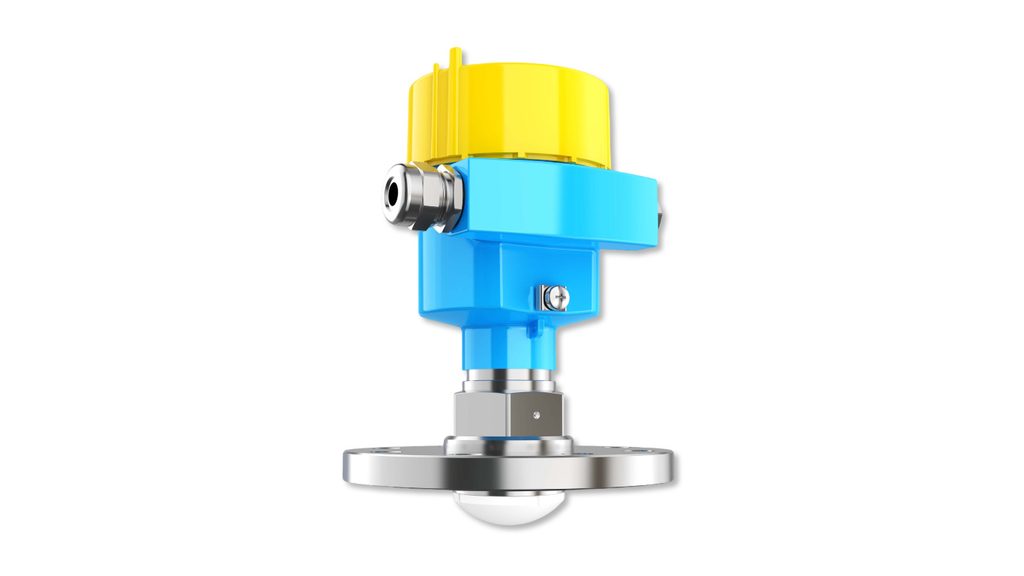
Modern 80 GHz radar level transmitters have become an attractive option for many industrial liquid level applications.
Their narrow beam angles, compact antenna designs, and high distance resolution can offer practical advantages.
For suitable refrigerant applications, potential benefits include:
Non-Contact Measurement
The sensor can measure liquid level without a probe extending into the refrigerant.
This may reduce direct exposure of sensing components to the process medium and simplify certain maintenance activities.
Reduced Dependence on Liquid Density
Radar measures distance to the liquid surface, making it less sensitive to density variations than hydrostatic measurement methods.
Compact Installation
Small antenna designs can be advantageous in vessels with limited mounting space.
Continuous Level Monitoring
Radar transmitters can provide continuous level data for integration with PLC, DCS, or other industrial control systems.
Advanced Signal Processing
Modern instruments may include echo tracking, false-echo suppression, and diagnostic functions that support stable operation in complex vessels.
Importantly, these advantages should be validated for the specific refrigerant and installation.
For low-dielectric media, application testing or manufacturer-supported feasibility assessment may be necessary before final selection.
9. How to Choose the Right Freon Level Sensor
Before purchasing a refrigerant level transmitter, engineers should collect detailed information about the application.
The following factors are especially important.
Refrigerant type: Identify the exact refrigerant designation, such as R22 or R134a, rather than relying only on the general term Freon.
Operating pressure: Confirm normal operating pressure, maximum design pressure, and possible transient conditions.
Temperature range: Determine both normal and extreme process temperatures.
Dielectric constant: Obtain reliable dielectric property data under relevant operating conditions, especially when considering radar or capacitance measurement.
Tank dimensions: Provide vessel height, diameter, nozzle dimensions, and internal structural details.
Measurement range: Define the minimum and maximum liquid levels and any relevant dead zones.
Accuracy requirements: Determine whether the application requires inventory monitoring, process control, or high/low level alarm functions.
Communication requirements: Select appropriate outputs, such as 4–20 mA, HART, or industrial digital communication interfaces.
Safety requirements: Verify material compatibility, pressure ratings, electrical approvals, and installation requirements.
Providing this information allows the instrument supplier to recommend a technically appropriate solution rather than selecting a sensor based on frequency or measurement range alone.
10. Frequently Asked Questions About Freon Level Measurement
Can radar level transmitters measure Freon?
Yes. Radar level transmitters can measure certain liquid refrigerants, including some Freon applications. However, successful measurement depends on the refrigerant’s dielectric constant, operating conditions, tank design, and transmitter performance.
Is 80 GHz radar suitable for low-dielectric refrigerants?
It can be suitable for some applications. The narrow beam and advanced signal processing of modern 80 GHz radar instruments offer advantages, but very low dielectric constants can still produce weak echoes. Technical evaluation is necessary.
Does temperature affect refrigerant level measurement?
Yes. Temperature changes can affect refrigerant density, vapor pressure, and phase behavior. The resulting measurement impact depends on the sensing technology.
What is the best level sensor for a refrigerant storage tank?
There is no universal best sensor. Non-contact radar, guided wave radar, differential pressure, capacitance, and magnetic level gauges may all be appropriate under different conditions.
Can one level transmitter measure every type of Freon?
Not necessarily. Different refrigerants have different physical properties and operating requirements. Instrument compatibility and performance should be confirmed for each application.
Conclusion
Freon level measurement presents several technical challenges, particularly because of low dielectric constants, changing temperature and pressure, vapor formation, and demanding sealing requirements.
Conventional measurement methods may experience errors or instability when these conditions are not properly considered.
Modern radar level transmitters, including 80 GHz FMCW instruments, offer promising solutions for many refrigerant storage and industrial refrigeration applications. Their non-contact operation, narrow beam angles, and advanced signal processing can help improve measurement reliability in suitable installations.
However, accurate refrigerant level monitoring requires more than selecting a high-frequency sensor.
The most effective solution comes from understanding the refrigerant’s physical properties, evaluating the vessel and operating conditions, and selecting an instrument that meets both measurement and safety requirements.
Looking for a reliable Freon level measurement solution?
Contact our technical team with your refrigerant type, tank dimensions, operating pressure, and temperature range. We can help evaluate suitable radar level measurement options for your application.